Getting Around Patong: Your Complete Transport Guide
Despite its lively atmosphere and reputation as Phuket’s busiest beach destination, Patong is surprisingly easy to navigate once you understand its basic layout. The town is relatively compact, with just a handful of main roads connecting the beach, shopping areas, hotels and entertainment precincts. Whether you plan to explore on foot, hire a scooter, catch a tuk-tuk or use a ride-hailing service, getting around is usually straightforward once you know the main routes.
Patong is connected to the rest of Phuket by three principal access roads, while movement within the town revolves around several main roads running roughly parallel to the beach and linked by numerous smaller connecting streets. Understanding this simple road network will help you make sense of the town far more quickly than relying on a map alone.
This guide explains the different ways to get around Patong, the advantages and disadvantages of each transport option, how to avoid common traffic frustrations, and practical tips from someone who lives in Patong and navigates its streets almost every day.
Understanding Patong’s Road Layout
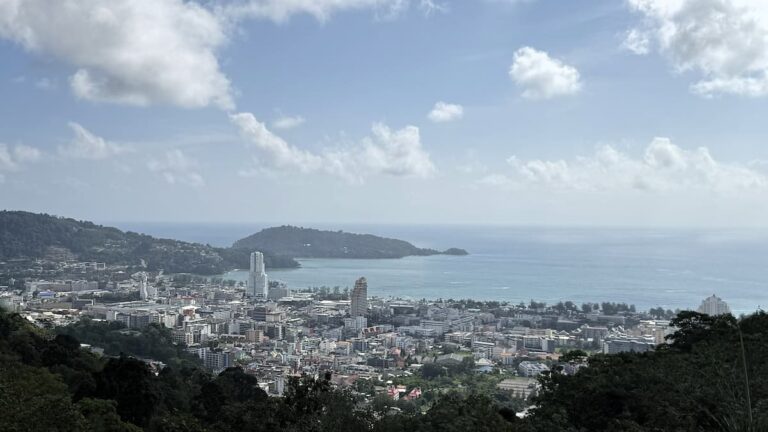
Patong is surrounded by steep hills on three sides and the Andaman Sea to the west, so unlike many cities it has only a small number of roads connecting it to the rest of Phuket. Visitors can enter or leave Patong by three principal routes. Phra Barami Road crosses Patong Hill to Kathu and Phuket Town, Kamala–Patong Road follows the west coast north through Kalim and Kamala, while Sirirat Road heads south towards Karon, Kata and the southern beaches.
Once inside Patong, the layout becomes much simpler. The town is built around a series of four main roads that run roughly parallel to Patong Beach and are linked by numerous smaller streets, known locally as sois. Rather than trying to memorise every street name, understanding these four roads will make navigating Patong much easier.
Closest to the beach is Thaweewong Road (Beach Road), which follows the curve of Patong Bay and provides access to the beachfront, Bangla Road, hotels, restaurants and many popular attractions.
Running just inland is Rat-U-Thit 200 Pi Road, Patong’s main commercial street. It is lined with hotels, shops, restaurants, bars and entertainment venues, while also providing access to Bangla Road and one side of Jungceylon Shopping Centre.
Further inland is Sai Kor Road, another important north–south route that passes Banzaan Fresh Market, the western side of Jungceylon and a growing number of hotels, restaurants and local businesses. Many residents and long-term visitors find it one of the easiest roads for travelling through central Patong.
The easternmost of the four is Nanai Road, a quieter road running through a predominantly residential and hotel district with restaurants, cafés, gyms, convenience stores and local businesses before reconnecting with the southern road network.
With these four roads connected by dozens of short sois, most destinations in central Patong are only a few minutes apart, making the town much easier to navigate than first-time visitors often expect.
Walking Around Patong
For many visitors, walking is the easiest and most enjoyable way to explore Patong. The central part of the town is relatively compact, and many hotels, restaurants, shopping centres, markets, nightlife and the beach are within comfortable walking distance of one another.
The numerous sois linking Patong’s main roads make it easy to move between Beach Road, Rat-U-Thit 200 Pi Road, Sai Kor Road and Nanai Road without having to follow the full length of each road. This interconnected layout means many destinations are closer than they first appear on a map.
Walking also gives you the opportunity to discover cafés, street food stalls, small shops and local businesses that are often missed when travelling by vehicle. During the evening, particularly around Bangla Road and the beachfront, walking is frequently quicker than sitting in slow-moving traffic.
The biggest challenge is not usually the distance—it’s the tropical climate. Even experienced walkers can find Patong’s heat and humidity exhausting, particularly during the middle of the day. Short walks between centrally located accommodation, Bangla Road, Jungceylon or OTOP Market are generally quite manageable, but longer walks can become uncomfortable without regular breaks, water and protection from the sun.
Visitors should also be aware that Patong is not designed around pedestrians in the same way as many Western cities. Footpaths are not continuous, some pavements are narrow or obstructed, and on many smaller sois you may need to share the road with vehicles. Always stay aware of your surroundings, keep an eye on approaching traffic and take extra care when crossing roads, as drivers may not always expect pedestrians.
For visitors staying within central Patong, it is entirely possible to spend several days exploring on foot. However, combining walking with an occasional tuk-tuk, ride-hailing service or motorcycle taxi is often the most comfortable way to explore areas beyond the town centre, particularly during the hottest part of the day.
Ride-Hailing Services
Ride-hailing apps have become one of the easiest ways to travel around Patong and the rest of Phuket. The two services I use most often are Grab and Bolt, both of which allow you to request a vehicle through your smartphone, see the estimated fare before the journey begins and follow your route on the app.
In my experience, using a ride-hailing app is often less expensive than arranging transport on the street, particularly for longer journeys. Another major advantage is that your destination is entered directly into the app, reducing the chance of misunderstandings about where you want to go. This is especially helpful if you are staying at a smaller hotel, visiting a lesser-known attraction or are unfamiliar with the local pronunciation of place names.
While most local drivers know Patong extremely well, communication can occasionally be challenging, particularly when relying on spoken directions alone. Having the destination displayed on the driver’s navigation system makes the journey easier for both you and the driver.
Ride-hailing services are particularly useful for airport transfers, travelling between beaches or returning to your accommodation after a night out. During the busiest periods, particularly in the evening and throughout the high season, waiting times may be longer as demand increases, although many visitors still find them more convenient than trying to locate a taxi or negotiate a fare.
Tuk-Tuks
Patong’s distinctive red tuk-tuks are one of the most recognisable forms of transport in Phuket and can be found throughout the town, particularly near hotels, shopping centres, Bangla Road and the beachfront. Unlike the three-wheeled tuk-tuks found in Bangkok, Phuket’s tuk-tuks are small converted trucks with covered seating for several passengers.
One of their greatest advantages is convenience. There is usually a tuk-tuk nearby, making them an easy option when you want to make a short journey without waiting for a ride-hailing service or walking in the tropical heat.
Unlike ride-hailing apps, fares are normally agreed before the journey begins, so it is worth confirming the price before getting in. For groups or families travelling together, the cost can often be shared between passengers, making a tuk-tuk more economical than it may first appear.
Tuk-tuks are particularly useful if you are carrying shopping, travelling with beach equipment or simply want to avoid walking in the hottest part of the day. They are also a convenient choice late at night when many visitors are returning to their accommodation after enjoying Patong’s nightlife.
If you are travelling alone, it is often worth comparing the fare with Grab or Bolt, as ride-hailing services may sometimes offer a less expensive alternative for the same journey.
Motorcycle Taxis
Motorcycle taxis are one of the quickest ways to travel short distances around Patong, particularly during the busiest times of the day when traffic slows cars, tuk-tuks and ride-hailing vehicles. They can usually be found waiting at designated taxi stands throughout the town or hailed in busy areas.
For solo travellers, a motorcycle taxi can be an excellent option when you need to travel only a short distance. Because motorcycles are able to filter through slow-moving traffic, journeys are often considerably faster than travelling by car during busy periods.
For visitors, fares within Patong are often relatively consistent for short trips, with many journeys costing around 100 baht, although the price will depend on distance and the individual driver. As with many forms of transport, it is sensible to confirm the fare before starting the journey. Occasionally, visitors may be quoted a higher price, particularly during busy periods or if the driver believes the passenger is unfamiliar with local fares. If the price seems unreasonable, it is usually easy to find another motorcycle taxi nearby.
Motorcycle taxis are best suited to solo travellers carrying little or no luggage. Riders should always wear the helmet provided and be comfortable travelling as a passenger on a motorcycle in busy traffic. If you are travelling as a couple, carrying shopping or large bags, or simply prefer a more relaxed journey, a tuk-tuk or ride-hailing service is generally a better choice.
For short journeys around central Patong, motorcycle taxis are often one of the fastest ways to get from one side of town to the other.
Renting a Scooter or Motorcycle
Renting a scooter is one of the most popular ways to explore Patong and the rest of Phuket. Rental shops are easy to find, daily rates are generally affordable and having your own transport gives you the freedom to travel whenever you like without waiting for taxis or ride-hailing services.
For experienced riders, a scooter can be the quickest way to travel around Patong, particularly during busy periods when traffic slows larger vehicles. Parking is usually much easier than with a car, and scooters can make it practical to visit attractions across the island in a single day.
However, riding in Phuket is very different from riding in many Western countries. Traffic can be heavy, roads are shared with cars, buses, delivery vehicles and other motorcycles, and driving styles may be unfamiliar to first-time visitors. Riders should only hire a scooter if they are confident, experienced and hold the appropriate licence and insurance for riding a motorcycle in Thailand.
Always wear a helmet, ride within your ability and avoid riding after consuming alcohol. During the rainy season, roads can become slippery, particularly after the first rain following a dry spell, so extra care should be taken.
If you are not an experienced rider, Patong’s excellent range of ride-hailing services, tuk-tuks and motorcycle taxis usually provide a safer and more relaxing way to explore the area.
Renting a Car
Hiring a car offers the greatest flexibility for exploring Phuket beyond Patong. If you plan to visit attractions across the island, including Phuket Town, the Big Buddha area, beaches along the west coast or the airport, having your own vehicle can be a convenient option.
Within Patong itself, however, a car is often less practical. Traffic can become heavily congested, particularly during the late afternoon and evening, while parking may be limited near popular attractions, shopping areas and the beachfront.
If your holiday is based entirely in Patong, many visitors find that walking, ride-hailing services and occasional tuk-tuks provide a more convenient way to get around. A rental car becomes more worthwhile if you intend to spend several days exploring other parts of Phuket.
Before renting a vehicle, ensure you hold the appropriate licence and insurance, familiarise yourself with local traffic rules and remember that vehicles in Thailand drive on the left-hand side of the road.
Local Tips for Getting Around Patong
After living in Patong for several years, I’ve found that choosing the right form of transport often depends more on the time of day than the distance you need to travel.
During the middle of the day, the tropical heat can make even relatively short walks uncomfortable. If you’re staying in central Patong, walking is still often the easiest option, but carrying water and taking advantage of air-conditioned shopping centres or cafés for a short break can make exploring much more enjoyable.
As the afternoon turns into evening, traffic throughout central Patong becomes progressively heavier. This is particularly noticeable around Bangla Road, Jungceylon and the beachfront, where large numbers of visitors head towards the same entertainment and shopping areas. A journey that appears quite short on a map may take considerably longer than expected once traffic builds.
If you’re travelling alone and are an experienced rider with the appropriate licence, a scooter is often the quickest way to move around Patong during busy periods. If riding isn’t for you, a motorcycle taxi can often be a faster alternative than travelling by car for short distances.
Before accepting a fare from a tuk-tuk or motorcycle taxi, it can be worthwhile checking the price of the same journey on Grab or Bolt. Even if you decide to take the local taxi, knowing the approximate app fare gives you a useful point of comparison.
Finally, don’t feel that every journey requires transport. One of Patong’s greatest advantages is that much of the town is surprisingly compact. Depending on where you’re staying, walking between the beach, shopping centres, restaurants and nightlife is often quicker—and certainly more enjoyable—than sitting in traffic.
Traffic, Peak Times & Local Tips
One of the biggest surprises for first-time visitors is that distance and travel time are often very different in Patong. A destination that appears to be only a kilometre or two away on the map can take much longer to reach during the busiest periods of the day.
This is partly because Patong has only a handful of main roads, but also because much of the town’s shopping, restaurants and nightlife are concentrated around Bangla Road, Jungceylon and the beachfront. As the afternoon turns into evening, thousands of people converge on the same area, creating congestion that affects much of central Patong.
For this reason, local residents often think differently about transport than visitors. If I’m travelling alone, I will almost always choose a scooter rather than a car because it is usually much quicker to move through traffic and easier to park. If you are an experienced rider with the appropriate licence, a scooter can be one of the most efficient ways to get around Patong. If not, a motorcycle taxi is often the quickest alternative for short trips.
Even if you don’t ride, it’s worth remembering that walking a few hundred metres can sometimes be faster than sitting in slow-moving traffic.
Travelling Beyond Patong
While walking, scooters and ride-hailing services are ideal for getting around Patong itself, many visitors also use the town as a base for exploring the rest of Phuket.
The most flexible options for travelling beyond Patong are a rental scooter or car, particularly if you plan to visit several attractions in a single day. Ride-hailing services such as Grab and Bolt are also convenient for shorter trips to nearby beaches, Phuket Town or the airport, although fares naturally increase with distance.
For budget-conscious travellers, Phuket also offers public transport connections. The Phuket Smart Bus operates along much of the island’s west coast, linking Patong with Phuket International Airport, Kamala, Surin, Bang Tao, Karon, Kata and other popular destinations. Local blue songthaews also provide inexpensive services between Patong and Phuket Town, although journeys are generally slower and schedules are less predictable than private transport.
If you plan to spend most of your holiday exploring different parts of Phuket rather than staying within Patong, hiring your own vehicle usually provides the greatest flexibility. However, if your accommodation is in central Patong and you’re only planning the occasional day trip, many visitors find that combining ride-hailing services with public transport is a practical and cost-effective alternative.
Explore More of Phuket
Getting around Patong is only one part of discovering Phuket. From beautiful beaches and cultural landmarks to local markets, scenic viewpoints and hidden corners of the island, there is far more to explore beyond the town centre.
Continue exploring with our Phuket Travel Guide, where you’ll find detailed destination guides, practical travel advice and local insights to help you make the most of your time on the island.
Related Reading
- Patong Beach Guide – Discover what makes Phuket’s most famous beach so popular, from swimming and water sports to dining, sunsets and beachfront activities.
- Wat Suwan Khiri Wong Visitor Guide – Explore Patong’s principal Buddhist temple, including its history, architecture, cultural significance and visitor information.
- Phuket Travel Guide – Plan your wider Phuket adventure with destination guides, practical travel advice and inspiration for exploring the island.
Frequently Asked Questions
Is Patong easy to get around without a car?
Yes. Most visitors staying in central Patong can comfortably explore on foot, while tuk-tuks, ride-hailing services and motorcycle taxis provide convenient options for longer journeys.
What is the best way to get around Patong?
That depends on the journey. Walking is ideal within the town centre, ride-hailing services such as Grab and Bolt offer good value for many trips, while experienced riders often find a scooter to be the quickest option during busy periods.
Are Grab and Bolt available in Patong?
Yes. Both Grab and Bolt operate throughout Patong and much of Phuket, making them popular alternatives to traditional taxis and tuk-tuks.
Are tuk-tuks expensive in Patong?
Tuk-tuks are convenient and widely available, but they are often more expensive than ride-hailing services for similar journeys. They can represent good value when the fare is shared between several passengers.
Is it safe to walk around Patong?
Patong is generally easy to explore on foot, particularly within the town centre. Visitors should be prepared for the tropical heat, remain aware of traffic and take extra care on roads where footpaths are limited or unavailable.
Should I rent a scooter in Patong?
A scooter offers flexibility and is often the quickest way to travel during busy periods. However, it is only recommended for experienced riders who hold the appropriate licence and insurance and are comfortable riding in Thailand’s traffic conditions.
Is there public transport in Patong?
Public transport is available but is primarily designed for travelling between Patong and other parts of Phuket rather than getting around Patong itself. The Phuket Smart Bus and local songthaews provide affordable transport to several destinations across the island.
Can I walk from Bangla Road to Jungceylon?
Yes. Bangla Road, Jungceylon Shopping Centre, Patong Beach, Banzaan Fresh Market and many central hotels are all within comfortable walking distance of one another, making this one of the easiest parts of Patong to explore on foot.