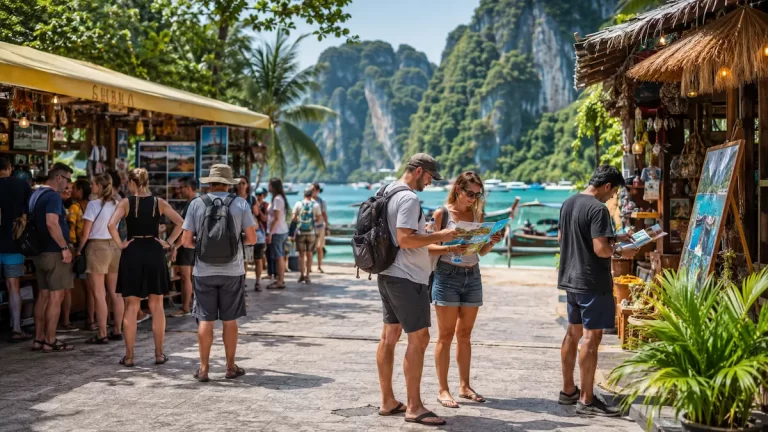
The Shift From Search Engines to Travel Discovery Ecosystems
Introduction
For much of the modern internet era, travel discovery was heavily dominated by search engines.
Travellers searched for:
- best beaches
- where to stay
- things to do
- itineraries
- travel costs
- transport guides
- hidden gems
and search engines functioned as the primary gateway connecting audiences to destination information online.
This structure shaped enormous parts of the modern travel industry.
Publishers built content strategies around rankings. Tourism businesses focused heavily on search visibility. Travel blogs expanded rapidly through SEO-driven publishing systems, while large destination websites competed aggressively for informational coverage across thousands of travel-related search queries.
For many years, this ecosystem worked remarkably well.
Search engines became one of the central organising systems of digital travel discovery.
But modern traveller behaviour is beginning to change significantly.
Today, many travellers no longer discover destinations through a single linear research pathway. Instead, discovery increasingly happens across fragmented and interconnected travel discovery ecosystems involving:
- TikTok
- YouTube
- Google Maps
- creator communities
- AI-generated summaries
- review platforms
- niche publishers
- recommendation systems
all influencing traveller decisions simultaneously.
This does not mean search engines no longer matter.
Far from it.
Search still plays an enormously important role in modern travel research and destination visibility. But search engines increasingly operate as one layer inside a much broader ecosystem of discovery rather than functioning as the sole gateway to destination understanding.
That distinction matters enormously.
As explored in Why Generic Travel Content Is Losing Trust, modern travellers are becoming increasingly selective about which information sources feel believable, contextual, and genuinely useful within saturated publishing environments. At the same time, as discussed in Why Human Editorial Judgement Still Matters in the AI Era, audiences increasingly seek interpretation, trust signals, and contextual understanding layered on top of informational abundance itself.
This broader structural shift is fundamentally reshaping how destinations are discovered online.
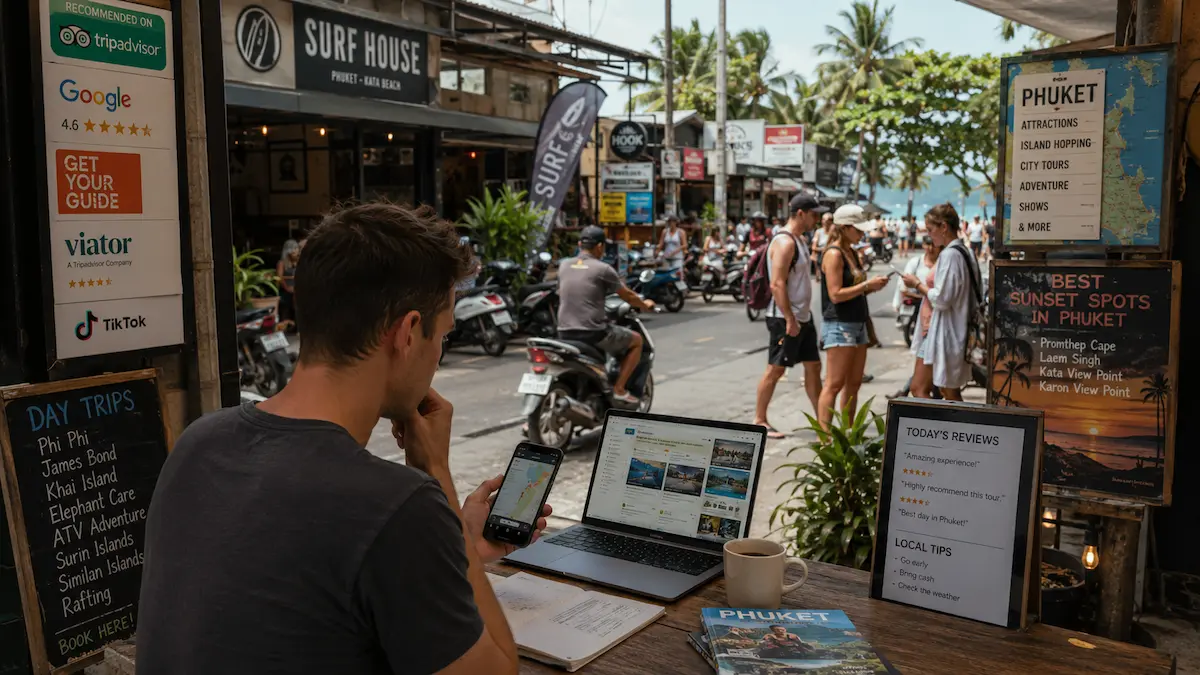
A traveller researching Phuket today may:
- encounter a destination through TikTok
- validate recommendations on Reddit
- watch YouTube breakdowns
- compare Google Maps reviews
- browse Instagram creator content
- search traditional publisher articles
- read hotel reviews
- ask AI systems for itinerary summaries
before making a single booking decision.
In many cases, modern travel discovery is no longer linear.
It is layered, iterative, fragmented, and ecosystem-driven.
This shift has major implications not only for publishers, but also for tourism businesses, creators, destination marketers, and travel brands attempting to build visibility online. The systems influencing traveller decisions are becoming increasingly interconnected, psychologically complex, and trust-dependent across multiple platforms simultaneously.
As broader digital media behaviour continues evolving — a shift increasingly documented by sources such as the Reuters Institute Digital News Report, Think with Google, and Skift — travel publishing itself is beginning to transition away from purely search-centric visibility models toward far more distributed discovery ecosystems.
In this article, we’ll examine how modern travel discovery ecosystems are reshaping traveller behaviour, why discovery is becoming increasingly fragmented across platforms, how trust now functions across layered recommendation systems, and why the future of destination visibility may depend less on isolated rankings alone and far more on contextual ecosystem positioning.
Search Engines Used to Dominate Discovery
For much of the modern internet era, search engines functioned as the primary infrastructure layer of travel discovery.
When travellers wanted to understand a destination, compare accommodation areas, research attractions, plan itineraries, or estimate travel costs, the process usually began with a search query. Search engines acted as the gateway connecting audiences to destination information across the wider internet.
This behaviour shaped enormous parts of the travel publishing industry.
Travel websites, tourism businesses, bloggers, affiliate publishers, and large media companies all adapted around search-driven visibility systems. Publishing strategies increasingly focused on:
- keyword targeting
- informational coverage
- ranking opportunities
- search intent optimisation
- scalable destination pages
- long-tail search traffic
In many ways, the modern travel blogging industry itself was built around this structure.
If a publisher could create enough useful informational content targeting enough relevant travel searches, visibility often followed naturally. Entire publishing ecosystems emerged around helping travellers answer practical destination questions such as:
- where to stay
- what to do
- best beaches
- transport options
- itineraries
- costs
- weather
- local tips
This model worked extremely well for a long period of time because search behaviour itself was heavily information-driven.
Travellers searched.
Publishers answered.
Search engines distributed visibility.
That relatively linear system helped shape much of the modern tourism content economy.
Importantly, none of this made search engines “bad” for travel publishing.
In fact, search dramatically expanded access to destination information globally. Smaller tourism businesses gained discoverability they previously lacked. Independent publishers could compete with larger media organisations through strong informational coverage. Travellers gained access to far more destination research than existed during earlier eras of guidebooks and traditional travel agencies alone.
Search fundamentally transformed travel accessibility online.
But the incentives created by search-driven publishing systems also produced long-term structural effects.
As competition for rankings intensified, many publishers increasingly focused on publishing scale itself. More pages often meant:
- more ranking opportunities
- more traffic potential
- more affiliate visibility
- broader search coverage
- larger informational footprint
Over time, this contributed heavily to the rise of mass-scale travel publishing systems.
As explored further in The Problem With Mass-Produced Travel Content, large volumes of destination material began competing across increasingly similar informational structures. Many travel websites expanded aggressively through scalable destination coverage designed primarily around search visibility mechanics rather than differentiated contextual interpretation.
At the same time, as discussed in Slow Publishing vs Content Saturation, the internet gradually became saturated with repetitive destination content covering many of the same topics repeatedly:
- best things to do
- hidden gems
- perfect itineraries
- where to stay
- must-visit attractions
In many cases, the challenge for travellers slowly shifted from finding information
to filtering overwhelming amounts of overlapping information.
This is where the limitations of purely search-centric discovery models began becoming more visible.
Search engines remain extraordinarily effective at organising and retrieving information. But travel decisions themselves are often more psychologically complex than isolated informational searches alone. Travellers rarely make decisions through a single query. Instead, destination research often involves:
- inspiration
- validation
- comparison
- emotional reassurance
- logistical planning
- social proof
- contextual interpretation
These layered behavioural patterns increasingly extend beyond traditional search environments.
This does not mean search disappears from travel discovery.
Far from it.
Search engines still remain one of the most important discovery layers within the modern internet. But increasingly, they function as part of a broader ecosystem of interconnected discovery systems rather than acting as the sole organising structure of destination research itself.
That distinction is quietly reshaping the future of travel visibility online.
Modern Travel Discovery Is Fragmented
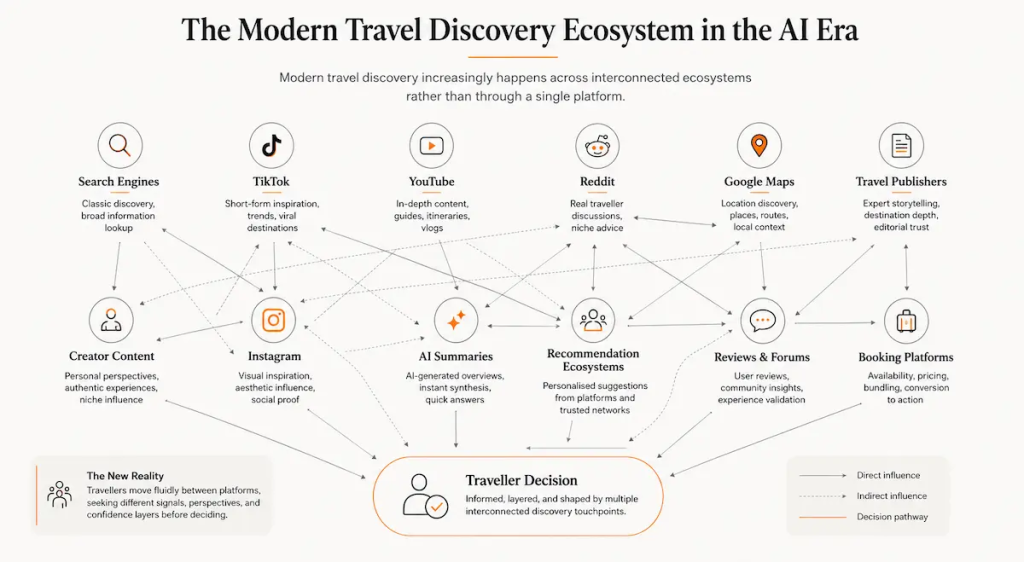
One of the biggest shifts reshaping the travel industry today is the fragmentation of modern travel discovery ecosystems.
For many years, travel research often followed a relatively predictable structure:
a traveller searched for information,
read a handful of articles,
compared options,
then gradually moved toward a booking decision.
Today, that process is becoming far less linear.
Modern travellers increasingly move fluidly between multiple discovery platforms, recommendation systems, creators, communities, and informational layers simultaneously. A single travel decision may now be influenced by:
- TikTok videos
- YouTube travel breakdowns
- Reddit discussions
- Instagram creators
- Google Maps reviews
- AI-generated summaries
- booking platform reviews
- publisher articles
- creator itineraries
- local recommendation communities
all interacting together within increasingly fragmented travel discovery ecosystems.
Importantly, these platforms do not simply duplicate one another.
They often serve completely different psychological functions during the travel research process.
For example:
- TikTok may create initial inspiration
- Instagram may reinforce emotional aspiration
- YouTube may provide deeper visual understanding
- Reddit may offer validation and perceived honesty
- Google Maps may assist logistical evaluation
- publisher articles may provide contextual structure
- reviews may reduce booking anxiety
- AI systems may help summarise information overload
This creates a much more layered form of travel discovery than the traditional search-centric model that dominated earlier eras of digital publishing.
In many ways, modern travel discovery is becoming:
- iterative
- multi-platform
- psychologically layered
- socially influenced
- ecosystem-driven
rather than purely information-retrieval based.
This distinction matters enormously.
Travellers are no longer simply “searching for answers.”
Increasingly, they are building confidence across multiple interconnected trust layers before making decisions.
A traveller researching Phuket today, for example, may:
- first encounter the destination through short-form video content
- search Google for accommodation areas
- compare Reddit discussions about scams or transport
- watch YouTube walking tours
- examine Maps reviews for hotels or restaurants
- ask AI systems for itinerary summaries
- browse creator recommendations
- compare booking platform reviews
- revisit social media content later
before finally committing to accommodation, tours, or flights.
This behaviour reflects the rise of highly fragmented travel discovery ecosystems where no single platform fully controls destination understanding anymore.
As explored further in Why Tourism Discovery Is Becoming Fragmented, modern travel visibility increasingly depends on how destinations appear across interconnected ecosystems rather than isolated search rankings alone.
At the same time, as discussed in How Travelers Actually Discover Destinations in 2026, travellers increasingly blend inspiration, validation, logistics, emotional reassurance, and contextual interpretation together throughout the research process itself.
This creates major implications for publishers, tourism businesses, and destination marketers.
Historically, many visibility strategies focused heavily on ranking performance inside search engines alone. But fragmented travel discovery ecosystems now distribute traveller attention across multiple interconnected environments simultaneously.
Visibility itself is becoming more ecosystem-based.
This means:
- creator content influences search behaviour
- social media affects booking confidence
- Reddit discussions shape trust perception
- Maps reviews influence local decisions
- AI summaries alter informational pathways
- publishers help contextualise fragmented information
- recommendation algorithms shape exposure patterns
all interacting together inside increasingly layered discovery systems.
Importantly, fragmentation does not necessarily reduce the importance of search engines.
Instead, search increasingly functions as one component inside a much broader discovery environment.
That is a fundamentally different visibility landscape from the one that shaped much of the early travel blogging era.
In many ways, modern travellers are no longer navigating a search engine.
They are navigating interconnected travel discovery ecosystems.
Discovery Is Becoming Trust-Layered
One of the most important characteristics of modern travel discovery ecosystems is that traveller trust is no longer built through a single source of information alone.
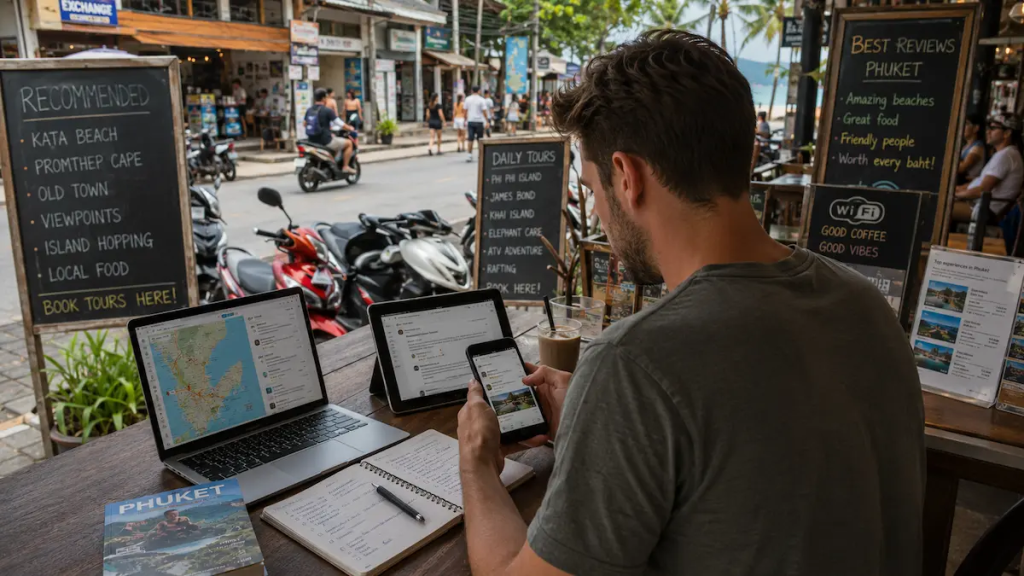
Increasingly, trust itself is becoming layered across multiple interconnected platforms and recommendation systems simultaneously.
For many years, search-driven travel discovery often operated through relatively direct informational pathways. A traveller searched for destination information, reviewed a handful of websites, and gradually formed enough confidence to move toward a booking decision.
Today, that process is becoming far more psychologically complex.
Modern travellers are increasingly aware that:
- algorithms influence visibility
- affiliate incentives shape recommendations
- social media encourages performance-driven content
- reviews can be manipulated
- AI systems may summarise repetitive information
- creator content may emphasise engagement over realism
As a result, travellers often seek confirmation across multiple environments before trusting important decisions.
This creates what could be described as:
layered trust behaviour.
Rather than relying on one platform exclusively, travellers increasingly build confidence gradually through overlapping informational systems.
For example, a traveller considering Phuket may:
- discover a beach through TikTok
- validate logistics through Google search
- compare opinions on Reddit
- examine hotel reviews
- watch YouTube walkthroughs
- explore Maps ratings
- browse Instagram creator content
- ask AI systems for itinerary summaries
before finally deciding whether the recommendation feels trustworthy enough to act upon.
In many ways, modern travel discovery ecosystems increasingly function through accumulated trust signals rather than isolated informational authority.
This distinction is extremely important.
The role of digital platforms is no longer simply to provide information.
Increasingly, platforms help travellers evaluate:
- credibility
- realism
- emotional fit
- social proof
- operational expectations
- risk
- reassurance
- contextual trust
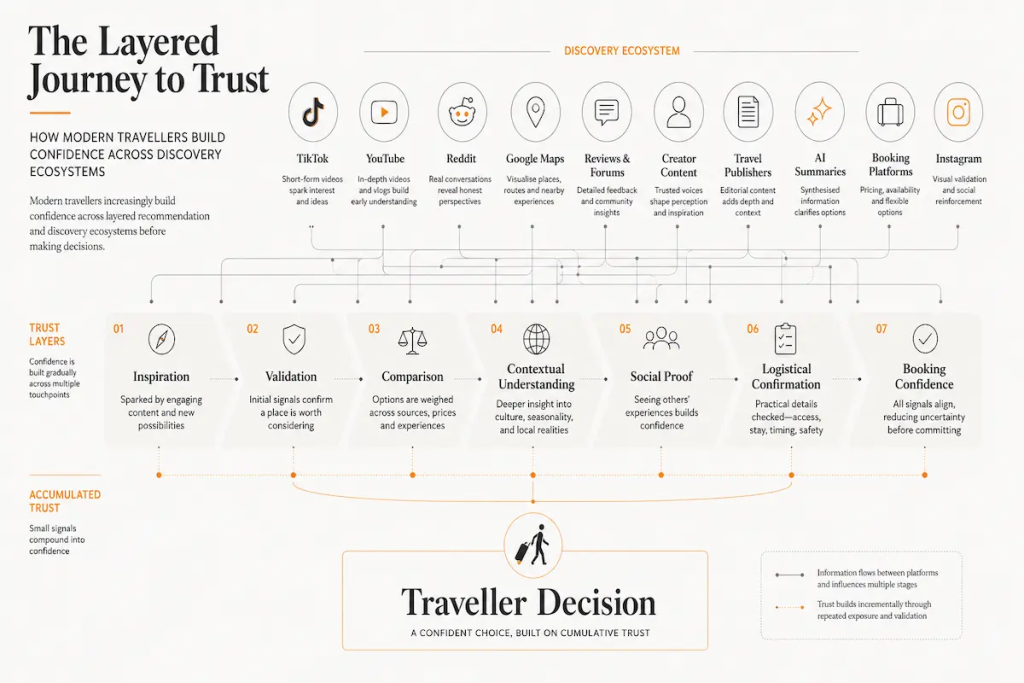
This is one reason discovery itself is becoming far more iterative than traditional search-driven models.
Travel decisions rarely happen instantly.
Instead, travellers often cycle repeatedly between:
- inspiration
- validation
- comparison
- reassurance
- logistical research
- emotional confirmation
across multiple platforms simultaneously.
As explored further in Why Trust Is Becoming the Most Valuable Asset in Travel Media, audiences increasingly reward publishers and creators capable of creating believable contextual interpretation within saturated information environments.
At the same time, as discussed in Why Generic Travel Content Is Losing Trust, travellers are becoming more selective about recommendations that feel repetitive, overly optimised, or disconnected from realistic travel behaviour.
This creates a major shift in how visibility itself functions online.
Historically, many travel publishers focused heavily on informational authority:
- more content
- broader keyword coverage
- larger destination libraries
- increased ranking opportunities
But inside modern travel discovery ecosystems, visibility increasingly depends on trust reinforcement across multiple interconnected environments.
For example:
- a creator video may generate initial interest
- Maps reviews may strengthen logistical confidence
- Reddit may provide perceived honesty
- publishers may create contextual understanding
- AI summaries may simplify information overload
- social proof may reduce booking hesitation
Together, these layers gradually build decision confidence.
This is one reason contextual publishing may become increasingly important in fragmented discovery systems.
Travellers are no longer simply asking:
“What information exists?”
Increasingly, they are asking:
“Which sources feel believable enough to trust?”
That is a fundamentally different discovery environment from the purely search-centric systems that dominated earlier phases of digital travel publishing.
In many ways, modern travel discovery ecosystems are becoming less about isolated visibility,
and more about interconnected trust architecture across multiple platforms simultaneously.
The Rise of Recommendation Ecosystems
One of the biggest changes reshaping modern travel discovery ecosystems is the growing influence of recommendation-driven visibility systems.
For many years, travel visibility was heavily associated with rankings.
Publishers focused on:
- search position
- keyword performance
- organic traffic
- informational coverage
- search intent optimisation
Visibility was largely understood through the logic of search:
a traveller searched for information,
and search engines returned ranked results.
But modern travel discovery increasingly operates very differently.
Today, large portions of destination visibility are shaped not by direct search behaviour alone, but by recommendation ecosystems operating across social platforms, creator networks, algorithmic feeds, behavioural systems, and engagement-driven content environments simultaneously.
This creates a major structural shift.
Increasingly, travellers do not always actively search for destinations first.
Often, destinations are recommended to them.
This recommendation-driven behaviour is now deeply embedded across:
- TikTok feeds
- Instagram algorithms
- YouTube recommendations
- Maps suggestions
- booking platform recommendations
- creator ecosystems
- AI-generated suggestions
- social sharing systems
- engagement-based discovery loops
In many cases, travellers encounter destinations passively before actively researching them.
That distinction matters enormously because recommendation systems operate differently from traditional search systems.
Search engines primarily organise information around expressed intent.
Recommendation ecosystems increasingly shape intent itself.
This is a fundamentally different form of visibility.
For example, a traveller may never intentionally search for a particular beach, café, neighbourhood, or island experience. Instead, exposure may originate through:
- a creator video
- an algorithmic recommendation
- a shared Instagram post
- a YouTube suggestion
- a Maps discovery prompt
- a trending TikTok location
- an AI-generated itinerary recommendation
before active destination research even begins.
This creates increasingly interconnected travel discovery ecosystems where exposure itself becomes behaviourally influenced by recommendation systems operating continuously in the background.
As explored further in The Future of Destination Visibility for Tourism Businesses, modern tourism visibility increasingly depends not only on being searchable, but on being discoverable within layered recommendation ecosystems that influence traveller behaviour before traditional search queries even occur.
At the same time, as discussed in Why Discovery Ecosystems Matter More Than Rankings Alone, visibility itself is gradually shifting away from isolated platform performance toward broader ecosystem positioning across multiple interconnected discovery layers.
This distinction is becoming especially important in travel because tourism decisions are highly emotional and socially influenced.
Travel is aspirational by nature.
People often discover destinations through:
- inspiration
- aesthetics
- social proof
- perceived experience
- creator storytelling
- emotional resonance
- behavioural recommendations
rather than purely through informational searches alone.
Recommendation ecosystems amplify these behavioural patterns dramatically.
This is one reason creator-led discovery systems are becoming increasingly influential within tourism visibility itself. Travellers frequently trust:
- creators
- communities
- recommendation loops
- social validation
- perceived authenticity
alongside — and sometimes even more than — traditional informational publishing structures.
Importantly, recommendation ecosystems are not replacing search engines entirely.
Instead, modern travel discovery increasingly blends:
- search-driven behaviour
with: - recommendation-driven exposure
inside layered travel discovery ecosystems.
That creates a much more dynamic visibility environment than the traditional search-centric travel web of earlier years.
In many ways, the future of destination visibility may depend less on where a business ranks inside a single platform,
and more on how effectively it participates across interconnected recommendation ecosystems influencing traveller behaviour simultaneously.
Why Contextual Publishers May Become More Valuable
As modern travel discovery ecosystems become increasingly fragmented, one of the biggest challenges facing travellers is no longer access to information.
It is interpretation.
Today, destination information exists almost everywhere simultaneously:
- social media
- search engines
- creator videos
- maps platforms
- booking systems
- AI-generated summaries
- review ecosystems
- forums
- recommendation feeds
The internet has never contained more travel content than it does now.
But informational abundance does not automatically reduce uncertainty.
In many cases, it increases it.
Travellers are often exposed to enormous volumes of:
- overlapping recommendations
- conflicting opinions
- algorithmic content
- repetitive destination summaries
- exaggerated “hidden gem” culture
- engagement-driven creator content
- affiliate-heavy publishing
all competing for attention across fragmented travel discovery ecosystems simultaneously.
This creates a major opportunity for contextual publishers.
As discovery environments become more saturated and psychologically complex, travellers increasingly value publishers capable of:
- interpreting complexity
- reducing uncertainty
- organising fragmented information
- explaining trade-offs
- creating realistic expectations
- helping audiences understand how destinations function operationally
This is where contextual publishing becomes increasingly important.
As explored further in Why Travel Publishing Needs More Context and Less Noise, modern travellers increasingly reward clarity and believable interpretation rather than endless informational expansion alone.
This distinction matters because fragmented travel discovery ecosystems often produce enormous amounts of exposure without necessarily creating understanding.
For example, a traveller researching Phuket today may encounter:
- visually appealing short-form videos
- creator recommendations
- AI itinerary summaries
- highly rated attractions
- booking platform suggestions
- social media trends
without fully understanding:
- how different areas actually feel
- which locations suit their travel style
- what logistical trade-offs exist
- how transport impacts pacing
- where crowd density changes experiences
- how nightlife affects atmosphere
- what compromises different accommodation areas create
This is one reason contextual publishers may become increasingly valuable inside modern travel ecosystems.
Their role increasingly involves helping travellers:
- interpret fragmented discovery
- prioritise relevance
- contextualise recommendations
- navigate informational overload
- connect experiences together realistically
rather than simply producing larger quantities of destination content.
As discussed further in The Rise of Independent Destination Publishing, smaller and more focused editorial publishers may increasingly benefit from this shift because contextual trust often scales differently from mass informational publishing.
At the same time, as explored in Why Smaller Travel Publications Still Matter, audiences frequently form stronger trust relationships with publishers who demonstrate:
- operational familiarity
- consistent perspective
- destination understanding
- realistic framing
- editorial identity
rather than purely informational breadth alone.
This creates a fundamentally different publishing environment from the earlier search-dominated internet era.
Historically, visibility often depended heavily on:
- publishing scale
- keyword expansion
- informational coverage
- search indexing
Increasingly, value may instead emerge from:
- interpretation
- contextual understanding
- ecosystem awareness
- trust reinforcement
- decision clarification
This is especially important because fragmented travel discovery ecosystems often create:
more information,
but not necessarily more clarity.
In many ways, contextual publishers are becoming navigators of complexity inside modern travel discovery systems.
Their role is no longer simply to provide information.
Increasingly, it is to help travellers understand how fragmented information should actually be interpreted within realistic travel decision-making environments.
That may become one of the most valuable forms of publishing trust in the AI era.

AI Will Accelerate Ecosystem Fragmentation Further
Artificial intelligence is not only reshaping content production.
It is also beginning to reshape how travellers navigate modern travel discovery ecosystems themselves.
As AI-assisted systems become increasingly integrated into search engines, recommendation platforms, travel tools, and publishing workflows, the structure of destination discovery is likely to become even more fragmented, layered, and interconnected over time.
This shift is already becoming visible across large parts of the internet.
Today, travellers can increasingly ask AI systems to:
- summarise itineraries
- compare destinations
- organise travel plans
- explain logistics
- recommend neighbourhoods
- simplify informational overload
- generate trip ideas
- synthesise reviews and recommendations
In many ways, AI is rapidly becoming another discovery layer inside modern travel discovery ecosystems.
But importantly, AI does not operate in isolation.
AI systems themselves often synthesise information from:
- publishers
- creator ecosystems
- reviews
- forums
- maps platforms
- recommendation systems
- public web content
- behavioural data environments
This creates a highly interconnected discovery structure where information increasingly flows between platforms rather than remaining isolated inside traditional search environments alone.
At first glance, AI summaries may appear to simplify travel research dramatically.
And in many ways, they do.
AI can often help travellers organise fragmented information more efficiently and reduce some of the friction involved in researching complex destinations.
But this shift may also create new forms of informational homogenisation.
As more AI systems synthesise broadly similar information sources, many travellers may increasingly encounter:
- repeated recommendations
- consensus-driven summaries
- flattened destination narratives
- interchangeable itineraries
- repetitive travel framing
across multiple platforms simultaneously.
This creates an interesting paradox inside modern travel discovery ecosystems.
AI may reduce informational complexity,
while simultaneously increasing demand for:
- perspective
- nuance
- contextual interpretation
- differentiated publishing
- believable editorial judgement
As explored further in Why AI Will Reshape Travel Publishing — Not Replace It, AI is becoming extraordinarily powerful as publishing infrastructure. But infrastructure alone does not automatically create contextual understanding or realistic destination interpretation.
At the same time, as discussed in Context vs Information in Modern Travel Publishing, travellers increasingly value publishers capable of helping them understand how information applies to different travel situations rather than simply generating broader informational summaries.
This distinction matters because travel decisions are rarely purely informational.
Travellers often seek:
- emotional reassurance
- realistic expectations
- traveller-type matching
- operational familiarity
- social validation
- nuanced trade-off interpretation
Many of these forms of understanding remain highly contextual.
This is one reason AI may actually accelerate the importance of contextual trust within fragmented travel discovery ecosystems.
The easier information becomes to generate and summarise,
the more valuable differentiated interpretation may become alongside it.
Importantly, this does not mean AI weakens the future of travel publishing entirely.
If anything, AI may increase the importance of publishers capable of:
- creating contextual clarity
- reducing uncertainty
- interpreting fragmented information
- building believable trust signals
- helping travellers navigate complexity realistically
In many ways, AI is not simply replacing parts of travel discovery.
It is adding another powerful layer into already fragmented travel discovery ecosystems.
And as those ecosystems continue expanding, the publishers most capable of providing contextual understanding inside increasingly synthesised information environments may ultimately become some of the most trusted voices within the future of travel media.
Conclusion
For many years, travel discovery was heavily shaped by search engines.
Travellers searched for information, publishers competed for rankings, and destination visibility often depended largely on search performance itself. This structure helped define much of the modern travel publishing industry and dramatically expanded global access to destination information online.
But modern travel behaviour is evolving.
Today, travellers increasingly move through fragmented travel discovery ecosystems involving:
- search engines
- social media
- creator platforms
- reviews
- recommendation systems
- maps platforms
- AI-generated summaries
- niche publishers
- online communities
all influencing destination decisions simultaneously.
This does not mean search engines are disappearing from travel discovery.
Far from it.
Search remains one of the most important layers of modern destination research. But increasingly, search functions as part of a broader interconnected ecosystem rather than acting as the sole gateway to traveller decision-making itself.
That distinction is fundamentally reshaping the future of tourism visibility online.
Modern travel discovery is becoming:
- layered
- iterative
- psychologically complex
- trust-dependent
- recommendation-driven
- ecosystem-based
Travellers rarely rely on a single source of information anymore. Instead, they build confidence gradually across multiple overlapping trust layers involving creators, communities, publishers, reviews, algorithms, AI systems, and recommendation environments simultaneously.
As explored throughout this article, fragmented travel discovery ecosystems are also changing the role of publishing itself.
In many ways, the future value of travel publishing may depend less on informational scale alone,
and more on:
- contextual interpretation
- trust reinforcement
- ecosystem understanding
- uncertainty reduction
- realistic decision guidance
This shift has significant implications not only for publishers, but also for tourism businesses, creators, and destination brands attempting to build visibility in increasingly fragmented digital environments.
Visibility itself is becoming more ecosystem-based.
Recommendation systems shape exposure.
Creators influence aspiration.
Maps platforms affect logistics.
AI systems synthesise information.
Publishers contextualise complexity.
Communities reinforce trust.
Together, these layers increasingly shape how travellers understand destinations long before bookings occur.
As AI-assisted systems continue accelerating informational abundance across the internet, the importance of contextual trust may continue rising alongside it. Travellers are unlikely to stop seeking destination information. But they may increasingly prioritise publishers and platforms capable of helping them interpret that information meaningfully within complex discovery environments.
In many ways, the future of destination visibility may belong less to isolated platforms organising information,
and more to interconnected travel discovery ecosystems helping travellers navigate complexity, trust, and decision-making across the modern internet.
Frequently Asked Questions
What are travel discovery ecosystems?
Travel discovery ecosystems refer to the interconnected platforms, systems, creators, publishers, reviews, algorithms, and recommendation networks that collectively influence how travellers discover and research destinations online. Modern travel discovery increasingly happens across multiple platforms simultaneously rather than through a single search engine alone.
Is Google still important for travel discovery?
Yes — Google and search engines still remain enormously important within modern travel discovery ecosystems. However, search increasingly functions as one layer inside a broader discovery environment involving social media, creators, AI summaries, maps platforms, reviews, and recommendation systems.
Why is travel discovery becoming fragmented?
Travel discovery is becoming fragmented because travellers now access destination information across many interconnected platforms including:
- TikTok
- YouTube
- Google Maps
- AI-generated summaries
- booking platforms
- creator ecosystems
- travel publishers
Each platform often serves different psychological and informational functions during the travel research process.
How do travellers discover destinations today?
Modern travellers often move fluidly between multiple discovery layers before making decisions. A traveller may:
- discover a destination through social media
- validate information through reviews or Reddit
- compare logistics using Google Maps
- watch YouTube walkthroughs
- read publisher articles
- ask AI systems for summaries
This layered behaviour increasingly defines modern travel discovery ecosystems.
What role do creators play in travel discovery?
Creators increasingly influence destination visibility through:
- short-form videos
- visual storytelling
- social proof
- recommendation systems
- aspirational travel content
Many travellers now encounter destinations through creators before performing traditional search-based research.
How are AI systems changing travel discovery?
AI systems are increasingly becoming another layer inside modern travel discovery ecosystems by helping travellers:
- summarise information
- compare destinations
- generate itineraries
- organise travel plans
- simplify informational overload
At the same time, AI may also increase demand for contextual publishing and differentiated editorial interpretation.
Why are trust signals becoming more important online?
Travellers are increasingly aware that algorithms, affiliate incentives, social media engagement systems, and AI-generated summaries all influence online visibility. As a result, audiences increasingly seek layered trust signals across multiple platforms before making decisions.
What is contextual travel publishing?
Contextual travel publishing focuses on helping travellers understand how destinations function in practice rather than simply listing recommendations. This includes:
- trade-offs
- traveller suitability
- logistical realities
- atmosphere
- pacing
- expectation management
- operational understanding
Contextual publishing is becoming increasingly valuable inside fragmented travel discovery ecosystems.
Are search engines losing influence in tourism?
Search engines are not disappearing, but their role is evolving. Search no longer fully controls travel discovery on its own. Increasingly, traveller decisions are shaped across interconnected ecosystems involving creators, reviews, recommendation systems, social platforms, AI summaries, and publishers simultaneously.
What is the future of travel discovery?
The future of travel discovery ecosystems will likely become increasingly:
- fragmented
- interconnected
- recommendation-driven
- AI-assisted
- trust-dependent
- context-focused
Publishers, creators, and tourism businesses capable of building believable trust and contextual understanding across multiple discovery layers may become increasingly valuable within modern travel visibility systems.
About The Author
David Hibbins is the founder of Travel With Insight, a publishing platform exploring the future of travel discovery, tourism visibility, contextual publishing, and AI-era destination media.
Based in Phuket, Thailand, David operates multiple travel and publishing projects including Go Find Asia, Resurgence Travel, and Reflections Photography. His work focuses on how travellers actually research destinations in modern digital environments shaped by creators, algorithms, AI systems, recommendation ecosystems, and fragmented discovery platforms.
Through long-form editorial publishing, destination observation, and ecosystem analysis, he explores topics including:
- modern travel discovery
- contextual travel publishing
- tourism visibility systems
- creator-led travel media
- AI-assisted publishing
- trust and recommendation ecosystems
- destination decision-making behaviour
His publishing philosophy centres on thoughtful interpretation, operational understanding, and helping travellers navigate increasingly complex travel discovery ecosystems with greater clarity and realism.