

Why Human Editorial Judgement Still Matters in the AI Era
Introduction
The conversation surrounding AI and modern publishing is often framed far too simply.
In many discussions, the debate becomes reduced to a binary argument between humans and machines, as though the future of publishing depends on choosing one over the other. But the reality is far more complex than that. AI is not simply changing how content is written. It is fundamentally reshaping how information is organised, produced, distributed, and scaled across the internet.
This shift is especially visible within travel media.
Today, destination information can be generated at extraordinary speed. AI-assisted systems can now help structure articles, summarise research, organise itineraries, rewrite recommendations, and accelerate publishing workflows at a scale that would have been almost impossible only a few years ago. As a result, the internet is rapidly filling with larger volumes of travel content competing for visibility across search engines, social platforms, creator ecosystems, maps, and recommendation networks simultaneously.
Broader shifts in audience trust and digital media behaviour have also been increasingly documented by the Reuters Institute Digital News Report.
But while AI dramatically increases informational scalability, it also exposes an increasingly important distinction:
information production is not the same thing as editorial judgement.
This is where human editorial judgement becomes increasingly important inside modern publishing ecosystems.
As explored in Why Generic Travel Content Is Losing Trust, travellers are becoming more selective about the information they consume online because much of modern travel publishing now feels repetitive, interchangeable, and disconnected from real-world experience. Large-scale publishing systems can produce enormous amounts of destination content, but scale alone does not automatically create trust, clarity, or meaningful guidance for travellers attempting to make complex decisions.
Similar concerns surrounding AI-assisted publishing, editorial trust, and media quality are increasingly being discussed across the wider publishing industry, including analysis from Nieman Lab.
At the same time, as discussed in The Problem With Mass-Produced Travel Content, AI has accelerated an existing structural shift already happening across digital publishing. The internet is no longer suffering from an information shortage. Instead, audiences increasingly face the opposite problem: overwhelming volumes of low-context information competing for attention at the same time.
This distinction matters enormously because travellers are rarely searching for information alone.
Increasingly, they are searching for interpretation.
They want to understand:
- which experiences suit their travel style
- what trade-offs different destinations create
- how places actually feel in practice
- what logistical friction exists
- how decisions connect together across an entire destination ecosystem
In many cases, the future value of travel publishing may depend less on who can produce the largest amount of information, and more on who can provide the clearest understanding of how that information should be interpreted.
That is where human editorial judgement still plays a critical role.
AI can organise information remarkably well. It can accelerate workflows, improve publishing efficiency, and help scale operational systems across the modern internet. But interpretation, prioritisation, contextual framing, and uncertainty reduction remain far more difficult to replicate at scale.
Even major AI developers such as OpenAI continue acknowledging the importance of human oversight, contextual understanding, and responsible interpretation within AI-assisted systems.
As AI-assisted publishing continues expanding, these forms of editorial understanding may become increasingly valuable precisely because informational generation itself has become easier.
In other words:
the more abundant content becomes, the more important human editorial judgement may become alongside it.
AI Is Extremely Good at Information Structuring
One of the biggest mistakes in modern publishing discussions is assuming that recognising the limitations of AI-assisted content automatically means rejecting AI itself.
That is not the reality of how modern publishing systems are evolving.
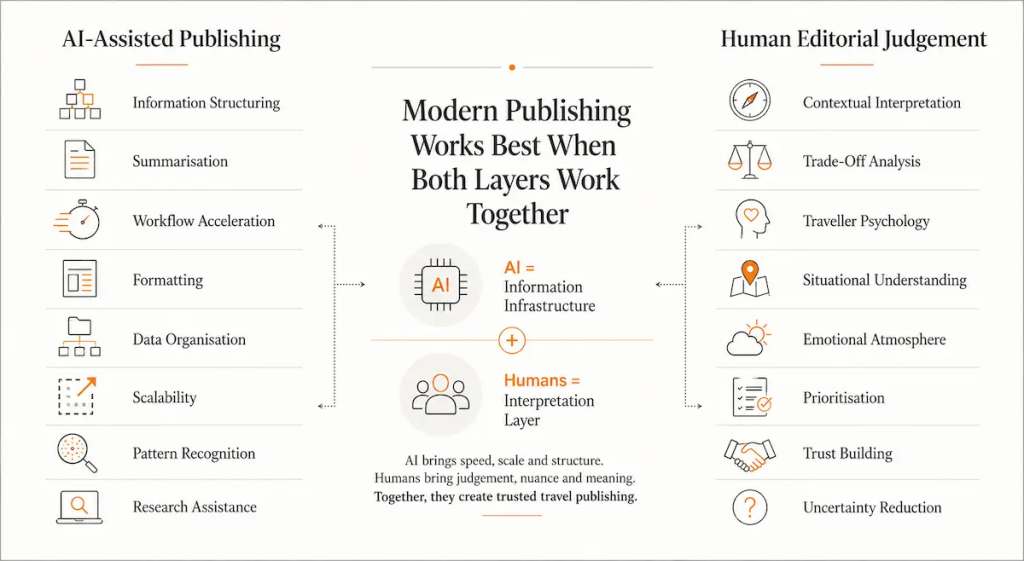
In many ways, AI is already becoming foundational infrastructure across large parts of digital publishing. The technology is exceptionally effective at tasks involving information organisation, structural assistance, workflow acceleration, summarisation, formatting, categorisation, and research support. Within travel publishing specifically, AI-assisted systems can help streamline enormous amounts of operational work that previously consumed significant publishing time.
For example, AI can assist with:
- structuring destination guides
- organising itineraries
- summarising transportation information
- formatting FAQs
- categorising recommendations
- accelerating research workflows
- improving publishing consistency
- helping publishers scale operational systems more efficiently
In practical terms, this dramatically lowers the friction involved in content production.
A travel publisher who previously may have spent days organising large volumes of logistical information can now accelerate parts of that process significantly using AI-assisted workflows. In many cases, this creates genuine advantages for both publishers and audiences. Faster information processing can improve content accessibility, reduce repetitive administrative work, and help publishers focus more energy on higher-level editorial thinking.
This is one reason AI will almost certainly remain deeply integrated into the future of digital publishing.
As explored further in Why AI Will Reshape Travel Publishing — Not Replace It, AI is not simply a passing trend inside the travel industry. It is rapidly becoming part of the operational infrastructure underlying modern publishing ecosystems themselves.
But this is also where a critical distinction begins to emerge.
Information structuring is not the same thing as human editorial judgement.
AI can organise information extremely efficiently. It can identify patterns across enormous datasets, summarise existing material rapidly, and generate coherent structural formatting at unprecedented scale. But structure alone does not automatically create clarity, usefulness, or trustworthiness within complex travel decision-making environments.
This becomes especially important in travel publishing because travel decisions are rarely based purely on isolated factual information.
Two articles may contain nearly identical logistical information about a destination:
- transportation
- accommodation areas
- attractions
- pricing
- itineraries
- seasonal advice
Yet one article may feel genuinely useful while the other feels generic and interchangeable.
That difference is often created by human editorial judgement rather than informational accuracy alone.
The challenge is that many modern publishing systems increasingly optimise for scalable information production rather than contextual interpretation. As discussed in The Future of Editorial Travel Publishing, AI dramatically increases the speed at which informational content can be generated, but speed itself does not necessarily improve the depth of understanding behind the publishing.
This distinction matters because travellers are increasingly overwhelmed by information abundance rather than information scarcity.
In highly saturated discovery environments, the problem is often no longer finding information.
The problem is determining:
- what matters
- what is realistic
- what applies to a specific traveller
- which trade-offs deserve attention
- which recommendations genuinely reduce uncertainty
AI can assist enormously with information organisation.
But deciding what deserves emphasis inside a complex travel decision often still depends heavily on human editorial judgement.
In many ways, this may become one of the defining characteristics of modern publishing in the AI era:
AI increasingly handles information infrastructure,
while humans increasingly provide interpretation, prioritisation, and contextual understanding layered on top of that infrastructure.
Editorial Judgement Is More Than Information
One of the biggest misconceptions surrounding modern publishing is the assumption that information alone automatically creates usefulness.
In reality, information and human editorial judgement are not the same thing.
This distinction is becoming increasingly important as AI-assisted publishing systems continue expanding across the internet. Today, enormous amounts of destination information can be generated, summarised, reformatted, and distributed at extraordinary speed. But while informational production has become dramatically easier, genuinely useful interpretation remains far more difficult to scale consistently.
This is because publishing is not simply the act of transferring information from one place to another.
At its highest level, publishing is also a process of:
- prioritisation
- contextual framing
- uncertainty reduction
- audience understanding
- decision guidance
- relevance filtering
- trade-off interpretation
In other words:
human editorial judgement helps determine what actually matters inside overwhelming volumes of available information.
This is where many generic publishing systems begin struggling.
A destination article may technically contain accurate information while still failing to meaningfully assist a traveller attempting to make real-world decisions. The facts themselves may be correct, but the publishing often lacks layered interpretation that helps readers understand how those facts connect together operationally.
For example, telling a traveller that an area is “busy” is technically information.
But that description alone says very little without context.
Busy for whom?
At what time?
In what way?
Energetic or stressful?
Suitable for nightlife travellers?
Suitable for families?
Walkable?
Overwhelming?
Social?
Commercialised?
Convenient despite the noise?
This is where human editorial judgement becomes essential because the usefulness of travel publishing often depends less on isolated facts and more on how those facts are interpreted within realistic traveller situations.
As explored further in Context vs Information in Modern Travel Publishing, contextual interpretation increasingly matters because travellers rarely make decisions based on informational categories alone. Real travel decisions are shaped by energy levels, expectations, comfort preferences, social dynamics, pacing, logistics, emotional fit, and behavioural priorities that often cannot be fully captured through surface-level destination summaries.
This is also why two articles containing nearly identical information can produce completely different outcomes for readers.
One article may simply repeat broad recommendations.
Another may actively help travellers think.
That distinction is enormously important.
In many cases, strong human editorial judgement involves deciding:
- what deserves emphasis
- what deserves less attention
- which trade-offs require explanation
- which expectations need managing
- which recommendations suit specific traveller types
- where uncertainty may exist
- where informational overload should be simplified
As discussed further in Building Destination Publishing Around Real Traveler Decisions, travellers increasingly value publishing that helps interpret complexity rather than simply expanding recommendation volume endlessly.
This becomes even more important inside highly saturated travel ecosystems where informational overlap is already extreme.
For example, Phuket already contains thousands of pages discussing:
- beaches
- nightlife
- hotels
- island tours
- itineraries
- markets
- transport
- restaurants
The challenge for travellers is often no longer access to information.
The challenge is understanding:
- which information applies to them
- how different areas actually function
- what compromises exist between options
- how travel styles influence recommendations
- how experiences connect together practically
This is where human editorial judgement creates differentiated publishing value.
Not by replacing information,
but by interpreting it.
Importantly, this does not mean AI lacks usefulness inside publishing systems.
Far from it.
AI may become extraordinarily effective at assisting with research, structure, summarisation, workflow efficiency, and informational organisation. But the growing abundance of scalable information may simultaneously increase the importance of publishers capable of providing realistic interpretation layered on top of that information.
In many ways, the future competitive advantage of travel publishing may depend less on who can produce the most information,
and more on who can provide the clearest understanding of how that information should actually be understood.
Why Context Is Difficult to Replicate at Scale
One of the reasons human editorial judgement remains so important in modern travel publishing is because context itself is extremely difficult to reproduce at scale.
Information can often be replicated relatively easily.
Context cannot.
This distinction becomes increasingly visible as AI-assisted publishing systems continue expanding across the travel industry. Large volumes of destination information can now be generated rapidly across thousands of pages, but contextual understanding usually develops much more slowly through observation, operational familiarity, lived experience, and repeated interaction with real-world environments over time.
This is especially important in travel publishing because destinations are not static informational objects.
They are dynamic ecosystems shaped by:
- atmosphere
- movement
- pacing
- seasonality
- traveller behaviour
- local infrastructure
- cultural expectations
- environmental conditions
- logistical friction
- social energy
Many of these variables shift constantly depending on circumstances, timing, traveller type, and situational expectations.
This creates a major challenge for scalable publishing systems attempting to summarise destinations primarily through broad informational formatting.
For example, Phuket cannot realistically be understood through a single simplified narrative.
The island contains:
- heavily commercialised nightlife zones
- quiet residential beach areas
- luxury resort districts
- local neighbourhood environments
- seasonal tourism fluctuations
- traffic bottlenecks
- hidden logistical challenges
- highly different social atmospheres between regions
Even areas located relatively close together can feel completely different operationally depending on:
- time of day
- weather
- season
- traveller personality
- budget
- transport confidence
- trip expectations
This is one reason contextual publishing often requires far more than informational summarisation alone.
As explored further in How Travelers Research Phuket Differently Today, travellers increasingly struggle not because information is unavailable, but because destinations contain multiple overlapping realities that generic publishing systems often flatten into simplified recommendation structures.
This is where human editorial judgement becomes increasingly valuable.
A publisher with operational familiarity can often recognise subtleties that are difficult to fully capture through scalable informational generation alone:
- how an area actually feels emotionally
- where transport friction creates fatigue
- which beaches suit slower travel styles
- where nightlife energy becomes overwhelming
- which recommendations work differently depending on timing
- how pacing affects overall trip experience
- where expectations frequently become misaligned
These forms of understanding are often highly situational.
They depend heavily on contextual interpretation rather than purely factual recall.
As discussed further in Why Travel Publishing Needs More Context and Less Noise, modern travellers increasingly reward publishers capable of reducing uncertainty through realistic framing rather than endlessly expanding informational volume.
This distinction matters because scalable systems often optimise primarily for coverage.
But coverage alone does not necessarily create understanding.
A destination guide may technically mention:
- beaches
- attractions
- hotels
- restaurants
- transport
- itineraries
while still failing to help travellers understand how those elements connect together operationally in practice.
This is one reason human editorial judgement may actually become more important as AI-assisted publishing expands further.
The easier informational generation becomes,
the more valuable contextual interpretation may become alongside it.
Importantly, context itself is not simply “extra detail.”
Context changes the meaning of information.
For example:
saying an area is “quiet” means very different things depending on whether a traveller is:
- seeking nightlife
- travelling with children
- working remotely
- staying long-term
- backpacking socially
- planning a honeymoon
- avoiding traffic
- prioritising beach access
Without contextual interpretation, even technically accurate information can become operationally misleading.
This is one reason modern travel publishing increasingly depends on layered understanding rather than informational scale alone.
In many ways, the future value of travel publishing may depend less on how efficiently information can be produced,
and more on how effectively publishers can contextualise that information around realistic human decision-making.
The Hidden Role of Editorial Filtering
One of the least discussed — but increasingly important — functions of human editorial judgement is filtering.
For many years, digital publishing systems largely rewarded expansion.
More pages.
More recommendations.
More keywords.
More coverage.
More listicles.
More search visibility.
In many ways, the internet trained publishers to believe that increasing informational volume automatically increased usefulness.
But inside modern travel ecosystems, the opposite problem is now emerging.
Travellers are no longer suffering from a shortage of information.
They are suffering from informational overload.
A traveller researching almost any major destination today may encounter:
- blog articles
- AI-generated summaries
- TikTok recommendations
- YouTube breakdowns
- Reddit discussions
- affiliate-heavy listicles
- creator itineraries
- Google Maps reviews
- tourism advertising
- booking platform recommendations
all competing for attention simultaneously.
This creates enormous cognitive noise during travel decision-making.
As a result, one of the most valuable forms of human editorial judgement increasingly involves deciding what does not deserve equal attention.
That is an extremely important shift.
Historically, many publishing systems focused on maximising information.
Increasingly, useful publishing may depend on reducing unnecessary complexity instead.
This is where editorial filtering becomes critical.
Strong editorial filtering helps:
- reduce overwhelm
- simplify trade-offs
- prioritise relevance
- remove low-value recommendations
- organise complexity
- guide realistic expectations
- create clearer decision pathways
In many ways, filtering itself is becoming a form of publishing value.
As explored further in Slow Publishing vs Content Saturation, the modern internet increasingly rewards informational speed and scale, but those same systems often create bloated publishing environments filled with repetitive recommendations and shallow destination summaries. The result is not always greater clarity for audiences. Often, it produces greater confusion.
This becomes particularly visible in highly saturated destinations.
For example, travellers researching Phuket may encounter hundreds of:
- “best beaches”
- “hidden gems”
- “must-see attractions”
- “perfect itineraries”
- “secret spots”
many of which overlap heavily with one another.
The problem is not simply duplication.
The problem is prioritisation.
Which experiences genuinely matter for different traveller types?
Which recommendations are realistically useful?
Which areas create unnecessary logistical friction?
Which activities are overhyped relative to expectations?
Which suggestions meaningfully improve a trip versus simply expanding a recommendation list?
This is where human editorial judgement often becomes more valuable than informational expansion itself.
As discussed further in Why Perspective Is Becoming More Valuable Than Information, travellers increasingly reward publishers capable of helping interpret relevance rather than endlessly increasing recommendation volume.
This distinction matters enormously in the AI era because scalable publishing systems naturally tend toward informational accumulation.
AI can generate:
- larger lists
- broader summaries
- more category coverage
- more itinerary variations
- more recommendation structures
very efficiently.
But abundance alone does not automatically improve decision-making.
In many cases, excessive informational volume actually increases uncertainty because travellers struggle to identify:
- what matters most
- what applies specifically to them
- what deserves trust
- what can safely be ignored
This is one reason editorial filtering may become increasingly valuable as AI-assisted publishing expands further across the internet.
The future competitive advantage of publishing may depend less on who can produce the largest amount of information,
and more on who can reduce complexity most effectively.
That is not simply a writing skill.
It is a form of human editorial judgement.
Importantly, filtering does not mean oversimplifying destinations into shallow narratives.
It means helping audiences navigate complexity without becoming overwhelmed by it.
In many ways, modern travel publishing is increasingly shifting from:
information accumulation
toward:
decision clarification.
And inside saturated discovery ecosystems, the publishers most capable of reducing uncertainty may ultimately become the publishers audiences trust most.
Why Trust Signals Still Depend on Humans
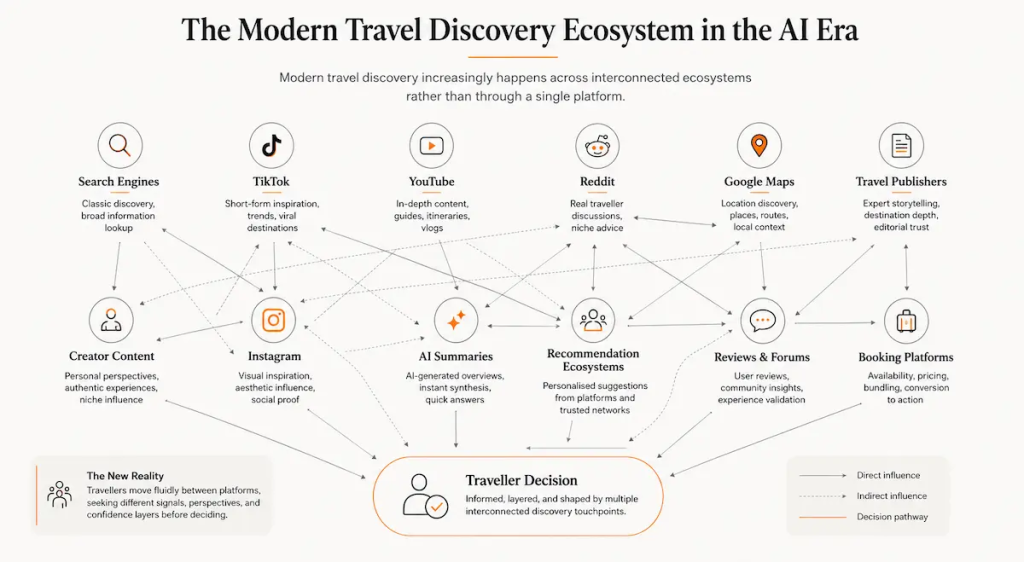
Modern travellers rarely rely on a single source of information when making destination decisions. Instead, travel discovery increasingly happens across interconnected ecosystems shaped by search, creators, reviews, AI summaries, maps platforms, and editorial publishing simultaneously.
One of the most important realities shaping modern publishing is that trust is rarely built through information alone.
Trust is built through perceived judgement.
This distinction is becoming increasingly important as AI-assisted publishing systems continue scaling across the internet. While large volumes of destination information can now be generated rapidly, travellers still look for signals that suggest a publisher genuinely understands what they are discussing beyond surface-level informational formatting.
This is where human editorial judgement continues playing a critical role.
In many cases, audiences are not consciously analysing publishing systems in technical detail. Travellers are rarely sitting down and formally evaluating whether an article was AI-assisted, manually written, or produced through hybrid workflows.
Instead, readers often assess trust instinctively through subtle contextual signals:
- clarity of interpretation
- consistency of perspective
- realistic framing
- operational understanding
- balanced recommendations
- nuanced trade-off discussions
- believable destination familiarity
- calm editorial tone
- reduction of uncertainty
These signals often shape perceived credibility far more than informational volume alone.
As explored further in Why Trust Is Becoming the Most Valuable Asset in Travel Media, modern audiences increasingly reward publishers capable of creating believable interpretive frameworks around destinations rather than simply producing endless recommendation structures.
This matters because travellers are rarely searching only for isolated factual answers.
They are often searching for reassurance.
They want to feel that:
- the publisher understands the destination operationally
- recommendations are grounded in realistic observation
- trade-offs are being acknowledged honestly
- complexity is being interpreted thoughtfully
- expectations are being managed realistically
In many ways, trust forms around perceived decision-making quality.
That is a fundamentally different dynamic from pure informational publishing.
For example, two publishers may technically recommend the same hotel area, itinerary structure, or travel route. But one publisher may feel significantly more trustworthy because the surrounding interpretation demonstrates:
- situational awareness
- contextual nuance
- balanced perspective
- understanding of traveller psychology
- realistic expectation management
This is one reason human editorial judgement remains difficult to fully replace inside publishing ecosystems increasingly shaped by scalable information generation.
As discussed further in Why Editorial Identity Matters More in AI Publishing, audiences increasingly form trust relationships not simply with information itself, but with consistent editorial perspective over time.
This creates a major shift in how publishing authority may function in the AI era.
Historically, authority often depended heavily on scale:
- more content
- broader keyword coverage
- larger publishing networks
- higher informational output
Increasingly, authority may instead depend more heavily on:
- interpretive consistency
- contextual reliability
- perspective clarity
- ecosystem familiarity
- trust reinforcement
That transition changes the role of publishers significantly.
Modern audiences increasingly want help navigating uncertainty inside fragmented discovery ecosystems where information already exists everywhere simultaneously.
This is one reason many travellers now move fluidly between:
- search engines
- YouTube
- TikTok
- creator ecosystems
- niche publications
- maps reviews
- recommendation communities
before making decisions.
The issue is not informational scarcity.
The issue is identifying which sources feel believable.
This is where human editorial judgement continues functioning as a major trust signal even within increasingly AI-assisted publishing environments.
Importantly, this does not mean trust can only exist in purely human-written systems.
The future will likely involve extensive AI-assisted workflows across much of digital publishing. But trust may increasingly depend on whether audiences believe genuine judgement, interpretation, and contextual understanding still exist somewhere inside the publishing process itself.
In many ways, travellers are not simply looking for information anymore.
They are looking for publishers whose judgement they feel comfortable relying on.
The Future Will Belong to Hybrid Publishing Systems
One of the biggest misconceptions surrounding AI and publishing is the idea that the future will belong entirely to either humans or machines.
In reality, the most effective publishing systems will likely combine both.
AI is rapidly becoming extraordinarily valuable as operational infrastructure inside modern publishing ecosystems. At the same time, human editorial judgement continues providing many of the interpretive layers that audiences increasingly value within saturated information environments.
This is why the future of travel publishing will likely be hybrid rather than purely automated or purely manual.
AI-assisted systems will almost certainly continue transforming:
- research workflows
- content organisation
- information summarisation
- structural formatting
- workflow efficiency
- scalability
- categorisation
- administrative publishing tasks
In many ways, these technologies dramatically reduce operational friction across modern publishing systems.
That creates genuine advantages.
Publishers can often spend less time handling repetitive informational tasks and more time focusing on:
- interpretation
- editorial strategy
- contextual analysis
- audience understanding
- ecosystem positioning
- trust development
- publishing clarity
This distinction matters enormously because scalable infrastructure and editorial judgement solve different problems.
AI helps process information efficiently.
Human editorial judgement helps determine how that information should be interpreted within realistic decision-making environments.
As explored further in The Future of Creator-Led Travel Media, audiences increasingly form trust relationships around perspective-driven publishing ecosystems rather than informational scale alone. Travellers often follow creators, publications, and editorial systems that help them reduce uncertainty and interpret destinations realistically rather than simply maximise recommendation volume.
This creates a publishing environment where hybrid systems may become increasingly powerful.
For example, AI may assist with:
- destination research synthesis
- itinerary formatting
- metadata organisation
- FAQ generation
- structural optimisation
- information categorisation
while human publishers continue guiding:
- contextual framing
- prioritisation
- trade-off interpretation
- traveller suitability
- editorial tone
- ecosystem understanding
- trust calibration
These layers work together rather than directly competing against one another.
As discussed further in The Return of Editorial Publishing in the AI Era, scalable information production may actually increase the value of thoughtful editorial interpretation rather than eliminate it. The easier content becomes to generate, the more audiences may reward publishers capable of providing believable perspective layered on top of that abundance.
This is especially important in travel publishing because travel itself is deeply situational.
Destinations are experienced differently depending on:
- personality
- budget
- timing
- energy levels
- travel style
- expectations
- comfort preferences
- social dynamics
- pacing
No purely scalable informational system can fully interpret all of these variables perfectly across every traveller situation.
This is one reason human editorial judgement may remain one of the most valuable competitive advantages inside future publishing ecosystems.
Not because humans outperform AI at informational processing speed.
But because interpretation itself remains deeply contextual.
Importantly, the future likely does not reward publishers who reject AI entirely.
Nor does it necessarily reward publishers who rely entirely on scalable automation without meaningful editorial oversight.
Instead, the strongest publishing systems may increasingly be those capable of combining:
- scalable operational efficiency
with: - believable editorial interpretation
In many ways, AI may become the infrastructure layer of publishing,
while humans remain the judgement layer built on top of it.
And as informational abundance continues accelerating across the internet, that combination may become one of the defining models of trusted publishing in the years ahead.
Conclusion
The future of travel publishing is not being shaped by a shortage of information.
It is being shaped by an overwhelming abundance of it.
Today, travellers navigate enormous volumes of destination content across search engines, creator ecosystems, maps platforms, social media, recommendation networks, AI-generated summaries, and large-scale publishing systems simultaneously. In this environment, the challenge is no longer simply accessing information.
The challenge is interpreting it meaningfully.
This is one reason human editorial judgement remains increasingly important in the AI era.
AI-assisted systems are already transforming modern publishing infrastructure in powerful ways. They improve workflow efficiency, accelerate information processing, assist research organisation, and dramatically lower the friction involved in content production itself. These technologies will almost certainly remain deeply integrated into the future of digital publishing.
But scalable information generation and editorial interpretation are not the same thing.
As explored throughout this article, travellers increasingly value:
- contextual understanding
- realistic framing
- trade-off interpretation
- operational familiarity
- uncertainty reduction
- perspective-driven guidance
These are forms of publishing value that often depend heavily on human editorial judgement layered on top of informational systems rather than informational scale alone.
This distinction becomes even more important as generic travel content continues expanding across the internet. When destination information becomes infinitely reproducible, differentiation increasingly shifts toward:
- interpretation
- contextual clarity
- editorial perspective
- trust signals
- ecosystem understanding
In many ways, the future competitive advantage of publishing may depend less on who can produce the most information,
and more on who can help audiences understand that information most effectively.
That is a fundamentally different publishing model from the one that dominated much of the early search-driven internet era.
As discussed in Why Generic Travel Content Is Losing Trust, travellers are becoming more selective about the publishing systems they trust inside increasingly saturated discovery environments. At the same time, as explored in Why Trust Is Becoming the Most Valuable Asset in Travel Media, authority itself may increasingly depend on contextual reliability and believable interpretation rather than sheer informational scale alone.
This does not mean AI reduces the importance of publishing.
If anything, the opposite may be true.
As information becomes easier to generate, thoughtful interpretation may become more valuable alongside it.
In many ways, the AI era may not reduce the importance of human editorial judgement.
It may make it far more visible.
Frequently Asked Questions
What is human editorial judgement in travel publishing?
Human editorial judgement refers to the ability to interpret, prioritise, contextualise, and frame information in ways that help travellers make realistic decisions. It goes beyond simply presenting facts and instead focuses on reducing uncertainty, explaining trade-offs, and helping audiences understand how destinations function in practice.
Why does human editorial judgement still matter in the AI era?
AI can organise and generate information efficiently, but travellers still look for contextual understanding, realistic interpretation, and trustworthy perspective. Human editorial judgement helps publishers explain what information actually matters for different traveller situations rather than simply expanding informational volume.
Can AI replace travel writers completely?
AI will likely become deeply integrated into travel publishing workflows, especially for research support, formatting, summarisation, and structural assistance. However, many aspects of contextual interpretation, traveller psychology, operational understanding, and editorial perspective still depend heavily on human editorial judgement.
How is AI changing travel publishing?
AI is dramatically accelerating the speed and scale of information production online. It can assist with:
- destination summaries
- itinerary structures
- formatting
- workflow efficiency
- content organisation
- research synthesis
As explored further in Why AI Will Reshape Travel Publishing — Not Replace It, AI is reshaping publishing infrastructure rather than simply replacing human involvement altogether.
Why are travellers becoming more selective about trust online?
Modern travellers are exposed to enormous volumes of repetitive and interchangeable content across blogs, videos, social media, AI summaries, and recommendation systems. As discussed in Why Generic Travel Content Is Losing Trust, audiences increasingly look for contextual clarity, believable perspective, and realistic destination understanding rather than generic informational repetition alone.
What is contextual travel publishing?
Contextual travel publishing focuses on helping travellers understand how destinations function in practice rather than simply listing recommendations. This includes:
- traveller suitability
- trade-offs
- pacing
- atmosphere
- logistical realities
- expectation management
- ecosystem understanding
As explored in Context vs Information in Modern Travel Publishing, contextual interpretation is becoming increasingly important inside saturated travel discovery environments.
Why is informational overload becoming a problem for travellers?
The internet now contains more travel content than ever before. Travellers often move between:
- search engines
- TikTok
- YouTube
- Google Maps
- creator ecosystems
- AI-generated summaries
This creates informational overload where the challenge becomes identifying what deserves trust rather than simply finding information itself.
What role will humans play in future publishing systems?
The future of publishing will likely involve hybrid systems combining AI-assisted infrastructure with human editorial judgement. AI may increasingly handle information processing and operational workflows, while human publishers continue providing interpretation, contextual framing, prioritisation, and trust-building perspective.
Why does contextual interpretation matter more than information alone?
Two articles may contain nearly identical factual information while still creating very different levels of usefulness for travellers. Contextual interpretation helps audiences understand:
- which recommendations apply to them
- what trade-offs exist
- how destinations actually feel
- how decisions connect together operationally
This is one reason human editorial judgement remains increasingly valuable inside modern travel publishing ecosystems.
What is the future of travel publishing?
The future of travel publishing will likely reward:
- contextual clarity
- editorial identity
- operational understanding
- trust signals
- ecosystem awareness
- realistic interpretation
- perspective-driven publishing
As scalable informational production continues expanding, publishers capable of reducing uncertainty through thoughtful interpretation may become increasingly valuable within modern travel discovery ecosystems.
About The Author
David Hibbins is the founder of Travel With Insight and a long-term destination publisher based in Phuket, Thailand. His work focuses on modern travel discovery, contextual publishing, tourism visibility systems, and how AI is reshaping the future of travel media.
Through projects including Go Find Asia, Resurgence Travel, and Reflections Photography, David explores how travellers actually research destinations in the modern internet era — combining editorial publishing, operational destination understanding, and real-world ecosystem observation across Southeast Asia.
His publishing philosophy focuses on:
- contextual travel understanding
- thoughtful editorial interpretation
- decision-focused destination publishing
- realistic travel guidance
- trust-driven publishing systems in the AI era
He writes extensively about travel publishing, tourism visibility, creator ecosystems, and the changing relationship between AI, trust, and destination discovery online.