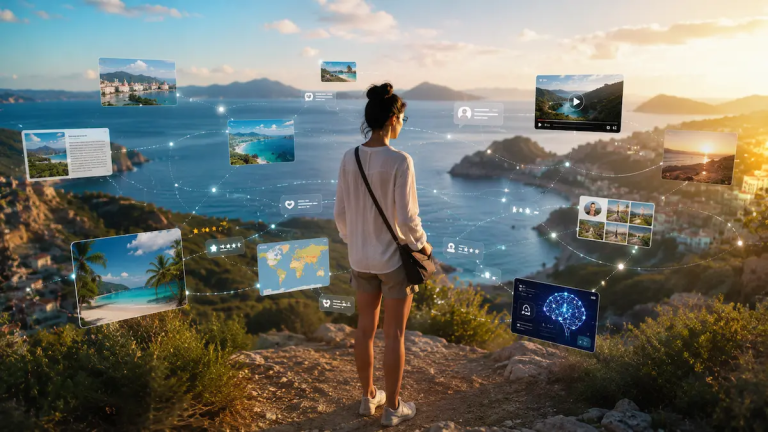

Why Human Publishing Still Matters In The AI Era
The internet has never contained more information about journalism, media, publishing, artificial intelligence, creators, and digital distribution than it does today. At the same time, understanding where the industry is actually heading has arguably become far more difficult.
In early 2026, the Reuters Institute for the Study of Journalism released its annual Journalism, Media, and Technology Trends and Predictions 2026 report by Nic Newman — one of the most widely respected industry research reports examining the future of publishing, media strategy, AI, platforms, creators, audience behaviour, and digital business models.
The original report spans a huge range of topics including:
- Generative AI
- search decline
- creator-led publishing
- video-first distribution
- answer engines
- platform dependency
- newsroom automation
- AI misinformation
- subscription models
- audience trust
- changing publisher strategies
Rather than attempting to reproduce the full report, this article serves as an AI-assisted editorial distillation of its major themes, strategic insights, and emerging patterns.
The goal is not to replace the original research, but to make the broader implications easier to absorb for publishers, creators, media operators, travel brands, and digital businesses trying to understand where the internet ecosystem may be heading next.
Some of the most important observations within the Reuters report extend far beyond journalism itself. Many of the same pressures affecting major news organisations are now beginning to impact:
- travel publishing
- SEO-driven websites
- creator businesses
- affiliate content
- destination marketing
- independent media brands
- and platform-reliant digital businesses of all kinds
This article summarises the report into practical knowledge bites and editorial observations while also exploring what some of these shifts may mean for the future of modern publishing in the AI era.
The original Reuters Institute report can be found here.
Key Knowledge Bites From The Reuters 2026 Media Trends Report
The Reuters report covers a huge range of interconnected shifts affecting modern publishing, AI, media, creators, platforms, and digital business models. Rather than approaching the report as a purely journalism-focused document, these knowledge bites explore the broader strategic patterns emerging across the internet — many of which now extend far beyond traditional media into travel publishing, creator ecosystems, SEO, tourism marketing, and independent digital brands.
1. AI Is Reshaping Information Access Faster Than Most Publishers Expected
One of the clearest themes throughout the Reuters report is that Generative AI is no longer being treated as an experimental technology. It is now actively reshaping how people search for information, consume media, and interact with content online.
Traditional search engines are increasingly evolving into AI-driven “answer engines” where users receive summarised responses directly inside chat interfaces rather than clicking through to websites.
For publishers, this represents one of the most significant structural changes the internet has experienced since the rise of social media.
Reuters notes that many publishers now expect search traffic to decline by more than 40% over the next three years as AI summaries, chatbots, and automated recommendation systems increasingly sit between users and original sources.
This shift is already beginning to impact:
- news publishers
- affiliate websites
- travel blogs
- informational content
- review sites
- and SEO-dependent businesses
Importantly, the report suggests this may fundamentally alter the economics of online publishing itself.
For years, publishers optimised content around traditional search visibility:
- ranking pages
- generating clicks
- capturing ad impressions
- and building traffic through Google search behaviour
But in an AI-driven ecosystem, users may increasingly consume the answer without ever visiting the original source.
This creates enormous uncertainty around:
- traffic
- attribution
- monetisation
- brand visibility
- and long-term sustainability for independent publishers
The Reuters report also introduces the growing importance of:
- AEO (Answer Engine Optimisation)
- GEO (Generative Engine Optimisation)
These emerging disciplines are likely to become increasingly important as publishers attempt to optimise visibility inside AI systems rather than traditional search result pages.
For smaller publishers and creator-led businesses, this may mean that:
- authority
- trust
- originality
- direct audience relationships
- and recognisable expertise
become more important than pure SEO mechanics alone.
In many ways, the report suggests the internet may be shifting from:
“Who ranks highest?”
towards:
“Who is trusted enough to be referenced by AI systems?”
2. Generic Content Is Becoming Increasingly Vulnerable
One of the most important strategic observations within the Reuters report is the growing belief that large amounts of generic informational content may become heavily commoditised by AI systems.
The report specifically highlights how publishers are beginning to reduce focus on:
- evergreen content
- utility content
- service journalism
- and broad general coverage
because AI tools can increasingly generate, summarise, and personalise this type of information quickly and at scale.
This has major implications far beyond traditional journalism.
Industries that rely heavily on searchable informational content — including travel publishing, affiliate websites, product reviews, and destination guides — may all face increasing pressure as AI systems become better at delivering instant answers directly inside search interfaces.
The Reuters report repeatedly returns to the idea that publishers will need to become more distinctive in order to survive.
Rather than competing on volume alone, many media organisations are now prioritising:
- original reporting
- contextual expertise
- human observation
- investigations
- personality-led content
- analysis
- commentary
- and on-the-ground experience
The underlying logic is simple:
AI can summarise information extremely efficiently, but it struggles to replicate:
- lived experience
- editorial judgement
- field observation
- nuanced perspective
- trust
- and genuine human context
This distinction becomes particularly important in travel publishing.
A generic “Top 10 Things To Do” article may become increasingly replaceable.
But content rooted in:
- local understanding
- personal observation
- practical judgement
- route experience
- cultural awareness
- visual documentation
- and real-world destination familiarity
may become significantly more valuable precisely because AI cannot easily fabricate authentic experience at scale.
The Reuters report also highlights how publishers increasingly believe that “human stories” and “on-the-ground reporting” represent some of the strongest defensive positions against AI commoditisation.
In practical terms, this suggests the future advantage for publishers may no longer come primarily from producing the largest quantity of content.
Instead, it may come from producing content that demonstrates:
- genuine proximity to the subject
- clear expertise
- recognisable perspective
- trusted editorial framing
- and difficult-to-replicate insight
The report repeatedly reinforces a broader theme:
in an internet increasingly flooded with AI-generated material, distinctiveness itself may become one of the most valuable assets a publisher can possess.

3. The Internet Is Shifting From Institution-Led Media Towards Personality-Led Media
Another major theme throughout the Reuters report is the accelerating shift away from institution-led media and towards personality-driven content ecosystems.
Increasingly, audiences are forming stronger connections with:
- creators
- podcasters
- YouTubers
- streamers
- independent journalists
- commentators
- and platform-native personalities
rather than traditional media brands themselves.
Reuters notes that many politicians, celebrities, and public figures are now deliberately bypassing traditional journalism entirely by speaking directly through podcasts, creator interviews, YouTube channels, livestreams, and social platforms.
This trend is reshaping how trust, attention, and influence operate online.
In previous internet eras, institutional authority often dominated:
- newspapers
- television networks
- magazines
- and large media organisations
acted as the primary gatekeepers of information.
Today, audiences increasingly value:
- authenticity
- familiarity
- recognisable personalities
- direct communication
- and perceived human connection
even when those creators may not operate under traditional journalistic standards.
The Reuters report highlights growing concern among publishers that creators are increasingly competing for:
- audience attention
- advertising revenue
- cultural influence
- and even editorial talent itself
Many publishers now fear losing their strongest journalists and personalities to the creator economy, where individuals can potentially build larger personal audiences and retain greater control over monetisation.
In response, many media organisations are actively adapting by:
- encouraging journalists to build public-facing identities
- investing in creator partnerships
- launching creator studios
- prioritising personality-led formats
- and restructuring content for social-first distribution
This trend extends well beyond journalism.
Across travel publishing, education, entertainment, photography, business media, and niche publishing, audiences increasingly follow:
- people
- perspectives
- and personalities
rather than websites alone.
The implication is significant.
A faceless website may struggle to build long-term loyalty in an internet increasingly dominated by:
- video
- social feeds
- creator ecosystems
- and algorithmic discovery
Whereas publishers and creators who successfully build:
- recognisable voices
- trusted personalities
- consistent editorial identity
- and direct audience relationships
may become more resilient over time.
Importantly, the Reuters report does not suggest that institutions disappear completely.
Rather, it suggests that institutions may increasingly need to behave more like creators:
- more human
- more visible
- more conversational
- more personality-driven
- and more platform-native
while still maintaining the credibility and standards that distinguish professional publishing from pure entertainment.
This tension between:
institutional trust
and
creator-style engagement
is likely to become one of the defining media challenges of the next decade.
4. Video Is Becoming Central To Modern Publishing Strategy
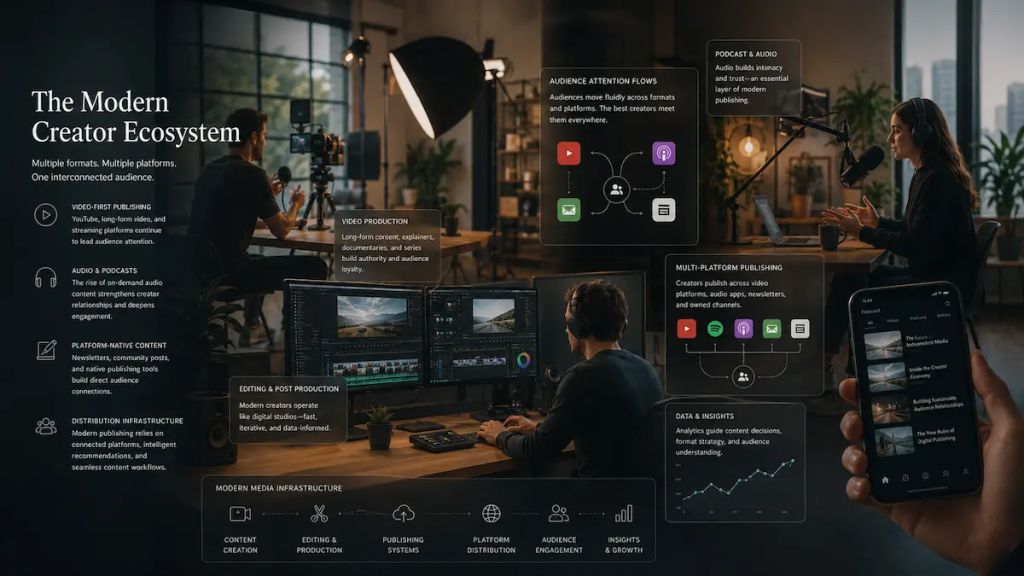
One of the clearest operational shifts identified throughout the Reuters report is the growing dominance of video across nearly every major digital platform.
Publishers increasingly believe that:
- short-form video
- vertical video
- podcasts
- livestreams
- and creator-led visual formats
will become essential for maintaining visibility and audience engagement in the years ahead.
Reuters notes that many traditional publishers are now aggressively investing in:
- YouTube
- TikTok
- Instagram Reels
- Shorts
- watch tabs
- and platform-native video ecosystems
while reducing emphasis on older traffic models built primarily around written articles and traditional social sharing.
The report argues that this shift is partly defensive.
As AI systems become increasingly capable of summarising written content instantly, text-based informational content may become easier to commoditise.
Video, however, remains more difficult to:
- compress
- replicate
- summarise
- and replace completely
particularly when it includes:
- personality
- human presence
- field footage
- demonstrations
- commentary
- storytelling
- or lived experience
This is one reason why many publishers now see video and audio as strategically important in the AI era.
The Reuters report also highlights how audience behaviour itself is changing.
Platforms increasingly prioritise:
- endless video feeds
- swipe-based discovery
- algorithmic recommendations
- and entertainment-driven engagement
rather than traditional link-sharing behaviour.
As a result, publishers are increasingly forced to compete inside environments where:
- attention spans are shorter
- visual engagement dominates
- and personality often outperforms institutional branding alone
Importantly, Reuters suggests that video is no longer simply a marketing layer added on top of publishing.
Instead, it is becoming part of the core publishing infrastructure itself.
This has major implications for:
- travel publishers
- creators
- photographers
- tourism brands
- educators
- and niche media businesses
especially those that historically relied heavily on written SEO traffic.
For travel publishing in particular, video creates opportunities that AI-generated text still struggles to fully replicate:
- environmental atmosphere
- real-world movement
- visual authenticity
- local interaction
- sound
- timing
- and emotional context
A creator physically walking through a destination, documenting observations, reacting in real time, and visually showing conditions carries a level of credibility that generic AI-generated summaries currently cannot reproduce effectively.
The Reuters report also notes the growing convergence between:
- publishing
- television
- creator culture
- streaming
- and social media
with YouTube increasingly functioning more like a global television network than a traditional social platform.
This suggests that future publishers may increasingly need to think less like:
article producers
and more like:
multi-format media operators
capable of distributing:
- text
- video
- audio
- commentary
- live content
- and platform-native experiences
across multiple ecosystems simultaneously.
5. Trust, Authenticity, And Human Judgement May Become More Valuable In The AI Era
While much of the Reuters report focuses on technological disruption, one of its deeper themes is the growing importance of trust, authenticity, and human editorial judgement in an internet increasingly saturated with AI-generated content.
The report repeatedly references concerns around:
- misinformation
- AI-generated “slop”
- synthetic media
- deepfakes
- fake news websites
- automated content farms
- and declining public trust online
As AI tools become capable of generating:
- articles
- videos
- images
- voices
- and realistic simulations at massive scale
the internet may become flooded with content that appears convincing but lacks:
- expertise
- accountability
- transparency
- or genuine human oversight.
Reuters suggests that this environment may ultimately increase the value of:
- trusted publishers
- recognised experts
- credible creators
- and human-led editorial systems
even if the broader information ecosystem becomes noisier and more fragmented.
Importantly, the report does not argue that audiences will automatically return to traditional media institutions.
In fact, Reuters notes that trust in journalism itself remains challenged in many countries.
Instead, trust may increasingly become attached to:
- individuals
- personalities
- communities
- brands
- and creators
that consistently demonstrate:
- accuracy
- transparency
- lived experience
- editorial integrity
- and recognisable expertise over time.
This has significant implications for independent publishers and creator-led businesses.
In an AI-saturated environment, audiences may increasingly ask:
- Who actually understands this subject?
- Who has genuine experience here?
- Who is physically present?
- Who has earned credibility over time?
- Who consistently provides reliable judgement?
The Reuters report strongly suggests that:
human judgement itself may become a differentiator.
Not because AI lacks information, but because information alone is no longer enough.
As content volume explodes, audiences increasingly need:
- filtering
- interpretation
- prioritisation
- contextual framing
- and trusted guidance
from people or brands they recognise.
This may become particularly important in sectors such as:
- travel
- photography
- education
- news
- product reviews
- and creator publishing
where nuance, environmental understanding, and situational judgement matter heavily.
The report also highlights growing interest in:
- digital provenance
- content verification
- authenticity standards
- and systems that prove where content originated
as platforms and audiences attempt to distinguish:
genuine human-created work
from:
automated synthetic media.
Ultimately, one of the report’s strongest underlying messages is that AI may not eliminate the importance of human publishing.
Instead, it may force publishers to become clearer about:
- what makes them trustworthy
- why their perspective matters
- what unique value they provide
- and why audiences should choose them over increasingly infinite automated alternatives.
6. Direct Audience Relationships Are Becoming Increasingly Critical
Another major strategic theme throughout the Reuters report is the growing importance of building direct audience relationships rather than relying heavily on platform algorithms for visibility.
For years, many publishers built traffic primarily through:
- Google search
- Facebook referrals
- X (Twitter)
- and other external platforms
But Reuters notes that referral traffic from traditional social media platforms has already fallen dramatically in recent years, while AI-driven search systems now threaten to reduce search traffic as well.
This creates a major structural problem for publishers that depend heavily on:
- platform discovery
- algorithmic reach
- SEO traffic
- or external distribution systems they do not control.
As platforms evolve, publishers increasingly lose control over:
- audience access
- monetisation
- visibility
- distribution
- and even how their content is displayed.
In response, many media organisations are now prioritising:
- subscriptions
- memberships
- newsletters
- podcasts
- events
- communities
- apps
- and direct brand loyalty
as defensive strategies against platform dependency.
The underlying logic is simple:
if a publisher owns a direct relationship with its audience, it becomes less vulnerable to sudden algorithm changes or platform disruptions.
Reuters repeatedly highlights how publishers are now trying to shift from:
rented audiences
towards:
owned audiences.
This shift extends far beyond traditional journalism.
For creators, travel publishers, photographers, educators, and niche businesses, direct audience relationships may become increasingly important in the years ahead.
An audience that:
- subscribes directly
- joins an email list
- watches repeatedly
- follows across multiple platforms
- engages with a brand consistently
- or participates in a community
is far more resilient than traffic that arrives passively from search algorithms alone.
The report also suggests that audience loyalty may become increasingly connected to:
- personality
- trust
- recognisable identity
- and community belonging
rather than simple information delivery.
This is partly because information itself is becoming abundant.
AI can already generate endless:
- summaries
- explanations
- recommendations
- and generic informational content.
But what AI struggles to replicate is:
- relationship
- familiarity
- shared perspective
- audience connection
- and community trust over time.
Reuters also notes that many publishers are increasingly investing in:
- real-world events
- live experiences
- podcasts
- creator-led formats
- and community ecosystems
to deepen audience engagement beyond traditional written publishing alone.
For smaller publishers and independent creators, this may actually create opportunity.
Large institutions often struggle to build genuine community connection at scale, while smaller creator-led brands can sometimes build stronger audience loyalty through:
- consistency
- visibility
- accessibility
- personality
- and authentic engagement.
In many ways, the report suggests that the future internet may become less about:
producing the most content
and more about:
building the strongest audience relationships around that content.
7. The Future Of Publishing May Depend On Adaptability Rather Than Stability
One of the strongest underlying messages throughout the Reuters report is that the publishing industry is entering a period of ongoing structural instability rather than moving toward a single predictable future.
The report repeatedly highlights how:
- AI systems
- platforms
- audience behaviour
- monetisation models
- discovery systems
- content formats
- and creator ecosystems
are all evolving simultaneously.
For publishers, this creates an environment where long-term certainty becomes increasingly difficult.
Strategies that worked:
- five years ago
- two years ago
- or even six months ago
may become significantly less effective as platforms, algorithms, and user behaviour continue to shift.
Reuters suggests that many publishers are now being forced to rethink not only:
- how content is distributed
- but also:
- what content should be created
- which formats matter
- how audiences behave
- what monetisation looks like
- and even what a “publisher” actually is.
This uncertainty is already visible across the internet.
The boundaries between:
- media companies
- creators
- influencers
- podcasters
- educators
- entertainment brands
- and independent publishers
are increasingly blurring together.
At the same time, AI is accelerating production speed so dramatically that information itself is becoming abundant and often overwhelming.
In response, Reuters suggests that future success may depend less on rigid business models and more on adaptability itself.
Publishers that survive may be those capable of:
- experimenting quickly
- evolving formats
- adjusting distribution strategies
- embracing new technologies carefully
- and responding rapidly to audience behaviour shifts.
This adaptability applies operationally as well.
The report notes that publishers increasingly need to function across:
- text
- video
- audio
- AI systems
- social ecosystems
- newsletters
- communities
- events
- and platform-native experiences
rather than relying on a single distribution channel.
Importantly, Reuters does not present AI purely as a threat.
The report also highlights how many publishers are already using AI to:
- accelerate workflows
- assist investigations
- improve coding
- support research
- automate repetitive tasks
- personalise experiences
- and experiment with new products.
The challenge is not simply whether AI should be used.
The challenge is:
how publishers maintain meaningful human value while integrating increasingly powerful automation systems.
This may become one of the defining strategic questions of modern publishing.
The Reuters report ultimately suggests that the future internet is unlikely to belong entirely to:
- pure automation
- or purely traditional publishing models.
Instead, the strongest publishers may become those capable of combining:
- human judgement
- trusted expertise
- recognisable identity
- editorial clarity
- technological adaptability
- and multi-format communication
inside an ecosystem that will likely continue changing far faster than many organisations are comfortable with.
One of the report’s more important underlying ideas is the possibility of a future “barbell effect” in publishing. On one side may sit highly automated, AI-assisted, scale-driven content systems capable of producing enormous volumes of information at minimal cost. On the other may sit highly distinctive, trust-based, personality-led publishing rooted in human judgement, expertise, and recognisable editorial identity. The publishers most vulnerable may ultimately become those caught uncomfortably in the middle — neither differentiated enough to build loyalty, nor efficient enough to compete with large-scale automation.
In many ways, the report paints a future where:
adaptability itself becomes a competitive advantage.
Conclusion
The Reuters Journalism, Media, and Technology Trends 2026 report paints a picture of an internet ecosystem undergoing one of the most significant transitions since the rise of social media itself.
Artificial intelligence is rapidly reshaping:
- search
- discovery
- publishing
- audience behaviour
- monetisation
- and content production
at the same time that creator culture, video platforms, and personality-led media continue transforming how audiences consume information online.
Traditional publishing models are being challenged from multiple directions simultaneously:
- declining search traffic
- reduced social referrals
- AI-generated summaries
- creator competition
- platform dependency
- and changing audience expectations.
At the same time, the report also suggests that the future may not belong entirely to automation.
In many ways, the growing flood of AI-generated content may increase the long-term value of:
- human judgement
- trusted expertise
- authenticity
- recognisable identity
- and genuine lived experience.
Across journalism, travel publishing, creator businesses, and independent media, the same underlying question increasingly emerges:
What can humans provide that automated systems cannot easily replicate?
For many publishers, the answer may lie in:
- context
- interpretation
- perspective
- trust
- observation
- creativity
- personality
- and direct audience relationships.
The report strongly suggests that future publishing success may depend less on producing the largest quantity of content and more on building:
- distinctive value
- adaptable systems
- loyal audiences
- and trusted editorial identity.
At the same time, adaptability itself appears to be becoming one of the most important competitive advantages in the modern internet era.
The platforms, technologies, and distribution systems shaping today’s internet continue evolving rapidly. Publishers that survive may not necessarily be the largest organisations, but those capable of:
- learning quickly
- evolving formats
- integrating technology intelligently
- and maintaining meaningful human value inside increasingly automated ecosystems.
For creators, publishers, travel brands, and digital businesses alike, the Reuters report serves as both:
- a warning
- and an opportunity.
The internet is changing rapidly.
But the organisations and individuals capable of combining:
- technology
- human judgement
- audience trust
- and adaptable publishing strategy
may still be positioned to build extremely valuable media businesses in the years ahead.
Original Reuters Institute report
Related Reading
If you’re exploring how AI, creator ecosystems, and changing discovery systems are reshaping modern publishing, these articles may also be useful:
- Why Generic Travel Content Is Losing Trust
- The Problem With Mass-Produced Travel Content
- The Shift From Search Engines to Travel Discovery Ecosystems
- Why Perspective Is Becoming More Valuable Than Information
- Why Editorial Identity Matters More in AI Publishing
Frequently Asked Questions
What is the Reuters 2026 Media Trends Report?
The Reuters Journalism, Media, and Technology Trends 2026 report is an annual industry research publication examining major shifts affecting journalism, publishing, artificial intelligence, audience behaviour, digital platforms, creator ecosystems, and modern media business models.
Why does this report matter beyond journalism?
Many of the trends identified in the report now extend far beyond traditional news organisations. The same structural changes affecting journalism are increasingly impacting travel publishing, creator businesses, SEO-driven websites, tourism marketing, affiliate publishing, and independent digital brands.
How is AI changing online publishing?
AI is increasingly reshaping:
- search behaviour
- content discovery
- audience expectations
- information access
- and publishing economics.
The report suggests that AI-powered answer engines, summaries, and recommendation systems may reduce direct website traffic while increasing the importance of trust, expertise, and distinctive publishing.
What is meant by “answer engines”?
Answer engines are AI-driven systems that provide summarised responses directly inside chat interfaces or search experiences, often reducing the need for users to click through to traditional websites.
Why is generic content becoming more vulnerable?
The report suggests that broad informational content can increasingly be summarised or reproduced by AI systems at scale. As a result, publishers may need to focus more heavily on:
- original observation
- lived experience
- editorial judgement
- personality
- contextual expertise
- and human perspective.
Why are creator-led publishing systems becoming more important?
Audiences increasingly form stronger connections with:
- creators
- personalities
- podcasters
- YouTubers
- and recognisable voices
rather than anonymous websites alone. This shift is reshaping how trust, loyalty, and audience engagement operate online.
How is video changing modern publishing?
The report highlights how:
- YouTube
- TikTok
- Instagram Reels
- podcasts
- livestreams
- and visual-first formats
are becoming central parts of modern publishing strategy as audience behaviour shifts toward platform-native and creator-led consumption.
Why does trust matter more in the AI era?
As AI-generated content becomes more widespread, audiences may increasingly seek:
- trusted publishers
- recognised expertise
- transparent editorial systems
- and genuine human judgement
to help filter overwhelming amounts of automated information online.
What does the report suggest about the future of publishing?
The report suggests that future publishing success may depend less on content volume alone and more on:
- adaptability
- audience relationships
- editorial identity
- contextual expertise
- multi-format publishing
- and maintaining meaningful human value inside increasingly automated ecosystems.
About The Author
David Hibbins is the founder of Travel With Insight and a long-term travel publisher focused on modern destination discovery, tourism visibility, and editorial travel ecosystems.
Through projects including Go Find Asia, Resurgence Travel, and Reflections Photography, his work explores how travelers research destinations, how businesses become discoverable online, and why thoughtful publishing still matters in an increasingly automated digital landscape.
His writing focuses on travel publishing, tourism positioning, creator ecosystems, and the evolving relationship between editorial trust, search, and modern travel discovery.