
Why Do People Take Holidays ? Looking Beyond Destinations
Most holiday planning begins with a destination.
Thailand. Italy. Japan. Australia.
We ask where we want to go, what we want to see, and how we will spend our time once we arrive.
Yet before any of those decisions comes a more fundamental question.
Why do people take holidays in the first place?
At first glance the answer seems obvious. People take holidays to relax, explore, spend time with family, or experience something new. However, when researchers have studied travel motivation over several decades, they have found that while individual reasons vary enormously, many can be grouped into a surprisingly small number of common themes.
Some people are seeking rest and recovery. Others want connection, discovery, personal growth, or meaningful experiences that create lasting memories. While the destinations may differ, the underlying motivations are often remarkably similar.
Understanding these motivations can help us look beyond destinations and better understand what we are really seeking from our time away.
In this article, we’ll explore what travel and wellbeing research tells us about why people take holidays and how understanding our motivations can help us make better travel decisions.
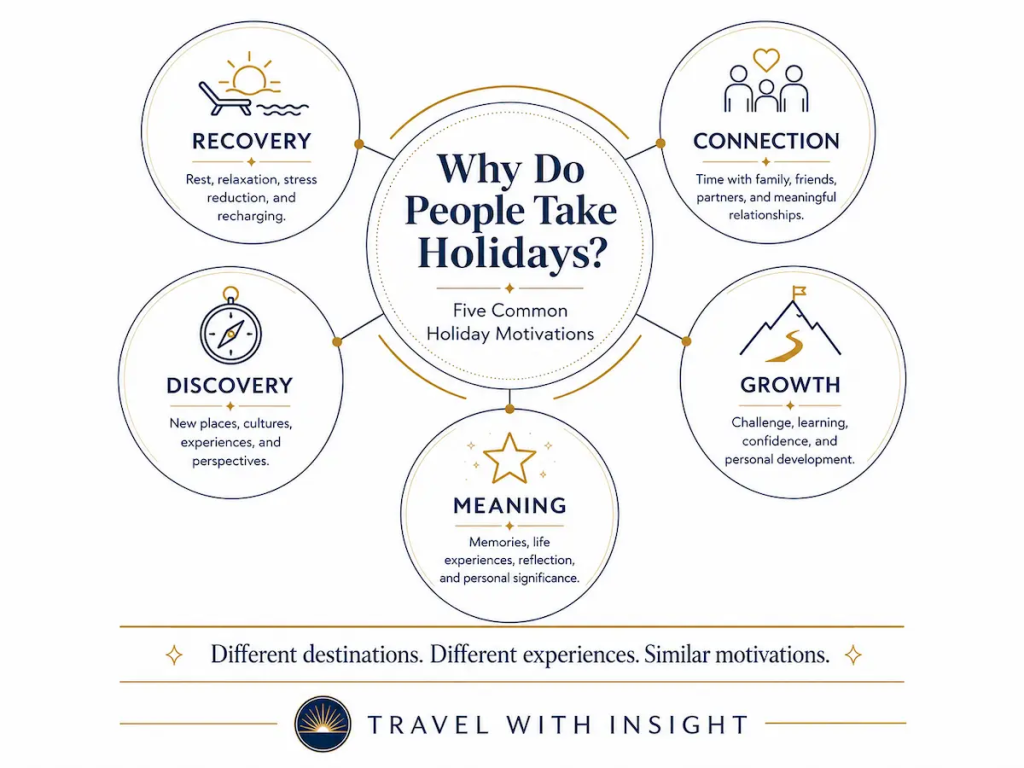
Five Common Reasons People Take Holidays
While every traveller has their own unique reasons for taking a holiday, travel motivation research suggests that many of those reasons can be grouped into a small number of common themes.
These motivations are not rigid categories, and most holidays involve more than one. However, they provide a useful framework for understanding what people are often seeking from their time away.
| Motivation | What People Are Seeking |
|---|---|
| Recovery | Rest, relaxation, and a break from everyday demands |
| Connection | Time with family, friends, partners, or themselves |
| Discovery | New places, cultures, experiences, and perspectives |
| Growth | Challenge, achievement, learning, and personal development |
| Meaning | Memorable experiences, reflection, and significant life moments |
A family holiday may be driven primarily by connection. A trekking adventure may focus on growth and achievement. A beach escape may centre on recovery and relaxation.
The important point is that while destinations, activities, and travel styles vary enormously, many holidays are ultimately designed to help people achieve one or more of these outcomes.
Before exploring each motivation in more detail, it is worth looking at what travel research tells us about why do people take holidays in the first place.
What Research Says About Why Do People Take Holidays
Researchers have been studying holiday motivations for decades, and while different models and theories have emerged over time, a common theme appears throughout much of the literature: people rarely take holidays simply because of a destination.
We spent a good amount of time reading and understanding this research in our effort to discover the answer to Why do people take holidays. It is only in understanding base needs can we make sure thaa we can recommend the best for an enjoyable travel experience.
One of the most influential concepts in tourism research is known as Push-Pull Theory. First developed by tourism researcher Graham Dann and later expanded by John Crompton, the theory suggests that travel decisions are influenced by two broad forces.
Push factors are the internal motivations that encourage someone to take a holiday. These may include stress, fatigue, routine, curiosity, a desire for family time, or the need for a change of environment.
Pull factors are the characteristics that attract someone towards a particular destination. These may include beaches, mountains, culture, food, history, wildlife, or specific experiences.
This distinction is important because it highlights a simple but often overlooked idea: the reason someone wants a holiday may be more important than the destination they ultimately choose.
Further research has built on these ideas by exploring concepts such as escape, novelty, wellbeing, personal development, and social connection. While researchers may use different terminology, many studies point towards a similar conclusion. People often take holidays because they are seeking something that is missing from their everyday lives, whether that is rest, connection, discovery, growth, or meaningful experiences.
Viewed through this lens, holidays become about much more than places on a map. They become opportunities to fulfil needs, pursue experiences, and create outcomes that enrich our lives both during the journey and after we return home.
Recovery: Taking Time To Recharge
For many people, one of the primary reasons for taking a holiday is recovery.
Modern life can be demanding. Work responsibilities, family commitments, daily routines, constant connectivity, and the pressures of everyday life can leave people feeling mentally and physically exhausted. Holidays provide an opportunity to step away from those demands and create space for rest and renewal.
Research into travel and wellbeing consistently identifies recovery as one of the most common holiday motivations. Studies have found that holidays can reduce stress, improve mood, and help people recover from work-related strain. While the effects may vary from person to person, the desire to recharge remains one of the strongest reasons people choose to take time away.
People seeking recovery may be looking for:
- Physical rest
- Mental relaxation
- Reduced stress
- Time away from routine
- Improved wellbeing
- A slower pace of life
Importantly, recovery does not necessarily mean doing nothing. For some travellers, recovery may involve relaxing by a pool or spending time on a beach. For others, it may mean enjoying nature, walking through a national park, reading a book in a quiet location, or simply spending time away from the pressures of everyday life.
Common Experience Types
Travellers motivated primarily by recovery often gravitate towards experiences such as:
- Beach holidays
- Resort stays
- Wellness retreats
- Spa and relaxation experiences
- Countryside escapes
- Slow travel journeys
- Nature-based experiences
While the destinations themselves may differ, the desired outcome remains remarkably similar. The goal is not necessarily to see more, do more, or achieve more. Instead, it is to return home feeling refreshed, re-energised, and better prepared for the demands of everyday life.
Connection: Spending Time With What Matters
While some people take holidays to rest and recharge, others are primarily motivated by connection.
In a world filled with busy schedules, work commitments, and competing priorities, holidays often provide rare opportunities to spend meaningful, uninterrupted time with the people who matter most. Whether travelling with a partner, family members, or close friends, many people value the chance to strengthen relationships and create shared experiences away from the distractions of everyday life.
Research into travel motivation consistently highlights social connection as one of the most important reasons people take holidays. While destinations may be remembered, it is often the people we share them with that leave the strongest impression. Many of our most treasured travel memories are linked not to a specific attraction or landmark, but to conversations, laughter, meals, and experiences shared with others.
People seeking connection may be looking for:
- Quality family time
- Romantic experiences
- Shared adventures
- Stronger friendships
- Opportunities to reconnect
- Time away from everyday distractions
Connection is not always about travelling with others. For some people, a holiday can also provide an opportunity to reconnect with themselves. Time away from routines and responsibilities can create space for reflection, clarity, and personal wellbeing.
Common Experience Types
Travellers motivated primarily by connection often seek experiences such as:
- Family holidays
- Couples getaways
- Multi-generational travel
- Group tours and shared adventures
- Retreats and wellness escapes
- Slow travel experiences
- Celebratory trips and special occasions
Regardless of the destination, the underlying goal remains the same. The holiday becomes a vehicle for strengthening relationships, creating shared memories, and investing time in the people who matter most.
Discovery: Experiencing Something New
Humans are naturally curious.
For many people, one of the most rewarding aspects of a holiday is the opportunity to experience something different from everyday life. New places, unfamiliar cultures, unique landscapes, local traditions, and different ways of living can all provide a sense of discovery that is difficult to replicate at home.
Travel researchers often refer to this as novelty seeking, and it is widely recognised as one of the most common travel motivations. People are drawn towards experiences that expand their understanding of the world and expose them to perspectives beyond their normal environment.
Discovery does not always require travelling to the other side of the world. What matters is the opportunity to encounter something unfamiliar, interesting, or unexpected.
People motivated by discovery may be seeking:
- New cultures and traditions
- Different landscapes and environments
- Local food and cuisine
- History and heritage
- Wildlife and nature
- Learning and exploration
- Fresh perspectives
For some travellers, discovery may involve wandering through historic streets in a new city. For others, it may mean visiting remote landscapes, experiencing local customs, learning about different cultures, or simply exploring places they have never seen before.
Common Experience Types
Travellers motivated primarily by discovery often seek experiences such as:
- Cultural journeys
- Food and culinary travel
- Wildlife experiences
- Scenic exploration
- Heritage travel
- City breaks
- Nature-based adventures
At its heart, discovery is about curiosity. It is the desire to learn, explore, and better understand the world around us. While the destinations may vary, the outcome remains remarkably consistent: travellers return home having seen, experienced, or understood something they did not know before they left.
Growth: Challenging Ourselves
Not every holiday is designed around relaxation or comfort.
For many travellers, some of the most rewarding experiences come from stepping beyond their usual routines and embracing new challenges. Whether physical, mental, or emotional, these experiences can create a sense of achievement that stays with people long after a holiday has ended.
Researchers have increasingly recognised personal growth as an important travel motivation. Travel often places people in unfamiliar environments, introduces them to different perspectives, and encourages them to develop new skills or overcome obstacles. These experiences can build confidence, independence, resilience, and a greater understanding of both the world and themselves.
People motivated by growth may be seeking:
- Personal challenge
- Achievement
- Confidence
- Learning and development
- New skills and abilities
- Greater independence
- A broader perspective on life
Growth does not always involve extreme adventure. While some travellers may seek demanding physical challenges, others may find growth through learning about a different culture, navigating an unfamiliar destination, trying something new, or stepping outside their comfort zone.
Often, it is the experiences that require a little effort or uncertainty that become the most rewarding. The challenge itself becomes part of the value of the holiday.
Common Experience Types
Travellers motivated primarily by growth often seek experiences such as:
- Trekking and hiking journeys
- Adventure travel
- Educational travel experiences
- Independent travel
- Active holidays
- Skills-based experiences
- Cultural immersion journeys
Unlike recovery, which focuses on restoration, growth is about development. Travellers return home not only with memories of where they have been, but with a greater sense of what they are capable of achieving.
Meaning: Creating Experiences That Last
While people may take holidays for many different reasons, there is often a deeper motivation that sits beneath them all.
Many travellers are ultimately seeking experiences that feel meaningful.
These are the moments that stay with us long after a holiday has ended. The conversation shared over dinner with family. The sunrise seen from a mountain summit. The sense of wonder experienced in a new culture. The achievement of completing a personal challenge. The simple joy of being fully present in a moment that feels significant.
Research into wellbeing and tourism increasingly recognises that memorable experiences can contribute to life satisfaction, personal fulfilment, and a stronger sense of wellbeing. While destinations and activities are important, it is often the meaning we attach to those experiences that determines how strongly we remember them.
People motivated by meaning may be seeking:
- Lasting memories
- Significant life experiences
- Personal fulfilment
- Reflection and perspective
- Celebrations and milestones
- Experiences aligned with personal interests
- Stories worth remembering
Meaning is highly personal. The experience that feels life-changing to one traveller may feel ordinary to another. What matters is not whether an experience appears important to others, but whether it holds significance for the individual experiencing it.
Common Experience Types
Travellers motivated primarily by meaning often seek experiences such as:
- Heritage and cultural journeys
- Photography-focused travel
- Special occasion holidays
- Bucket-list experiences
- Personal interest travel
- Reflective retreats
- Immersive cultural experiences
Unlike the other motivations explored in this article, meaning is often not a specific outcome in itself. Rather, it can emerge through recovery, connection, discovery, or growth. The most memorable holidays are often those that combine several of these motivations and create experiences that continue to enrich our lives long after we return home.
Most Holidays Combine Several Motivations
While it can be useful to think about holiday motivations as separate categories, real-world travel experiences are rarely that simple.
Most holidays involve a combination of motivations rather than a single purpose. A traveller may initially choose a holiday for one reason, only to discover that the experience provides benefits in several other areas as well.
For example, a beach holiday may primarily provide recovery through rest and relaxation, while also creating opportunities for connection with family and friends.
A cultural journey may satisfy a desire for discovery through new experiences while also encouraging personal growth through learning and exposure to different perspectives.
A trekking adventure may offer challenge and achievement, contributing to growth, while simultaneously creating meaningful memories that last a lifetime.
Even a simple weekend getaway can provide a combination of recovery, connection, and meaning.
The goal is not to place every holiday into a single category. Instead, these motivations provide a useful lens through which to understand what people may be seeking from their time away.
The more clearly we understand those motivations, the easier it becomes to choose experiences that align with our needs, interests, and expectations.
Perhaps the most important lesson is that successful holidays are not necessarily defined by destinations alone. They are often defined by how effectively they help travellers achieve the outcomes they are looking for.
The Travel With Insight Perspective
At Travel With Insight, we believe that understanding why do people take holidaya is often just as important as deciding where they want to go.
Two travellers may choose the same destination for entirely different reasons.
One may be looking for rest and recovery after a demanding year at work. Another may be seeking adventure, personal growth, and new experiences. A third may simply want quality time with family and friends.
While the destination may be the same, the holiday that best serves each traveller could be completely different.
This belief sits at the heart of how we think about travel discovery.
Rather than viewing holidays simply as destinations, hotels, attractions, or tour packages, we believe that meaningful travel planning begins with understanding what a traveller hopes to gain from their time away.
For some people, that may be recovery from the pressures of everyday life.
For others, it may be connection with loved ones, the excitement of discovery, opportunities for personal growth, or the chance to create experiences that feel genuinely meaningful.
The destination remains important, but it is often only part of the equation.
The real goal is helping people use their available time, budget, and energy to create the experience that best matches what they are seeking from their holiday.
When travellers understand what they are looking for, they are often better positioned to choose experiences that align with their needs and expectations. A destination is no longer simply selected because it is popular or recommended by others. Instead, it becomes a deliberate choice based on the outcome the traveller hopes to achieve.
In our view, the most successful holiday is not necessarily the one that visits the most places, includes the most activities, or follows the most popular itinerary.
It is the one that delivers the outcome that matters most to the traveller.
Looking Beyond The Destination
For many travellers, holiday planning begins with a destination.
A country catches their attention. A photograph inspires them. A recommendation from a friend sparks an idea. Before long, they are researching flights, accommodation, and activities.
There is nothing wrong with starting this way. Destinations matter, and the world is full of extraordinary places worth exploring.
However, understanding why we want a holiday can sometimes be just as important as deciding where we want to go.
Someone seeking recovery may benefit from a very different experience than someone seeking adventure and personal growth. A traveller hoping to reconnect with family may prioritise different experiences than someone motivated by discovery or cultural exploration.
By looking beyond the destination and considering what we hope to gain from our time away, we can often make more informed travel decisions.
Questions such as:
- What do I need most right now?
- What am I hoping this holiday will give me?
- Which experiences are most likely to deliver that outcome?
can sometimes provide greater clarity than focusing on destinations alone.
The destination remains important, but understanding the motivation behind the journey may be the first step towards creating a holiday that is truly memorable and rewarding.
Conclusion
Every traveller has their own reasons for taking a holiday, and no two journeys are exactly the same.
Yet despite the countless destinations, travel styles, and personal preferences that exist, research suggests that many holiday motivations can be grouped into a small number of common themes. People often travel to recover, connect, discover, grow, or create experiences that feel meaningful.
Understanding these motivations does not guarantee the perfect holiday, but it can help us make more informed travel decisions.
Rather than focusing exclusively on where we want to go, it can be valuable to consider what we hope to gain from the experience.
After all, the destination is only part of the journey.
The experiences we have, the people we share them with, and the outcomes we take home with us are often what make a holiday truly memorable.
About Travel With Insight
Travel With Insight was created to help travellers make more informed travel decisions.
Rather than focusing solely on destinations, we explore the ideas, motivations, experiences, and perspectives that shape how people discover and experience the world.
If you would like to learn more about our approach to travel discovery and the philosophy behind the publication, we invite you to visit our About page.
Learn more about Travel With Insight →
Related Reading
What Type Of Holiday Am I Really Looking For?
Not all holidays serve the same purpose. Explore how understanding your motivations can help identify the types of experiences most likely to meet your needs and expectations.
How To Choose The Right Destination For You
Once you understand what you are seeking from a holiday, the next step is finding destinations that align with those goals. Discover a more thoughtful approach to destination selection.
Why Travel Discovery Matters
Learn why modern travel planning often begins long before a booking is made and how better travel discovery can lead to more rewarding travel experiences.
Frequently Asked Questions
Why do people take holidays ?
People take holidays for many different reasons, but research suggests most motivations can be grouped into a small number of common themes. These include recovery, connection, discovery, personal growth, and the desire for meaningful experiences and lasting memories.
Why are holidays important?
Holidays can provide opportunities to rest, reduce stress, strengthen relationships, experience new places, learn new things, and create memorable experiences. For many people, holidays contribute positively to overall wellbeing and life satisfaction.
What is the main purpose of a holiday?
The purpose of a holiday varies from person to person. Some people seek relaxation and recovery, while others seek adventure, connection, discovery, or personal growth. The most successful holidays are often those that align with what the traveller is hoping to gain from the experience.
Do people take holidays for different reasons?
Yes. Every traveller is unique, and motivations can vary significantly. However, travel motivation research has found that many individual reasons can be grouped into broader categories such as recovery, connection, discovery, growth, and meaning.
Is choosing a destination the most important part of planning a holiday?
Destinations are important, but they are only one part of the decision-making process. Understanding what you want from a holiday can often help you choose experiences and destinations that are better suited to your needs and expectations.
Can a holiday have more than one purpose?
Absolutely. Most holidays combine multiple motivations. A family holiday may provide connection and meaningful memories, while an adventure holiday may offer both discovery and personal growth. The motivations often overlap rather than existing as separate categories.
About The Author
David Hibbins is the founder of Travel With Insight and a travel writer, photographer, and tourism researcher with a particular interest in how people discover, experience, and understand destinations.
Through Travel With Insight, David explores the ideas that shape modern travel decisions, from travel discovery and destination research to the motivations that influence why people travel in the first place. His work focuses on helping travellers make more informed decisions and create experiences that better align with their interests, expectations, and personal goals.
Drawing on extensive travel throughout Asia and beyond, David combines practical travel experience with research-driven insights to examine not only where people travel, but also why they travel and what they hope to gain from their journeys.
When not writing, David can often be found exploring new destinations with a camera in hand, searching for the stories, experiences, and perspectives that make travel meaningful.