Wat Suwan Khiri Wong Visitor Guide: A Complete Guide to Patong’s Historic Temple
Just a few minutes from Patong Beach and the energy of Bangla Road, Wat Suwan Khiri Wong Patong offers visitors the opportunity to discover a very different side of Thailand’s most famous resort town. While millions of travellers come to Patong for its beaches, nightlife and entertainment, relatively few take the time to explore the temple that has quietly served as the spiritual and community heart of the town for generations.
More than simply a place of worship, Wat Suwan Khiri Wong Patong provides an insight into Thai Buddhism, local history and the traditions that continue to shape everyday life in Patong. Within its peaceful grounds you’ll find beautifully crafted Buddhist architecture, an elegant ubosot, distinctive bai sema marking the temple’s sacred boundary, memorials to respected abbots, a replica Buddha footprint and many of the features that define a traditional Thai Buddhist temple.
Whether you’re visiting for cultural interest, photography or quiet reflection, understanding what you’re seeing transforms the experience. Every building, statue and monument has a purpose, and every part of the temple tells something of Buddhism, the local community and the people who have cared for this sacred place over many decades.
This guide explores the temple’s history, layout, architecture and symbolism, helping you appreciate not only what to see at Wat Suwan Khiri Wong, but also why it remains one of Patong’s most important cultural and religious landmarks.
| Temple Name | Wat Suwan Khiri Wong Patong (วัดสุวรรณคีรีวงก์) |
|---|---|
| Location | Patong, Kathu District, Phuket, Thailand |
| Established | c. late 19th century (officially recognised as a temple in the early 20th century) (we can confirm exact dates) |
| Religious Tradition | Theravada Buddhism |
| Principal Buildings | Ubosot (Ordination Hall), Viharn (Assembly Hall), Sala, Monks’ Residences |
| Highlights | Ubosot, Bai Sema, Replica Buddha Footprint, Memorial to Former Abbots, Temple Grounds, Traditional Buddhist Architecture |
| Importance | Principal Buddhist temple serving the Patong community |
| Opening Hours | (To confirm with the temple) |
| Admission | Free |
| Dress Code | Modest clothing recommended. Cover shoulders and knees when entering sacred buildings. |
| Photography | Photography is generally permitted throughout the temple grounds. Be respectful during religious ceremonies and avoid disturbing worshippers. |
| Time Required | 45–90 minutes |
| Accessibility | Level paths throughout most public areas with on-site parking available. Some buildings may only be accessible during ceremonies or special occasions. (Pending confirmation regarding the ubosot.) |
History of Wat Suwan Khiri Wong
Long before Patong became one of Thailand’s best-known tourist destinations, it was a small coastal community connected by sea rather than roads. Surrounded by steep hills and dense forest, the bay provided a sheltered anchorage, freshwater and access to the rich natural resources that supported early settlement. As the community grew, so too did the need for a local Buddhist temple to serve its spiritual, cultural and social life.
Wat Suwan Khiri Wong was established during this period of gradual development and has remained at the centre of the Patong community ever since. Over the decades, the temple has expanded alongside the town itself, evolving from a modest local monastery into the principal Buddhist temple serving one of Phuket’s busiest districts. While Patong has been transformed by tin mining, improved transport, international tourism and rapid urban growth, the temple has continued to fulfil the roles it has always held—providing a place for worship, religious ceremonies, community gatherings, merit-making and important life events.
Many of the buildings visitors see today reflect this continuing evolution. New structures have been added, older buildings have been renovated or replaced, and the temple grounds have gradually expanded to meet the needs of a growing community. Despite these changes, Wat Suwan Khiri Wong remains an active monastery rather than simply a historic monument, with resident monks continuing the daily religious traditions that have shaped the temple for generations.
The temple’s changing name reflects both the history of the local community and its own development. It was originally known as Wat Pa Tong (วัดป่าตอง), taking its name directly from the village of Pa Tong in which it was established. The place name is traditionally understood to mean “banana forest,” referring to the wild banana groves that once covered much of the valley before Patong’s modern development. As the temple expanded and became the principal Buddhist temple serving the growing community, it was later renamed Wat Suwan Khiri Wong (วัดสุวรรณคีรีวงก์). The new name combines the words Suwan (golden), Khiri (mountain) and Wong (community), conveying the meaning “Community of the Golden Mountain.” While the original name reflected the area’s natural landscape, the later name expresses the temple’s broader spiritual identity while continuing to acknowledge the mountainous landscape that surrounds Patong.
Today, the temple offers visitors more than an opportunity to admire traditional Thai architecture. It provides a window into the history of Patong itself, preserving a connection to the town’s cultural and spiritual heritage that long predates the hotels, entertainment venues and busy streets found just beyond its walls.
If you’re interested in the complete story of the temple’s origins, development and its relationship with the growth of Patong, you can explore our detailed history of Wat Suwan Khiri Wong, which examines the site’s evolution from the earliest settlement through to the present day.
Temple Layout
Although Wat Suwan Khiri Wong has expanded considerably over the years, its layout remains easy to explore and follows the traditional organisation found in many Thai Buddhist temples. Rather than being centred around a single building, the temple is arranged as a collection of sacred, ceremonial and community spaces, each serving a distinct role within the daily life of the monastery.
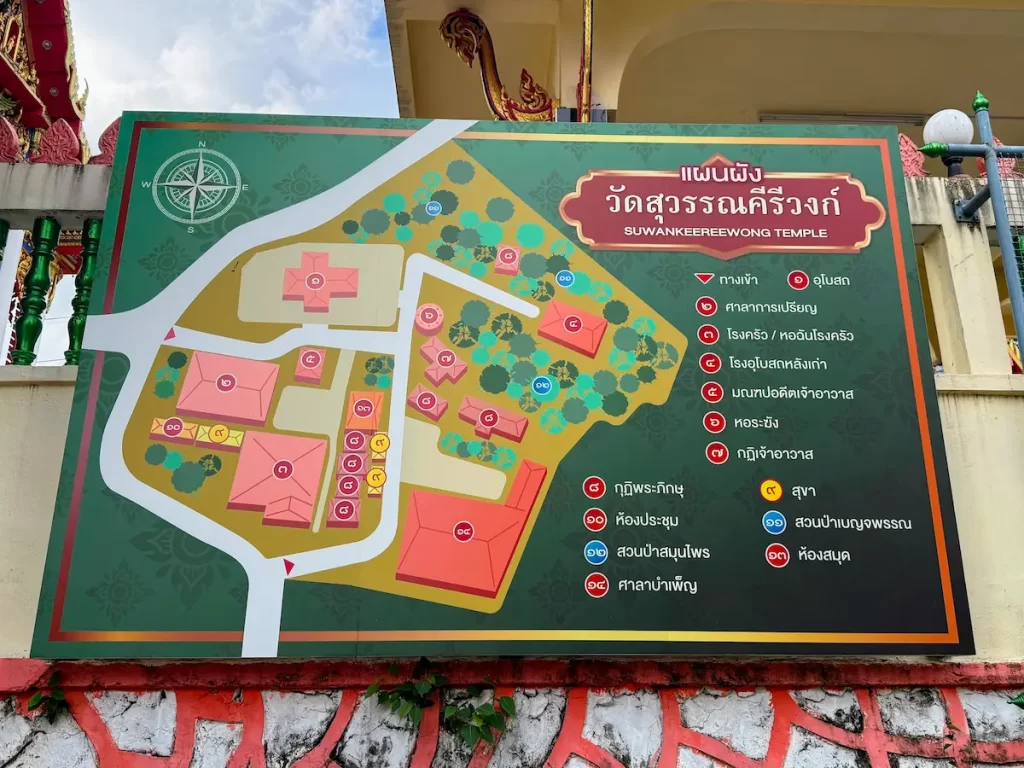
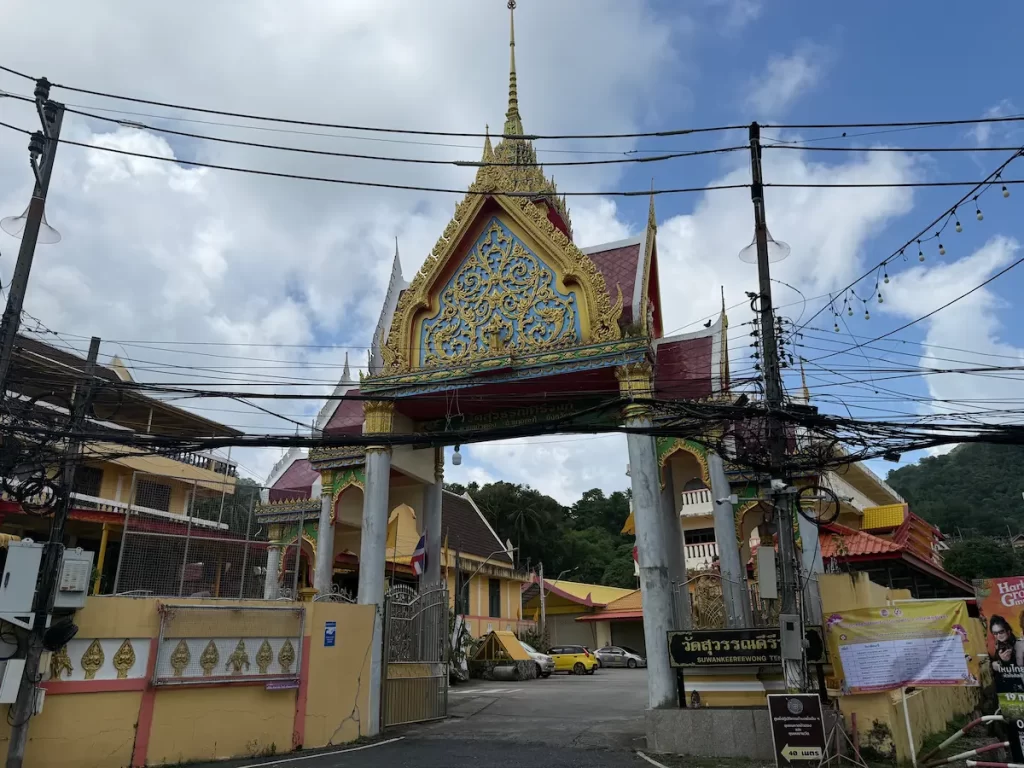
Most visitors arrive by vehicle, and the temple can be entered from either of its two public entrances. The main entrance faces Phra Barami Road, while a second entrance on Phisit Karani Road provides more direct access to the principal parking area. This secondary entrance is often the more convenient option, particularly as several roadside stalls nearby sell flowers, incense, candles and other offerings for those wishing to make merit during their visit.
If entering through the main entrance on Phra Barami Road, there is a small parking area immediately inside the gate. However, it is generally easier to continue along the temple’s internal access road, which curves around to the larger parking area serving the main visitor areas.
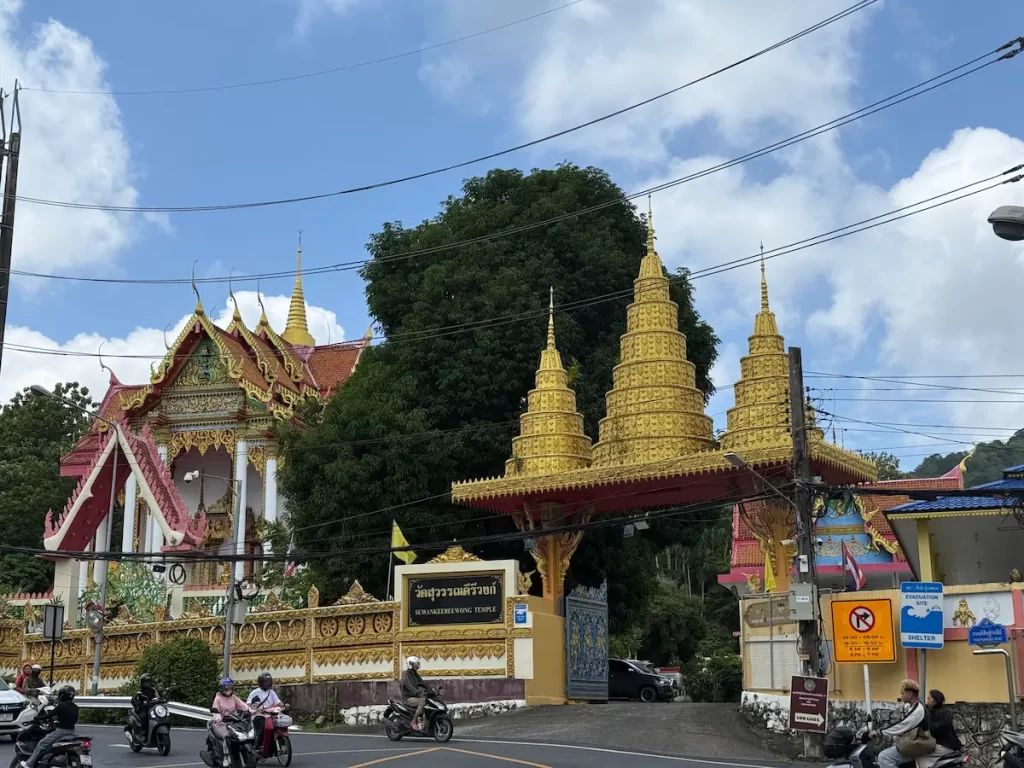
The heart of Wat Suwan Khiri Wong is its ceremonial precinct. Entering from the main entrance, the ubosot immediately stands on your left, while the Sala Pariyan, used for teaching and community activities, is on your right. Between these two buildings sits the mondop, together forming the ceremonial centre of the temple.
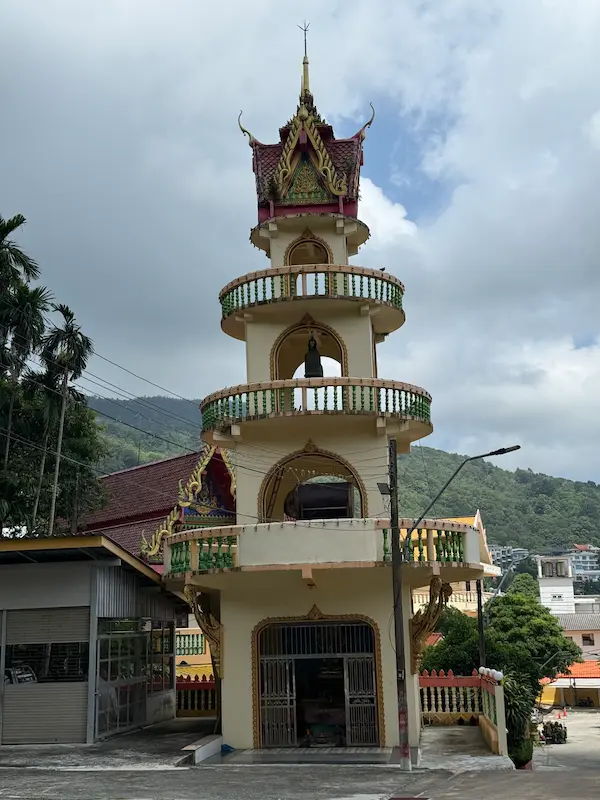
Continuing towards the ubosot, you’ll pass the distinctive multi-tiered bell tower on your right. Beneath it is a small shrine housing the replica Buddha footprint, one of the temple’s most interesting devotional features.
The ubosot itself sits within its own ubosot precinct, enclosed by an ornate boundary wall with several entrance gates. Although the precinct can be entered from different directions, the beautifully decorated principal gateway beside the bell tower forms the ceremonial approach to the temple’s most sacred building and is the entrance most visitors naturally follow. Passing through this gateway, you’ll find an open sala containing a Buddha image together with statues commemorating several of the temple’s respected monks. From here, the ubosot entrance stands directly ahead, creating an impressive approach that emphasises the building’s spiritual importance.
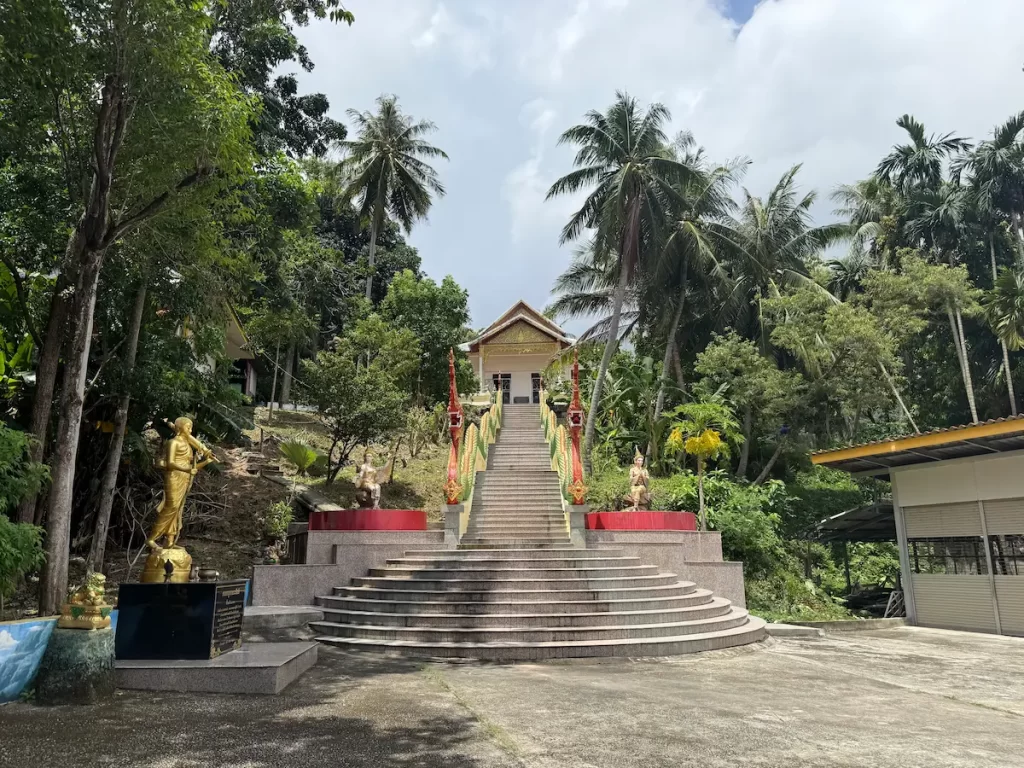
Leaving the ubosot through its principal entrance, a naga-lined staircase leads to the upper precinct, where the temple’s former ubosot, a smaller bell tower and one of the older kuti can be found. Although the views are not as expansive as those from Wat Doi Thep Nimit, this elevated area offers pleasant views across parts of Patong while providing an excellent perspective over the temple grounds below.
Returning to the lower level, a small devotional shrine stands near the temple signage, while the road to the right leads into one of the quietest corners of the grounds. Rather than a formal landscaped garden, this area has been left in a more natural setting, with mature trees, shaded pathways and a single bench creating a peaceful place for quiet reflection away from the temple’s busier ceremonial spaces.
Beyond the main visitor areas lies the monastic precinct, where the practical life of the monastery continues each day. Here you’ll find public toilets, active service buildings, additional kuti and residential buildings occupied by the monks, together with other facilities that support the temple’s daily operation. While these buildings remain an important part of the monastery, visitors will naturally spend most of their time exploring the ceremonial and devotional areas.
Travel With Insight
Rather than heading straight for the ubosot, allow yourself time to explore the temple as a whole. Thai Buddhist temples are carefully organised, with different areas serving ceremonial, devotional and monastic purposes. Understanding how these spaces work together reveals that Wat Suwan Khiri Wong is not simply a collection of beautiful buildings, but a living monastery that continues to serve the spiritual and community life of Patong every day.
Temple Highlights Explained
Wat Suwan Khiri Wong rewards visitors who take the time to look beyond its impressive architecture. Every major building, monument and shrine serves a purpose, reflecting centuries of Buddhist tradition while continuing to play an active role in the spiritual life of Patong.
Some features, such as the ubosot and bai sema, are found in almost every Thai Buddhist temple, while others—including the memorial to former abbots and the replica Buddha footprint—offer a deeper insight into the history and identity of this particular monastery. Understanding what these structures represent transforms a walk through the temple from simple sightseeing into a far richer cultural experience.
The following highlights explore not only what you’ll encounter as you move through the temple grounds, but also why each feature is important and what to look for during your visit.
Ubosot
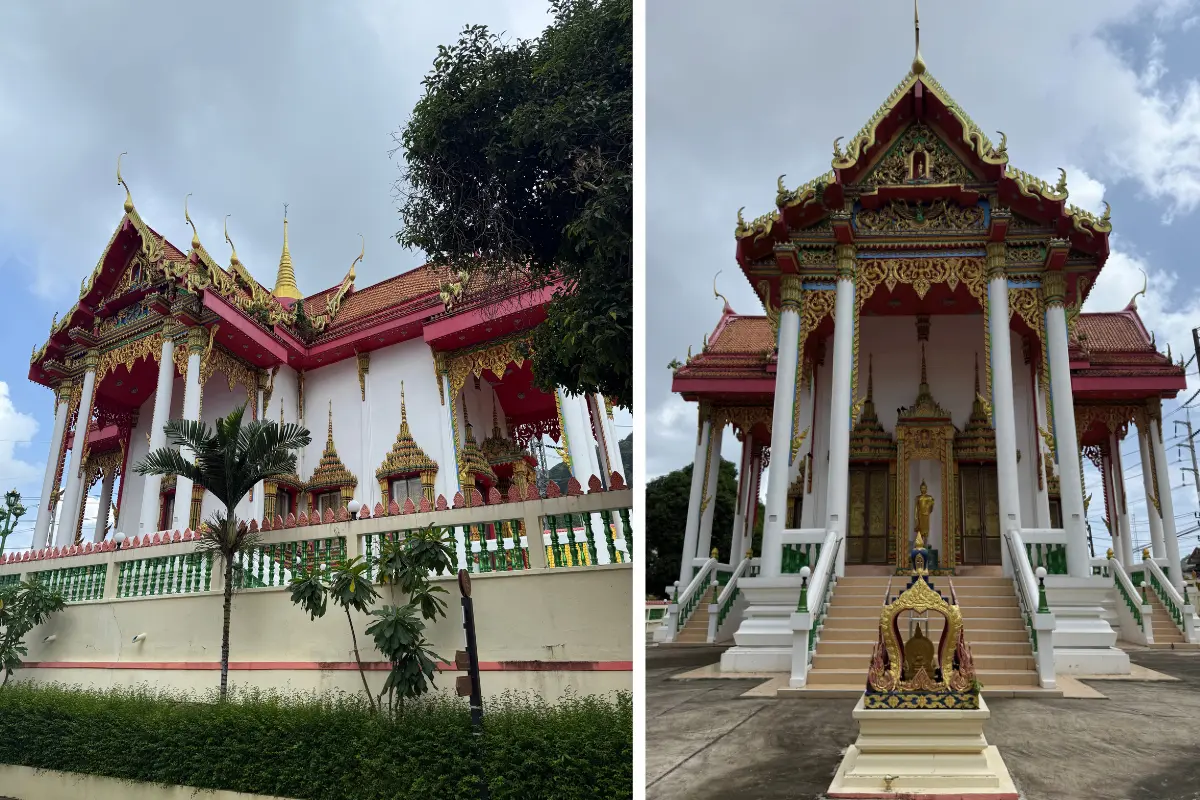
Standing at the centre of the ubosot precinct, the ubosot is the most sacred building within Wat Suwan Khiri Wong. As visitors pass through the beautifully decorated principal gateway, their attention is naturally drawn towards the building’s elegant façade. This deliberate alignment creates a ceremonial approach, immediately establishing the ubosot as the spiritual heart of the temple.
Unlike the viharn, which is primarily used by worshippers for prayer and merit-making, the ubosot serves a very specific purpose within Thai Buddhism. It is the temple’s ordination hall, where monks are formally ordained and where the Sangha conducts its most important religious ceremonies. Because of this sacred role, the ubosot occupies a unique position within every Thai Buddhist temple.
At Wat Suwan Khiri Wong, the ubosot stands within its own enclosed precinct, emphasising both its physical and spiritual importance. Although visitors naturally focus on the building itself, the surrounding space has been carefully designed to create a gradual transition from the wider temple grounds into the temple’s most sacred area.
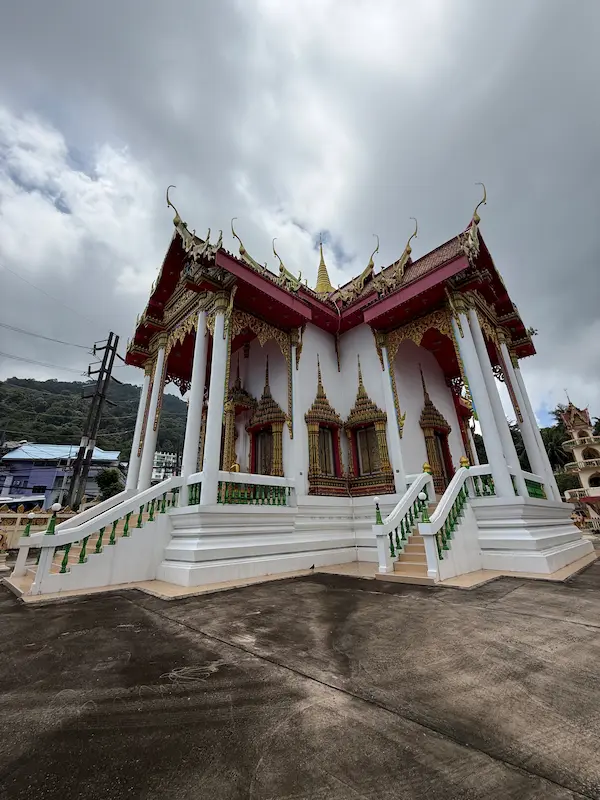
It is only after pausing for a moment that the other features within the precinct begin to reveal themselves. To the right of the approach is an open sala containing a Buddha image together with statues of several of the temple’s former abbots, while a second open sala stands opposite on the left, providing a quiet place for worshippers to rest, reflect or gather before entering the ubosot. Surrounding the building itself are the temple’s bai sema, which quietly mark the consecrated boundary within which ordinations take place.
For many visitors, the ubosot remains one of the highlights of Wat Suwan Khiri Wong. Its elegant architecture, richly decorated rooflines and central position immediately capture attention, while its role within the monastery reflects the enduring traditions of Theravada Buddhism. Although the interior is not always open to visitors outside important ceremonies and festivals, the exterior alone offers an excellent opportunity to appreciate the craftsmanship and symbolism found in a traditional Thai ordination hall.
Travel With Insight
Before walking around the ubosot, spend a moment standing just inside the principal gateway. Notice how your eyes are instinctively drawn towards the building ahead before gradually discovering the surrounding salas, bai sema and other features of the precinct. This isn’t accidental—it is a carefully planned ceremonial approach that reflects the ubosot’s role as the spiritual heart of the monastery.
Bai Sema
Surrounding the ubosot are eight bai sema, one of the temple’s most significant yet easily overlooked features. While many visitors admire their decorative appearance, few realise that these sacred markers define the consecrated ordination boundary of the ubosot. It is within this boundary that monks are ordained and the Sangha conducts its most important religious ceremonies.
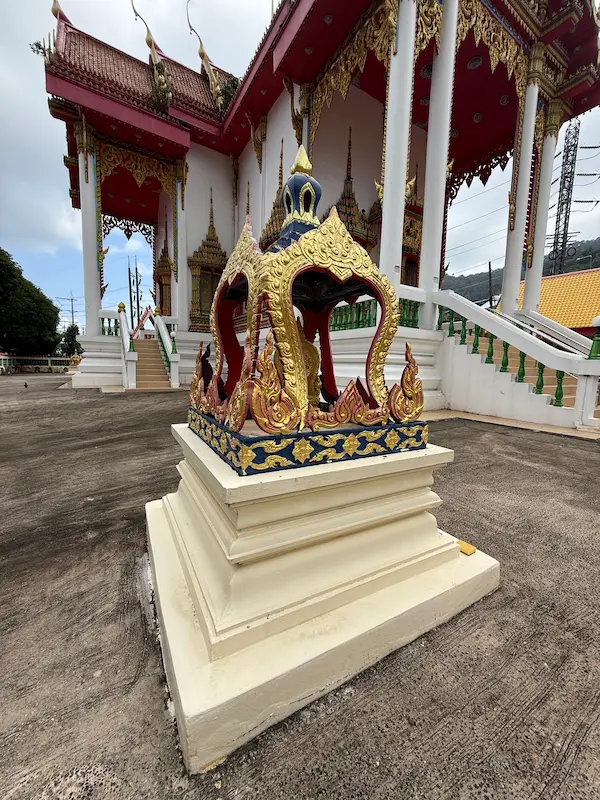
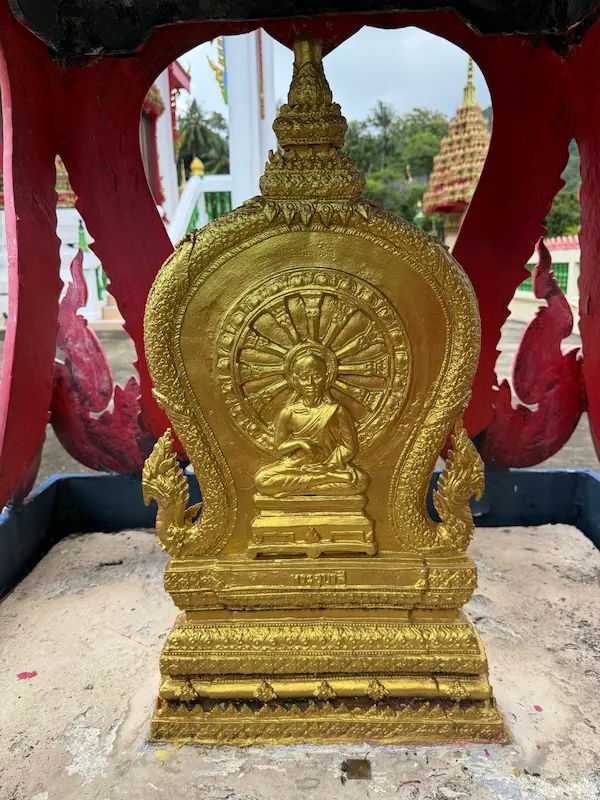
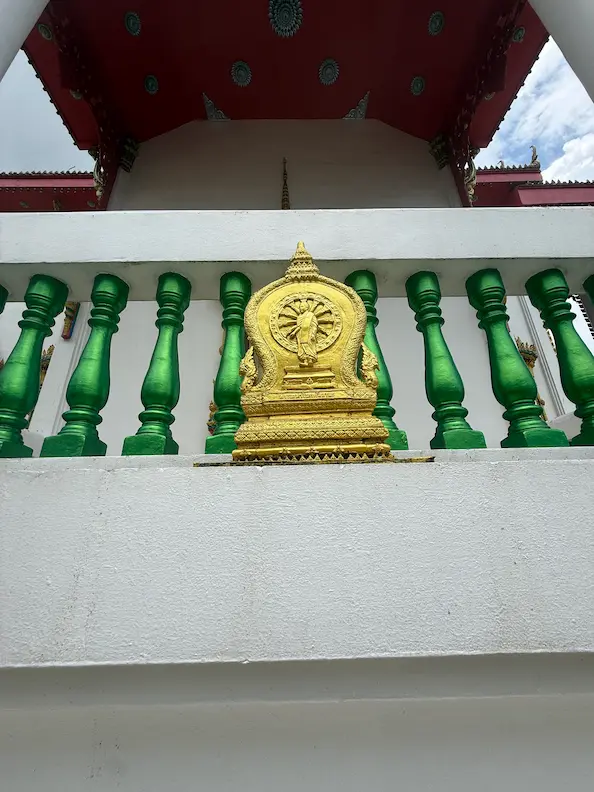
In many Thai temples, bai sema are simple upright stone markers, their distinctive leaf-like shape making them easy to recognise. At Wat Suwan Khiri Wong, however, their presentation is particularly distinctive. Six of the bai sema are housed within ornate ceremonial shrines positioned along the eastern and western sides of the ubosot, while the northern and southern bai sema are incorporated into the raised terraces surrounding the building. Together they create a consecrated boundary that differs visually from the more regular arrangement visitors may notice at many other temples.
Although the decorative shrines naturally attract attention, it is the bai sema themselves that carry the religious significance. They are not simply architectural ornaments or boundary markers for the temple grounds. Instead, they identify the sacred limits of the ubosot’s ordination space, distinguishing it from every other building within the monastery.
As you walk around the ubosot, you’ll notice that the bai sema are easy to overlook, particularly after first entering the ubosot precinct. The principal gateway and the elegant façade of the ubosot naturally draw your attention forward, meaning many visitors pass by the bai sema without appreciating their purpose. Taking a slow walk around the building reveals how thoughtfully they have been integrated into both the architecture and the ceremonial layout of the precinct.
Travel With Insight
Most visitors remember the ubosot but forget the bai sema that surround it. Before leaving the ubosot precinct, take a moment to walk around the building and look at each one individually. Once you understand that these markers define the sacred ordination boundary rather than simply decorating the temple, you’ll begin recognising bai sema at Buddhist temples throughout Thailand—and you’ll never look at an ubosot in quite the same way again.
Open Sala of Revered Monks
Standing to the right of the ceremonial approach within the ubosot precinct is an open sala containing a Buddha image together with a line of statues and commemorative portraits honouring revered monks. The Buddha image stands slightly elevated at one end of the display, with the statues of the monks extending alongside it, creating a quiet space for reflection before entering the ubosot.
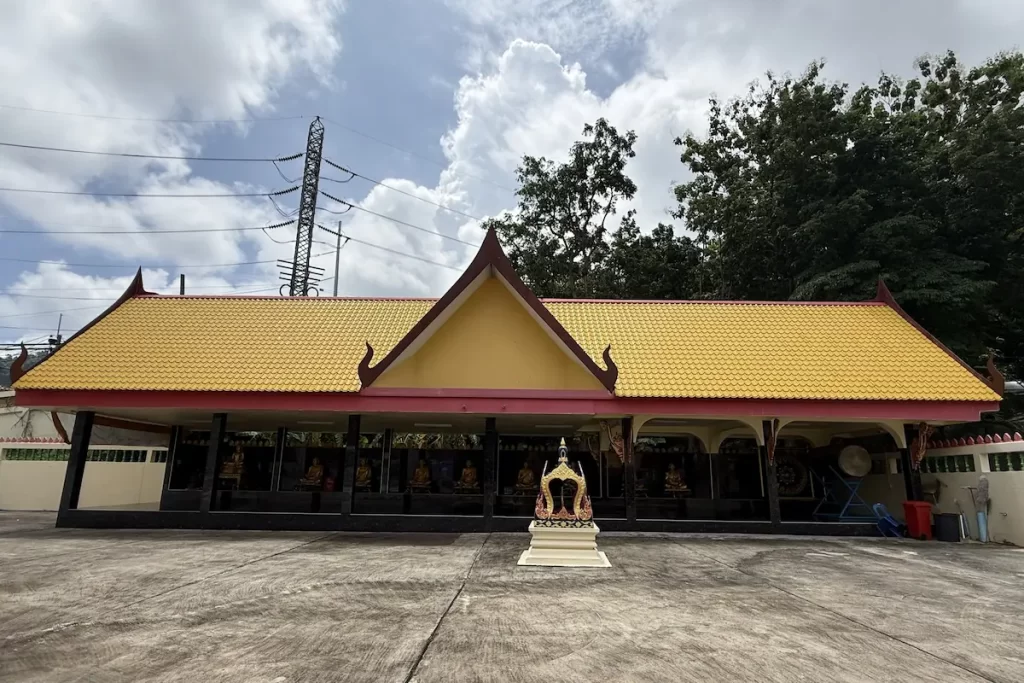
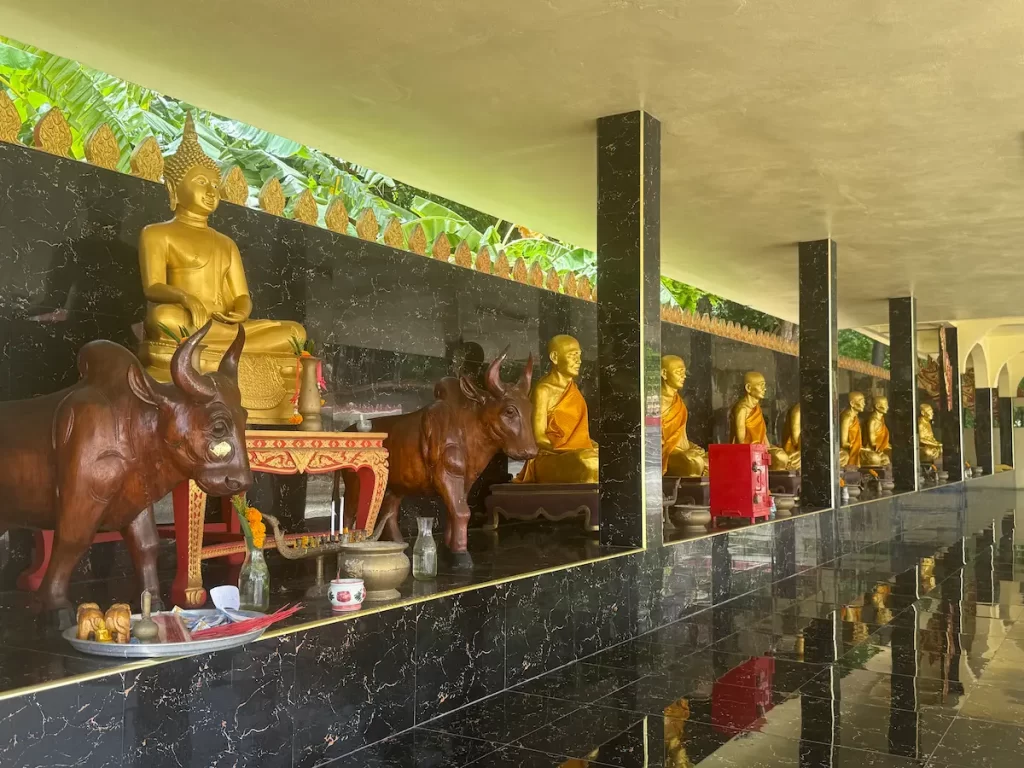
Although the statues naturally attract attention, they should not be mistaken for representations of the Buddha. Instead, they commemorate respected monks whose lives, teachings and service have made a lasting contribution to Buddhism and to the development of Wat Suwan Khiri Wong and the wider community. Throughout Thailand, it is common for temples to honour highly regarded abbots and influential monks, preserving their memory for future generations.
The historical photographs and commemorative displays within the sala strengthen this connection with the temple’s past, reminding visitors that a monastery is shaped not only by its buildings, but also by the generations of monks who have guided, taught and cared for it. Looking closely, you’ll notice the distinctive robes, ceremonial fans, walking staffs and name plaques that identify each individual, encouraging visitors to appreciate them as real people rather than symbolic figures.
Travel With Insight
Spend a few moments looking along the entire display rather than focusing on a single statue. The arrangement reminds visitors that while revered monks are honoured for preserving and teaching Buddhism, the Buddha remains the foundation upon which that tradition is built.
Replica Buddha Footprint Shrine
Located beneath the temple’s distinctive bell tower is a small shrine housing a replica Buddha footprint (Phra Phutthabat). Although modest in size compared with the nearby ubosot, it is one of Wat Suwan Khiri Wong’s most distinctive devotional features and is easily overlooked by visitors moving between the principal gateway and the temple grounds.
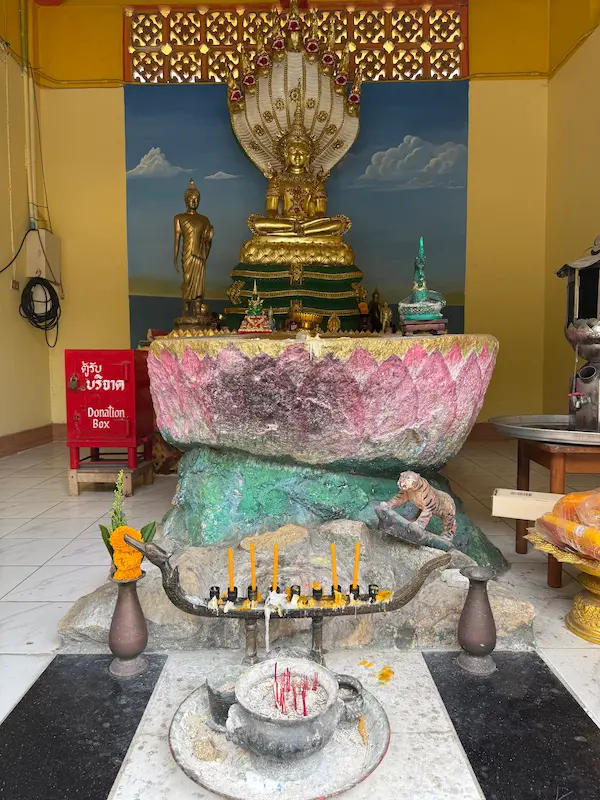
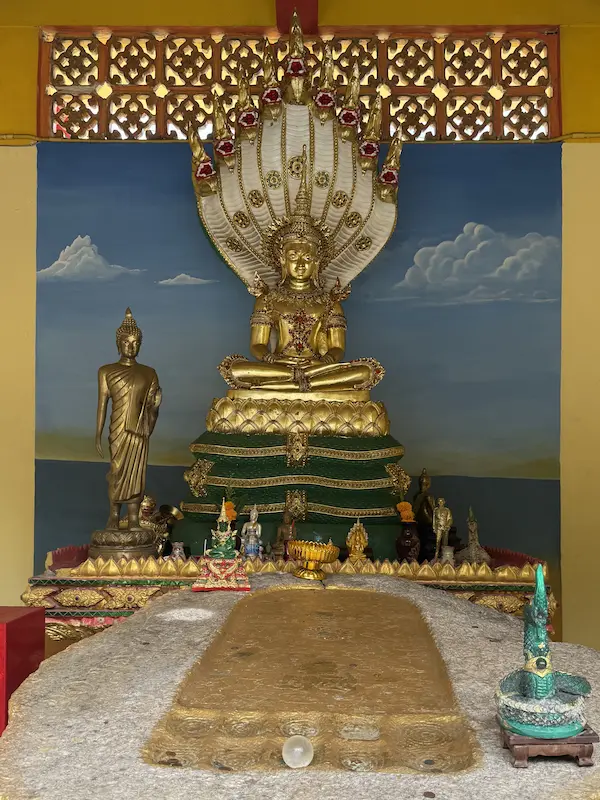
Representations of the Buddha’s footprint have been revered throughout the Buddhist world for many centuries. Rather than depicting the Buddha in human form, the footprint symbolises his presence, his enlightenment and the path of his teachings. It serves as a reminder that while the Buddha is no longer physically present, the Dharma—the teachings he left behind—continues to guide those who follow the Buddhist path.
Unlike some features of the temple that visitors simply admire as they pass, the replica footprint remains an active place of devotion. During repeated visits to Wat Suwan Khiri Wong, it is not uncommon to see local worshippers pausing here to pray, light incense, make offerings or spend a few quiet moments in reflection. In fact, it is often one of the busiest devotional points within the temple, attracting regular acts of worship throughout the day.
Visitors may also notice coins carefully placed within the grooves of the footprint. According to local tradition, balancing a coin upright within one of these grooves is considered a sign of good fortune. While this is a local custom rather than a formal Buddhist teaching, it adds another layer of personal devotion and quiet participation for many who visit the shrine.
Whether you choose to make an offering or simply pause for a moment of reflection, the shrine provides a reminder that Wat Suwan Khiri Wong is not simply a place to admire traditional architecture—it is a living monastery where centuries-old Buddhist traditions continue to be practised by the local community every day.
Travel With Insight
If you’re fortunate enough to visit while local residents are making offerings, spend a few moments observing quietly before approaching the shrine yourself. Watching how local Buddhists interact with the replica footprint often reveals more about the temple’s living traditions than any information board or guidebook can explain.
Bell Tower
Rising above the replica Buddha footprint shrine, the temple’s elegant multi-tiered bell tower is one of the most recognisable landmarks within Wat Suwan Khiri Wong. Its graceful rooflines complement the surrounding architecture while naturally drawing visitors towards the principal gateway of the ubosot precinct.
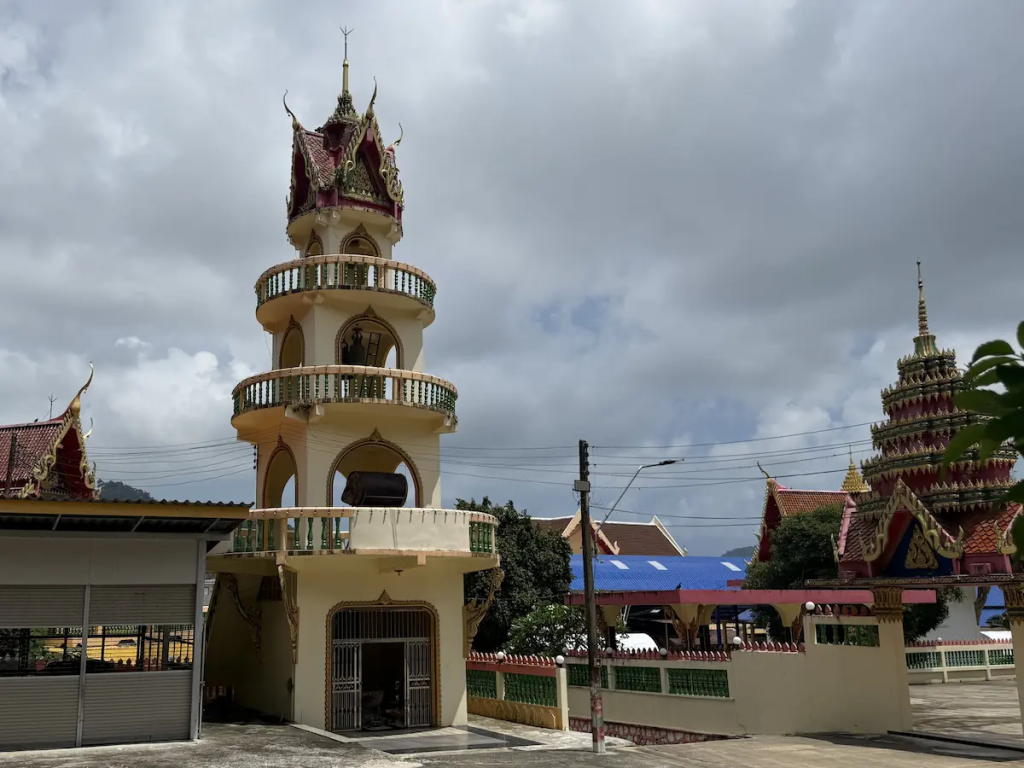
Bell towers have long been an important feature of Thai Buddhist temples. While they may occasionally be used to announce the time or signal important events, their primary role is ceremonial. The ringing of the temple bell traditionally marks religious observances, calls the community to important occasions and serves as a reminder of the presence of the monastery within daily life.
At Wat Suwan Khiri Wong, the bell tower also performs an important architectural role. Positioned beside the principal gateway to the ubosot precinct, it creates a natural transition between the wider temple grounds and the temple’s most sacred area. Together with the replica Buddha footprint shrine beneath it, the tower forms one of the most distinctive features visitors encounter as they approach the ubosot.
Although many visitors simply photograph the tower before continuing on, taking a moment to appreciate its position within the overall layout reveals how carefully the ceremonial precinct has been designed. The bell tower, principal gateway, open salas and ubosot work together to create a harmonious sequence that gradually prepares visitors for the temple’s most sacred space.
Travel With Insight
Rather than viewing the bell tower as a separate structure, look at how it frames your approach to the ubosot precinct. Thai temples are rarely arranged by accident. Buildings are carefully positioned to guide movement, frame important views and create a gradual transition from the everyday world into sacred space.
Mondop
Standing between the ubosot and the Sala Pariyan, the mondop is one of the temple’s most distinctive architectural features. Unlike the larger buildings surrounding it, the mondop is a compact square structure crowned by an elegant multi-tiered roof, immediately distinguishing it from the other halls within the ceremonial precinct.
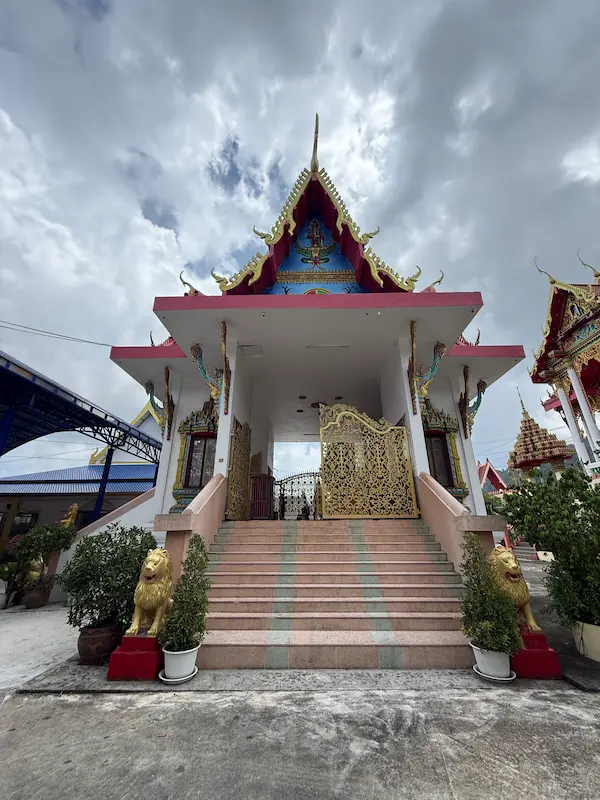
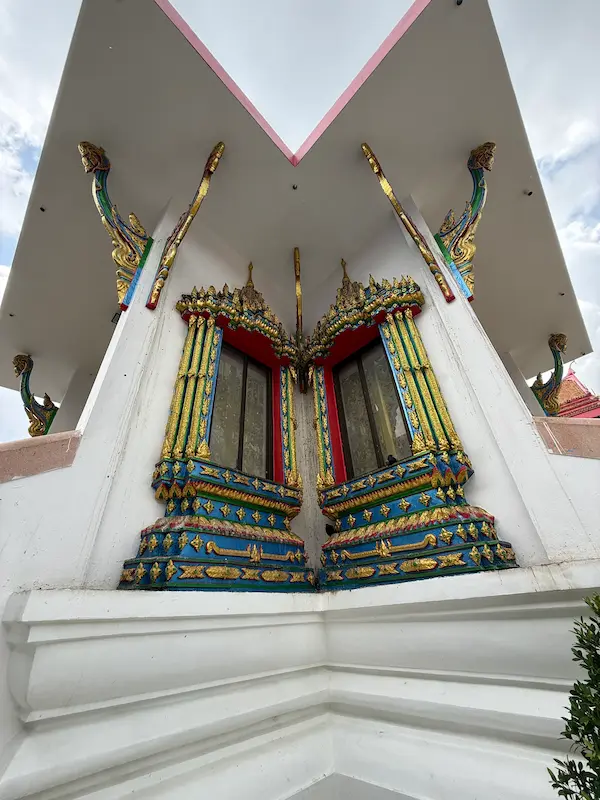
A mondop is a traditional architectural form found throughout Thailand, particularly within Buddhist temples and royal complexes. While its purpose varies from one temple to another, a mondop is generally built to house or commemorate something of particular religious significance. Depending on the temple, this may include sacred scriptures, revered Buddha images, relics or other important devotional objects.
At Wat Suwan Khiri Wong, the mondop contributes to the balanced composition of the ceremonial precinct, complementing the larger surrounding buildings while adding another layer of architectural interest. Its compact proportions and finely detailed design make it an attractive subject for photography, particularly when viewed alongside the ubosot and the surrounding temple grounds.
Although visitors often admire the building for its beauty, the mondop also reflects an important aspect of Thai Buddhist architecture. Rather than constructing identical buildings for every purpose, temples traditionally employ different architectural forms to reflect the significance of the space or object contained within them. The mondop therefore serves not only as an attractive structure, but also as a reminder that architecture itself carries meaning within a Buddhist monastery.
Travel With Insight
It’s easy to assume every building in a Thai temple serves the same purpose. In reality, the architecture itself often provides the first clue. Once you learn to recognise structures such as the ubosot, viharn and mondop, you’ll begin understanding the function of a temple long before reading a single information sign.
Naga-Lined Staircase
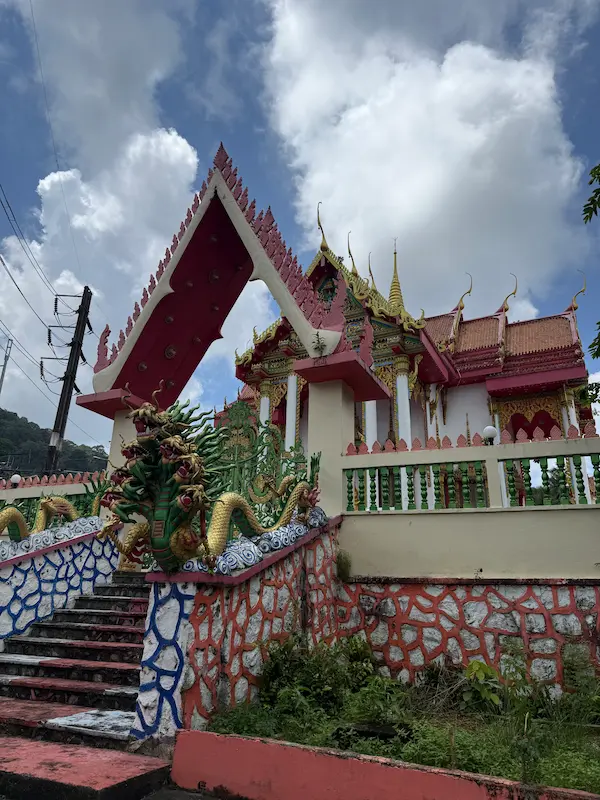
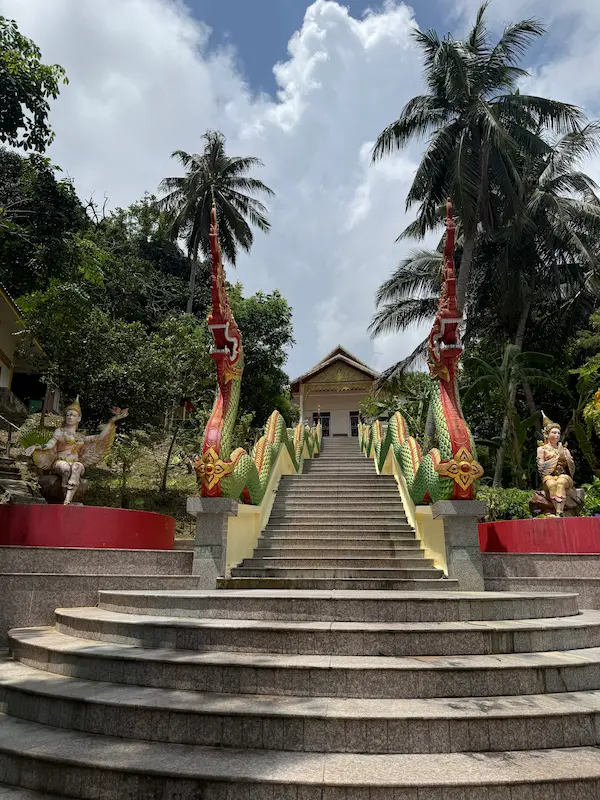
Leaving the ubosot precinct through the principal gateway, your attention is naturally drawn towards the impressive naga-lined staircase rising ahead. Framed by two towering naga heads at its base and leading through several flights of steps towards the former ubosot, it forms one of the most striking architectural features within Wat Suwan Khiri Wong.
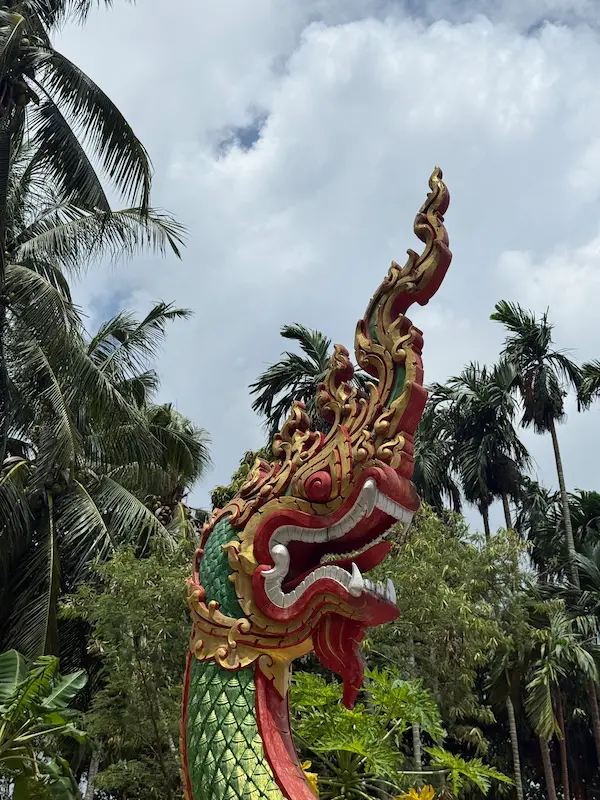
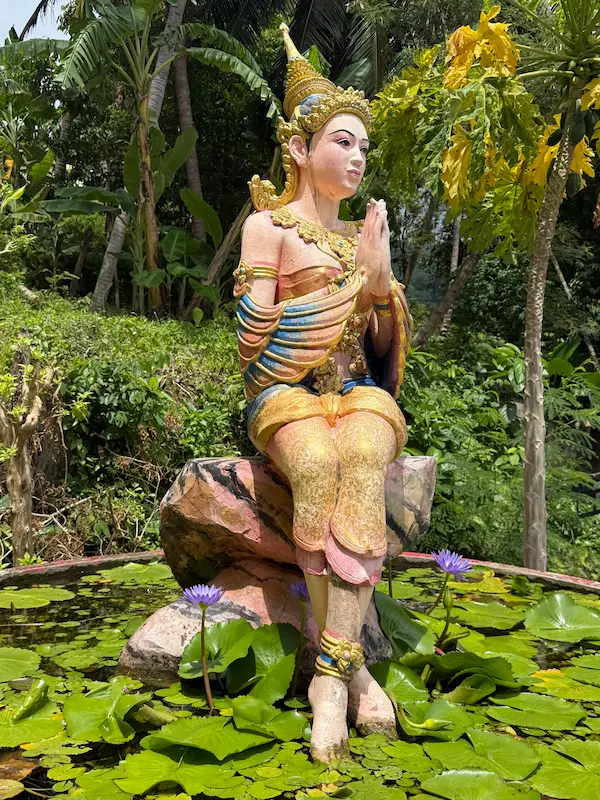
In Thai Buddhist tradition, naga are revered serpentine beings associated with protection, wisdom and the safeguarding of sacred places. Their presence beside temple staircases symbolically marks the transition from one space to another, guiding visitors from the lower ceremonial precinct towards the quieter upper level of the monastery.
At Wat Suwan Khiri Wong, the staircase creates a strong visual axis through the temple. The naga rise alongside the balustrades, their bodies extending with the climb before their tails finish near the top of the terrace. As you ascend, the former ubosot gradually comes into view, while looking back reveals an increasingly elevated perspective across the temple grounds below.
The climb itself is gentle rather than demanding, encouraging visitors to pause occasionally and appreciate both the craftsmanship of the naga sculptures and the changing perspective as the lower precinct falls away behind them. Reaching the upper terrace rewards visitors with one of the temple’s quieter and more contemplative spaces, where the former ubosot, an older kuti and a smaller bell tower preserve an earlier chapter in the monastery’s history.
Travel With Insight
Before climbing the stairs, stop at the bottom and look straight ahead. Notice how the naga, the staircase and the former ubosot align to create a single ceremonial approach. The journey to the upper precinct begins long before you take the first step—the architecture has already invited you upwards.
Former Ubosot
Standing at the top of the naga-lined staircase, the former ubosot preserves an earlier chapter in the history of Wat Suwan Khiri Wong. Before the construction of the present ubosot below, this building served as the temple’s principal ordination hall and remains one of the monastery’s most historically significant structures.
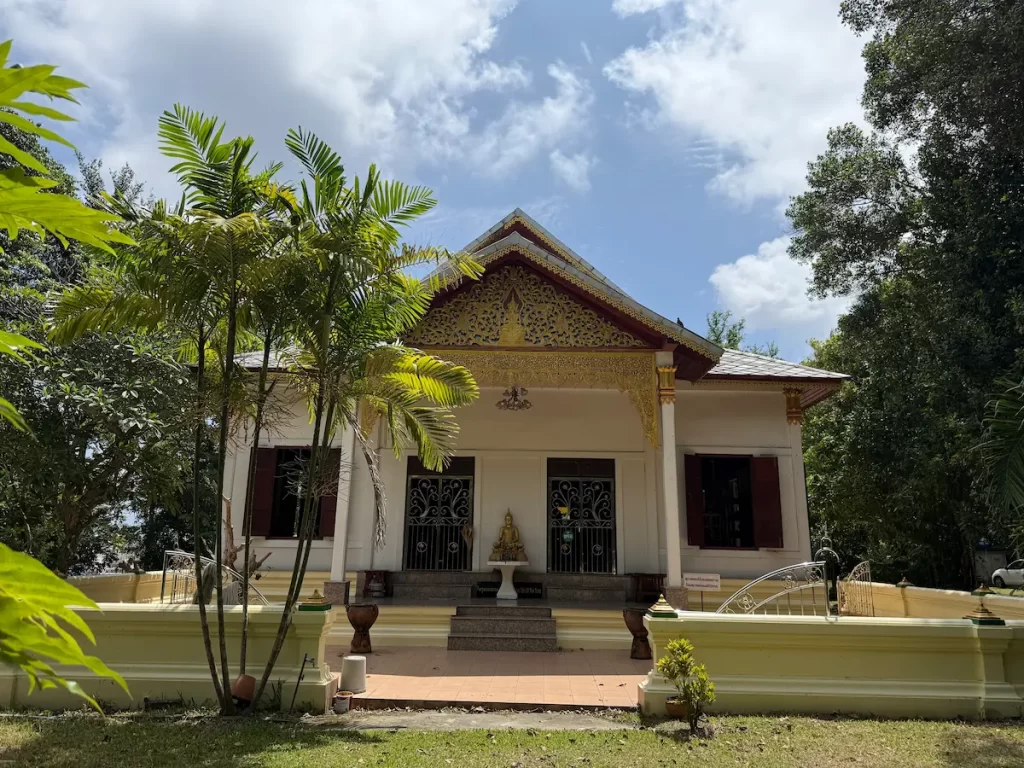
Compared with the larger ubosot below, the former ubosot has a much simpler architectural character. Its white walls, timber shutters and restrained decoration reflect an earlier period of the temple’s development, creating a peaceful atmosphere that contrasts with the grandeur of the main ceremonial precinct.
Today the building continues to serve as a place of devotion and remembrance. Inside are Buddha images, historical photographs, commemorative displays and memorials to respected monks connected with the temple’s past. For many visitors, it provides the strongest tangible connection with the generations of monks who shaped Wat Suwan Khiri Wong long before modern Patong grew around it.
The upper terrace itself has a noticeably different atmosphere. Mature trees surround the former ubosot, filtering views across the rooftops of the lower temple towards Patong beyond. Although the outlook is not panoramic, the elevated position and quieter surroundings encourage visitors to slow down and appreciate the peaceful setting.
Nearby, a small bell tower and one of the temple’s older kuti reinforce the historic character of the upper precinct, preserving a glimpse of what Wat Suwan Khiri Wong may once have felt like before its later expansion.
Travel With Insight
The former ubosot rewards visitors who spend time looking beyond the architecture. Inside are photographs, memorials and devotional objects that tell the story of the people who built, led and cared for the monastery across generations. If you’d like to explore that story in greater detail, our companion article, The History of Wat Suwan Khiri Wong, examines the temple’s development from its earliest origins through to the present day.
Inside the Former Ubosot
The interior of the former ubosot serves not only as a place of worship but also as a repository of the temple’s collective memory. Alongside the principal Buddha images are memorials to former abbots, historic photographs, relic displays and ceremonial objects that together trace the development of Wat Suwan Khiri Wong across generations.
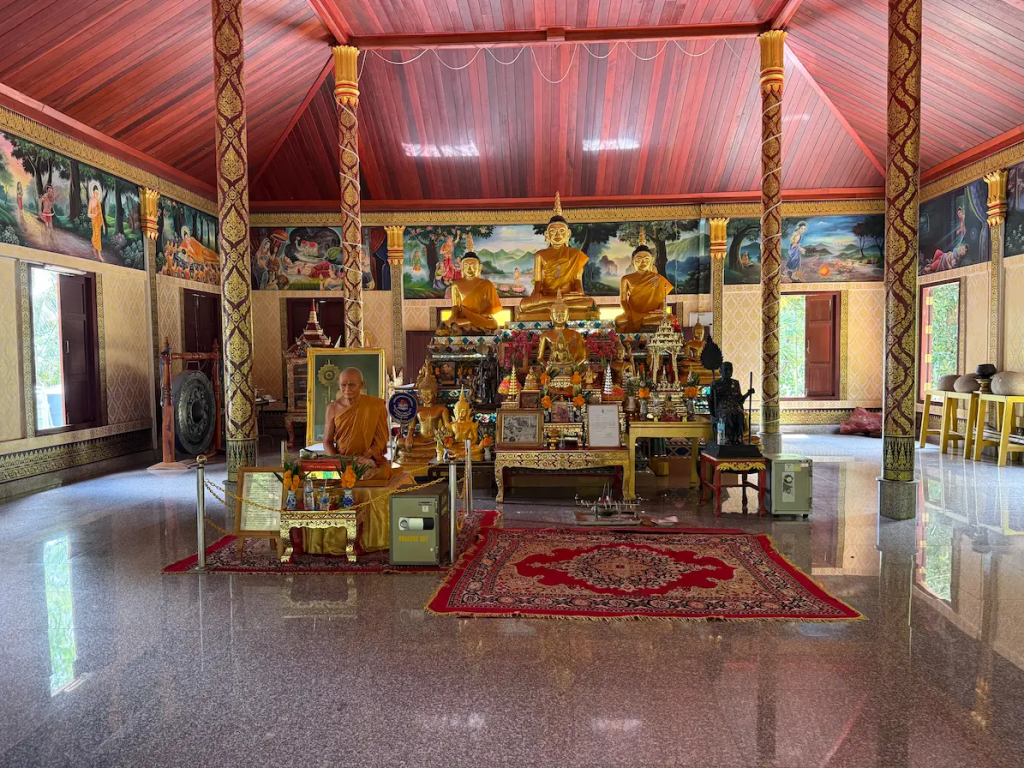
One of the most prominent memorials is the lifelike wax figure of Phra Kru Pisitkoranee (Luang Pho Kaew), one of the temple’s most respected former abbots. According to the accompanying display, he played a leading role in developing both the temple and the wider Patong community, including helping establish the road between Kathu and Patong and supporting education through the temple school. The memorial was created after his passing so local people could continue to pay their respects.
Nearby stands a bronze statue of Luang Pho Pleng, another highly respected monk associated with the temple. Historical photographs displayed around the shrine preserve rare glimpses of earlier ceremonies and monastic life, while a framed royal document records the official granting of Buddha relics for enshrinement within the temple.
Rather than functioning as a formal museum, these displays remain part of the temple’s living devotional space. Visitors will often see flowers, incense and offerings placed before the memorials, reflecting the continuing respect shown to the monks who helped shape the temple and the Patong community.
Travel with Insight
The former ubosot is more than an old ordination hall. Take a few minutes to look beyond the principal Buddha images at the historical photographs, memorials to former abbots and royal documents. Together they tell the story of how Wat Suwan Khiri Wong grew alongside the Patong community over the past century.
Understanding Wat Suwan Khiri Wong Patong
One of the most rewarding aspects of visiting Wat Suwan Khiri Wong is discovering that the temple is more than a collection of attractive buildings. Every hall, shrine and devotional space serves a purpose, reflecting centuries of Buddhist tradition while continuing to support the daily religious life of the Patong community.
Many visitors naturally admire the architecture, artwork and peaceful surroundings, but understanding how these spaces are used provides a deeper appreciation of the temple. From the ubosot where important monastic ceremonies are held, to the mondop where worshippers pray before Buddha images associated with the days of the week, each feature helps tell the story of living Buddhism in Thailand.
The following sections explore some of the traditions and practices visitors are most likely to encounter at Wat Suwan Khiri Wong, helping explain not only what they are seeing, but why they remain important today.
Why Is the Ubosot Important?
The ubosot is the most sacred building at Wat Suwan Khiri Wong and the spiritual heart of the monastery. While visitors are often drawn to its elegant architecture and richly decorated rooflines, its true significance lies in its religious purpose. The ubosot is the only building within the temple where monks may perform the most important acts of the Sangha, including ordinations, the recitation of the monastic code and other formal ceremonies that require a consecrated space.
Unlike many buildings within the temple that are open for prayer or community activities, the ubosot serves a specific ceremonial function. This is one of the reasons it is not always open to casual visitors. As an active place of worship rather than a museum or historic monument, access is generally reserved for religious observances, special ceremonies and major Buddhist festivals, although the temple can best advise when visitors may have an opportunity to see the interior.
Wat Suwan Khiri Wong is unusual in that it has two ubosot. The present building continues to fulfil the temple’s ceremonial role, while the former ubosot on the upper terrace has been carefully preserved as an important part of the monastery’s history. Together they illustrate how the temple has grown over time while maintaining continuity with its past.
The sacred role of the ubosot is also reflected in the bai sema surrounding it. These consecration markers define the ritual boundary within which ordinations and other formal monastic ceremonies take place. Understanding the relationship between the ubosot and its bai sema helps explain why this building occupies such a central place within every Thai Buddhist temple.
Travel With Insight
If the ubosot is closed during your visit, don’t think of it as something you’ve missed. Its restricted access is part of what makes it special. The building continues to fulfil the same sacred purpose today as it did when it was first consecrated, reminding visitors that Wat Suwan Khiri Wong is a living monastery where Buddhist traditions are still actively practised.
Why Is the Mondop Important?
Standing prominently between the ubosot and the Sala Pariyan, the mondop at Wat Suwan Khiri Wong is much more than an attractive architectural feature. While its elegant multi-tiered roof immediately catches the eye, its purpose is devotional rather than ceremonial, providing a place where visitors and local worshippers can quietly pray and make merit.
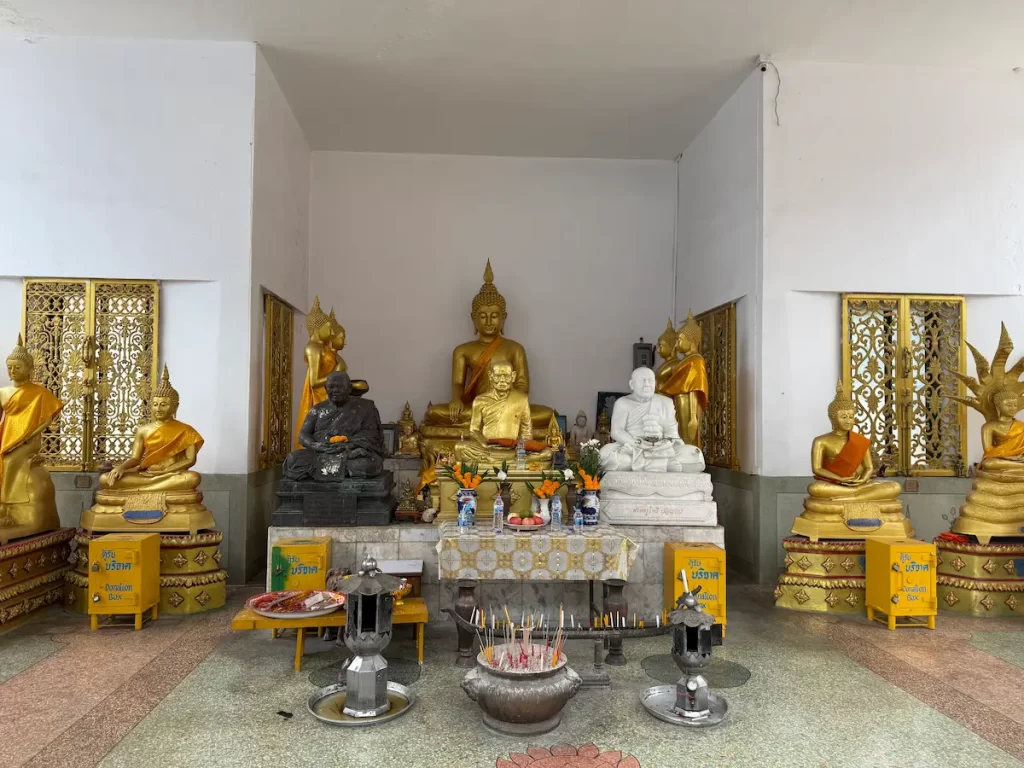
Inside the mondop are Buddha images representing the traditional days of the week, each associated with a particular posture of the Buddha. In Thai Buddhist culture, many people know the day on which they were born and will often pay their respects before the Buddha image corresponding to their birth day. It is common to see flowers, incense, candles and small donations offered here as acts of devotion and merit-making.
Although the Buddha images differ in posture and gesture, they do not represent different Buddhas. Instead, each depicts the historical Buddha during a different moment of his life or ministry, with every posture carrying its own symbolic meaning and story within Buddhist tradition. Together they remind worshippers of different aspects of the Buddha’s teachings while providing a personal point of connection through their birth day.
The mondop at Wat Suwan Khiri Wong remains an active place of worship. Rather than simply admiring the architecture, visitors are welcome to pause respectfully, observe the devotional practices taking place and, if they wish, make a quiet offering alongside local worshippers.
Travel With Insight
If you know the day of the week on which you were born, look for the corresponding Buddha image inside the mondop. You’ll notice that each posture is different, reflecting a particular episode from the Buddha’s life rather than representing a different Buddha. It’s a uniquely Thai tradition that adds a personal connection to many temple visits.
Why Do People Pray Before the Replica Buddha Footprint?
For many first-time visitors, the replica Buddha footprint is one of the temple’s most intriguing features. Unlike the Buddha images found throughout Wat Suwan Khiri Wong, the footprint does not attempt to portray the Buddha in human form. Instead, it symbolises his presence, enlightenment and the path of his teachings.
The tradition of venerating Buddha footprints dates back many centuries and is found throughout the Buddhist world. Rather than worshipping the footprint itself, Buddhists pay their respects to what it represents—the life, wisdom and teachings of the historical Buddha. The footprint serves as a reminder that although the Buddha is no longer physically present, his teachings continue to guide those who follow the Buddhist path.
At Wat Suwan Khiri Wong, the replica footprint remains one of the temple’s most active devotional spaces. Throughout the day, local worshippers stop to light incense, offer flowers and spend a few moments in quiet prayer before continuing with their visit. You may also notice coins carefully placed within the grooves of the footprint. According to local tradition, balancing a coin upright within one of these grooves is believed to bring good fortune. While this is a local custom rather than a formal Buddhist teaching, it reflects the personal expressions of faith that continue to be practised at the temple.
Visitors are welcome to pause respectfully and observe these traditions. Whether making an offering or simply reflecting quietly, the shrine provides a meaningful opportunity to experience the living devotional practices that remain an important part of everyday Buddhist life in Thailand.
Travel With Insight
If local worshippers are present, spend a few moments simply watching before approaching the shrine yourself. Their quiet gestures—lighting incense, placing flowers or pausing in silent reflection—often reveal more about the role of the Buddha footprint than any written explanation ever could.
Why Are Revered Monks Honoured?
As you explore Wat Suwan Khiri Wong, you’ll notice that many of the devotional spaces include statues, portraits and memorials dedicated to respected monks. For visitors unfamiliar with Thai Buddhism, it can be surprising to see these displayed alongside Buddha images, leading some to wonder whether they are also objects of worship.
In Theravada Buddhism, the Buddha remains the central figure of devotion. The monks honoured throughout the temple are remembered for a different reason. They are recognised as teachers, abbots and spiritual leaders whose lives helped preserve, teach and pass on the Buddha’s teachings to future generations. Their memorials celebrate a lifetime of service rather than divine status.
At Wat Suwan Khiri Wong, many of these monks also played an important role in the development of both the monastery and the Patong community. Through their leadership, the temple expanded, schools were established, local infrastructure improved and the monastery continued to serve as an important centre of community life. Honouring these individuals reflects gratitude for their contribution as much as their religious example.
Visitors may notice local people pausing to pay their respects before these memorials, sometimes offering flowers or quietly bowing. These gestures are expressions of respect and remembrance rather than worship in the same sense as devotion directed towards the Buddha. They acknowledge the important role these monks played in preserving Buddhism and serving the local community.
Travel With Insight
As you move through the temple, notice how the Buddha images and the memorials to revered monks are displayed differently. The distinction reflects an important principle in Thai Buddhism: the Buddha is honoured as the Enlightened Teacher, while respected monks are remembered for dedicating their lives to preserving and sharing his teachings.
Why Does The Temple Have Bell Towers?
The graceful bell tower at Wat Suwan Khiri Wong is more than an attractive landmark. For centuries, bells have played an important role in Buddhist monasteries, helping mark the rhythm of daily monastic life and important religious ceremonies.
Traditionally, temple bells have been rung to announce significant occasions, call monks together for communal activities and mark the beginning or conclusion of important ceremonies. Their clear, resonant sound carries across the surrounding area, serving as both a practical signal and a reminder of mindfulness for those within the temple.
Although modern monasteries no longer rely on bells in the same way they once did, they remain an important symbol of Buddhist tradition. At Wat Suwan Khiri Wong, the bell tower also marks the entrance to the ubosot precinct, creating a visual transition into the temple’s most sacred area while preserving a feature that has long been associated with Thai Buddhist monasteries.
Visitors may occasionally hear the bell during ceremonies or special occasions, although at other times it stands quietly as part of the temple’s architectural landscape. Even when silent, it continues to represent the enduring traditions of monastic life and the ceremonial rhythm of the monastery.
Travel With Insight
As you pass beneath the bell tower, imagine the role it once played in the daily life of the monastery. Long before watches and mobile phones, the sound of the temple bell helped shape the rhythm of worship, community life and the routines of the resident monks.
Everyday Life at Wat Suwan Khiri Wong
Although visitors are naturally drawn to the ubosot and other ceremonial buildings, much of daily life at Wat Suwan Khiri Wong takes place away from the main visitor areas. Resident monks follow a regular routine of prayer, study and community responsibilities, while temple staff and volunteers maintain the grounds and support the monastery’s ongoing activities.
Beyond the ceremonial precinct are practical buildings that help the temple function each day. These include monks’ residences, service areas and the Bodhi Wisdom Building, which supports the temple’s administrative, educational and community activities. While these buildings are less ornate than the temple’s sacred structures, they remind visitors that Wat Suwan Khiri Wong is an active monastery serving the Patong community rather than simply a historic attraction.
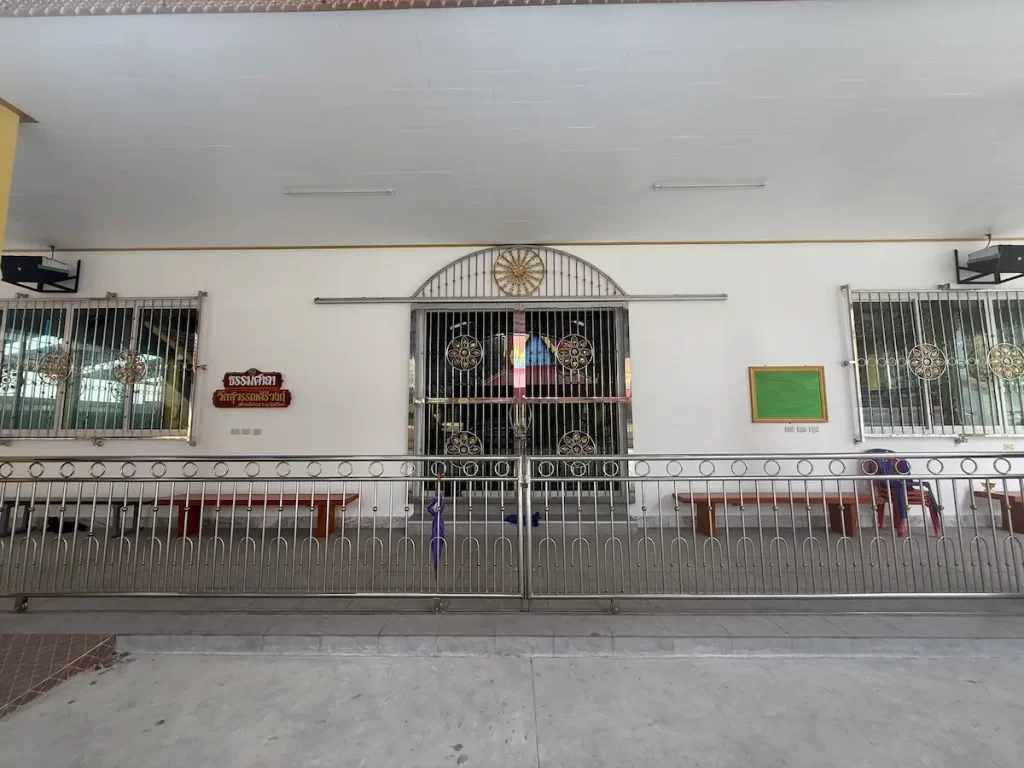
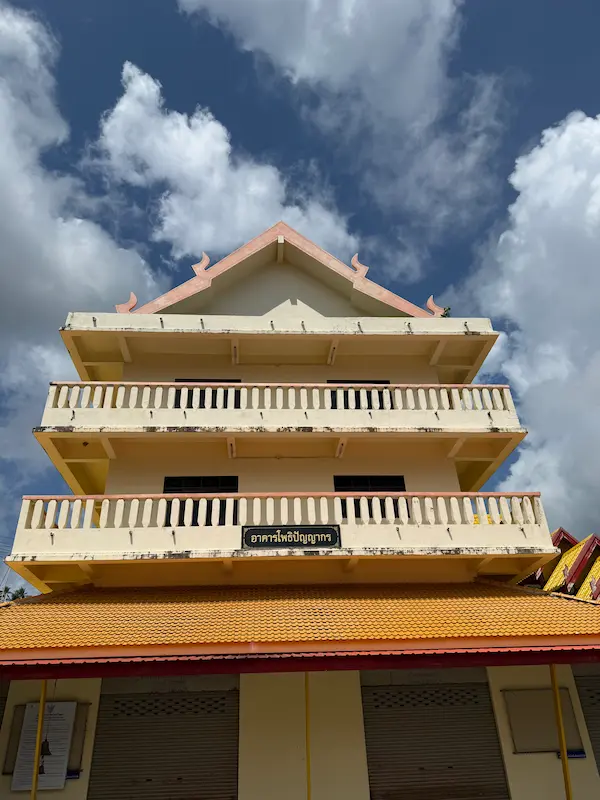
Visitors may also encounter local residents making merit, preparing offerings, speaking with monks or quietly attending to everyday tasks. These ordinary moments are often among the most authentic experiences of a visit, offering a glimpse into the continuing role the temple plays in the spiritual and community life of Patong.
Visitor Experience
Despite being located just a few minutes from Patong Beach and one of Phuket’s busiest entertainment districts, Wat Suwan Khiri Wong feels remarkably removed from the pace of the town that surrounds it. Crossing through the temple gates, the sounds of traffic gradually give way to birdsong, quiet conversation and the occasional ringing of a temple bell, creating a sense of calm that many visitors find surprising.
The experience of exploring the temple unfolds gradually rather than all at once. The ceremonial precinct naturally draws your attention towards the ubosot before encouraging you to wander between the surrounding shrines and devotional spaces. Climbing the naga-lined staircase to the former ubosot introduces a noticeable change in atmosphere, with mature trees, quieter pathways and glimpses across Patong providing a peaceful contrast to the activity below.
Unlike some temples that function primarily as tourist attractions, Wat Suwan Khiri Wong remains closely connected to the local community. During a typical visit you may encounter residents stopping briefly to make merit, families paying their respects, monks moving quietly between buildings or worshippers placing flowers and incense before the Buddha footprint. These everyday moments often leave as strong an impression as the architecture itself.
Whether you spend thirty minutes exploring the highlights or linger longer to appreciate the history and devotional spaces, the temple rewards visitors who take their time. It is a place where the details reveal themselves slowly, reminding us that some of the most meaningful travel experiences come not from rushing between attractions, but from pausing long enough to understand the life that continues within them.
Who Will Enjoy Visiting?
Wat Suwan Khiri Wong appeals to visitors looking for more than simply another sightseeing stop. While it may not be Phuket’s largest or most elaborate temple, it offers an authentic glimpse into the island’s Buddhist traditions and the community that has grown around them.
History enthusiasts will appreciate the opportunity to explore both the present and former ubosot, together with the memorials, historical displays and architectural features that reflect the temple’s gradual development over more than a century. Those interested in Thai culture and Buddhism will find plenty to discover, from the replica Buddha footprint and weekday Buddha images to the bai sema and other ceremonial elements that reveal how a working monastery functions.
The temple is also well suited to photographers. The richly decorated ubosot, elegant bell tower, naga-lined staircase and peaceful upper precinct provide a variety of photographic subjects, while the quieter atmosphere allows time to compose images without feeling rushed. Visitors who enjoy observing everyday life will often see local residents making merit, offering prayers or quietly spending time within the temple grounds, providing a genuine insight into contemporary Buddhist practice.
Families, first-time visitors to Thailand and anyone seeking a peaceful break from the energy of Patong will also find Wat Suwan Khiri Wong rewarding. The grounds are easy to explore, the atmosphere is welcoming and there is enough variety to hold the interest of visitors with different levels of familiarity with Thai temples.
Visitors expecting dramatic mountain views, monumental architecture or a major tourist attraction may find the experience more understated. The temple’s greatest strength lies not in a single spectacular feature, but in the way its history, architecture and living traditions come together to create a place that feels authentic, peaceful and deeply connected to the local community.
Photography Guide
Wat Suwan Khiri Wong offers a rewarding variety of photographic subjects, from traditional Buddhist architecture and intricate decorative details to quieter moments of everyday temple life. Unlike many of Phuket’s more heavily visited attractions, the relaxed atmosphere often allows photographers time to compose images carefully without feeling rushed.
The ubosot is naturally the temple’s most striking architectural subject. Its ornate rooflines, colourful detailing and symmetrical approach through the principal gateway create strong compositions from a variety of angles. The surrounding bai sema, decorative gateways and open salas provide additional opportunities to photograph smaller architectural details that are easily overlooked.
One of the temple’s most distinctive compositions is the naga-lined staircase leading to the former ubosot. Photographing from the base of the staircase naturally draws the eye upwards through the naga towards the historic building above, creating one of the temple’s strongest leading-line images. From the upper terrace, the quieter surroundings, mature trees and filtered views back across the lower temple grounds offer a completely different style of photography.
The former ubosot rewards slower, more observational photography. Historical displays, devotional objects and memorials provide opportunities to document the temple’s heritage, while respecting any restrictions on photography inside the building. Throughout the temple, details such as carved roof decorations, guardian figures, bells, lotus ponds and offerings can all make compelling subjects alongside wider architectural views.
Early morning and the late afternoon generally provide the most pleasing light for exterior photography, with softer shadows and warmer tones across the temple grounds. Regardless of the time of day, photographers should remain mindful that Wat Suwan Khiri Wong is an active place of worship. If local people are praying or making offerings, giving them space and avoiding intrusive photography is both respectful and often results in more natural images.
Travel With Insight
Some of the most memorable photographs at Wat Suwan Khiri Wong aren’t of the buildings themselves, but of the quiet moments between them. A worshipper placing flowers before the Buddha footprint, sunlight filtering through the trees around the former ubosot or the symmetry of the naga staircase can often tell a richer story than simply photographing another temple façade.
Planning Your Visit to Wat Suwan Khiri Wong Patong
Best Time to Visit
Wat Suwan Khiri Wong can be visited throughout the year, although mornings and the late afternoon generally provide the most comfortable conditions for exploring the temple grounds. The softer light also enhances the colourful architecture and creates better conditions for photography.
Visitors hoping to experience the temple at its liveliest may wish to visit during major Buddhist festivals, when the grounds become a focal point for community worship and merit-making. At these times, there may also be opportunities to see parts of the temple that are not normally open during everyday visits.
Getting There and Parking
The temple can be entered from either Phra Barami Road or Phisit Karani Road.
While both entrances provide access to the temple, many visitors find the Phisit Karani Road entrance more convenient. It offers easier vehicle access to the main parking area and is located beside several roadside stalls selling flowers, incense, candles and other offerings for those wishing to make merit before entering the temple.
If entering via Phra Barami Road, a small parking area is available immediately inside the entrance, although continuing around the internal access road provides access to the larger visitor parking area.
Admission
Entry to Wat Suwan Khiri Wong is free of charge.
As with most Thai Buddhist temples, donations are welcomed and help support the ongoing maintenance of the monastery and its community activities.
Dress and Respectful Behaviour
Visitors are encouraged to dress modestly by covering their shoulders and knees, particularly if entering sacred buildings or attending religious ceremonies.
Shoes should be removed before entering buildings where indicated, voices kept low and mobile phones placed on silent whenever possible. If monks or local worshippers are praying, giving them space and avoiding unnecessary interruptions helps maintain the peaceful atmosphere of the temple.
How Long Should You Allow?
Most visitors will comfortably explore the main highlights of Wat Suwan Khiri Wong in 45 to 60 minutes.
Those interested in photography, history or Buddhist architecture may wish to allow 90 minutes or more, particularly if taking time to explore the former ubosot, its historical displays and the quieter upper precinct.
Accessibility
The lower ceremonial precinct is generally easy to explore using paved pathways.
However, reaching the former ubosot requires climbing the naga-lined staircase, making the upper precinct less suitable for visitors with limited mobility. As with many historic temples, some paths are uneven, so comfortable footwear is recommended.
Conclusion
Wat Suwan Khiri Wong offers visitors the opportunity to experience a side of Patong that many never discover. While the beaches, restaurants and nightlife have made the town internationally famous, the temple remains a place where centuries of Buddhist tradition continue to shape everyday community life.
Whether you’re drawn by its elegant ubosot, the historic former ordination hall, the naga-lined staircase or simply the peaceful atmosphere beneath its mature trees, the temple rewards those who take the time to look beyond its architecture. Every building, shrine and devotional space contributes to a deeper understanding of Thai Buddhism and the important role monasteries continue to play within local communities.
Unlike attractions created for tourism, Wat Suwan Khiri Wong remains a living monastery where monks, local residents and visitors share the same sacred space. That authenticity is perhaps its greatest strength. Rather than simply observing history, visitors have the opportunity to experience a temple that continues to fulfil the same spiritual and community role it has for generations.
For anyone seeking to understand Patong beyond its beaches and entertainment, Wat Suwan Khiri Wong is one of the town’s most rewarding cultural experiences. It is a place best explored slowly, with curiosity, respect and a willingness to look beyond what first catches the eye.
Frequently Asked Questions: Wat Suwan Khiri Wong Patong
Is Wat Suwan Khiri Wong worth visiting?
Yes. Wat Suwan Khiri Wong is one of the most rewarding cultural attractions in Patong for visitors interested in Thai Buddhism, local history and traditional architecture. Although it lacks the dramatic viewpoints or monumental scale of some Phuket temples, its authentic atmosphere and active role in the local community provide a genuine insight into everyday Buddhist life.
Is there an entrance fee to visit Wat Suwan Khiri Wong?
No. Entry to Wat Suwan Khiri Wong is free. As with most Buddhist temples in Thailand, donations are welcome and help support the temple’s maintenance, resident monks and community activities.
How long should I spend at Wat Suwan Khiri Wong?
Most visitors allow 45 to 60 minutes to explore the main temple grounds. If you enjoy photography, architecture or learning about Thai Buddhism, allowing 90 minutes provides enough time to appreciate the former ubosot, historical displays and quieter upper precinct.
Can visitors enter the ubosot?
The ubosot is not routinely open to visitors, as it remains an active ordination hall used for important religious ceremonies. It may be opened during major Buddhist festivals or special occasions, although this varies depending on the temple’s activities.
What should I wear when visiting the temple?
Visitors should dress modestly by covering their shoulders and knees, particularly if entering sacred buildings or attending religious ceremonies. Shoes should be removed before entering buildings where required, and respectful behaviour is expected throughout the temple grounds.
What is the difference between the two ubosot?
The present ubosot serves as the temple’s principal ordination hall and remains the centre of important monastic ceremonies. The former ubosot, reached via the naga-lined staircase, has been preserved as an important historic and devotional building, allowing visitors to appreciate an earlier chapter in the temple’s history.
When is the best time to visit Wat Suwan Khiri Wong?
Early morning and late afternoon are generally the most comfortable times to visit, offering cooler temperatures, softer light for photography and a more peaceful atmosphere. Visitors interested in experiencing the temple during important Buddhist celebrations may also wish to plan their visit around major religious festivals.
Continue Exploring Patong
Patong Travel Guide
Start here for a complete overview of Patong, including its beaches, different areas, attractions, food, nightlife, transport and practical travel information.
Phuket Travel Guide
Explore Phuket beyond Patong, including its beaches, towns, cultural attractions, viewpoints and other places worth discovering around the island.
Related Reading
The History of Wat Suwan Khiri Wong
Explore the history of Patong’s principal Buddhist temple, from its early origins and former ubosot to its expansion alongside the growth of modern Patong.
Wat Doi Thep Nimit Visitor Guide
Discover another important Buddhist temple in the Patong area, set on the hillside above the town with views across Patong Bay.
Phra Phrom Shrine Patong
Visit the four-faced shrine near Dolphin Roundabout and discover another of Patong’s smaller but culturally significant sacred places.
Explore Phuket Your Way
If you’d prefer some help turning Phuket’s culture, temples, beaches and local experiences into a trip that suits the way you want to travel, Resurgence Travel creates personalised Thailand itineraries and private travel experiences.
Your trip can be shaped around the places and experiences that genuinely interest you, while leaving enough flexibility to enjoy Phuket at your own pace.
About the Author
David Hibbins is a travel writer and photographer based in Phuket, Thailand. He spends much of his time exploring the island on foot, photographing its beaches, neighbourhoods, food and everyday life, and writing practical guides based on firsthand experience. His approach to travel writing focuses on helping visitors understand what a destination is actually like so they can make choices that suit the way they want to travel.