The History of Wat Suwan Khiri Wong: Patong’s Temple and the Community That Grew Around It
Wat Suwan Khiri Wong is described simply as Patong’s principal Buddhist temple, but that description understates its historical importance. The temple’s development is closely connected with the development of Patong itself, from a small and relatively isolated coastal settlement into one of Thailand’s best-known tourism centres.
Established under the earlier name Wat Pa Tong, the monastery grew gradually rather than appearing as a complete temple complex at a single moment. Over time, it served not only as a place of worship, but also as a centre of education, community leadership, welfare, ceremony and local identity. Its buildings, former abbots, school connections, roads and memorial spaces all preserve different stages in Patong’s growth.
This article brings together evidence from temple records, government and school sources, local histories, onsite inscriptions, memorial statues, historical plaques and community tradition. Some parts of the story are clearly documented, while others remain incomplete or survive only through oral memory. Where the evidence is uncertain, that uncertainty is stated openly rather than replaced with assumption.
The aim is therefore not to present Wat Suwan Khiri Wong as a fixed monument belonging to one period, but as a living institution that has continually adapted to the changing needs of the community around it. Its history reveals how religion, education, infrastructure, local leadership and social responsibility were once closely intertwined in Patong, and how the temple continued to evolve as formal government, urban development and tourism transformed the town.
To understand the history of Wat Suwan Khiri Wong is, in many ways, to understand the history of Patong itself.
Wat Suwan Khiri Wong Quick Summary
Original name: Wat Pa Tong
Recorded establishment: Around 1769
Location: Eastern entrance to Patong, Phuket
First recorded wisungkhamsima: 1892
Old ubosot rebuilt: 1929 under Luang Pho Khiao
Temple school established: 1909
Modern ubosot sacred boundary announced: 1988
Historic role: Religion, education, welfare, community leadership and local development
Present role: Worship, ordination, Buddhist education, funerals, memorial ceremonies and community support
Historical significance: The temple’s development closely reflects Patong’s transformation from an isolated coastal settlement into a modern tourism town
Important uncertainties: The earliest abbots, the date of the temple’s renaming and parts of the building chronology remain unconfirmed
Patong Before Wat Pa Tong
Understanding the historical development of Wat Suwan Khiri Wong first requires an understanding of Patong as a community. The temple did not suddenly appear in an empty landscape in 1769. By that time, Patong Bay had already been used and inhabited for generations.
The geography of the area helps explain why.
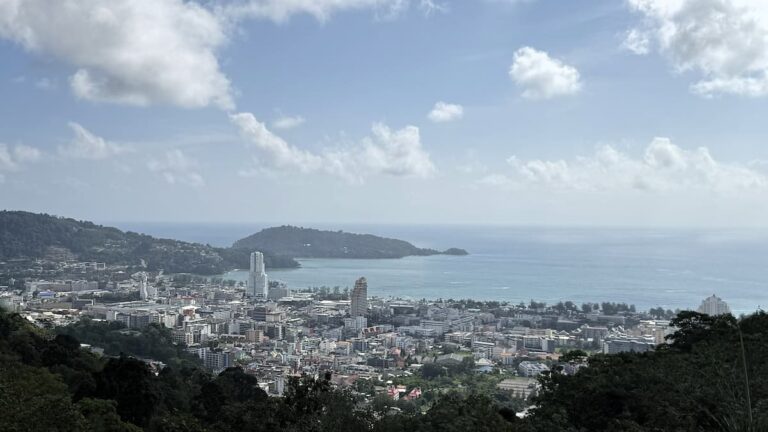
Patong Bay offered vessels a comparatively sheltered anchorage along Phuket’s west coast, particularly during changing monsoon conditions. Fresh water flowed from the surrounding hills, while the sea and forested coastal plain provided fish, fruit, timber and other essential resources. Although the steep mountain ridge made Patong difficult to reach from Phuket’s interior, the bay was accessible to the maritime communities and trading vessels travelling through the Andaman Sea.

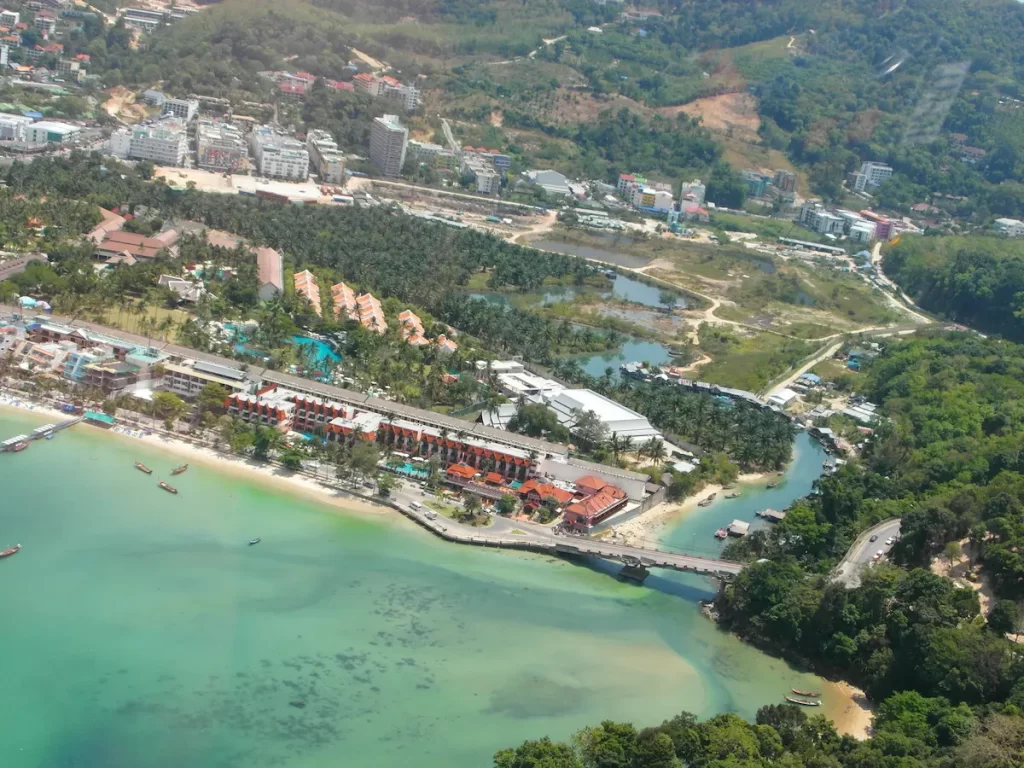
The identity of Patong’s earliest inhabitants cannot be established from the surviving historical or archaeological evidence. It is nevertheless reasonable to assume that people were using the sheltered bay long before any permanent village developed. During periods of lower sea levels, Phuket formed part of the Southeast Asian mainland, and there is little reason to think early hunter-gatherer communities would have ignored an area that offered fresh water, abundant marine resources and natural shelter. Over time, different peoples almost certainly occupied or used the area. Historical sources identify the Chao Ley (sea people) among Phuket’s earliest known communities, and Patong’s protected bay would have provided an attractive seasonal anchorage within their traditional maritime range. The island also formed part of the wider Malay cultural world for many centuries, and Malay-speaking communities became firmly established across southern Thailand, including Phuket. Patong itself retains both a Chao Ley settlement beside the creek and a long-established Muslim community, reflecting this layered history. While the sequence and timing of these early populations cannot be reconstructed with certainty, the evidence suggests that Patong developed through successive communities rather than a single founding population.
The earliest written account presently identifiable with Patong comes from the English merchant Thomas Bowrey, who travelled through the region during the 1670s. Bowrey described a Phuket port called Banquala, generally identified with Patong Bay. His account places it among the island’s recognised seaports and describes trading vessels entering the harbour, paying customs duties and moving into a creek or river connected with the settlement.
Bowrey portrayed seventeenth-century Phuket as culturally divided but interconnected. Siamese communities occupied much of the island’s interior, while Malay inhabitants formed a substantial part of the population around its seaports. He also recorded the presence of Orang Laut (Chao Ley) maritime groups in the surrounding region. Banquala therefore formed part of a wider maritime world shaped by Malay seafarers, regional traders and Siamese political authority.
An incident from around 1675 provides particularly strong evidence that Banquala was more than a temporary anchorage. After a Dutch vessel seized an Acehnese trading craft carrying tin, local Malay inhabitants protested that vessels within the waterway were under the protection of the Raja of Junkceylon, the island’s governor. When the Dutch opened fire on the gathering crowd, local residents responded by felling trees across the waterway, trapping the Dutch vessel before attacking and destroying it.
The account does not identify a Patong village headman or explain exactly who organised the response. Nevertheless, it demonstrates that the settlement had merchants, residents, commercial activity and an understood connection to the island’s governing authority. The coordinated mobilisation of a substantial number of inhabitants also suggests that some form of local leadership and community organisation already existed, even though its structure and officeholders remain unknown.
By the time Wat Pa Tong enters the surviving historical record in 1769, Patong had therefore existed as an organised coastal community for at least several generations. The temple did not create Patong. Rather, it emerged within a settlement that already possessed inhabitants, maritime trade, access to natural resources and its own social relationships.
Precisely when Buddhist practice began in Patong is not known. A rural temple would rarely have begun as the complete collection of halls, residences and sacred structures seen today. More commonly, a monk may have settled where an established community was able to support a monastic presence. His first residence might have been a simple shelter or kuti, accompanied by a small place for meditation, chanting and community offerings.
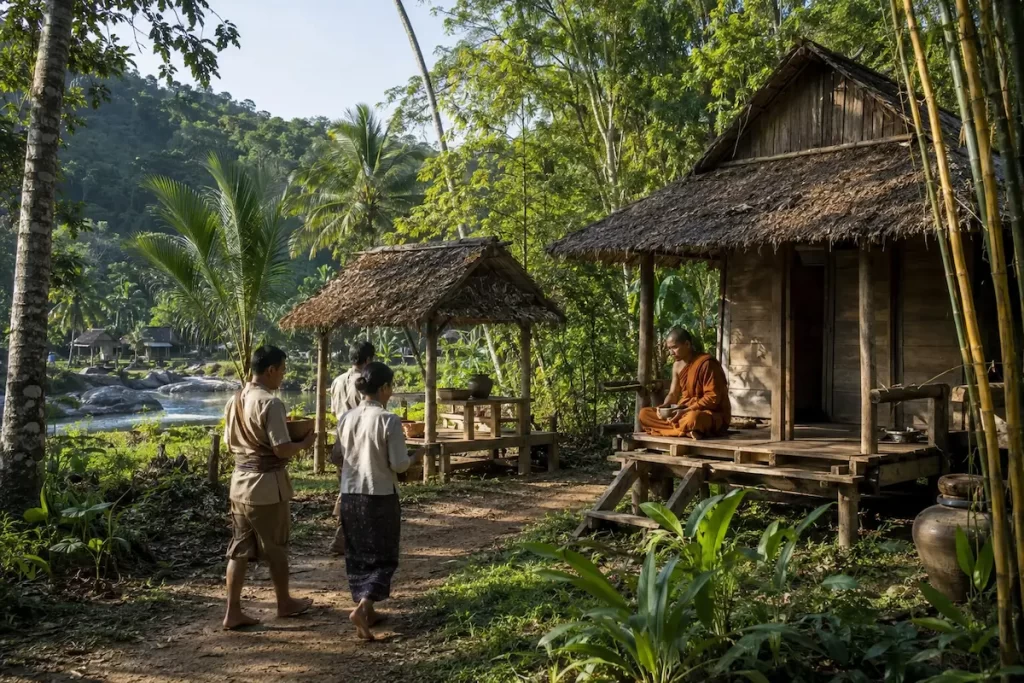
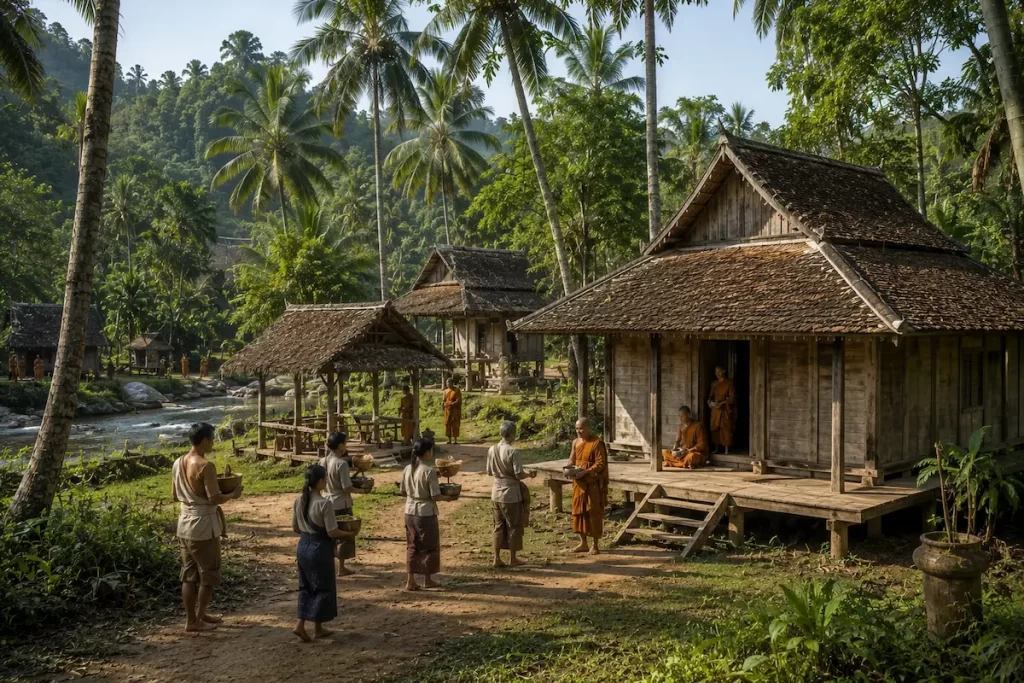
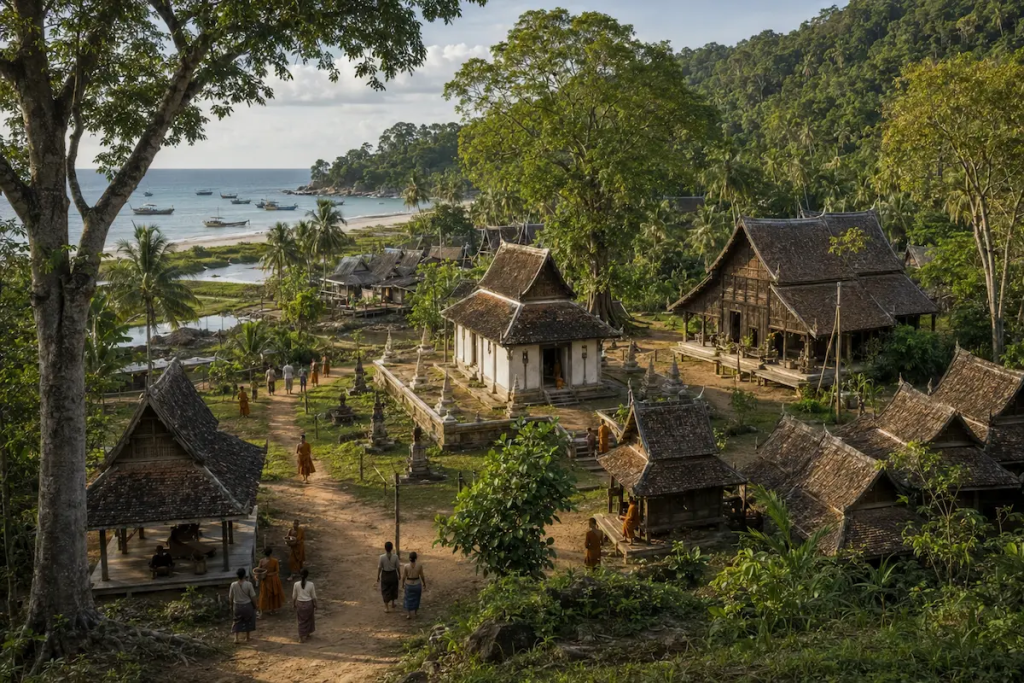
As local support increased, that modest place of practice could gradually develop. Additional monks might arrive, more permanent residences could be constructed, and villagers might provide a sala for gatherings, teaching and merit-making. Only later would the site acquire larger ceremonial buildings, clearly defined land and a formally consecrated ubosot.
There is currently no evidence identifying the first monk to reside at Patong, the location of the earliest religious shelter, or whether that first place of practice stood on exactly the same ground as the present temple. The process may have taken many years and perhaps several generations.
What is known is that Wat Pa Tong, later renamed Wat Suwan Khiri Wong, is officially recorded as having been established around 1769. That date should not be interpreted as the day on which someone simply decided to construct a complete temple. It is more appropriately understood as the earliest documented point in a longer evolution of organised Buddhist practice, resident monks and community support.
The recorded establishment of Wat Pa Tong therefore represents an important stage in Patong’s development. It suggests that by the late eighteenth century, the settlement had become sufficiently stable, populated and organised to sustain a recognised Buddhist institution—one that would eventually become central to the religious and community life of Patong.
From Village Monastery to Modern Temple Complex: 1769 to the Present
Like Patong itself, Wat Suwan Khiri Wong is a dynamic and continually evolving place. Since its establishment in 1769, the temple has not remained a fixed collection of buildings preserved unchanged through time. It has expanded, adapted and been rebuilt in response to the changing needs of the monastic community and the surrounding population.
The temple complex visible today is therefore the result of more than two and a half centuries of gradual development. New religious, residential, educational and community buildings were added as Patong grew from a small settlement into a major urban and tourism centre. Older structures were retained, altered or replaced, while new facilities reflected the temple’s expanding role in ordination, worship, education, public service and community life.
The temple’s early development also took place during a period of considerable political uncertainty around Phuket. Francis Light, the British trader who maintained close relationships with Thalang’s leaders and possessed extensive knowledge of Phuket and the surrounding region, became an important source of information during this period. His surviving correspondence, together with letters sent to him by members of Thalang’s ruling family, provides evidence of the growing Burmese threat during the 1780s. Light appears to have helped communicate warnings before the Burmese assault of 1785–1786 includnig potentially the vessles anchoring in the bay, which culminated in the celebrated defence of Thalang led by Lady Chan and Lady Mook.
The principal fighting during that invasion occurred in northern Phuket rather than at Patong, and no surviving evidence presently shows that Wat Pa Tong or the Patong settlement was directly attacked. Nevertheless, conflict on that scale would likely have created insecurity across the island and disrupted trade, food supplies, movement and ordinary community life.
The danger did not end with the successful defence of Thalang. Burmese forces returned repeatedly during the early nineteenth century, and in 1809–1810 they captured Thalang during a period of widespread destruction, displacement and depopulation across Phuket. Settlements were burned, inhabitants were killed or captured, and many others fled the island.
It is therefore possible that Patong and its young temple community were disrupted, temporarily abandoned or affected by the wider destruction. However, there is currently no direct documentary or archaeological evidence proving that Wat Pa Tong itself was burned, destroyed or occupied by Burmese forces. The most accurate conclusion is that the monastery existed within an island profoundly affected by war, while the precise consequences for the temple remain unknown.
This uncertainty is itself part of the temple’s history. No building now standing at Wat Suwan Khiri Wong can be securely identified as surviving unchanged from its establishment in 1769. The absence of early structures may reflect the ordinary replacement of timber buildings, environmental decay, later rebuilding, wartime disruption or some combination of these factors. What endured was not necessarily a particular building, but the temple community and its continuing relationship with the settlement around it.
One of the earliest firm structural milestones appears in 1892, when the temple received its first recorded royal grant of wisungkhamsima, the formally defined sacred boundary required for valid monastic ordinations. This grant is associated with the old hillside ubosot, a comparatively modest building measuring approximately 12 by 18 metres.
The existence of this sacred boundary indicates that, by the late nineteenth century, Wat Suwan Khiri Wong had become a formally established monastic institution capable of conducting ordinations. The surviving old ubosot therefore represents an important stage in the temple’s development, even though the present concrete building may include later repairs, rebuilding or alterations.
During the early twentieth century, the temple’s role expanded beyond worship and monastic life into education. Wat Suwan Khiri Wong School opened on 1 June 1909, initially using a temple kuti as a classroom. The school began with only 11 pupils, while a monk served as both headteacher and teacher.
A purpose-built school building was later constructed within the temple grounds in 1917, followed by another building in 1927. As the local population continued to grow, a further school building was erected in 1962 on temple-owned land approximately 400 metres away, and the school was eventually transferred there.
This progression from a small classroom inside a monk’s residence to dedicated school buildings demonstrates how the temple adapted to the changing needs of Patong. It also reflects the wider historical role of Thai monasteries as centres of literacy, education and community organisation.
The temple continued to contribute to the physical and civic development of Patong during the twentieth century. A memorial structure was built in 1968 to commemorate King Bhumibol Adulyadej’s visit to Phuket in 1959. In 1974, the temple and its leadership were also involved in the construction or improvement of a road into the Patong community.
This road development is closely associated with Phra Khru Phisitkorani, remembered locally as Luang Pho Khiao, whose name survives in Phisit Karani Road. His role illustrates how the authority of a temple abbot could extend beyond religious ceremonies into community leadership and practical infrastructure.
By 1982, Wat Suwan Khiri Wong had been recognised by the Department of Religious Affairs as a model development temple. This recognition places the monastery within a significant period of institutional expansion and modernisation.
The clearest architectural expression of this phase was the construction of the present main ubosot. The newer ordination hall was built on a much larger scale than the older hillside ubosot, measuring approximately 22 by 30 metres and following a chaturamuk, or four-gabled cruciform, design.
The new ubosot received a separate royal wisungkhamsima allocation in 1987, formally announced on 18 January 1988. This indicates that the new ordination hall and its sacred boundary had been established by that time, although the exact beginning and completion dates of construction have not yet been confirmed.
The newer ubosot is approximately three times the footprint of the older hall. Its larger scale, formal cruciform design and surrounding sacred boundary wall suggest more than the simple replacement of an older building. It reflects the temple’s growth from a small village monastery into a larger religious and community institution serving an increasingly populated Patong.
The relationship between the two ubosots is one of the clearest expressions of the temple’s layered history. The older hillside hall preserves the memory of an earlier period, while the larger modern ubosot represents expansion, institutional confidence and the changing scale of the community around it.
The wider temple complex also developed through the gradual addition of buildings serving different religious and practical purposes. The sala kan parian, a large Thai-style reinforced-concrete hall measuring approximately 21 by 38 metres, provides space for sermons, merit-making ceremonies and community gatherings.
Unlike the ubosot, which is ritually restricted by its sacred boundary and used primarily for monastic acts, the sala kan parian serves as a more flexible public and ceremonial space. Its presence reflects the temple’s need to accommodate larger gatherings and a broader range of community activities.
The temple also contains extensive monastic accommodation. These buildings include a two-storey reinforced-concrete row of monks’ quarters with approximately 35 rooms, the two-storey Somdet Building, several single-storey concrete kuti and two two-storey wooden kuti.
The mixture of timber and reinforced-concrete residences suggests that the monastic accommodation developed across different periods. The wooden buildings may preserve an older architectural tradition, while the larger concrete blocks indicate later expansion and a need to house a growing or more permanent monastic population.
Other major structures include the monks’ dining hall, which measures approximately 16 by 40 metres, and a two-storey library constructed from a combination of concrete and timber. These buildings demonstrate the practical organisation required to support daily monastic life, study, communal meals and visiting monks.
The bell tower is another prominent feature of the complex. Rising through five levels to a height of approximately 18 metres, it contains a bell, drum, gong and kang sadan, a suspended metal percussion instrument. These instruments regulate monastic time, announce ceremonies and carry sound across the temple grounds and surrounding community.
The temple also contains a replica Buddha footprint associated with a dedicated sacred structure, together with memorial buildings honouring former abbots and teachers. The Mondop Buraphachan, located near the sala kan parian, commemorates respected predecessors whose leadership contributed to the temple’s development.
Images of former abbots preserve the memory of figures including Luang Pho Nang Suea, Pho Than Nai Hip, Luang Pho Thao, Phra Khru Phisitkorani and Phra Khru Photipanyakon. These memorials transform the temple’s institutional history into part of its physical landscape.
Buildings such as the Photipanyakon Building and the surviving kuti associated with a former abbot further reinforce this continuity. The temple complex preserves not only sacred images and ritual spaces, but also the memory of the monks who shaped its relationship with Patong.
Viewed as a whole, Wat Suwan Khiri Wong was not built according to a single original blueprint. Its development was incremental and responsive. New buildings appeared as religious functions expanded, as educational needs increased, as the monastic population changed and as Patong itself grew.
Its earliest structures were likely modest and made from local, perishable materials. By the late nineteenth century, the temple possessed a formally consecrated ordination hall. During the twentieth century, it became increasingly involved in education, road development, civic life and public ceremonies. By the 1980s, the construction of the larger ubosot marked a new phase of architectural and institutional expansion.
Today, the temple contains old and new ubosots, monks’ residences, a preaching and assembly hall, dining facilities, a library, a bell tower, memorial buildings, educational spaces and devotional structures. Each belongs to a different aspect of temple life, and together they reveal how the monastery has adapted over time.
Wat Suwan Khiri Wong is therefore not a monument belonging to a single historical moment. It is a living religious complex shaped by war, rebuilding, population growth, education, civic development and continuing Buddhist practice. Like Patong itself, it remains a dynamic and evolving place, preserving traces of its past while continuing to respond to the present.
The Temple at the Centre of Patong Community Life
For much of Patong’s history, Wat Suwan Khiri Wong was probably far more than a place visited for prayer or religious ceremonies. In a small and geographically isolated rural community, the temple would have been one of the few permanent institutions capable of bringing residents together, preserving shared customs and organising activities that affected the settlement as a whole.
There is presently insufficient evidence to claim that the temple formally governed Patong. Local authority would also have rested with village headmen, prominent families and officials appointed through the wider Thai administrative system. Nevertheless, the abbot and senior monks were likely among the community’s most respected and influential figures. Their authority came not from control of taxation or law enforcement, but from education, moral standing, literacy, continuity and their ability to mediate between families and different parts of the settlement.
This pattern was common in rural Thailand. Before the widespread development of government schools, municipal offices, public halls and formal welfare services, the local wat often functioned as the most important shared public space. It could serve simultaneously as a place of worship, education, public assembly, hospitality, mediation, charity and cultural preservation. Monks frequently acted as teachers, advisers and trusted intermediaries, while temple grounds provided a relatively neutral place in which community concerns could be discussed. Studies of the social role of Thai monasteries continue to identify temples as community public spaces, while monks have also maintained recognised roles in counselling and conflict resolution.
For early Patong, this role was probably intensified by geography. The settlement was separated from the principal administrative and commercial centres on the eastern side of Phuket by steep, forested hills. Travel overland was difficult, particularly before modern roads connected Patong more effectively with Kathu and Phuket Town. A permanent institution within the community therefore carried greater importance than it might have in a settlement located close to established government offices.
Wat Suwan Khiri Wong would have provided a place where the community gathered for major Buddhist observances, funerals, cremations, weddings and merit-making ceremonies. It would also have helped regulate the social calendar through temple festivals, holy days and seasonal observances. Birth, adulthood, temporary ordination, marriage, illness and death all brought families into contact with the monastery, making the temple part of the ordinary structure of community life rather than a place used only on exceptional occasions.
The temple would also have acted as a repository of local memory. Abbots and long-resident monks often remained within or connected to a community for longer than individual government officials. They knew its families, disputes, obligations and traditions, and could preserve knowledge across generations. In a community where written records may have been limited, this continuity gave the temple considerable social influence.
Its educational role can be demonstrated more directly. Wat Suwan Khiri Wong School began operating within the monastery in 1909, initially using a kuti as a classroom and with a monk serving as both teacher and headteacher. Dedicated school buildings were subsequently constructed within the temple grounds before the expanding school moved to separate temple-owned land. This development provides concrete evidence that the monastery was performing a public function that would later be increasingly assumed by the state. Even in the twenty-first century, municipal early-childhood education in Patong continued to use classrooms connected with Wat Suwan Khiri Wong School, showing the persistence of the relationship between temple, school and local administration.
The temple’s involvement in road development provides another important example. Its association with the improvement of access into Patong during the twentieth century suggests that the abbot’s responsibilities were not understood as purely ceremonial. The leadership of Phra Khru Phisitkorani, remembered through the name of Phisit Karani Road, demonstrates how a senior monk could help mobilise labour, cooperation and community support for practical development.
In this sense, the temple probably participated in a form of community administration even though it was not itself a governmental authority. Decisions may have been discussed in or around the temple, respected monks may have helped settle disagreements, and the monastery could lend legitimacy to collective projects. Its influence was social, moral and organisational rather than bureaucratic or financial.
This distinction is important. The temple was unlikely to have collected public revenue, issued regulations or administered Patong in the manner of a modern municipality. Instead, it helped provide many of the functions that allow a community to operate: maintaining social cohesion, educating children, assisting vulnerable residents, resolving tensions, organising shared ceremonies and providing a recognised place for collective action.
The balance began to change as Patong became more closely connected to the rest of Phuket and developed into a major tourism centre. Roads improved, the population expanded and government departments assumed greater responsibility for schooling, infrastructure, sanitation, public health, planning and welfare. The transformation accelerated during the tourism boom of the late twentieth century, when Patong’s needs became too extensive and technically complex to be managed primarily through traditional village institutions.
Patong was established as a separate sanitary district in 1986, elevated to a subdistrict municipality on 12 January 1994 and then to town-municipality status on 12 April 2002. These changes created increasingly formal administrative structures responsible for budgets, public works, regulation and urban services.
As these institutions expanded, Wat Suwan Khiri Wong’s direct involvement in the practical administration of Patong would naturally have diminished. Roads, waste management, drainage, schools, planning and other public services increasingly became the responsibility of elected authorities and professional government departments. The temple no longer needed to serve as Patong’s principal meeting place, school or organising institution.
That did not mean the temple became less important. Rather, its role became more specialised. Formal government assumed greater responsibility for financial administration, infrastructure and regulation, while the temple continued to fulfil needs that could not be addressed as easily through municipal budgets or bureaucratic systems.
These included funerals and cremations, religious instruction, ordination, merit-making, festival observance, spiritual guidance, counselling and the preservation of local Buddhist traditions. The temple also remained a place where people experiencing hardship could seek food, temporary support, advice or connection with others in the community. Its halls and grounds continued to provide space for collective ceremonies and community events, even as formal civic administration moved elsewhere.
The temple’s role can therefore be understood as changing rather than disappearing. In early rural Patong, religious, educational, social and administrative functions overlapped because the community possessed relatively few permanent institutions. As Patong urbanised, those functions gradually separated. Schools became part of a formal education system, municipal offices assumed administrative responsibilities and specialist agencies provided services once organised informally within the community.
Wat Suwan Khiri Wong nevertheless retained responsibility for what might be described as Patong’s non-commercial and non-bureaucratic social needs. It continued to address questions of belonging, morality, memory, grief, generosity and shared identity—areas that remain important even in a highly commercial tourism city.
This continuing role is particularly significant in modern Patong. Much of the town’s public image is associated with beaches, hotels, nightlife and tourism, yet the temple preserves a connection with the older settlement that existed before the tourism economy transformed the bay. For long-established local families, it remains a place associated with ancestors, former abbots, education, funerals, festivals and community memory.
Wat Suwan Khiri Wong therefore charts not only the religious history of Patong but also the changing organisation of the community itself. It began as one of the settlement’s central institutions, probably participating in education, mediation, welfare and collective decision-making. As formal government and the tourism economy expanded, it gradually transitioned away from many administrative and practical responsibilities while continuing to serve the social, spiritual and cultural needs that modern institutions could not entirely replace.
The temple may no longer stand at the administrative centre of Patong, but it remains one of the strongest surviving links between the modern city and the community from which it developed.
The Abbots and Revered Monks Who Shaped Wat Suwan Khiri Wong
The leadership history of Wat Suwan Khiri Wong survives through a combination of written records, local histories, onsite inscriptions, memorial statues and oral tradition. The evidence is uneven: several recent abbots can be identified through formal ecclesiastical records, while the earliest leaders are remembered principally through the temple’s own commemorative display and the stories preserved by the Patong community.
The most important onsite evidence is found inside the temple’s memorial sala. There, a Buddha image stands at the head of a carefully arranged line of seated monks. The matching sculptural style, identical pedestals, equal spacing and individual name plaques indicate that this is a deliberately created historical and devotional gallery rather than a random collection of statues added over time.
The arrangement presents the Buddha as the supreme teacher, followed by the monks through whom Buddhist teaching, temple administration and community leadership were continued at Wat Suwan Khiri Wong.
Based on the inscriptions examined onsite, the sequence appears to be:
- Phra Khru Photipanyakon, known as Pho Than Chali
- Luang Pho Khiao
- Luang Pho Palat Naep or Baen
- Luang Pho Tao
- Pho Than Nai Hip
- Luang Pho Somphan Khong
- Luang Pho Somphan Sin
- Luang Pho Nang Suea
The temple’s own published account similarly preserves eight former abbots or revered leaders. However, the arrangement in the sala should not yet be assumed to represent a strict chronological order. The statues may have been positioned according to remembered succession, seniority, institutional importance or another principle known within the temple.
The different titles used on the plaques are also significant. Some monks are identified by formal ecclesiastical titles beginning with Phra Khru, while others retain familiar local forms of address such as Luang Pho and Pho Than. This suggests that the display preserves the names by which the monks were actually remembered in Patong rather than rewriting every figure under a uniform modern title.
The Earliest Remembered Leaders
The least is known about Luang Pho Nang Suea, Luang Pho Somphan Sin, Luang Pho Somphan Khong, Luang Pho Tao and Luang Pho Palat Naep or Baen.
Their presence in the sala confirms that the temple considers them part of its institutional and spiritual history, but reliable dates for their births, ordinations, periods of leadership and individual achievements have not yet been located.
Some of these names may be familiar forms of address rather than full formal monastic names. The term somphan, for example, could refer to the senior monk responsible for a monastery rather than functioning simply as a personal name.
These monks probably served during the period when Patong remained a small and geographically isolated rural settlement. Their responsibilities would likely have extended well beyond the performance of ceremonies. Senior monks in such communities commonly acted as teachers, moral advisers, mediators, organisers of communal activity and trusted points of continuity between generations.
Although their individual achievements remain uncertain, their collective importance is substantial. They maintained the monastery through the period before detailed written records became common and preserved the continuity of the institution from its early history into the better-documented twentieth century.
Pho Than Nai Hip and Patong’s Sacred Folklore
Pho Than Nai Hip is among the most memorable of the early monks because of the folklore surrounding him.
His name is commonly understood approximately as “the revered monk in the chest.” Local accounts remember him as an unusually disciplined and spiritually powerful monk, and stories associated with him describe an ability to disappear or move unseen. Some versions connect this ability with a locked wooden chest from which he was said to vanish.
These stories cannot be treated as verifiable biography. They belong instead to Patong’s sacred oral tradition and reveal the exceptional reverence with which he was remembered.
In rural Thai Buddhist culture, respected meditation monks were often credited with protective abilities, extraordinary discipline or powers beyond ordinary explanation. Such stories expressed a community’s belief in the monk’s spiritual attainment, regardless of whether they were intended to be understood literally.
Pho Than Nai Hip’s placement within the sala sequence is especially interesting. Despite his strong association with the temple’s early folklore, he is not positioned at the beginning of the line. This may mean that other leaders preceded him, that the display is not arranged chronologically or that the temple followed another principle when organising the statues.
His precise period as abbot remains unknown and should be confirmed by the temple if records or oral histories survive.
Luang Pho Khiao: The First Clearly Documented Leader
Phra Khru Phisitkorani, known locally as Luang Pho Khiao or Pho Than Khiao, is the earliest monk in the remembered sequence for whom substantial dated evidence has been found.
A Patong local-history publication identifies him as a former abbot of Wat Suwan Khiri Wong and records his lifespan as 1894–1985. The same source lists a viharn dedicated to Phra Khru Phisitkorani among the important places of the community surrounding the temple.
His exact years as abbot have not yet been confirmed through a surviving appointment record. However, the available evidence shows that his influence extended across a significant part of the twentieth century and that he played an important role in both the development of the temple and the wider Patong community.
Onsite evidence provides the strongest direct connection between Luang Pho Khiao and the temple’s surviving architecture. A plaque on the old hillside building records that major work was carried out there under his leadership in 1929, when the building functioned as the temple’s ubosot.
Because Wat Suwan Khiri Wong had already received its first recorded wisungkhamsima in 1892, the 1929 project was most likely a reconstruction or substantial rebuilding of an earlier ordination hall rather than the establishment of the temple’s first-ever sacred space.
The building later ceased to serve as the active ubosot after the larger modern ordination hall was established. It was retained as a viharn and restored again in 2011.
This plaque is particularly important because it provides direct documentary evidence linking Luang Pho Khiao with a surviving structure. It moves his architectural contribution beyond oral tradition and establishes him as a major figure in the physical development of the monastery.
Luang Pho Khiao is also associated with the broader development of Patong. Temple and local accounts connect him with education, community improvement and the development of roads linking Patong with Kathu and with different parts of the settlement.
Improved overland access was one of the most consequential changes in Patong’s history. Before dependable roads, the community was separated from eastern Phuket by steep, forested hills. Better access allowed residents, food, commercial goods, teachers, officials and medical assistance to move more easily between Patong and the rest of the island.
Local tradition credits Luang Pho Khiao with helping to initiate and organise road construction. Some accounts describe the route as an inland or “back road” running along the foothills behind the settlement, connecting the northern and southern parts of Patong and linking them with the road over the hills toward Kathu.
This description fits the geography of Patong and the later importance of Phisit Karani Road, but the exact route, construction dates and administrative arrangements still require confirmation from temple or municipal records.
A respected abbot did not need formal municipal authority to influence such a project. His reputation, relationship with local families and position within the community could help mobilise labour, donations and cooperation. In this way, Luang Pho Khiao’s leadership appears to have extended beyond religious ceremonies into the practical development of Patong.
The apparent preservation of his ecclesiastical title in the name Phisit Karani Road provides a lasting public memorial to this role. Although the precise naming history should still be formally confirmed, the connection between the road name and his title appears strong.
Luang Pho Khiao is also closely associated with Wat Suwan Khiri Wong School.
The school began within the temple in 1909, initially using a kuti as a classroom and with a monk serving as both teacher and headteacher. Because Luang Pho Khiao was born in 1894, he would have been only about fifteen years old when the school first opened. He therefore could not have been the senior abbot responsible for its original foundation.
His involvement was more likely connected with a later and particularly important stage of the school’s expansion.
By 1962, compulsory education had been extended and student numbers had increased beyond the capacity of the original buildings inside the temple grounds. A new school building was therefore constructed on thorani song—land belonging to the monastery—approximately 400 metres from the main temple complex. The school was subsequently transferred to this new site.
As abbot during this period, Luang Pho Khiao was probably closely involved in making temple land available and supporting the school’s expansion. However, the surviving published school history does not yet explicitly identify him as the individual who authorised the allocation.
The available evidence indicates that the expansion took place during his leadership and was consistent with his wider reputation as a development-oriented abbot. Local tradition further suggests that the land may have been donated by his son, who reportedly served as the village headman, although this has not yet been verified through official documentation.
Luang Pho Khiao’s legacy therefore survives in several interconnected forms.
He is linked directly with the reconstruction or substantial rebuilding of the old ubosot in 1929. He is remembered in relation to the improvement of Patong’s road access. He appears to have supported the expansion of local education on temple land. His ecclesiastical title survives in the name of one of Patong’s major roads, and a viharn within the temple commemorates him.
Together, these sources present him not simply as a ceremonial religious leader, but as a monk deeply involved in the practical development of both Wat Suwan Khiri Wong and the Patong community.
Phra Khru Photipanyakon, Pho Than Chali
Phra Khru Photipanyakon, widely known as Pho Than Chali or Luang Pu Chali, is the most clearly documented of Wat Suwan Khiri Wong’s recent former abbots.
Onsite examination suggests that he may be represented more than once within the temple’s memorial spaces. A white statue and a bronze representation appear to carry versions of his formal title and familiar monastic name. This indicates that the number of statues within the temple should not automatically be interpreted as the number of separate abbots.
The formal title should be read as Phra Khru Photipanyakon, while the associated monastic name Photipanyo corresponds with the familiar name Chali.
Pho Than Chali led Wat Suwan Khiri Wong during the period in which Patong underwent its most dramatic transformation. Under his leadership, the surrounding community developed from a relatively small local settlement into an international tourism centre characterised by rapid population growth, road construction, hotels, commerce and urban expansion.
The temple also entered a major period of architectural and institutional development.
In 1982, Wat Suwan Khiri Wong was recognised as a model development temple. During the following years, the larger modern ubosot was developed, replacing the old hillside building as the temple’s principal ordination hall.
A new wisungkhamsima was allocated for the modern ubosot in the late 1980s and formally announced in 1988. This established a new sacred boundary suitable for the enlarged ordination hall and marked a major transition in the physical organisation of the monastery.
The exact construction sequence still requires clarification because onsite and documentary dates may refer to different stages of planning, building, royal approval and formal announcement. Nevertheless, the larger ubosot clearly belongs to the temple’s modern expansion under Pho Than Chali’s long period of leadership.
His responsibilities extended beyond construction. Available records associate him with Buddhist education, monastic examinations, public welfare, moral instruction and community-development activities.
In 2000, he was elevated to the status of a first-class abbot of a private temple, reflecting both his seniority and the institutional importance of Wat Suwan Khiri Wong.
He remained abbot until his death at Patong Hospital on 14 August 2020 at the age of 93. His death ended a period of leadership during which the temple and the town around it had changed almost beyond recognition.
Transitional Leadership After 2020
Following the death of Pho Than Chali, official Buddhist records identify Phra Khru Sangharak Buasri as acting abbot.
This temporary leadership ensured continuity in monastic administration while the formal process of appointing the next permanent abbot was completed.
Although his period in charge may have been brief, it belongs in the institutional succession. The temple may be able to clarify the exact dates of his service and whether he held other senior responsibilities before or after acting as abbot.
Phra Khru Athon Suwanakit and the Contemporary Temple
Phra Khru Athon Suwanakit had already served for many years in senior temple and ecclesiastical roles before becoming abbot.
He was appointed deputy abbot during the 1990s, later served as a teacher of Buddhist studies and became ecclesiastical chief of Kathu subdistrict in 2015.
He was formally appointed abbot of Wat Suwan Khiri Wong in November 2021 and subsequently advanced further within the Sangha’s administrative hierarchy.
Under his leadership, the temple continues to serve Patong through religious education, meditation programmes, scholarships, youth activities, health-promotion initiatives, community volunteering and assistance for elderly, housebound and vulnerable residents.
The temple also works alongside Patong Municipality, schools, public-health agencies, police and local community organisations.
This reflects the changing role of monastic leadership in Patong. Earlier abbots may have functioned as central organisers within a rural settlement that had few permanent institutions. The present abbot leads the temple within a much larger administrative network of municipal, provincial and national agencies.
The role is consequently more collaborative, but it remains important in areas that cannot be reduced to formal government services: spiritual guidance, funerals, ordination, moral education, grief, remembrance, cultural continuity and the preservation of Buddhist practice.
Memorial Sala and the Temple’s Former Abbots
The memorial statues preserve the memory of the monks who shaped Wat Suwan Khiri Wong and guided its relationship with the Patong community.
The Buddha occupies the position of ultimate teacher. The monks who follow represent the continuation of the teaching through local leadership, monastic discipline and service to the Patong community.
The display also reveals the limits of the surviving historical record. Some figures can be connected with firm dates, buildings and official positions. Others remain known only by familiar names and the reverence expressed through their statues.
The gallery therefore preserves both documented institutional history and local sacred memory.
The memorial statues confirm that the temple preserves the memory of a recognised group of influential monks. However, the arrangement should not automatically be read as a complete chronological succession of abbots. Some figures may have been included for their spiritual or institutional importance, while others may be represented in more than one form.
A Continuing Tradition of Leadership
The remembered monks of Wat Suwan Khiri Wong reflect the changing history of Patong itself.
The earliest leaders maintained a monastery in an isolated rural community and survive mainly through names, statues and oral tradition.
Pho Than Nai Hip became part of Patong’s sacred folklore.
Luang Pho Khiao, who lived from 1894 to 1985, became the first leader securely linked with a dated surviving structure and with the twentieth-century development of the temple and surrounding community.
Pho Than Chali guided the monastery through the tourism boom and the creation of the modern temple complex.
Phra Khru Athon Suwanakit now leads the temple within a densely populated urban environment, working through formal Sangha structures and partnerships with government and community organisations.
The character of leadership changed over time, but one expectation remained constant: the abbot and senior monks were responsible not only for the resident monastic community, but also for the moral, social and spiritual wellbeing of the people around the temple.
The Temple Today: Buildings, Sacred Spaces and Memorials
The history of Wat Suwan Khiri Wong can be read not only through documents and local memory, but also through the arrangement of the present temple complex. Its buildings belong to different periods and serve different purposes. Some preserve the monastery’s earlier history, while others reflect its expansion during the twentieth and twenty-first centuries. Together, they show how a small rural monastery gradually developed into the large religious and community complex visible today.
The temple was not created as a complete architectural plan at one moment. Like many Thai monasteries, it appears to have expanded incrementally. Older structures were rebuilt, new halls were added, residential buildings multiplied and sacred functions shifted from one part of the grounds to another as the monastic community and the surrounding population grew.
The result is a layered complex rather than a single historic monument. Walking through Wat Suwan Khiri Wong is therefore also a way of moving through different stages in the development of Patong.
Temple at Patong’s Eastern Entrance
Wat Suwan Khiri Wong stands at the eastern entrance to Patong, close to the historic route connecting the settlement with Kathu and the rest of Phuket. Before Patong became a major tourism centre, the monastery stood beside a much smaller rural community.
Local historical material records that the community around the temple was once known as Ban Nai Rai and later as the Sai Wat community, meaning the community beside the temple. Within living memory, it consisted of only a few dozen households.
The temple was therefore not separate from the settlement. It formed one of its central reference points and provided a place for worship, education, ceremonies, meetings and community support.
Although modern Patong has expanded around it, the temple’s position still preserves a visible connection with the older settlement and the historic route by which the community was linked with the rest of Phuket.
Sala Kan Parian
One of the largest buildings in the complex is the sala kan parian, the temple’s main preaching, teaching and community assembly hall.
Although the word sala is often associated with an open-sided pavilion, a sala kan parian can be a large enclosed building. At Wat Suwan Khiri Wong, it appears to function as a substantial hall for sermons, Buddhist teaching, merit-making ceremonies, community meetings and other activities involving monks and laypeople.
A view through the windows shows a raised stage or focal area containing a Buddha image. The remainder of the interior could not be examined closely, so its full arrangement and any inscriptions or memorial objects inside remain unknown.
Its size reflects the temple’s development beyond the needs of a small rural monastery. As Patong’s population grew, the temple required a larger shared space for religious instruction, ceremonies and community gatherings that did not need to take place inside the consecrated ubosot.
Former Ubosot, Now the Old Viharn
One of the most historically important surviving buildings is the old hillside structure that once served as the temple’s ubosot and is now used as a viharn.
An ubosot is the formally consecrated ordination hall of a Thai Buddhist temple. It is the building within which monks conduct ordinations and other official acts of the Sangha. Its sacred status depends not only on the building itself, but also on the recognised sima boundary surrounding it.
Wat Suwan Khiri Wong received its first recorded wisungkhamsima in 1892. This established a formal sacred boundary for ordination and other monastic ceremonies.
The surviving hillside building, however, is associated with major work carried out under Luang Pho Khiao in 1929. An onsite plaque links him directly with the building and records its former use as the temple’s ubosot.
Because the sacred boundary had already been granted in 1892, the 1929 work was probably a reconstruction or substantial rebuilding of an earlier ordination hall rather than the creation of the temple’s first-ever sacred space.
The earlier hall may have been smaller, constructed from less durable materials or no longer suitable for the needs of the growing monastery. Rebuilding it in 1929 would have preserved the older sacred precinct while providing a more substantial structure.
Later, when the larger modern ubosot was constructed and a new sacred boundary established, the older building ceased to serve as the temple’s active ordination hall.
Rather than being demolished, it was retained and converted into a viharn. A viharn is used for worship, Buddha images, chanting and devotional activity, but it does not normally carry the same formal ordination function as an ubosot.
The building was restored again in 2011, showing that the temple continued to preserve it as an important link with its earlier history.
Inside the former ubosot is a large rounded stone bearing traces of gold leaf. Its form and context suggest that it may be an old luk nimit, one of the consecrated stones formerly associated with the sacred boundary. This remains an onsite observation rather than a confirmed identification, but it is consistent with the building’s previous function.
Modern Ubosot
The present ubosot represents a much later stage in the development of Wat Suwan Khiri Wong.
It is considerably larger than the former hillside hall and follows a chaturamuk design, with a central structure extending in four directions. Its scale and formal plan reflect the expansion of the temple during the late twentieth century.
The old ubosot measured approximately 12 by 18 metres, while the modern hall measures approximately 22 by 30 metres. The newer building therefore has roughly three times the floor area of the older one.
This increase in scale indicates more than a simple replacement. It reflects the changing size, status and requirements of the temple as Patong’s population expanded and the monastery became more formally integrated into the administrative structure of the Thai Sangha.
A new wisungkhamsima was allocated for the modern ubosot in the late 1980s and formally announced in January 1988.
The establishment of a new sacred boundary transferred the temple’s formal ordination function from the older hillside building to the new hall.
The modern ubosot therefore represents both architectural expansion and institutional transition. It belongs to the period when Wat Suwan Khiri Wong was developing from a village monastery into a larger urban temple serving a rapidly changing community.
The interior of the modern ubosot may contain further historical evidence, including donor plaques, foundation inscriptions, murals, dedication texts or records of the hall’s construction. Access to those details would likely help clarify the exact construction dates and the individuals responsible for the project.
Open-Sided Memorial Sala
Near the modern ubosot, on the same raised platform, is a smaller open-sided sala containing a Buddha image followed by a carefully arranged sequence of seated monk statues.
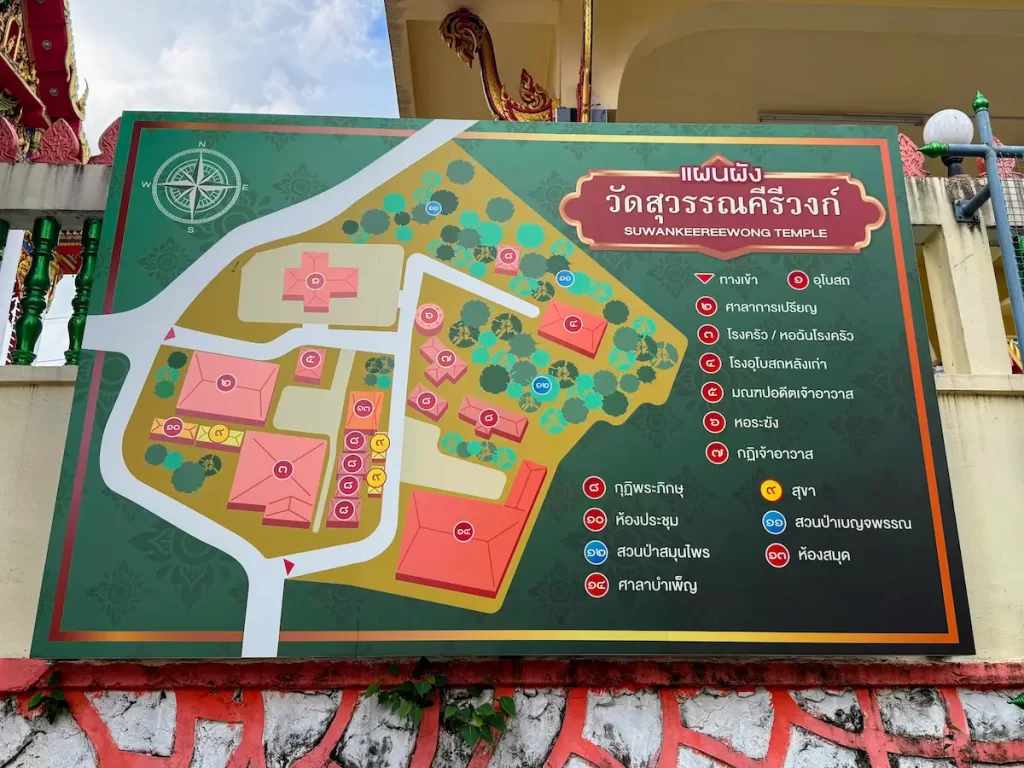
The open-sided memorial sala is not clearly identified on the temple layout plan. Its purpose is instead evident from the Buddha image, the uniform statues of monks, their matching pedestals and the individual name inscriptions.
The Buddha occupies the principal position, followed by monks associated with the temple’s history. The statues preserve the memory of former abbots and other revered monks associated with Wat Suwan Khiri Wong. Their arrangement should not necessarily be read as a complete chronological succession, and some figures may have been included for their spiritual or institutional importance rather than because they formally served as abbot.
Bai Sema and Luk Nimit
The sacred boundary of an ubosot is established by two related elements: the visible bai sema and the buried luk nimit.
The bai sema are the upright consecration markers positioned around the ubosot. At Wat Suwan Khiri Wong, each gilded leaf-shaped marker is enclosed within an ornate shrine-like structure and inscribed with the name of a sacred figure, such as Phra Upakut or Phra Anon, making them both boundary markers and devotional monuments.
Beneath each bai sema is a luk nimit, a consecration stone buried during the ceremony that establishes the sacred boundary. Traditionally, eight are placed around the ubosot, with a ninth buried beneath its centre.
Together, the bai sema and luk nimit define the sima, the consecrated space within which formal monastic ceremonies, including ordinations, may take place.
When the present ubosot became the temple’s active ordination hall, the former ubosot ceased to function as the consecrated ordination space and was retained as a viharn. Although its original sima was no longer required for ritual purposes, traces of the earlier boundary may still survive.
The absence of visible bai sema around the former ubosot today may indicate that they were removed during later reconstruction or landscaping, while one or more earlier boundary markers may have been preserved within the building.
Mondop
The temple plan identifies a mondop dedicated to former abbots or respected predecessors.
A mondop is a sacred building, usually square in plan, used to enshrine important religious objects. Depending on the temple, these may include Buddha images, relics, scriptures, footprints or commemorative statues.
At Wat Suwan Khiri Wong, the mondop combines several devotional functions. It houses the seven weekday Buddha images together with statues of revered monks associated with the temple, creating a space that honours both Buddhist devotion and the monastery’s own monastic heritage.
The prominent placement of the monk statues reflects the importance of lineage within Thai Buddhism. While not every figure has yet been positively identified, the arrangement demonstrates how the temple preserves the memory of those who contributed to its spiritual leadership and development. Rather than relying solely on written history, that lineage is expressed through architecture, sculpture and devotional practice.
Bell Tower and Replica Buddha Footprint
The bell tower is one of the most distinctive structures within Wat Suwan Khiri Wong. It contains the instruments traditionally used to regulate monastic life and announce ceremonies, including the bell, drum, gong and other suspended percussion instruments.
In a traditional monastery, these sounds marked times for chanting, meals, observances and community gatherings. They also carried the presence of the temple beyond its immediate grounds and into the surrounding settlement.
At Wat Suwan Khiri Wong, the bell tower is more than a raised platform for sound instruments. At its base is a replica Buddha footprint, creating a combined structure with both practical and devotional functions.
Buddha footprints are symbolic representations of the Buddha rather than literal portraits. They evoke his presence through the marks associated with his passage through the world and the teachings he left behind. Replica footprints often become objects of reverence, receiving offerings, gold leaf and acts of merit-making.
The placement of the footprint beneath the bell tower brings together two different aspects of temple life. Above, the instruments regulate time and announce religious activity. Below, the footprint provides a quieter focus for personal devotion and reflection.
This combination makes the bell tower a layered structure rather than simply an architectural landmark. It serves the daily organisation of the monastery while also housing an important devotional object at ground level.
Abbot’s Residence and Monks’ Quarters
The temple plan identifies a separate abbot’s residence together with several buildings used as monks’ quarters.
These residential structures are essential to understanding the complex as a functioning monastery rather than simply a collection of public religious monuments.
The temple’s records describe a mixture of reinforced-concrete residential blocks, single-storey kuti and older wooden buildings.
This variety suggests that the accommodation developed over different periods. Smaller timber kuti may reflect earlier patterns of monastic residence, while larger concrete buildings indicate later expansion and the need to house more monks in a growing urban temple.
The abbot’s residence also reflects the administrative responsibilities attached to temple leadership. The abbot is not only a senior religious figure but also the person responsible for the management of buildings, land, monks, finances, ceremonies and relationships with public authorities.
As Wat Suwan Khiri Wong became more complex, the administrative demands placed on the abbot and senior monks would also have increased.
Dining, Meeting and Community Buildings
The temple includes a dining hall, meeting spaces, kitchen facilities and multipurpose salas.
These structures reveal the practical organisation required to support daily monastic life and large public events.
The monks’ dining hall provides space for communal meals and the receiving of food offered by laypeople. Kitchen facilities support ceremonies and merit-making events in which food may be prepared for monks and participants.
Meeting rooms and special-purpose halls allow the temple to host discussions, educational programmes, welfare activities and cooperation with local authorities.
These buildings illustrate the continued overlap between religious and community functions.
Even after formal municipal institutions assumed responsibility for administration, infrastructure and public services, the temple remained an important venue for activities involving schools, health agencies, community groups and local leaders.
Library
The temple plan also identifies a library.
Temple libraries traditionally preserve Buddhist texts, educational materials and records used by monks and lay students.
At Wat Suwan Khiri Wong, the library reflects the monastery’s longstanding connection with education. The temple once housed Patong’s early school, and Buddhist instruction continues to form part of its modern activities.
The library therefore belongs to a broader history in which the monastery acted as a place of learning as well as worship.
Its contents may also hold important historical evidence, including old photographs, commemorative books, funeral publications, appointment documents, construction records and local histories that have not yet been made publicly available.
Funeral and Memorial Services
Wat Suwan Khiri Wong provides space for funeral chanting, memorial ceremonies and merit-making for the deceased. A dedicated building within the temple complex appears to support these services, allowing monks, relatives and members of the community to gather over the course of the funeral rites.
The actual cremation does not take place within the temple grounds. It is conducted at a separate consecrated cremation facility elsewhere in Patong, closer to the beach.
This arrangement reflects the temple’s continuing role in caring for families through death and mourning, even though the final cremation is physically separated from the main monastery.
A Layered Religious Landscape
Wat Suwan Khiri Wong is therefore best understood not as a single historic building, but as a layered religious landscape.
The former ubosot preserves an earlier phase of the monastery and the leadership of Luang Pho Khiao. The modern ubosot reflects the temple’s expansion during the rapid growth of Patong. The sala kan parian and memorial gallery preserve teaching, community activity and institutional memory. The mondop, bell tower, Buddha footprint, library, residences and welfare buildings reveal the many functions the temple continues to perform.
Some structures are primarily sacred, others practical, educational, residential or commemorative. Together, they form a living complex that has continued to adapt as Patong changed around it.
The temple visible today is therefore not the survival of one original 1769 design. It is the accumulated result of rebuilding, expansion, restoration and changing community needs across more than two centuries.
Walking through the grounds is, in effect, walking through different periods of Patong’s history.
Conclusion
Wat Suwan Khiri Wong is not the product of a single construction period or a history preserved only in official dates. It is the accumulated result of more than two centuries of rebuilding, leadership, religious practice and service to the Patong community.
Its earlier name, Wat Pa Tong, recalls the monastery’s origins within a small and relatively isolated settlement. The first recorded wisungkhamsima, the former ubosot, the expansion of the school, the work of influential abbots, the construction of the modern ordination hall and the growth of its community buildings each represent a different stage in the temple’s development.
As Patong changed, the temple changed with it. Functions once centred on the monastery—education, community organisation, welfare and informal leadership—were gradually assumed by schools, municipal authorities and government agencies. Yet the temple did not lose its importance. Its role became more specialised, continuing through ordination, funerary and memorial services, Buddhist education, moral guidance, community support and the preservation of local memory.
The surviving buildings make this layered history visible. The former ubosot preserves an earlier phase of the monastery, while the modern ubosot reflects its later expansion. The sala kan parian, memorial spaces, monks’ residences, library, bell tower and other facilities reveal the religious, educational, residential and social responsibilities the temple has carried over time.
Important gaps remain. The complete succession of early abbots, the exact date of the temple’s renaming, the detailed history of several buildings and the full extent of particular leaders’ contributions still require confirmation. These uncertainties do not weaken the story. They show that the history of Wat Suwan Khiri Wong remains a living field of local knowledge, preserved partly in documents and partly in the memories of the temple and community.
What emerges most clearly is that the history of the temple cannot be separated from the history of Patong. Wat Suwan Khiri Wong helped educate its children, support its families, preserve its religious traditions and guide the community through periods of isolation, modernisation and rapid urban growth.
The temple is therefore more than Patong’s principal Buddhist monastery. It is one of the strongest surviving links between the modern tourism town and the community from which it developed.
Related Reading
Wat Suwan Khiri Wong: A Complete Guide to Patong’s Buddhist Temple
Explore the present temple complex, including its principal buildings, Buddha images, memorial spaces, religious practices and the features visitors can see throughout the grounds.
Inside a Thai Buddhist Temple: A Guide to the Buildings and Sacred Spaces
Learn the purpose of an ubosot, viharn, sala kan parian, mondop, bell tower, monks’ residences, bai sema and other structures commonly found within Thai Buddhist temples.
The History of Patong: From Coastal Settlement to Tourism Centre
Discover how geography, migration, transport, local leadership and tourism transformed Patong from a small coastal community into one of Thailand’s best-known destinations.
Buddhism in Thailand: Beliefs, Traditions and Everyday Practice
Understand the foundations of Thai Theravada Buddhism, including merit-making, ordination, temple etiquette, offerings and the relationship between monasteries and their surrounding communities.
Frequently Asked Questions
When was Wat Suwan Khiri Wong founded?
Local and temple records place the establishment of the monastery around 1769, when it was known as Wat Pa Tong. The surviving temple complex developed gradually over the following centuries.
Was Wat Suwan Khiri Wong always the temple’s name?
No. Its earlier name was Wat Pa Tong, or Wat Patong. The precise date when it became known as Wat Suwan Khiri Wong has not yet been firmly established.
What is the oldest surviving building at the temple?
The former ubosot, now used as a viharn, is one of the oldest documented surviving structures. It underwent major reconstruction or rebuilding under Luang Pho Khiao in 1929 and was restored again in 2011.
Why does the temple have two ubosot buildings?
The older hillside building once served as the temple’s ordination hall. As the monastery and Patong community expanded, a larger modern ubosot was constructed and received a new sacred boundary in the late 1980s. The former ubosot was then retained as a viharn.
Who was Luang Pho Khiao?
Luang Pho Khiao, formally titled Phra Khru Phisitkorani, was a former abbot who lived from 1894 to 1985. He is associated with the rebuilding of the old ubosot, road development, education and the wider modernisation of Patong.
What role did the temple play in the Patong community?
The temple served as a centre of worship, education, community gatherings, welfare and informal leadership. As Patong urbanised, many administrative functions passed to schools and municipal authorities, while the temple continued its religious, social and commemorative roles.
Does cremation take place at Wat Suwan Khiri Wong?
The temple provides space for funeral chanting, memorial ceremonies and merit-making. The actual cremation is carried out at a separate consecrated facility elsewhere in Patong.
Continue Exploring Patong
Patong Travel Guide
Start here for a complete overview of Patong, including its beaches, different areas, attractions, food, nightlife, transport and practical travel information.
Phuket Travel Guide
Explore Phuket beyond Patong, including its beaches, towns, cultural attractions, viewpoints and other places worth discovering around the island.
Related Reading
Wat Suwan Khiri Wong Visitor Guide
Explore the present temple complex, including its main buildings, Buddha images, memorial spaces and the features visitors can see throughout the grounds.
Understanding Patong: A Complete Guide to Patong’s Areas, Roads and Beaches
See how Patong’s different areas, roads and beaches fit together and how the modern destination developed around its geography.
Phra Phrom Shrine Patong
Discover another important sacred site in Patong and learn more about the four-faced shrine near Dolphin Roundabout.
Explore Phuket Your Way
If you’d prefer some help turning Phuket’s culture, beaches and local experiences into a trip that suits the way you want to travel, Resurgence Travel creates personalised Thailand itineraries and private travel experiences.
Your trip can be shaped around the places and experiences that genuinely interest you, while leaving enough flexibility to enjoy Phuket at your own pace.
About the Author
David Hibbins is a travel writer and photographer based in Phuket, Thailand. He spends much of his time exploring the island on foot, photographing its beaches, neighbourhoods, food and everyday life, and writing practical guides based on firsthand experience. His approach to travel writing focuses on helping visitors understand what a destination is actually like so they can make choices that suit the way they want to travel.