Thailand’s Major Festivals: A Traveller’s Guide to Thai Celebrations
Thailand Festivals are woven deeply into life in Thailand. Some fill streets across the country with water, music and celebration, while others bring families to temples, illuminate rivers with candlelit offerings or transform individual communities through traditions that have been passed down for generations.
Songkran and Loi Krathong are celebrated across much of Thailand and have become internationally recognised symbols of the country. Others, such as Yi Peng in Northern Thailand, Phi Ta Khon in Loei and the Phuket Vegetarian Festival, are more regional in origin but have become equally remarkable expressions of Thailand’s cultural diversity.
What makes these celebrations particularly interesting is how closely many remain connected to everyday Thai life. Buddhism and merit-making, respect for family and elders, spiritual beliefs, agriculture, water, ancestry and community traditions do not appear only when festival day arrives. They remain visible throughout the year, with major festivals often bringing these beliefs and customs dramatically to the foreground.
This guide therefore isn’t intended to catalogue every festival in Thailand. There are far too many local celebrations, temple fairs and regional traditions for that to be useful. Instead, we focus on the major festivals and observances that offer travellers the greatest insight into Thailand — including nationwide celebrations alongside regional traditions whose cultural importance reaches far beyond the communities where they began.
Understanding these festivals is about more than knowing when Songkran starts or where to see lanterns floating through the night sky. Look beyond the spectacle and they reveal something much more interesting: the beliefs, histories and communities that continue to shape Thailand today.
Quick Summary: Thailand Festivals
Thailand’s festival calendar combines nationwide celebrations, Buddhist observances and distinctive regional traditions. Some are celebrated across the country, while others are closely associated with one community or region but have become important expressions of Thai culture.
For travellers, the experience can range from the nationwide energy of Songkran to candlelit Buddhist ceremonies, Chiang Mai’s famous lanterns and deeply rooted local traditions in Isan, Loei and Phuket.
| Festival | Usually | Where to Experience It | Go If You Want To Experience |
|---|---|---|---|
| Songkran | April | Nationwide | Thai New Year, water celebrations and traditional customs |
| Loi Krathong | November* | Nationwide | Candlelit krathongs, waterways and one of Thailand’s most atmospheric traditions |
| Yi Peng | November* | Chiang Mai & Northern Thailand | Lanna culture and Thailand’s famous lantern celebrations |
| Buddhist Holy Days | Throughout the year* | Nationwide | Temples, merit-making and Thailand’s living Buddhist traditions |
| Ubon Candle Festival | July* | Ubon Ratchathani | Monumental wax sculptures, Buddhism and Isan community culture |
| Phi Ta Khon | June–July* | Dan Sai, Loei | Masks, local spiritual beliefs and Buddhist traditions |
| Bun Bang Fai | May* | Isan, especially Yasothon | Rockets, agricultural traditions and lively community celebrations |
| Phuket Vegetarian Festival | September–October* | Phuket | Chinese-Thai heritage, purification and intense religious processions |
| Chinese New Year | January–February* | Bangkok & Chinese-Thai communities | Thailand’s Chinese heritage, shrines and community celebrations |
| Ok Phansa & Naga Fireballs | October* | Nong Khai | Mekong culture, Buddhist traditions and naga beliefs |
Many Thai festivals follow lunar calendars, so exact dates change each year. Always confirm official dates before planning a trip specifically around a festival.
Why Festivals Matter So Much in Thailand
Thailand festivals make more sense when they are viewed as part of the country’s living culture rather than simply as events on an annual calendar. Many bring together traditions and beliefs that remain visible throughout the rest of the year, only on a much larger and more public scale.
Buddhism is one of the strongest influences. Temple visits, merit-making, offerings, respect for monks and important days in the Buddhist calendar remain part of life for many Thai people. Major observances such as Visakha Bucha and Khao Phansa grow directly from these religious traditions, while festivals including Ubon Ratchathani’s Candle Festival have developed spectacular regional celebrations around them.
But Buddhism is only one layer. Older spiritual beliefs, Brahmanical traditions, reverence for ancestors, agricultural cycles and regional customs frequently exist alongside Buddhist practice rather than being neatly separated from it. Phi Ta Khon in Loei, for example, combines Buddhist merit-making with local beliefs and the extraordinary masked figures for which the festival has become famous.
Thailand’s cultural diversity adds another dimension. Lanna traditions remain particularly visible in the north, Isan has celebrations closely connected with agriculture and local beliefs, while generations of Chinese migration have left a profound cultural legacy in Bangkok, Phuket and many other parts of the country. Festivals such as Yi Peng, Bun Bang Fai and the Phuket Vegetarian Festival reflect these different regional and community identities.
This helps explain why restricting a guide to festivals celebrated everywhere in Thailand would miss an important part of the story. Some of the country’s most distinctive celebrations belong strongly to one place, yet their significance and imagery have become recognised throughout Thailand and around the world.
For travellers, this is what makes Thailand’s festival calendar so rewarding. The celebrations can be spectacular, but behind the lanterns, water fights, candles, masks and processions are traditions that reveal much more about the communities taking part in them.
Songkran — Thailand’s New Year Festival
For many visitors, Songkran is immediately associated with enormous water fights, crowded streets and several days when staying dry can become almost impossible. That is certainly part of modern Songkran, but Thailand’s traditional New Year carries considerably more meaning than its most visible celebration suggests.
Held each April, with the principal public holiday period traditionally falling from 13–15 April, Songkran marks a time of renewal and new beginnings. In 2023, UNESCO inscribed “Songkran in Thailand, traditional Thai New Year festival” on its Representative List of the Intangible Cultural Heritage of Humanity.
Water lies at the heart of the tradition, but historically its use is much gentler and more symbolic than the water battles seen in major tourist areas today. Scented water may be poured over Buddha images, while younger family members traditionally pour water over the hands of parents and elders as a gesture of respect and to ask for their blessings.
Songkran is also a period for returning home and spending time with family. Homes and communal spaces may be cleaned in preparation for the new year, while temple visits, merit-making, giving alms and remembering ancestors remain important parts of the celebration for many Thai families.
Experiencing Songkran in Thailand
One of the remarkable things about Songkran is its reach. Unlike many of Thailand’s famous regional festivals, it is celebrated throughout the country, although the experience can vary enormously depending on where you are.
Bangkok and major tourist destinations such as Chiang Mai, Pattaya and Phuket can become centres of large-scale street celebrations, with water guns, buckets, music and enormous crowds. Smaller towns and communities can offer a very different experience, where temple activities, family gatherings and traditional ceremonies remain more prominent.
Chiang Mai is particularly famous for Songkran, while Bangkok hosts celebrations in several areas of the city. But travellers do not necessarily need to seek out a special destination to encounter it — during Songkran, much of Thailand participates in one form or another.
Songkran Is More Than a Water Fight
For visitors, joining the water celebrations can be tremendous fun, but understanding what is happening beyond the streets makes the festival far more interesting.
Visit a temple during the Songkran period and you may see Buddha images being respectfully bathed, people making merit and families participating in traditions far removed from the water battles taking place nearby.
Both experiences are genuinely part of contemporary Songkran.
The huge public celebration is what has made the festival internationally famous, but underneath it remains a Thai New Year centred on renewal, family, respect and beginning another year with good fortune.
Loi Krathong — Thailand’s Festival of Light and Water
As darkness falls on the full moon of the twelfth Thai lunar month, rivers, lakes and waterways across Thailand begin to glow with small floating offerings. This is Loi Krathong, one of Thailand’s most beautiful and widely recognised traditional celebrations.
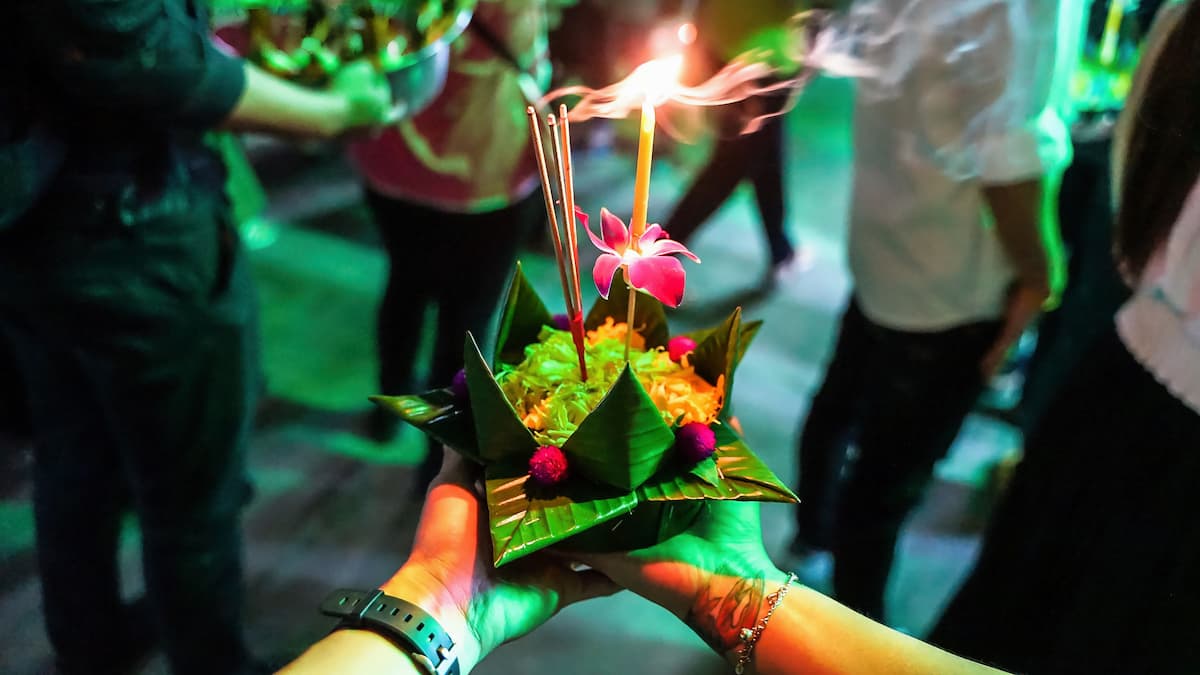
Usually falling in November, although the exact date changes each year, Loi Krathong takes its name from the act at the centre of the festival. Loi means to float, while a krathong is a small decorated vessel traditionally made from natural materials such as banana leaves and sections of banana trunk.
Candles, incense and flowers are placed on the krathong before it is gently released onto the water. Interpretations of the tradition vary, but commonly include showing gratitude and respect to water, asking forgiveness for its use and pollution, making merit, and symbolically releasing misfortune or negativity from the previous year.
Experiencing Loi Krathong in Thailand
Loi Krathong is celebrated throughout Thailand, but its character changes considerably from one destination to another.
Sukhothai has become particularly associated with elaborate celebrations around the ruins of Sukhothai Historical Park, reflecting the city’s strong historical connection with the festival tradition. Bangkok sees krathongs released along the Chao Phraya River and other waterways, while communities throughout the country hold their own temple events, ceremonies and local celebrations.
The experience does not necessarily need to be enormous to be memorable. A small gathering beside a local lake or temple can reveal the quieter side of Loi Krathong more clearly than some of the large organised events.
Increasing environmental awareness has also changed the way the festival is celebrated. Natural and biodegradable krathongs are increasingly encouraged, while some communities limit release locations or organise the collection of offerings after the festival.
When Loi Krathong Meets Yi Peng
Northern Thailand adds another dimension to the celebration.
In Chiang Mai and other parts of the former Lanna cultural region, Loi Krathong occurs at approximately the same time as Yi Peng, a Northern Thai tradition associated with lanterns and illumination.
The result can appear to visitors to be one enormous festival: krathongs floating on the water, lanterns illuminating temples and streets, processions moving through the city and, where permitted, glowing khom loi rising into the night sky.
They are, however, distinct traditions.
That distinction is easily missed — and understanding it reveals another layer of Thailand’s remarkable regional culture.
Yi Peng — Northern Thailand’s Famous Lantern Festival
Few images of Thailand are as instantly recognisable as hundreds of glowing lanterns rising together into the night sky. The celebration behind much of that imagery is Yi Peng, a traditional Lanna festival most strongly associated with Chiang Mai and Northern Thailand.
Yi Peng takes place around the full moon of the second month of the traditional Lanna lunar calendar, usually coinciding with Loi Krathong in November. Light is central to the celebration, with homes, temples and public spaces decorated with colourful lanterns, while Buddhist merit-making and religious ceremonies form an important part of the tradition.
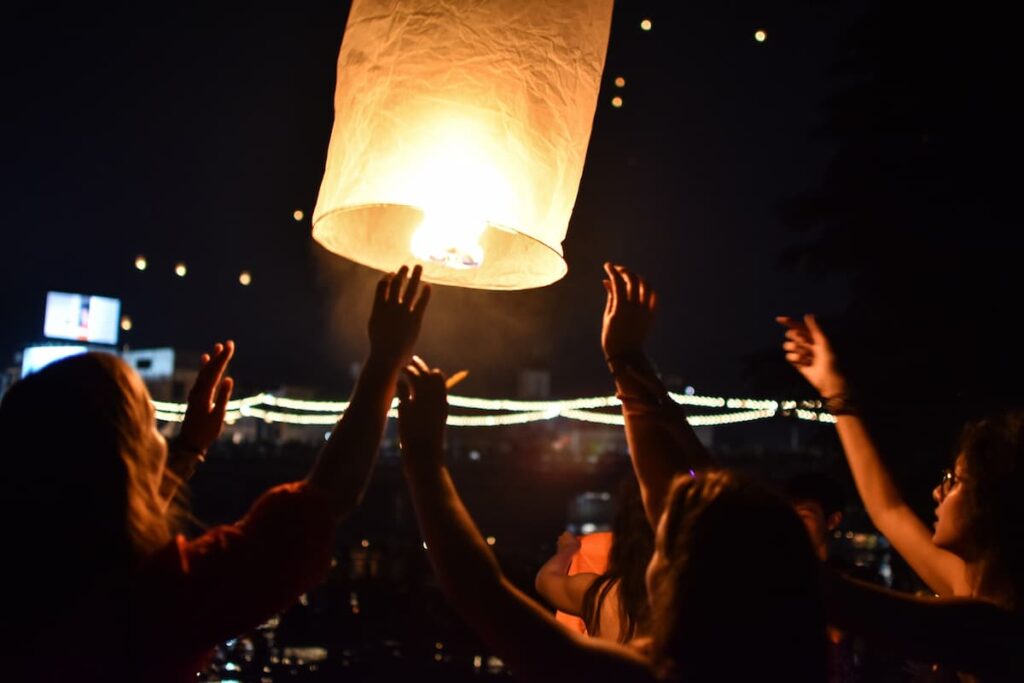
The best-known lanterns among international visitors are khom loi — paper lanterns that rise when the heated air inside them becomes buoyant. Their release has become symbolic of letting go of misfortune and making wishes for the future, although Yi Peng encompasses considerably more than the mass lantern releases seen in photographs.
Yi Peng or Loi Krathong — What’s the Difference?
The distinction can be confusing because visitors to Chiang Mai can experience both festivals at essentially the same time.
Loi Krathong is the wider Thai tradition centred on floating decorated krathongs on water. Yi Peng developed from the Lanna traditions of Northern Thailand and is particularly associated with lanterns and illumination.
In Chiang Mai, the two celebrations now overlap so closely that they can easily feel like different parts of a single festival. A traveller might release a krathong onto the water, walk past illuminated temples and later watch lanterns rising into the sky without any obvious indication that these customs have different cultural origins.
This is also why Yi Peng is frequently described internationally simply as Thailand’s “Lantern Festival”, while some photographs of sky lanterns are incorrectly labelled as Loi Krathong.
Experiencing Yi Peng in Chiang Mai
Chiang Mai is the best-known destination for experiencing Yi Peng, with temples, streets and public spaces throughout the city decorated for the festival period. Traditional lantern displays, religious ceremonies, cultural performances and processions can all form part of the celebrations.
Visitors hoping to see the spectacular mass release of khom loi should be aware that lantern releases are increasingly controlled. Restrictions are imposed because uncontrolled lanterns can create fire hazards and interfere with aviation, particularly around Chiang Mai International Airport. Large releases may therefore take place only at authorised locations and times, and some highly photographed mass-release events are organised separately from the public celebrations.
That distinction is worth understanding before travelling specifically for the famous photographs.
Even without thousands of lanterns filling the sky simultaneously, Yi Peng remains one of Thailand’s most atmospheric celebrations. Illuminated temples, traditional Lanna lanterns and the simultaneous presence of Loi Krathong create an experience that is unmistakably Northern Thai — and demonstrate perfectly how a strongly regional tradition can become one of Thailand’s most internationally recognised cultural images.
Thailand’s Important Buddhist Festival Days
Not every important celebration in Thailand resembles a festival in the conventional sense. Several of the most significant dates in the Thai calendar are Buddhist holy days, when the emphasis shifts away from entertainment towards temples, merit-making, religious observance and reflection.
For travellers, these days can be less visually obvious than Songkran or Loi Krathong, but they provide an important window into the role Buddhism continues to play in Thai life. Temples may become particularly active, families make merit and attend ceremonies, and evening candlelit processions known as wian tian can take place around important temple buildings.
Makha Bucha
Usually falling in February or March, Makha Bucha commemorates an important gathering of 1,250 disciples who, according to Buddhist tradition, assembled spontaneously to hear the Buddha teach.
In Thailand, people may visit temples, make merit, give alms and participate in evening candlelight processions. During wian tian, worshippers traditionally walk clockwise around the principal temple building three times while carrying flowers, incense and candles.
Visakha Bucha
Visakha Bucha is among the most important days in the Buddhist calendar. Usually occurring in May or June, it commemorates three defining events traditionally associated with the same full-moon day: the Buddha’s birth, enlightenment and passing into final Nirvana.
Temples throughout Thailand hold religious activities, and many people make merit, listen to teachings and participate in candlelight processions after sunset.
For travellers, it can be one of the most meaningful occasions to observe Buddhist practice in Thailand, provided temples are approached as active places of worship rather than festival attractions.
Asalha Bucha
Usually falling in July, Asalha Bucha commemorates the Buddha’s first sermon after attaining enlightenment and the establishment of the Buddhist Sangha, or monastic community.
Temple visits, merit-making and evening ceremonies take place around Thailand. Asalha Bucha also leads directly into another important period in Thai Buddhism — Khao Phansa.
Khao Phansa — The Beginning of Buddhist Lent
Khao Phansa marks the beginning of the approximately three-month Buddhist rains retreat. Traditionally, monks remain based at a particular monastery during the rainy season rather than travelling extensively.
The observance has deep historical connections with Thailand’s seasonal and agricultural rhythms, and communities traditionally support monasteries with useful supplies during the retreat.
Among these offerings were candles, once essential for monks studying and conducting religious activities after dark. In Ubon Ratchathani, that practical act of offering candles eventually developed into one of Thailand’s most extraordinary regional celebrations — the Ubon Ratchathani Candle Festival.
Ok Phansa — The End of Buddhist Lent
Ok Phansa marks the end of the rains retreat, usually in October. Temples and communities around Thailand observe the occasion through merit-making and religious ceremonies, while different regions have developed their own distinctive traditions around the period.
These include boat races, Tak Bat Thewo alms-giving ceremonies and, along the Mekong in Nong Khai, celebrations surrounding the mysterious Naga fireballs.
Together, these Buddhist observances reveal something important about Thailand’s festival culture. The spectacular regional celebrations visitors encounter are often not isolated inventions. They have developed around religious practices and calendar dates that continue to be observed much more widely throughout the country.
Ubon Ratchathani Candle Festival — Buddhist Faith on a Monumental Scale
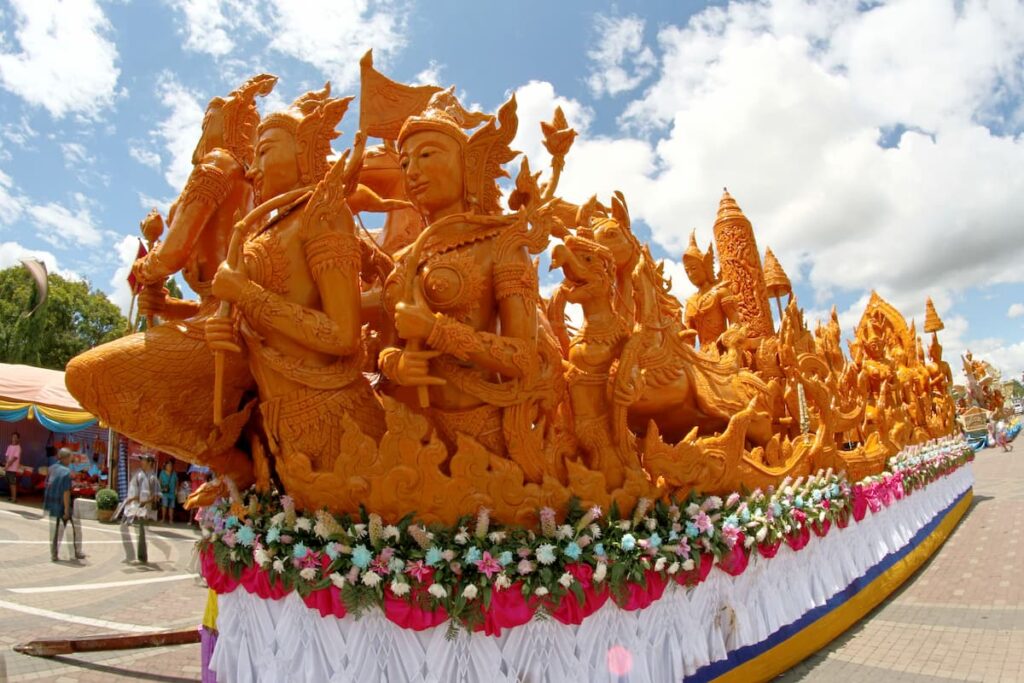
The Ubon Ratchathani Candle Festival is one of the clearest examples of how a Buddhist observance can develop into an extraordinary regional celebration. Held around Asalha Bucha and Khao Phansa, the festival transforms the traditional offering of candles to Buddhist monasteries into enormous works of art.
The origins are relatively practical. As monks entered the rainy-season retreat, communities provided candles and other necessities to support life and religious study within the monastery. Over time in Ubon Ratchathani, individual candle offerings developed into increasingly elaborate community creations and processions.
Today, teams of artists and craftspeople create immense sculpted wax displays, often depicting scenes and figures drawn from Buddhism, mythology and Thai artistic traditions. Some take weeks to complete before being carried through the city on enormous decorated floats during the festival procession.
More Than a Parade of Giant Candles
The scale of the sculptures can make the Candle Festival appear primarily artistic, but its connection with Khao Phansa remains fundamental to understanding it.
Temples and communities participate in the preparations, and the process of creating the candles itself has become an important expression of local identity. Skills are passed between generations, neighbourhoods work together on elaborate entries, and religious observance continues alongside the public celebrations.
For travellers, this makes Ubon particularly interesting. The festival is spectacular enough to justify travelling specifically to see it, yet what visitors are watching grew from a practice found much more widely across Buddhist Thailand.
Ubon Ratchathani simply took that tradition in an extraordinary direction.
Experiencing the Ubon Candle Festival
Ubon Ratchathani, in Thailand’s northeastern Isan region, is the centre of the celebration. Activities take place around the Khao Phansa period, generally in July, although the exact dates change according to the lunar calendar.
The main candle procession attracts large crowds, but some of the most interesting experiences can occur before the parade itself. Visitors may be able to see communities and artisans working on the enormous wax sculptures and appreciate the detail that becomes difficult to take in once the floats begin moving through crowded streets.
The festival also provides an excellent introduction to Isan beyond Thailand’s better-known beach and city destinations. Here, Buddhist practice, local craftsmanship and community participation come together in a celebration that remains unmistakably connected to its place of origin.
It is precisely the kind of regional festival that deserves a place in a wider guide to Thailand: not because it is celebrated everywhere, but because it shows how a nationwide religious tradition can develop a remarkable local identity.
Phi Ta Khon — Thailand’s Famous Ghost Festival
With towering masks, painted faces, bells and colourful costumes filling the streets, Phi Ta Khon is one of Thailand’s most distinctive regional festivals. It takes place in Dan Sai district in Loei Province in northeastern Thailand and is often introduced to visitors simply as Thailand’s “Ghost Festival”.
The name captures the extraordinary appearance of the celebration, but not its deeper meaning. Phi Ta Khon forms part of Bun Luang, an important local merit-making festival that brings Buddhist traditions together with longstanding community beliefs surrounding spirits and protection.
One explanation for the festival’s ghostly figures is connected with the story of Prince Vessantara, the Buddha in one of his previous lives. According to tradition, the celebrations surrounding his return were so joyful that spirits emerged to join the festivities. The story became intertwined with local beliefs and developed into the masked celebration seen in Dan Sai today.
Behind the Famous Phi Ta Khon Masks
The masks are what make Phi Ta Khon immediately recognisable. Traditionally made using locally available materials, they are decorated with vivid patterns and exaggerated features before being combined with colourful costumes.
During the festival, groups of masked participants move through Dan Sai dancing, making noise and interacting with the crowds. The atmosphere can appear playful and chaotic, particularly when viewed through photographs or videos.
Yet the masked procession is only one part of a wider religious and community event.
Buddhist ceremonies, merit-making and sermons form part of Bun Luang, demonstrating again how difficult it can be to divide Thai religious practice, local spiritual beliefs and public celebration into completely separate categories.
Experiencing Phi Ta Khon in Dan Sai
Unlike Songkran or Loi Krathong, Phi Ta Khon is strongly tied to a specific community. Dan Sai is the festival’s cultural home, and travelling there is part of experiencing the tradition in its proper context.
The festival usually takes place around June or July, but visitors need to check the confirmed dates each year. The timing is traditionally determined locally and follows the lunar calendar rather than a fixed annual date.
Its popularity now attracts visitors from across Thailand and overseas, but Phi Ta Khon remains valuable precisely because of its local identity.
It is a good reminder that cultural importance does not have to mean nationwide participation. A festival rooted in one relatively small community can reveal just as much about Thailand as celebrations taking place across the entire country — particularly when centuries of Buddhist tradition, local belief and community identity continue to meet in the same streets.
Bun Bang Fai — Thailand’s Rocket Festival
Few celebrations demonstrate the connection between Thailand’s festivals and traditional agricultural life as dramatically as Bun Bang Fai, the Rocket Festival. Most strongly associated with communities across Isan in northeastern Thailand, the festival takes place as the dry season gives way to the rains and farmers prepare for another rice-growing season.
The centrepiece is exactly what the name suggests: enormous homemade rockets are carried in colourful processions before being launched high into the sky. Behind the spectacle, however, lies a longstanding tradition connected with fertility, rainfall and the agricultural cycle.
In traditional belief, launching rockets towards the heavens encourages the forces responsible for rain to provide the water needed for the coming crops. The celebrations also incorporate Buddhist merit-making, demonstrating again how different strands of belief can exist alongside one another within Thai festival culture.
Where to Experience Bun Bang Fai
Rocket festivals take place in several communities across Isan, but Yasothon hosts the best-known celebration and has become particularly associated with Bun Bang Fai.
The festival generally takes place in May, although dates and individual community celebrations vary. Processions, music, dancing and elaborately decorated rockets build towards the launches, with teams competing over their creations and performances.
The atmosphere can be loud, humorous and highly energetic. Some traditions surrounding the festival are deliberately playful and irreverent, providing a very different experience from the quieter atmosphere of Thailand’s major Buddhist holy days.
Visitors should also remember that these are genuine rocket launches rather than theatrical effects. Safety restrictions and viewing arrangements should be respected, and spectators should remain within designated areas.
A Festival Shaped by the Coming Rains
Bun Bang Fai becomes much more interesting once its timing is understood.
For generations of farming communities in northeastern Thailand, the arrival of sufficient rain could determine the success of the year’s rice crop. Celebrating, making merit and appealing for rain before planting therefore carried significance far beyond entertainment.
Modern agricultural life has changed enormously, but the festival has survived.
That continuity is what earns Bun Bang Fai a place among Thailand’s major cultural celebrations. The rockets are spectacular, but beneath them is something much older: a community marking the changing season and expressing hopes for rain, fertility and a successful harvest.
Phuket Vegetarian Festival — Faith, Purification and Thai-Chinese Heritage
The Phuket Vegetarian Festival is one of Thailand’s most intense and distinctive cultural celebrations. Famous internationally for dramatic street processions and acts of ritual piercing performed by spirit mediums, the images can be confronting — but focusing only on those scenes misses much of what the festival means to Phuket’s Chinese-Thai community.
Held for nine days during the ninth lunar month of the Chinese calendar, usually in September or October, the festival is associated with the worship of the Nine Emperor Gods. Its development in Phuket is closely connected with the island’s Chinese heritage and the communities that grew around its historic tin-mining industry.
For many participants, this is fundamentally a period of spiritual cleansing and merit-making. People may dress in white, observe a strict vegetarian or vegan-style diet, visit Chinese shrines, make offerings and follow behavioural rules intended to purify the body and mind.
Across Phuket, the festival becomes part of everyday life. Yellow flags identifying vegetarian food appear outside restaurants and stalls, shrines become centres of intense activity, and processions move through streets that visitors may have travelled many times without previously noticing their religious significance.
The Processions and Ma Song
The most internationally recognised aspect of the festival involves the ma song, spirit mediums believed by participants to become vessels for deities during the ceremonies.
During processions, some ma song undertake extreme acts of ritual piercing and other forms of bodily mortification. Firecrackers explode continuously as processions move between shrines and through local communities, creating an atmosphere unlike almost any other festival in Thailand.
These practices should be understood within their religious and cultural context rather than treated simply as spectacle. Visitors are generally able to observe the processions, but photography and behaviour should remain respectful, particularly around participants undertaking rituals and people actively worshipping.
The scenes can also be graphic. Travellers uncomfortable with blood, piercing or intense ritual practices should be aware of this before positioning themselves close to the main processions.
More Than a Phuket Tradition
Phuket has developed the most internationally famous expression of Thailand’s Vegetarian Festival, but similar Chinese-Thai observances take place elsewhere in the country, including other communities across Southern Thailand and Bangkok.
Phuket nevertheless remains particularly important because of the depth of the tradition on the island. Historic Chinese shrines such as Jui Tui, Bang Neow and Kathu become central to the festival, reflecting a cultural heritage that remains visible throughout Phuket Town and former mining communities long after the nine-day celebration ends.
This is also why the festival belongs in a wider guide to Thailand’s major celebrations despite its strong regional identity.
It reveals a side of Phuket that can be almost completely hidden by the island’s international image of beaches and resorts. For nine days, longstanding Chinese-Thai traditions move unmistakably into the foreground — but the shrines, communities and beliefs behind them are there throughout the year.
Chinese New Year — Thailand’s Thai-Chinese Traditions
Chinese New Year did not originate in Thailand, but generations of Chinese migration and integration have made it an important part of the country’s cultural landscape. In communities with strong Chinese-Thai heritage, the Lunar New Year brings shrines, homes, businesses and streets to life with traditions that have been maintained and adapted over generations.
Usually falling in January or February, the celebration centres on family, paying respect to ancestors, making offerings and welcoming prosperity for the year ahead. Red decorations and clothing become highly visible, Chinese shrines receive worshippers, and some communities hold lion and dragon dances, cultural performances and large public celebrations.
For travellers, Bangkok’s Yaowarat district provides the most famous setting, but Chinese New Year in Thailand extends considerably further. Major celebrations also take place in places such as Nakhon Sawan, Hat Yai and other communities with longstanding Chinese-Thai populations.
Chinese Heritage as Part of Modern Thailand
Including Chinese New Year among Thailand’s major celebrations requires an important distinction. It is not a traditional Thai festival in the same sense as Songkran or Loi Krathong, and it is not observed by every Thai household.
Its importance comes from what it reveals about Thailand itself.
Chinese migration has influenced Thai commerce, food, architecture, religion and family life over generations. Chinese shrines are found throughout the country, while many families identify with both Thai society and Chinese ancestry without seeing the two as contradictory.
The festival therefore provides another example of why Thai culture is better understood as layered rather than uniform.
This becomes particularly apparent when travelling between regions. The Chinese-Thai traditions of Bangkok’s Yaowarat, Phuket’s historic communities and the large celebrations in Nakhon Sawan share cultural roots, but each has developed within its own local setting.
For travellers trying to understand Thailand beyond its most immediately visible traditions, Chinese New Year provides an important perspective. It demonstrates that some of the celebrations now woven into Thai life arrived through migration — and became part of the country through the communities that continued to practise them.
Ok Phansa and the Naga Fireballs of Nong Khai
Along the Mekong River in Nong Khai, the end of Buddhist Lent is associated with one of Thailand’s most unusual annual traditions. Around Ok Phansa, crowds gather beside the river hoping to see glowing reddish lights rise from the Mekong and disappear into the night sky.
Known as Bang Fai Phaya Nak, or the Naga fireballs, the phenomenon has become closely associated with local beliefs surrounding the naga — the powerful serpent-like beings that occupy an important place in Buddhist stories and the spiritual traditions of communities along the Mekong.
According to local tradition, the fireballs are connected with naga living beneath the river and appear to honour the Buddha at the end of the rains retreat. Various natural and human explanations for the lights have also been proposed, and their physical cause remains the subject of considerable debate.
For travellers, however, understanding the cultural significance of the event does not require choosing between those explanations. The important story is why thousands of people continue to gather along the Mekong and what the naga represents within the communities that live beside it.
Where Buddhism and Mekong Beliefs Meet
Naga imagery is not confined to this festival. Serpent figures appear extensively in temples across Thailand, particularly along stairways and entrances, and the naga has especially strong associations with water and the Mekong region.
Around Ok Phansa, these longstanding beliefs become intertwined with the Buddhist calendar. Temples hold merit-making activities, communities celebrate the conclusion of the monks’ rains retreat, and events take place along the river while spectators wait for the mysterious lights.
The best-known viewing areas are in Nong Khai Province, particularly communities along the Mekong, although the exact locations and intensity of the phenomenon can vary from year to year.
Visitors travelling specifically for the Naga fireballs should therefore treat seeing them as a possibility rather than a guaranteed performance. The surrounding religious observances and community celebrations are a more reliable reason to experience Ok Phansa on the Mekong.
Like several of Thailand’s most interesting regional traditions, the Naga fireballs sit at the intersection of Buddhism, local spiritual belief, landscape and community identity. Whether a visitor leaves convinced by the legend or by a more earthly explanation is ultimately less important than understanding why the story continues to matter to the people who gather beside the river each year.
Other Thai Festivals and Traditions Worth Knowing
Thailand’s festival calendar extends far beyond the major celebrations covered above. Across the country, individual provinces and communities maintain traditions shaped by local history, agriculture, waterways, religion and regional identity.
The following are not necessarily festivals around which most international travellers would plan an entire Thailand itinerary, but each reveals another part of the country’s cultural landscape.
Longboat Racing Festivals
Traditional longboat races take place in river communities across Thailand, particularly around the end of Buddhist Lent and as rivers swell during the later months of the rainy season.
Teams of paddlers race long, narrow boats representing temples or communities, often accompanied by local fairs and religious activities. Some racing boats incorporate naga imagery and longstanding beliefs connected with rivers, rain and the spirits associated with the boats themselves.
Nan, Phichit and several communities along major rivers are particularly known for the tradition, but there is no single national longboat festival. Instead, it is a good example of similar customs developing distinctive local identities across different parts of Thailand.
Chonburi Buffalo Racing Festival
The Chonburi Buffalo Racing Festival, or Wing Kwai, reflects Thailand’s longstanding relationship with agriculture.
Held annually in Chonburi around the end of Buddhist Lent, the tradition brings decorated buffaloes and their handlers together for races and associated celebrations. The festival has continued for generations and offers a very different picture of Chonburi from the coastal tourism for which the province is better known internationally.
Behind the racing is the historic importance of buffaloes to Thai farming communities, particularly before agricultural mechanisation transformed rice cultivation.
Royal Ploughing Ceremony
The Royal Ploughing Ceremony is better understood as an important national tradition than as a conventional festival, but it deserves mention because of what it reveals about Thailand’s agricultural heritage.
Held in Bangkok before the main rice-growing season, the ancient ceremony symbolically marks the beginning of cultivation and seeks an auspicious agricultural year. Brahmanical rituals, royal tradition and predictions concerning the coming harvest are brought together in a ceremony whose significance reflects the historic importance of rice cultivation to Thailand.
Visitors should approach it as a formal cultural and royal ceremony rather than a public festival.
Tak Bat Thewo
Around Ok Phansa, some Thai temples hold Tak Bat Thewo, a distinctive alms-giving tradition commemorating the Buddha’s return from the heavenly realm after teaching his mother.
Monks descend from an elevated temple or staircase while laypeople wait below to offer food and other alms. One of the best-known celebrations takes place at Wat Sangkat Rattana Khiri in Uthai Thani, where a long staircase descending from Khao Sakae Krang creates a particularly striking setting.
Like many traditions in this guide, its importance lies not simply in what visitors can photograph. It demonstrates how Buddhist stories and merit-making practices continue to be expressed through community traditions across Thailand.
Together, these celebrations reinforce an important point: there is no realistic way to reduce Thailand’s festival culture to a definitive top-ten list. Beyond the nationally recognised events are hundreds of provincial, temple and community traditions, many of which remain deeply important precisely because they belong to a particular place.
When Is the Best Time to Experience Festivals in Thailand?
There is no single festival season in Thailand. Major celebrations occur throughout the year, which means travellers can encounter an important cultural event in almost any season.
The important complication is that many Thai festivals and Buddhist observances follow Thai, Buddhist, Lanna or Chinese lunar calendars rather than a fixed Gregorian date. Their dates can therefore change from year to year. Always check confirmed dates before booking a trip specifically around a festival.
| Festival or observance | Usually occurs | Main destination or reach |
|---|---|---|
| Chinese New Year | January–February | Bangkok, Nakhon Sawan, Hat Yai and Chinese-Thai communities |
| Makha Bucha | February–March | Nationwide |
| Songkran | 13–15 April | Nationwide |
| Bun Bang Fai | May, with local variations | Isan, especially Yasothon |
| Visakha Bucha | May–June | Nationwide |
| Phi Ta Khon | Usually June–July | Dan Sai, Loei |
| Asalha Bucha & Khao Phansa | July | Nationwide |
| Ubon Candle Festival | Around Khao Phansa, usually July | Ubon Ratchathani |
| Vegetarian Festival | September–October | Phuket and Chinese-Thai communities |
| Ok Phansa | Usually October | Nationwide |
| Naga Fireball celebrations | Around Ok Phansa | Nong Khai and the Mekong |
| Loi Krathong | Usually November | Nationwide |
| Yi Peng | Usually November | Northern Thailand, especially Chiang Mai |
Which Festival Should You Plan a Thailand Trip Around?
For a first experience of a major nationwide Thai celebration, Songkran and Loi Krathong are the easiest choices. Both are celebrated widely enough that travellers can incorporate them into many different Thailand itineraries rather than travelling to one particular province.
For something more regionally distinctive, Yi Peng in Chiang Mai, Phi Ta Khon in Dan Sai, Bun Bang Fai in Yasothon, the Ubon Candle Festival and Phuket Vegetarian Festival can justify planning part of a trip around a particular destination.
The experience you want matters as much as the festival’s fame. Songkran can be exuberant and chaotic, while an important Buddhist holy day may offer a much quieter opportunity to observe temple life. Yi Peng is renowned for atmosphere and illumination, whereas Phuket’s Vegetarian Festival can be intense and confronting.
There is therefore no single “best” Thai festival for every traveller.
Choose according to the part of Thai culture you want to experience — and if a particular festival is important to your trip, confirm both its dates and the local programme before making non-refundable travel arrangements.
Experiencing Thai Festivals Respectfully
Visitors are welcomed at many of Thailand’s festivals, and joining a celebration can become one of the most memorable experiences of a trip. The important thing to remember is that behind the crowds, costumes and spectacular photographs, many of these events remain religious or culturally significant occasions for the communities taking part.
At temples and Buddhist ceremonies, dress respectfully, remove shoes where required and avoid interrupting people who are praying or making merit. Photography is often acceptable, but permission should be sought when the situation feels personal or when you are close to worshippers, monks or ritual participants.
During processions, allow participants to move freely rather than stepping into their path for a photograph. This is particularly important during events such as the Phuket Vegetarian Festival, where religious rituals can be intense and participants are not performing simply for spectators.
Songkran has its own considerations. Water throwing may dominate busy celebration areas, but monks, elderly people, babies, people working and anyone clearly trying to avoid the festivities should not automatically be treated as targets. Protect phones, cameras and important documents, and expect transport to be slower in major celebration zones.
Environmental considerations also matter. During Loi Krathong, use only locally permitted, biodegradable offerings and follow local guidance about where krathongs may be released. Sky lanterns during Yi Peng should only be released where and when they are legally permitted because of fire and aviation risks.
Travellers should also be aware that major Buddhist holy days can affect alcohol sales and entertainment. Restrictions vary according to the occasion and applicable regulations, so check locally rather than assuming bars, restaurants and nightlife venues will operate normally.
Perhaps the simplest principle is also the most useful: not every cultural experience requires active participation.
Sometimes joining in is welcomed. At other moments, quietly watching from an appropriate distance is the more respectful way to experience what is taking place. Thailand’s festivals become considerably more rewarding when they are approached as living traditions first and visitor attractions second.
Travel With Insight: Thailand Festivals
Having spent years living in Thailand and travelling through different parts of the country, one of the things that has increasingly stood out to me is how present tradition remains in everyday life.
I have travelled in countries where major religious or cultural occasions such as Christmas and Easter remain highly visible, but Thailand has felt different to me. Here, you do not necessarily have to wait for a major festival to see people visiting temples, making offerings, paying respect at shrines, making merit or maintaining traditions that have been passed through families and communities.
It is something I probably noticed only gradually. A shrine beside a business, food being offered to monks early in the morning, a temple suddenly much busier on an important Buddhist day, or a small ceremony taking place within a community can initially seem like separate observations. Over time, you begin to recognise how these practices connect with the much larger celebrations.
I have been fortunate enough to experience Songkran in Chiang Mai five times so far, and I have enjoyed every one of them. Some experiences have involved embracing the enormous water-fight mentality; others have allowed me to see much more of the traditional and respectful side of Thai New Year. I have celebrated with Thai friends and with foreign friends, and each time has felt different.
Perhaps surprisingly, my favourite Songkran experience was in Ao Nang. The celebration was smaller than Chiang Mai or Patong, but somehow felt deeper and more connected to the community around it. Celebrating in Phuket and Patong has been different again. The scale, atmosphere and character change from place to place, but the underlying principles of renewal, family, respect and celebration remain remarkably consistent.
Some festival memories stay with you for completely different reasons. My first experience of Yi Peng was in Chiang Mai, where it overlapped with Loi Krathong. At the time, I did not really distinguish between the two. There were krathongs on the water and lanterns rising into the night sky, and I simply experienced it as one remarkable celebration.
I understood the cultural distinction much later, but the memory came first. Watching those lanterns rise above Chiang Mai remains one of my favourite moments from many beautiful experiences in Thailand.
These experiences have changed the way I look at Thai festivals. Songkran becomes more than a water fight when you understand the family, renewal, merit-making and respect behind it. The Ubon Candle Festival makes more sense when you understand Khao Phansa. Yi Peng becomes more interesting when it is recognised as a living Lanna tradition rather than simply an extraordinary photograph of lanterns in the sky.
For me, that is one of the most rewarding things about spending more time in Thailand: the festivals make much more sense once you start noticing the traditions between the festivals.
The spectacle may be what first catches your attention, but understanding what sits behind it is often what stays with you.
Frequently Asked Questions About Festivals in Thailand
What is the biggest festival in Thailand?
Songkran is generally considered Thailand’s biggest and most widely celebrated festival. Thai New Year takes place each April, with celebrations occurring across the country. Although internationally famous for enormous water fights, Songkran also remains an important period for family reunions, temple visits, merit-making, renewal and showing respect to elders.
What are the most important festivals in Thailand?
Songkran and Loi Krathong are Thailand’s best-known nationwide celebrations, but several regional festivals also have major cultural significance. These include Yi Peng in Northern Thailand, Phi Ta Khon in Loei, Bun Bang Fai in Isan, the Ubon Ratchathani Candle Festival and the Phuket Vegetarian Festival. Important Buddhist observances such as Visakha Bucha and Khao Phansa also form an important part of Thailand’s annual cultural calendar.
Are Loi Krathong and Yi Peng the same festival?
No. Loi Krathong and Yi Peng are separate traditions that occur at approximately the same time. Loi Krathong is celebrated widely across Thailand and centres on floating decorated krathongs on water. Yi Peng originates from the Lanna culture of Northern Thailand and is particularly associated with lanterns and illumination.
Because both are celebrated simultaneously in places such as Chiang Mai, visitors can easily experience them as one combined celebration.
What is Thailand’s lantern festival called?
The famous Northern Thai lantern festival is Yi Peng, most strongly associated with Chiang Mai and the wider Lanna cultural region. The glowing sky lanterns known as khom loi have become internationally recognised images of the festival.
Yi Peng coincides with Loi Krathong, which is why images of sky lanterns are sometimes incorrectly described simply as Loi Krathong.
Which Thai festival is best for visitors?
For a first major festival experience, Songkran and Loi Krathong are the easiest to incorporate into a Thailand trip because they are celebrated throughout much of the country.
Travellers looking for a more regional experience might consider Yi Peng in Chiang Mai, Phi Ta Khon in Dan Sai, the Ubon Candle Festival, Bun Bang Fai in Yasothon or the Phuket Vegetarian Festival.
The best choice depends on whether you want a large public celebration, religious and cultural traditions, spectacular imagery or a more locally distinctive experience.
When are Thailand’s major festivals?
Thailand’s festival calendar runs throughout the year. Songkran has fixed principal dates from 13–15 April, while many other festivals and Buddhist observances follow lunar calendars and therefore change dates each year.
Loi Krathong and Yi Peng usually occur in November, the Phuket Vegetarian Festival generally falls in September or October, and major Buddhist observances occur at different points throughout the year.
If a festival is an important reason for your trip, always confirm the official dates before booking accommodation or transport.
Do businesses close during festivals in Thailand?
It depends on the festival and location. During major celebrations such as Songkran, government offices, banks and some businesses may close while tourism businesses, restaurants and entertainment areas can become extremely busy.
Major Buddhist holy days can also bring restrictions on alcohol sales, while local festivals may cause road closures, altered transport routes and large crowds around temples or procession areas.
Travellers should check local arrangements for the particular destination and festival rather than assuming normal operating conditions.
Continue Exploring
Continue planning your journey with our wider destination guides.
Thailand Travel Guide
Explore Thailand’s regions, destinations, culture and practical travel information with our complete country guide.
Southern Thailand Travel Guide
Discover Southern Thailand’s islands, beaches, national parks, cultural attractions and destinations across the Andaman Coast and Gulf of Thailand.
Northern Thailand Travel Guide
Explore the mountains, historic cities, temples, communities and distinctive Lanna culture of Northern Thailand.
Related Reading
Discover more about Thailand’s culture, history and places with these related guides.
Thailand’s Most Important Historical Sites
Explore ancient capitals, archaeological sites and historic landmarks that reveal different periods of Thailand’s past.
Thailand’s Most Important Temples
Discover some of Thailand’s most significant Buddhist temples and the history, architecture and traditions behind them.
Thailand’s Most Popular Islands
Explore the islands that attract the greatest number of visitors and what makes each one different.
Thailand’s Most Popular Beaches
Discover some of Thailand’s best-known beaches, from major resort destinations to celebrated island and mainland coastlines.
About the Author
David Hibbins is a travel publisher, destination researcher and the creator of Travel With Insight.
Through years of travel, tourism and publishing projects across Southeast Asia, he has developed a particular interest in how travellers research destinations, compare experiences and make travel decisions.
His work focuses on helping travellers move beyond popularity rankings, marketing claims and generic “best of” lists by providing balanced, research-driven destination guides. Rather than telling people where they should travel, his goal is to help readers understand the strengths, limitations and unique character of each destination so they can choose the places that best match their own interests, travel style and goals.
As the creator of Travel With Insight, David researches destinations throughout Southeast Asia, exploring not only where travellers go, but why they choose certain places, how destinations differ and what creates genuinely memorable travel experiences.
His work covers destination research, regional travel planning, traveller behaviour and the decision-making frameworks that help people plan more rewarding journeys.
Explore More Travel Resources
Every great journey begins with informed decisions. The more you understand a destination before you arrive, the more rewarding your travel experience becomes.
Whether you’re still researching Southern Thailand or you’re ready to start planning your itinerary, these additional resources can help.
Travel With Insight
Continue exploring our in-depth destination guides, travel inspiration and practical planning advice designed to help you make informed travel decisions throughout Thailand and Southeast Asia.
Go Find Asia
Looking for even more travel inspiration? Go Find Asia explores destinations, experiences and travel ideas across Asia, helping you discover where to go, what to see and how to plan your next adventure.
Resurgence Travel
When you’re ready to turn your research into reality, Resurgence Travel offers curated itineraries, personalised travel planning and local expertise to help you experience the very best of Thailand and Southeast Asia.