
Historical Places in Thailand: Where to Experience the Country’s Past
Thailand’s history is visible in far more than its famous temple ruins. Former capitals, royal palaces, fortified old towns, trading communities, ancient religious sites and places connected with more recent events all reveal different chapters in the country’s development.
Some of Thailand’s best-known historical places, including Ayutthaya and Sukhothai, provide a window into kingdoms that shaped the country centuries ago. Elsewhere, Chiang Mai reflects the legacy of the Lanna Kingdom, Khmer-era monuments survive across the northeast, and the historic neighbourhoods of Phuket, Songkhla and Bangkok reveal the influence of trade, migration and cultural exchange.
Thailand’s more recent history can also be explored through royal Bangkok, historic provincial towns and Second World War sites around Kanchanaburi. Together, these places offer a much broader picture of the country’s past than ancient ruins alone.
This guide explores the historical places in Thailand that are most useful for understanding that story, what makes each one significant, and how to decide which are worth including in your trip.
Historical Places in Thailand: Quick Summary
Thailand’s historical places offer very different experiences, from ruined capitals and Khmer temples to royal palaces, old trading towns and Second World War sites.
If you are deciding where to include history in your Thailand itinerary, these are some of the strongest places to consider.
| Destination | Go if… |
|---|---|
| Ayutthaya | You want impressive ancient ruins and an easy historical trip from Bangkok |
| Sukhothai | You want a quieter ancient capital that is ideal for exploring slowly or by bicycle |
| Chiang Mai | You want to experience Lanna history within a living modern city |
| Phanom Rung | You are interested in Khmer architecture and early regional history |
| Bangkok | You want royal history, historic temples and the story of Thailand’s present-day capital |
| Kanchanaburi | You are interested in Second World War history and the Thailand–Burma Railway |
| Nakhon Si Thammarat | You want to explore the religious and cultural history of Southern Thailand |
| Phuket Old Town | You are interested in tin mining, migration and multicultural trading history |
| Songkhla Old Town | You want a less-visited historic town shaped by Thai, Chinese and Malay influences |
| Lopburi | You want royal and international history beyond Thailand’s better-known ancient capitals |
Ancient Capitals: Sukhothai and Ayutthaya
Sukhothai and Ayutthaya are two of the most important places for understanding the development of Thailand. Both served as capitals of powerful kingdoms, but they represent different periods and offer very different experiences for travellers today.
Sukhothai
Sukhothai emerged as an important kingdom during the 13th century and is closely associated with the development of distinctive Thai traditions in art, architecture, religion and government. Its surviving temples, Buddha images, ponds and monuments are spread across a large historical landscape rather than concentrated within a modern city centre.
That setting is a major part of the experience. Exploring Sukhothai Historical Park by bicycle or on foot allows you to move between substantial temple complexes and smaller ruins surrounded by trees and open spaces. Wat Mahathat forms the historic centre, while sites such as Wat Si Chum and its enormous seated Buddha provide some of Sukhothai’s most memorable individual monuments.
For travellers interested in Thailand’s early kingdoms, Sukhothai provides both historical context and one of the country’s most atmospheric archaeological landscapes.
Ayutthaya
Founded in 1350, Ayutthaya developed into the centre of a powerful kingdom that dominated much of the region for more than four centuries. Its position on interconnected rivers helped it become an important centre for commerce and diplomacy, with merchants and representatives arriving from across Asia, the Middle East and Europe.
The surviving city reflects that scale. Temple towers, monasteries, Buddha images and palace remains are scattered throughout modern Ayutthaya, including Wat Mahathat, Wat Ratchaburana and the large reclining Buddha at Wat Lokaya Sutharam.
Visiting Ayutthaya therefore offers more than an encounter with ruined temples. The remains provide a glimpse of a wealthy, internationally connected capital that played a major role in shaping the Thailand that followed.
Its proximity to Bangkok also makes Ayutthaya one of Thailand’s most accessible major historical destinations, whether visited independently, on a day trip or as part of a longer journey north.
Sukhothai or Ayutthaya: Which Should You Visit?
If your itinerary only allows time for one ancient capital, the choice depends largely on the experience you want.
Choose Sukhothai if you prefer a quieter historical landscape, enjoy exploring by bicycle and want to learn more about an earlier period in the development of the Thai kingdoms.
Choose Ayutthaya if you want larger concentrations of monumental ruins, are interested in Thailand’s royal and international history, or need a historical destination that can easily be reached from Bangkok.
Both are worth visiting on a longer journey through Thailand, but they do not provide the same experience. Seeing both helps reveal how the country’s political, religious and cultural centres evolved over several centuries.
Royal Thailand: Palaces and Historic Royal Centres
Thailand’s royal history extends well beyond the ancient capitals. Palaces, royal temples and former administrative centres provide a different perspective on how the country developed, particularly during the transition from Ayutthaya to Bangkok and the emergence of modern Thailand.
The Grand Palace and Historic Bangkok
Established in 1782 following the founding of Bangkok as the new capital, the Grand Palace became the political and ceremonial centre of the early Rattanakosin Kingdom. Its location beside the Chao Phraya River formed part of a new royal city whose temples, canals, defensive structures and communities shaped the historic centre of Bangkok.
Within the palace complex is Wat Phra Kaew, home of the Emerald Buddha and one of Thailand’s most important religious sites. The surrounding architecture also reflects successive periods of royal construction and changing influences as Bangkok developed during the 19th and early 20th centuries.
Rather than viewing the Grand Palace in isolation, it is worth exploring it as part of historic Rattanakosin. Wat Pho, the old city streets and the riverfront help place the palace within the larger story of Bangkok becoming Thailand’s capital.
Bang Pa-In Royal Palace
Around 20 kilometres south of Ayutthaya, Bang Pa-In provides a very different royal experience. Although a palace existed here during the Ayutthaya period, much of the complex visitors see today was developed by Kings Mongkut and Chulalongkorn during the 19th century.
The collection of Thai, European and Chinese-influenced buildings reflects a period when Siam was engaging increasingly with foreign powers while undertaking significant political, technological and social change.
Bang Pa-In works particularly well as an addition to an Ayutthaya visit. Together, the two places reveal very different stages of Thai royal history rather than simply providing another collection of historic buildings.
Lopburi and King Narai’s Palace
Lopburi offers another perspective on Thailand’s royal past. Although the city has a much longer history, it became particularly important during the 17th-century reign of King Narai, who used Lopburi as a second royal centre away from Ayutthaya.
The remains of Phra Narai Ratchaniwet, commonly known as King Narai’s Palace, reflect a period of extensive diplomatic and commercial contact between Siam and the outside world. Persian, European and other foreign communities were active in the kingdom, while diplomatic missions connected the royal court with countries as distant as France.
Lopburi is therefore particularly interesting for travellers who want to look beyond Thailand’s better-known capitals. Its surviving palace and archaeological sites reveal that royal power, international trade and diplomacy were not confined to Ayutthaya itself.
Historic Old Towns and Cities
Not every historical place in Thailand is an archaeological site. In several cities, old streets, traditional buildings, temples, markets and long-established communities remain part of everyday life. These places provide an opportunity to experience how different periods of Thai history continue to influence modern towns and cities.
Chiang Mai Old City
Chiang Mai was founded in 1296 as the capital of the Lanna Kingdom, which developed its own cultural and architectural traditions across much of what is now Northern Thailand.
The historic centre remains defined by its moat and surviving sections of the old city walls and gates. Within them are numerous temples associated with different periods of Chiang Mai’s history, including Wat Chedi Luang and Wat Phra Singh.
Unlike an archaeological park, Chiang Mai Old City remains a busy part of the modern city. Temples continue to function, markets occupy historic neighbourhoods and streets that once formed part of the Lanna capital are now lined with homes, restaurants, guesthouses and businesses.
This combination makes Chiang Mai particularly useful for understanding how historical places in Thailand can remain part of everyday life rather than existing purely as preserved monuments.
Phuket Old Town
Phuket Old Town tells a very different story. Its historical importance is closely connected with the island’s development as a major tin-mining and trading centre, particularly during the 19th and early 20th centuries.
Chinese migration played an important role in that development, while Phuket’s connections with regional trading centres including Penang influenced the architecture and culture of the town. Colourful shophouses, Chinese shrines, former merchant homes and narrow commercial streets remain visible throughout the historic centre.
Streets including Thalang Road, Dibuk Road and Phang Nga Road make the area easy to explore on foot, while places such as the Thai Hua Museum provide additional context for understanding Phuket’s Chinese heritage.
For travellers who primarily associate Phuket with beaches and resorts, the Old Town reveals a much older commercial and multicultural side of the island.
Songkhla Old Town
Songkhla’s historic centre developed through its position on important maritime and regional trading routes in Southern Thailand. Thai, Chinese and Malay communities all contributed to the character of the city, creating a cultural mixture that remains visible in its architecture, religious sites and food.
Nakhon Nok, Nakhon Nai and Nang Ngam roads form the core of the Old Town, where traditional shophouses, Chinese temples, street art and historic buildings sit alongside contemporary cafés and local businesses.
Songkhla receives far fewer international visitors than Phuket or Chiang Mai, but that is part of its appeal. The historic district still feels closely connected with the surrounding city rather than functioning primarily as a visitor attraction.
Other Historic Towns Worth Exploring
Several other Thai towns can add another dimension to a history-focused journey.
Lamphun is one of Northern Thailand’s oldest cities and provides an opportunity to explore the region’s history before the rise of Chiang Mai.
Lampang retains traditional timber houses, temples and neighbourhoods associated with the northern teak trade, alongside influences from both Lanna and later commercial development.
Chanthaburi has a distinctive historic waterfront community shaped by regional commerce and Chinese and Vietnamese settlement.
Phetchaburi combines royal, religious and urban history, with old neighbourhoods and temples surrounding a city that was particularly important to several kings of the Chakri dynasty.
These smaller historic centres can be especially rewarding for travellers who want to explore Thailand’s past beyond its most famous destinations.
Temples That Help Tell Thailand’s History
Temples are among the most visible historical landmarks in Thailand, but many are also active religious sites rather than monuments to the past. Some have been rebuilt, expanded or restored repeatedly over centuries, allowing their architecture, religious traditions and royal connections to reveal different periods of Thai history.
Rather than attempting to list Thailand’s most famous temples, the following examples are particularly useful for understanding how the country developed.
Wat Arun, Bangkok
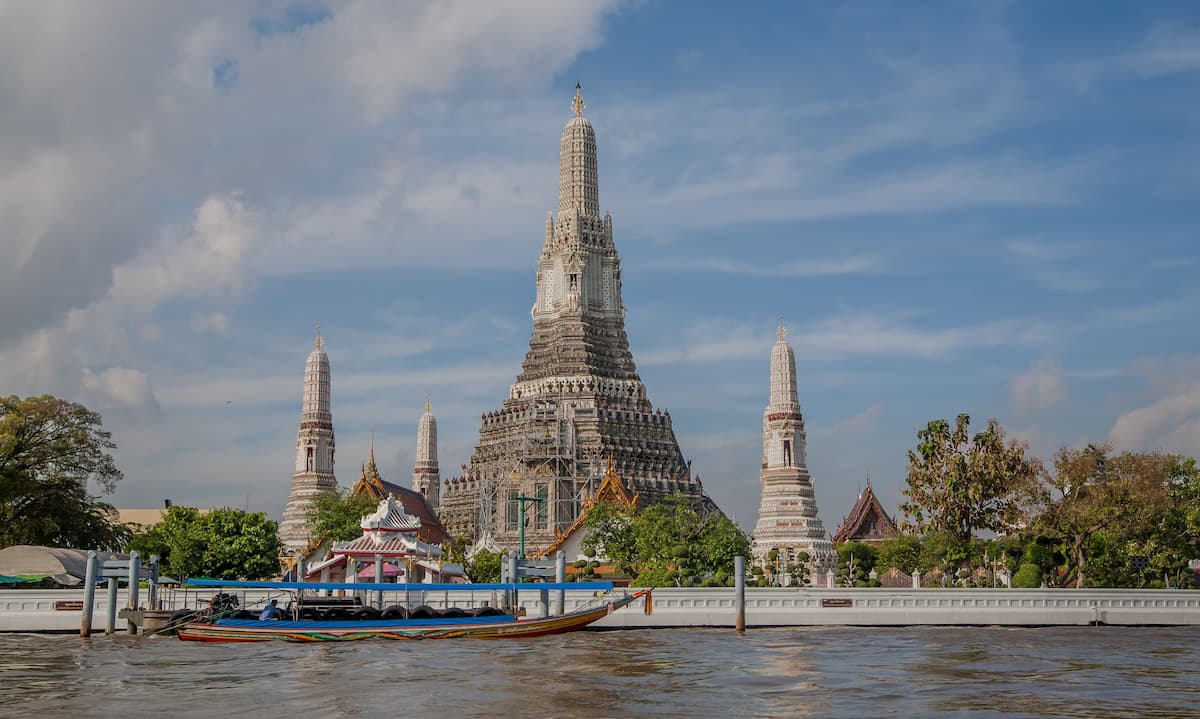
Standing beside the Chao Phraya River, Wat Arun is closely associated with the period when Thonburi briefly served as the capital of Siam following the fall of Ayutthaya in 1767.
King Taksin established his capital at Thonburi, and the temple that occupied this site became part of the new royal centre. Although much of Wat Arun’s distinctive appearance developed later, particularly its towering central prang, its location provides an important connection between the Ayutthaya and Bangkok periods.
For travellers exploring historic Bangkok, Wat Arun helps explain why both sides of the Chao Phraya are important to the story of the modern capital.
Wat Pho, Bangkok
Located immediately south of the Grand Palace, Wat Pho predates the establishment of Bangkok as the capital but was extensively rebuilt under King Rama I and subsequently expanded by later monarchs.
The temple became an important centre for preserving and teaching knowledge, including medicine, literature, religion and traditional Thai massage. Inscriptions and illustrations were placed around the complex so knowledge could be made more widely accessible.
Today, Wat Pho is best known to many visitors for its enormous Reclining Buddha, but its historical importance extends well beyond this single image. The temple provides an unusually accessible connection between religion, royal patronage, education and the development of early Rattanakosin Bangkok.
Wat Chedi Luang, Chiang Mai
Wat Chedi Luang provides a window into Chiang Mai at the height of the Lanna Kingdom. Construction of its enormous chedi began around the end of the 14th century, and the structure became one of the most important religious monuments in the northern capital.
The Emerald Buddha, now housed at Wat Phra Kaew in Bangkok, was kept here during the 15th and 16th centuries. Although the chedi was later damaged and partially restored, its scale still demonstrates the importance of Chiang Mai as a major political and religious centre.
Visiting Wat Chedi Luang alongside Chiang Mai’s surviving walls, gates and other historic temples helps make the former Lanna capital considerably easier to understand.
Wat Phra Mahathat Woramahawihan, Nakhon Si Thammarat
Wat Phra Mahathat Woramahawihan reflects the long religious importance of Nakhon Si Thammarat and provides a valuable southern counterpart to the better-known historic temples of Bangkok and Northern Thailand.
The temple’s large white stupa has been a major centre of Theravada Buddhist devotion for centuries and is traditionally associated with relics of the Buddha. Its importance also reflects Nakhon Si Thammarat’s historical role as a significant political, religious and trading centre on the Malay Peninsula.
For travellers exploring Southern Thailand, the temple demonstrates that the region’s history extends far beyond its modern beach destinations. Nakhon Si Thammarat developed its own longstanding religious and cultural connections with communities across the wider region, making it one of the most important places for understanding the history of southern Thailand.
Khmer History in Thailand
Long before the rise of Sukhothai and Ayutthaya, parts of what is now Thailand were connected to the powerful Khmer Empire centred at Angkor. That influence was particularly strong across the northeast, where substantial stone sanctuaries, roads and settlements remain evidence of the region’s connections with the wider Khmer world.
These sites offer a very different historical experience from Thailand’s later Buddhist capitals, with architecture influenced by Hindu and Mahayana Buddhist traditions and extensive use of sandstone and laterite.
Phanom Rung Historical Park
Phanom Rung is one of the most impressive Khmer temple complexes in Thailand. Built on the rim of an extinct volcano in present-day Buriram Province, the sanctuary developed over several centuries and was primarily dedicated to the Hindu god Shiva.
The approach is part of what makes Phanom Rung memorable. A long processional route leads through gateways and across a raised walkway before reaching the main sanctuary, where carved lintels, doorways and sandstone structures survive within a carefully restored complex.
Its elevated position was not simply chosen for dramatic views. In Hindu belief, the mountain setting symbolically represented Mount Kailash, the sacred home of Shiva.
For travellers interested in architecture and early regional history, Phanom Rung provides one of the clearest opportunities in Thailand to experience the scale and sophistication of Khmer religious construction outside Cambodia.
Phimai Historical Park
Phimai, in Nakhon Ratchasima Province, was another important Khmer centre. Unlike Phanom Rung’s isolated hilltop setting, the sanctuary stands within a historic town that was connected to Angkor through the Khmer Empire’s network of routes and settlements.
The main sanctuary is notable for both its scale and its Buddhist associations. Its architecture demonstrates that Khmer religious life was more diverse than the monumental Hindu temples most commonly associated with the empire.
Exploring Phimai also helps put the monument into a broader context. The surrounding town, ancient gateways and nearby archaeological remains provide evidence of a substantial settlement rather than an isolated religious structure.
Muang Tam
Located close to Phanom Rung, Muang Tam is smaller and usually much quieter than its famous neighbour. The complex is particularly distinctive for its symmetrical layout, sandstone structures and large L-shaped ponds surrounding the central sanctuary.
Because the two sites are close together, Muang Tam and Phanom Rung can easily be visited on the same trip. Seeing both provides a better impression of the concentration of Khmer-era sites that once existed across this part of northeastern Thailand.
Phanom Rung or Phimai: Which Should You Visit?
Choose Phanom Rung if you want the most dramatic setting, particularly impressive architecture and the opportunity to combine it with nearby Muang Tam.
Choose Phimai if you are interested in the relationship between a Khmer sanctuary and the historical town that developed around it, or if its location fits more naturally into a journey through Nakhon Ratchasima and northeastern Thailand.
For travellers with a strong interest in history, visiting both is worthwhile. Together they reveal how closely parts of present-day Thailand were once connected to the political, religious and cultural world centred on Angkor.
Thailand’s Trading and Multicultural History
Thailand’s location between the Indian Ocean, the South China Sea and the wider mainland Southeast Asian trading world brought its kingdoms and coastal communities into contact with merchants, migrants and diplomats from across Asia and beyond.
Chinese, Indian, Malay, Persian and European influences became part of the development of different regions at different times. Today, some of the clearest evidence survives not in ancient monuments but in old commercial streets, religious buildings, waterfront communities and neighbourhoods where generations of families settled and built new lives.
Phuket Old Town
Phuket’s historical development was closely connected with international trade and the island’s valuable tin deposits. As mining expanded, migrants arrived from southern China and became an important part of Phuket’s commercial and cultural life.
The resulting local culture drew together Chinese traditions with Thai and regional influences, while Phuket’s connections with ports such as Penang can still be seen in its historic architecture. Shophouses, merchant homes and Chinese shrines survive throughout the Old Town.
Rather than repeating the Old Town as a sightseeing destination, it is worth considering it here as evidence of how migration and international commerce helped create the Phuket that exists today.
Songkhla
Songkhla developed through a very different combination of geography and cultural influences. Its position near the entrance to Songkhla Lake connected maritime trade with communities throughout the surrounding region.
Thai, Chinese and Malay influences became embedded in the city over generations. Historic shophouses, Chinese shrines, Buddhist temples and Muslim communities reflect a southern society shaped by movement between the Malay Peninsula, the Gulf of Thailand and trading networks further afield.
Exploring Songkhla therefore offers more than attractive old streets. It provides an accessible introduction to the cultural complexity that has characterised Southern Thailand for centuries.
Chanthaburi Waterfront
Chanthaburi’s historic waterfront community developed beside the Chanthaburi River, where trade supported a diverse population of Thai, Chinese and Vietnamese residents.
Traditional houses and commercial buildings remain along the narrow riverside streets, while the nearby Cathedral of the Immaculate Conception reflects the longstanding presence of a Catholic community with particularly strong connections to Vietnamese migration.
Chanthaburi later became internationally known for its gemstone trade, adding another layer to the city’s commercial history.
For travellers, the waterfront provides a compact example of how migration, religion and commerce could shape a provincial Thai town.
Historic Communities Along Bangkok’s Chao Phraya River
Bangkok’s development cannot be separated from the Chao Phraya River. Before roads became the dominant way of moving around the capital, the river and its network of canals carried people, produce and international trade directly through the city.
Communities of different origins developed along its banks. Chinese merchants became particularly important to Bangkok’s commercial growth, while Muslim, Portuguese and other communities also established neighbourhoods connected with the river and the royal capital.
Exploring areas such as Kudeejeen on the Thonburi side of the river reveals a Bangkok that is quite different from its palaces and major temples. Churches, mosques, shrines, old houses and local food traditions preserve evidence of communities whose histories became part of the city itself.
Together, Phuket, Songkhla, Chanthaburi and Bangkok demonstrate an important part of Thailand’s past: its history was shaped not only by kings and kingdoms, but also by the merchants, migrants and communities who connected the country with the wider world.
Thailand and the Second World War
Thailand’s historical places are not limited to ancient kingdoms and royal capitals. Some of the country’s most significant modern historical sites are connected with the Second World War and the construction of the Thailand–Burma Railway.
The railway was built during the Japanese occupation of much of Southeast Asia to create a supply route between Thailand and Burma. Allied prisoners of war and large numbers of Asian civilian labourers were forced to work on its construction under extremely harsh conditions. Thousands died from disease, malnutrition, exhaustion, mistreatment and the dangerous working environment.
Today, Kanchanaburi and the surviving sections of the railway provide some of the most important places in Thailand for understanding this period.
Kanchanaburi and the Bridge over the River Kwai
Kanchanaburi is the main starting point for exploring the history of the Thailand–Burma Railway. Its best-known landmark is the bridge crossing the Khwae Yai River, internationally associated with the name “Bridge on the River Kwai.”
The bridge is only one part of a much larger story. Visiting it alongside Kanchanaburi’s museums and memorial sites provides considerably more context about the railway, the people who constructed it and the conditions they endured.
The Thailand–Burma Railway Centre, located near Kanchanaburi War Cemetery, is particularly useful for understanding the route and construction of the railway before travelling to some of its surviving sections.
Kanchanaburi War Cemetery
Close to the centre of Kanchanaburi, the war cemetery contains the graves of thousands of Allied prisoners of war who died during construction of the railway.
It is a place of remembrance rather than a conventional visitor attraction. Walking among the carefully maintained graves puts individual names and ages to a history that can otherwise become dominated by statistics and the engineering story of the railway itself.
Hellfire Pass
Hellfire Pass, northwest of Kanchanaburi, is one of the most confronting surviving sections of the former railway.
Prisoners and labourers cut through rock to create a passage for the railway line, often working for extremely long periods in brutal conditions. The cutting became associated with the name Hellfire Pass because the sight of exhausted workers labouring by torchlight was said to resemble a scene from hell.
Today, visitors can walk along part of the former railway route and through the cutting. The accompanying memorial museum provides historical context and helps explain the experiences of those who worked there.
Travelling on the Surviving Railway
Sections of the original route remain in use, allowing travellers to take a train from Kanchanaburi towards Nam Tok.
The journey crosses the famous bridge and later follows sections of track beside the River Khwae Noi, including the wooden viaduct at Tham Krasae. The scenery can be beautiful, but understanding how and why the railway was constructed gives the journey a very different significance.
Kanchanaburi is therefore best approached as more than a day trip to photograph the bridge. Combining the railway with the museums, cemetery and Hellfire Pass provides a much fuller understanding of one of the most difficult chapters represented by Thailand’s historical places.
Historical Places in Southern Thailand
Southern Thailand is better known internationally for its beaches and islands than its history, but the region has been connected with maritime trade, religious exchange and migration for centuries. Its position on the Malay Peninsula placed communities on both the Andaman and Gulf coasts within trading networks linking India, China, the Malay world and the wider Indian Ocean.
The result is a historical landscape quite different from the ruined capitals of Central Thailand. Old trading towns, religious centres, Chinese communities and sites associated with regional conflicts provide some of the best places to explore the South’s past.
Nakhon Si Thammarat
Nakhon Si Thammarat is one of the most historically important cities in Southern Thailand. Long before the development of the region’s modern tourism centres, it was an important centre of political power, religion and trade on the Malay Peninsula.
Wat Phra Mahathat Woramahawihan remains its most prominent historical landmark, but the city’s significance extends beyond a single temple. Its old city walls, religious traditions and surviving historic neighbourhoods provide evidence of a regional centre whose influence developed over many centuries.
For travellers exploring Southern Thailand beyond its beaches, Nakhon Si Thammarat is one of the strongest destinations for understanding the region’s deeper history.
Songkhla Old Town
Songkhla provides another perspective on southern history. Its position beside Songkhla Lake and close to the Gulf of Thailand encouraged trade and interaction between Thai, Chinese and Malay communities.
The historic streets of the Old Town preserve much of that multicultural character through traditional shophouses, shrines, temples and local architecture.
Rather than visiting a preserved archaeological landscape, travellers experience a historic district that remains part of a functioning southern city.
Phuket Old Town
Phuket’s Old Town reflects the history of the Andaman coast, particularly the wealth and migration associated with the island’s tin-mining industry.
Chinese shrines, merchant houses and rows of historic shophouses reveal a side of Phuket that predates its transformation into one of Thailand’s major international tourism destinations.
Together with Songkhla, it also demonstrates how differently historic communities developed on Thailand’s two southern coasts.
Thalang and the Two Heroines
Phuket’s history extends considerably beyond the Old Town. In the north of the island, Thalang is associated with one of Phuket’s best-known historical events: resistance to a Burmese invasion in 1785.
According to the traditional account, two sisters, Chan and Mook, helped organise the defence after the death of Thalang’s governor. They were subsequently honoured with the titles Thao Thep Kasattri and Thao Si Sunthon and remain important figures in Phuket’s local history.
The Two Heroines Monument stands at a major junction in Thalang and commemorates their role in the island’s defence. Nearby historical and cultural sites provide additional context for understanding the communities that existed on Phuket long before modern tourism.
For visitors staying on the island, exploring Thalang alongside Phuket Old Town provides a broader picture of Phuket’s past — from local conflict and settlement to mining, migration and international trade.
Southern Thailand’s historical places may be less immediately recognisable than Ayutthaya or Sukhothai, but they reveal an important part of the country’s story. They also show why the South should be understood as more than a collection of beach destinations.
Historical Places Near Bangkok
Bangkok is a useful base for exploring several of Thailand’s most important historical places. Ancient ruins, royal palaces and sites connected with more recent history can all be reached from the capital, making it possible to add a significant historical experience without travelling to another region of the country.
Ayutthaya
Around 80 kilometres north of Bangkok, Ayutthaya is the obvious choice for travellers who want to visit one of Thailand’s former capitals.
The historical park and surrounding city contain the remains of temples, monasteries and royal structures from a kingdom that dominated the region for more than four centuries. Its proximity to Bangkok makes Ayutthaya practical as a day trip, although staying overnight provides more time to explore beyond the busiest central sites.
Bang Pa-In
Bang Pa-In Royal Palace lies south of Ayutthaya and can easily be combined with the former capital.
The palace is particularly interesting for travellers interested in Thailand’s 19th-century royal history and the architectural influences that appeared as Siam increased its engagement with Europe and other foreign powers.
Combining Bang Pa-In with Ayutthaya also creates a useful contrast between the ruins of an earlier royal capital and a palace associated primarily with a much later period of the monarchy.
Lopburi
Further north, Lopburi rewards travellers willing to travel beyond the usual Bangkok day-trip circuit.
The city contains remains from several historical periods, but its association with King Narai and the 17th-century Ayutthaya Kingdom is particularly important. Phra Narai Ratchaniwet and other surviving monuments help explain Lopburi’s former role as a secondary royal centre with extensive international connections.
Lopburi can be visited from Bangkok, although it also fits naturally into an overland journey towards Northern Thailand.
Kanchanaburi
West of Bangkok, Kanchanaburi provides a completely different historical experience.
Rather than ancient kingdoms and royal palaces, its principal historical sites are associated with the Second World War and the Thailand–Burma Railway. The bridge, war cemetery and museums around Kanchanaburi can be visited on a long day trip, but staying at least one night makes it much easier to include Hellfire Pass and explore the history in greater depth.
Nakhon Pathom
Nakhon Pathom offers another accessible historical excursion west of Bangkok. The city is dominated by Phra Pathom Chedi, one of Thailand’s most recognisable Buddhist monuments and a site associated with the long history of Buddhism in the region.
It can be useful for travellers particularly interested in religious history but who do not have time to travel to the major historical parks further from Bangkok.
Choosing a Historical Day Trip from Bangkok
For a first visit, Ayutthaya is usually the strongest choice because of its historical significance and accessibility.
Choose Bang Pa-In with Ayutthaya if you are particularly interested in royal history, Kanchanaburi for Second World War history, Lopburi for a less conventional journey into the Ayutthaya period, or Nakhon Pathom if your main interest is Thailand’s religious history.
Travellers with more time should consider staying overnight in Ayutthaya or Kanchanaburi rather than treating every historical destination around Bangkok as a day trip.
Which Historical Places in Thailand Should You Visit?
The best historical places to visit in Thailand depend on the period of history that interests you, where you are travelling and how much time you have. A first-time visitor based in Bangkok will have very different options from someone travelling through Northern Thailand or exploring the South.
Rather than trying to see as many historical sites as possible, choose places that add something distinctive to your trip.
| If you’re interested in… | Consider visiting… | Why |
|---|---|---|
| Ancient Thai kingdoms | Sukhothai | A spacious historical landscape associated with one of the earliest major Thai kingdoms |
| Monumental ruins | Ayutthaya | Extensive remains of a powerful former capital with strong royal and international connections |
| Lanna history | Chiang Mai | Historic temples, walls and neighbourhoods within the former Lanna capital |
| Khmer history | Phanom Rung and Phimai | Two of Thailand’s most significant surviving Khmer temple complexes |
| Royal history | Bangkok, Bang Pa-In and Lopburi | Different periods of Thai royal history from Ayutthaya through the Rattanakosin era |
| Second World War history | Kanchanaburi | The Thailand–Burma Railway, museums, war cemetery and Hellfire Pass |
| Trade and migration | Phuket, Songkhla and Chanthaburi | Historic communities shaped by commerce, migration and regional cultural exchange |
| Southern Thai history | Nakhon Si Thammarat | A longstanding southern centre of religion, trade and regional influence |
| Historic old towns | Chiang Mai, Phuket and Songkhla | Places where historic architecture and communities remain part of modern city life |
| History close to Bangkok | Ayutthaya | One of Thailand’s most important historical destinations and easily accessible from the capital |
If This Is Your First Trip to Thailand
You do not need to build an entire itinerary around historical sites to experience Thailand’s past.
For most first-time visitors, Bangkok and Ayutthaya provide a strong introduction. Bangkok reveals the royal and religious history of the current capital, while Ayutthaya introduces the kingdom that preceded it.
If you are travelling north, adding Chiang Mai introduces the distinct history and culture of Lanna, while Sukhothai is particularly worthwhile for travellers who want a deeper historical experience.
In Southern Thailand, Phuket Old Town, Songkhla or Nakhon Si Thammarat can add historical context to a trip otherwise centred on beaches, islands and nature.
The aim does not need to be seeing every important historical place. Visiting a small number of well-chosen sites from different periods can provide a much clearer understanding of how Thailand developed and why its regions remain so culturally distinct today.
Planning a Historical Trip Through Thailand
Thailand’s historical places range from active temples in busy city centres to extensive archaeological parks and remote memorial sites. A little planning can make these visits considerably more rewarding, particularly when combining them with a wider Thailand itinerary.
Don’t Try to Visit Everything
Unless history is the main purpose of your trip, there is little reason to move from one historical site to another simply to complete a list.
Instead, consider adding historical places that complement the regions you already plan to visit. Ayutthaya works naturally with Bangkok, Chiang Mai introduces Lanna history during a Northern Thailand journey, while Phuket Old Town or Nakhon Si Thammarat can add historical context to a trip through the South.
Allow Enough Time for the Larger Sites
Large historical parks such as Sukhothai and Ayutthaya deserve several hours rather than a rushed visit between other attractions.
Staying overnight can also change the experience considerably. It provides more freedom to explore early or late in the day, visit less prominent sites and spend time understanding the historical landscape rather than moving quickly between its most photographed monuments.
Remember That Many Temples Are Still Active
There is an important difference between exploring an abandoned temple ruin and entering a functioning Buddhist temple.
At active temples, dress respectfully, remove shoes where required and follow local guidance concerning photography and access to religious areas. Buddha images and sacred structures should be treated as objects of religious significance rather than simply historical exhibits.
Use Museums to Add Context
Ruins and historic buildings do not always explain themselves. A local museum or interpretation centre can make a substantial difference to what you understand when you subsequently explore a site.
This is particularly useful at places such as Kanchanaburi, where understanding the human history behind the railway is essential, and at archaeological sites where only part of the original city or religious complex survives.
Treat War and Memorial Sites Differently
Places such as Kanchanaburi War Cemetery and Hellfire Pass commemorate people who suffered and died. They should be approached differently from conventional sightseeing attractions.
Allow time to read the historical information, respect restrictions and remember that descendants and relatives may still visit these places for remembrance.
Combine History With the Rest of Thailand
Historical sightseeing does not need to become a separate type of holiday. Some of the most rewarding experiences come from combining it naturally with the rest of a journey.
An ancient capital can break up a trip between Bangkok and Northern Thailand, an old town can add another dimension to a beach holiday, and a historic temple can provide context for the religious traditions encountered throughout the country.
Used this way, Thailand’s historical places do more than fill an itinerary. They help explain the landscapes, cities, traditions and communities you encounter during the rest of your trip.
Thailand’s History: Summary
Thailand’s history did not begin with a single kingdom or follow a simple progression towards the modern country. Different peoples, kingdoms and cultural influences developed across the region over many centuries, often overlapping and interacting with powerful neighbours and international trading networks.
Early settlements and regional cultures were influenced by connections with India and the spread of Buddhism and Hinduism. From around the first millennium CE, cultures including Dvaravati developed across parts of present-day Thailand, while the Khmer Empire later exercised considerable political and cultural influence across areas of the northeast and central region.
By the 13th century, Sukhothai had emerged as an important Thai kingdom. During roughly the same period, Lanna developed as a major northern kingdom centred on Chiang Mai, creating distinctive religious, artistic and cultural traditions that remain visible across Northern Thailand.
Ayutthaya, founded in 1350, subsequently became one of Southeast Asia’s most powerful kingdoms. Its capital developed into a major centre of regional and international trade before the city was destroyed by a Burmese army in 1767.
A new capital was established at Thonburi under King Taksin before King Rama I founded Bangkok as the capital in 1782. The Rattanakosin era that followed saw the kingdom confront expanding European colonial power, undertake significant reforms and gradually develop into modern Thailand while avoiding formal colonisation.
Thailand’s history was also shaped far beyond its royal capitals. Chinese migration and international commerce transformed towns including Phuket and Chanthaburi, while southern communities maintained longstanding connections with the Malay world and maritime trading networks.
The 20th century brought further political and social change, including the end of absolute monarchy in 1932 and Thailand’s involvement in the events of the Second World War.
The historical places explored below represent different parts of this much larger story. Understanding roughly where they fit makes ancient ruins, temples, old towns, royal palaces and more recent memorial sites considerably easier to appreciate when you encounter them.
Frequently Asked Questions About Historical Places in Thailand
What is the most famous historical place in Thailand?
Ayutthaya is arguably Thailand’s most widely recognised historical destination. The former capital contains extensive temple and palace ruins and is easily reached from Bangkok. Sukhothai is equally important historically and is particularly rewarding for travellers interested in the earlier development of the Thai kingdoms.
Is Ayutthaya or Sukhothai better to visit?
Choose Ayutthaya if you want easy access from Bangkok, extensive monumental ruins and the history of a major international and royal capital. Choose Sukhothai if you prefer a quieter archaeological landscape, enjoy exploring by bicycle and are particularly interested in earlier Thai history. Travellers with enough time can visit both, as they represent different periods and experiences.
What are the oldest historical places in Thailand?
Thailand has important historical sites that predate both Sukhothai and Ayutthaya. These include archaeological remains associated with early cultures and kingdoms as well as Khmer-era sites such as Phimai and Phanom Rung. The history contained within modern Thailand therefore extends considerably further back than the better-known Thai capitals.
What historical places can I visit from Bangkok?
Ayutthaya is one of the easiest major historical destinations to visit from Bangkok. Other options include Bang Pa-In Royal Palace, Nakhon Pathom and Kanchanaburi. Lopburi is farther away but can also be reached from Bangkok or incorporated into a journey towards Northern Thailand.
Are there historical places in Southern Thailand?
Yes. Nakhon Si Thammarat is one of Southern Thailand’s most important historic cities, while Songkhla Old Town and Phuket Old Town reveal the region’s trading and multicultural history. Thalang in Phuket is also associated with important events in the island’s local history.
Which historical places in Thailand are best for a first visit?
For most first-time visitors, Bangkok and Ayutthaya provide the easiest introduction to Thai history. Chiang Mai adds the distinct history of the former Lanna Kingdom for travellers heading north, while Sukhothai is an excellent addition for those wanting a more substantial historical experience.
Can you visit Thailand’s historical sites independently?
Most major historical places in Thailand can be visited independently. Historical parks such as Ayutthaya and Sukhothai are straightforward to explore, while old towns and historic districts are often best experienced on foot. A knowledgeable local guide can be worthwhile at more complex sites where understanding the historical context adds significantly to the experience.
Continue Exploring
Thailand Travel Guide
Plan your journey with our complete guide to Thailand, including where to go, what to see and how the country’s different regions compare.
Southern Thailand Travel Guide
Explore the beaches, islands, cities, culture and historic destinations of Southern Thailand.
Related Reading
UNESCO World Heritage Sites in Thailand
Explore Thailand’s internationally recognised cultural and natural treasures, including places of outstanding historical and environmental significance.
Which Temples Should You Visit in Thailand?
Discover Thailand’s remarkable Buddhist temples, from historic religious centres and royal landmarks to distinctive temples found across the country.
Thai Culture, Festivals and Traditions
Discover the customs, festivals and traditions that have shaped Thailand’s cultural identity and continue to influence everyday life across the country.
About the Author
David Hibbins is a travel publisher, destination researcher and the creator of Travel With Insight.
Through years of travel, tourism and publishing projects across Southeast Asia, he has developed a particular interest in how travellers research destinations, compare experiences and make travel decisions.
Rather than relying on popularity rankings, marketing claims or generic “best of” lists, David’s work focuses on helping travellers understand why a destination may be right for them. His guides are designed to provide practical frameworks that help people evaluate destinations and choose experiences that match their own interests, travel style and travel goals.
As the creator of Travel With Insight, David regularly researches destinations, traveller behaviour and the evolving ways people discover and plan travel online. His work explores destination discovery, regional travel planning and the factors that shape memorable travel experiences, with the goal of helping readers travel with greater confidence and deeper understanding.
Explore More Travel Resources
If you’re looking for more travel inspiration, Go Find Asia explores the best places across Asia for beaches, food, culture, hiking, wildlife and unforgettable experiences. For travellers planning a visit to Phuket, Resurgence Travel offers local travel guides, suggested itineraries and personalised tours designed to help you experience the island with confidence.
5 Comments
Comments are closed.