Floating Markets in Thailand: 7 Markets and the Experiences They Offer
Thailand’s floating markets offer a fascinating glimpse into the country’s long relationship with rivers, canals and waterside communities. Once an important part of everyday trade and transport, these markets have evolved in different ways, from traditional morning markets where vendors still sell produce from boats to lively riverside food markets and purpose-built cultural attractions.
No two floating markets offer quite the same experience. Damnoen Saduak is famous for its busy canals and iconic boat-filled scenes, Amphawa comes alive with food and evening atmosphere, while smaller markets such as Tha Kha provide a quieter connection with traditional canal-community life. Around Bangkok, other markets place greater emphasis on local food, weekend shopping and easy access from the city.
This guide explores seven distinctive floating markets in Thailand, looking at what makes each one different, what you can expect when you visit and which market is likely to suit the experience you are looking for.
Quick Summary
Thailand’s floating markets range from traditional canal communities and boat-based trading to food-focused weekend markets and modern cultural attractions. There is no single best choice — the right market depends on the kind of experience you want.
Use this quick comparison to find the floating market that best fits your trip.
| Floating Market | Go Here If You Want… |
|---|---|
| Damnoen Saduak | The iconic Thai floating-market experience, with busy canals and vendors selling from boats. |
| Amphawa | An atmospheric afternoon and evening with food, seafood and a lively canal-side setting. |
| Tha Kha | A smaller, quieter market with stronger connections to traditional agriculture and canal-community life. |
| Khlong Lat Mayom | A food-focused Bangkok market with an extensive choice of Thai dishes, snacks and produce. |
| Taling Chan | A convenient floating-market experience that is easy to include in a Bangkok itinerary. |
| Bang Nam Phueng | A community market that can be combined with cycling and exploring green Bang Krachao. |
| Pattaya Floating Market | An organised cultural attraction showcasing regional Thai food, crafts and traditions. |
Best overall for the classic experience: Damnoen Saduak
Best for food and evening atmosphere: Amphawa
Best for traditional character: Tha Kha
Best easy option from Bangkok: Taling Chan
What Are Floating Markets in Thailand?
Floating markets developed from a way of life shaped by Thailand’s rivers and canals. Before modern roads became widespread, waterways were important routes for transporting people, agricultural produce and everyday goods, particularly across the fertile plains of Central Thailand. Communities grew along these waterways, and boats provided a practical way for farmers, traders and residents to buy and sell goods.
The floating markets travellers encounter today vary considerably. At some, vendors still sell fruit, vegetables, prepared food and other products directly from small boats. At others, most trading now takes place from stalls, wooden buildings and restaurants beside the water, with boats forming only one part of the overall experience.
There are also modern attractions that use the floating-market concept to showcase Thai food, architecture, crafts and regional culture. These should not be confused with historic trading communities, but they can still provide an enjoyable experience when visitors understand what they are going to see.
This distinction matters when choosing a floating market. A traveller looking for canals filled with colourful boats will have very different expectations from someone interested in local food, traditional community life or a relaxed evening beside the water. Rather than treating every floating market as the same experience, it is better to choose one for what it does particularly well.
1. Damnoen Saduak Floating Market — Best for the Iconic Experience
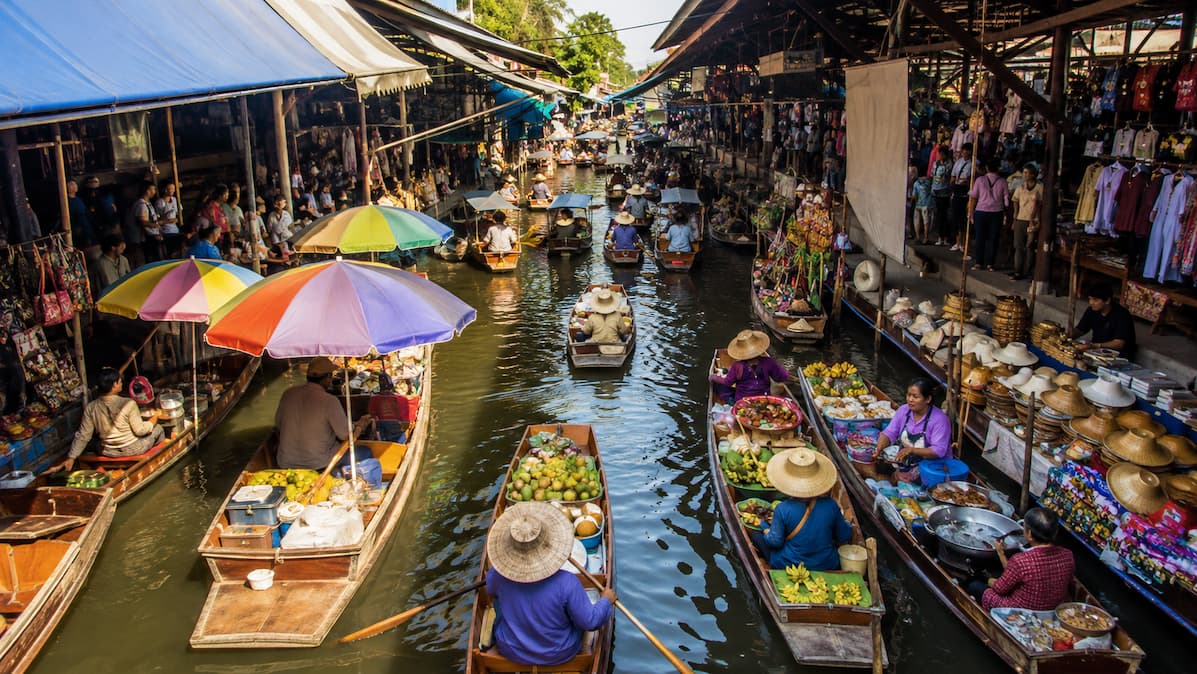
If there is one place that represents the classic image of a Thai floating market, it is Damnoen Saduak. Located in Ratchaburi Province, around 100 kilometres southwest of Bangkok, the market is famous for its narrow canals, wooden boats and vendors selling fruit, vegetables, snacks and souvenirs from the water.
The market has its roots in the extensive canal network developed through this part of Central Thailand, where waterways once provided essential connections between agricultural communities. Today, however, Damnoen Saduak is also a major international tourist attraction. Its popularity has transformed the experience, and visitors should expect tour groups, souvenir sellers and a busy commercial atmosphere alongside the traditional elements of canal trading.
Mornings are the main time to visit. Small boats move through the waterways carrying produce and prepared food, while shops and stalls line sections of the canal. Visitors can explore parts of the market on foot or take a boat through the canals for a closer view of life along the water.
For photographers, Damnoen Saduak remains difficult to match. Boats loaded with tropical fruit, colourful produce and freshly prepared food create the scenes that have made Thailand’s floating markets famous around the world. Arriving earlier in the morning can also provide a better opportunity to experience the market before the largest tour groups arrive.
Damnoen Saduak is not the place to choose if your priority is a quiet local market largely untouched by tourism. Its strength is something different: it provides the most recognisable and visually impressive version of the Thai floating-market experience.
Best for: First-time visitors who want the iconic boat-filled floating-market experience.
Keep in mind: Damnoen Saduak is heavily visited and commercialised, so come expecting a major tourist attraction rather than an undiscovered local market.
2. Amphawa Floating Market — Best for Evening Atmosphere
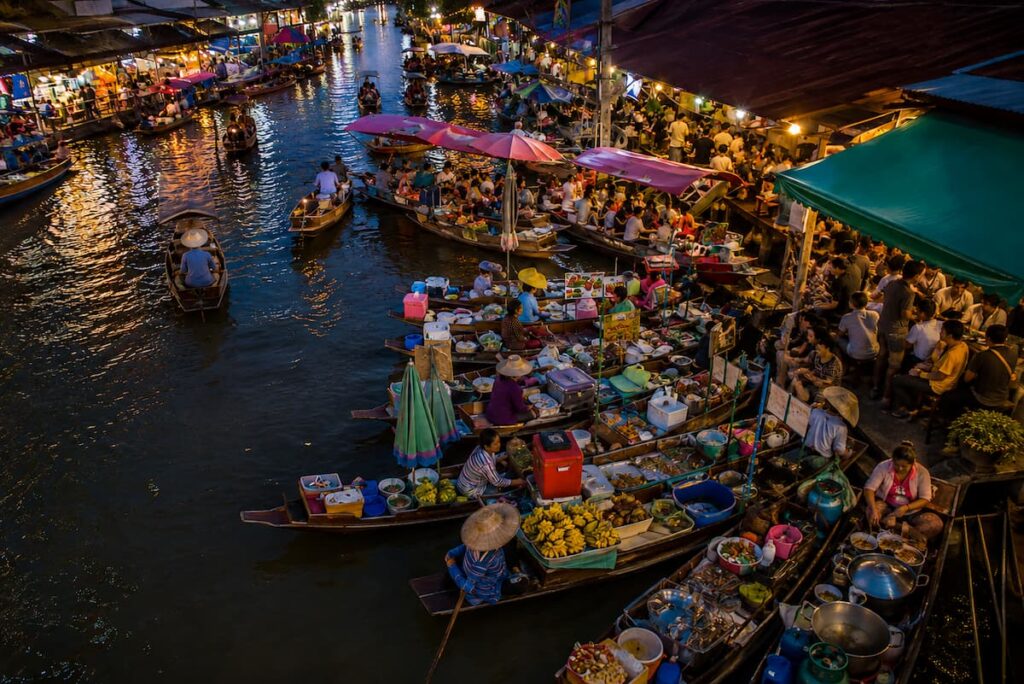
Amphawa offers a very different experience from the busy morning canals of Damnoen Saduak. Located in Samut Songkhram Province, the market is centred around an established canal-side community where wooden houses, shops, cafés and food vendors line the water. Rather than arriving at sunrise, visitors come later in the day as the market builds towards its liveliest period in the afternoon and evening.
Food is a major part of the experience. Seafood, Thai snacks, desserts and local dishes are sold along the canal, with some vendors preparing food from small boats beside the waterfront. Much of the market itself is on land, however, so visitors should expect a lively riverside market rather than canals continuously filled with trading boats.
The setting is one of Amphawa’s greatest attractions. As daylight fades, the canal-side buildings, restaurants and activity along the waterfront create an atmosphere quite different from Thailand’s better-known morning floating markets. Boat trips along the surrounding waterways are also available, making it possible to see more of the communities and scenery beyond the main market.
Amphawa is particularly well suited to travellers who want to make the market part of a longer afternoon or evening excursion. The emphasis is less on capturing the stereotypical floating-market photograph and more on eating, exploring the waterfront and enjoying the surroundings.
It is therefore better viewed as an alternative to Damnoen Saduak rather than a smaller version of it. Choosing between the two largely depends on the experience you want: Damnoen Saduak for the famous boat-filled morning scenes, or Amphawa for food and an atmospheric evening beside the canal.
Best for: Travellers looking for local food, a lively waterfront and an afternoon-to-evening floating-market experience.
Keep in mind: Much of Amphawa’s activity takes place beside the canal rather than entirely on the water, and its strongest atmosphere is later in the day.
3. Tha Kha Floating Market — Best for Traditional Local Character
For travellers interested in the traditional roots of Thailand’s floating markets, Tha Kha offers a quieter and more community-focused experience. Located in Samut Songkhram Province, not far from Amphawa, the market developed around an agricultural canal community where local growers and traders used boats to transport and sell their produce.
Tha Kha operates on a much smaller scale than Damnoen Saduak. Vendors gather along the canal with fruit, vegetables, prepared food and other local products, while small boats remain part of the market scene. The surrounding coconut plantations, waterways and traditional homes also help retain a stronger sense of the agricultural landscape from which floating markets originally developed.
The appeal here is not spectacle. There are fewer boats, fewer stalls and considerably less of the organised tourism infrastructure associated with Thailand’s most famous floating markets. Instead, Tha Kha provides an opportunity to see how waterways, farming and local trade have remained connected within communities of Central Thailand.
Visitors can explore the market from the canal banks and, when available, take a small boat through the surrounding waterways. The slower pace makes Tha Kha particularly appealing for travellers who value local character and observation over shopping or entertainment.
It is worth remembering that a more traditional market can also mean a more modest visitor experience. Anyone expecting long canals crowded with colourful boats may find Tha Kha understated. For those interested in understanding where Thailand’s floating-market tradition came from, that is precisely what makes it worthwhile.
Best for: Travellers looking for a smaller market with stronger connections to traditional agriculture and canal-community life.
Keep in mind: Tha Kha is quieter and less visually dramatic than the major tourist markets, and operating days and hours should be checked before making a special journey.
4. Khlong Lat Mayom Floating Market — Best for Food
Khlong Lat Mayom is one of the best choices for travellers whose main priority is eating rather than seeing canals crowded with boats. Located in western Bangkok, this popular weekend market combines a waterside setting with an extensive selection of Thai food, fresh produce, desserts and local products.
Much of the activity takes place on land beneath covered market areas and along the canal. Visitors can wander between stalls preparing grilled seafood, noodles, curries, snacks and traditional sweets, while fresh fruit and vegetables add to the atmosphere of a busy local food market. There are vendors on and around the water, but the experience is quite different from the boat-filled scenes associated with Damnoen Saduak.
That distinction is important. Khlong Lat Mayom is best approached as a lively Bangkok market built around a canal community rather than as a destination where everything happens from boats. For many visitors, this actually makes it easier to explore: you can move between food stalls at your own pace, stop for different dishes and spend much of the visit simply discovering what is being cooked around you.
Boat trips through the surrounding waterways can add another dimension to a visit, providing a glimpse of houses, vegetation and everyday life along Bangkok’s quieter canals. This combination of food and waterways makes Khlong Lat Mayom particularly useful for travellers who want a floating-market experience without travelling far outside the capital.
Come hungry rather than expecting a perfectly staged floating-market scene. Khlong Lat Mayom’s strength lies in the variety of food, its energetic weekend atmosphere and the opportunity to experience another side of Bangkok beyond the city’s major attractions.
Best for: Food lovers who want to combine a Bangkok market with a canal-side experience.
Keep in mind: Most of the market is on land, so this is not the place to choose if your priority is seeing large numbers of vendors trading from boats.
5. Taling Chan Floating Market — Best for an Easy Bangkok Visit
Taling Chan Floating Market is a practical choice for travellers who want to experience Bangkok’s canal-side culture without committing to a long journey outside the city. Located in the western part of Bangkok, it offers a compact combination of local food, waterside dining and market activity that can fit comfortably into a wider day of sightseeing.
Food is central to the experience. Stalls sell Thai dishes, snacks, fruit and sweets, while one of the market’s most distinctive areas extends beside the canal, where visitors can sit close to the water and enjoy freshly prepared food. Boats and the surrounding waterways contribute to the setting, although, as with Khlong Lat Mayom, much of the actual market operates from stalls on land.
Its greatest advantage is accessibility. Travelling to markets such as Damnoen Saduak or Amphawa can occupy a substantial part of the day, whereas Taling Chan provides an opportunity to experience a floating-market environment while remaining within Bangkok. Canal trips can also be available, allowing visitors to explore some of the quieter waterways and communities of the city’s western districts.
Taling Chan is smaller and less visually dramatic than Thailand’s famous destination markets, but that is not necessarily a disadvantage. It works particularly well for travellers who are curious about floating markets but do not want one to dominate their Bangkok itinerary.
Best for: Bangkok visitors looking for a convenient, food-focused floating-market experience without travelling far outside the city.
Keep in mind: Taling Chan is relatively compact and much of the market activity takes place beside the water rather than from boats, so expectations should be different from Damnoen Saduak.
6. Bang Nam Phueng Floating Market — Best for a Community Escape
Bang Nam Phueng Floating Market offers another interpretation of the floating-market experience, combining local food and community products with the greener surroundings of Bang Krachao in Samut Prakan Province. Despite its proximity to central Bangkok, the area feels noticeably removed from the dense urban landscape across the Chao Phraya River.
The market spreads through shaded walkways and along narrow waterways, with vendors selling Thai dishes, snacks, desserts, fruit, drinks, handicrafts and locally made products. Most trading takes place from stalls rather than boats, so visitors expecting a traditional boat-filled floating market should adjust their expectations accordingly.
What makes Bang Nam Phueng particularly appealing is the wider destination around it. Bang Krachao is known for its vegetation, quiet lanes, small communities and cycling routes, making the market easy to combine with several hours exploring the area. Rather than travelling solely to see a floating market, visitors can make it one part of a broader escape from central Bangkok.
The atmosphere also reflects the market’s community focus. Food and locally produced goods are more important to the experience than elaborate tourist displays, while the waterways and tropical surroundings provide a reminder of the landscape that once characterised much more of the Bangkok region.
Bang Nam Phueng therefore makes most sense for travellers interested in experiencing a local weekend market while exploring Bang Krachao, rather than those searching specifically for Thailand’s famous floating-vendor scenes.
Best for: Travellers who want to combine a community market with cycling, greenery and a wider exploration of Bang Krachao.
Keep in mind: Despite its name, Bang Nam Phueng is predominantly a land-based market beside waterways rather than a traditional market filled with trading boats.
7. Pattaya Floating Market — Best for a Cultural Attraction
Pattaya Floating Market is fundamentally different from the historic canal communities elsewhere on this list. Located south of central Pattaya in Chonburi Province, it is a purpose-built visitor attraction designed to bring together food, architecture, crafts and cultural traditions associated with different regions of Thailand.
The attraction is organised around representations of Thailand’s four major regions — North, Northeast, Central and South. Wooden buildings, walkways and waterways create the floating-market setting, while shops and vendors offer regional dishes, snacks, handicrafts, souvenirs and other products. Visitors can explore on foot, with boat experiences and cultural activities adding to the attraction.
What Pattaya Floating Market does not offer is the historical continuity found at places such as Tha Kha. It was created for tourism rather than developing naturally as a trading point for surrounding agricultural communities. Being clear about that distinction makes it easier to judge the market on what it is actually designed to provide.
For visitors already staying in Pattaya, that can still make it worthwhile. Instead of travelling several hours to one of Central Thailand’s historic floating markets, travellers can experience an accessible introduction to regional Thai food, architecture and cultural traditions within a single organised attraction.
Its inclusion also demonstrates how broadly the idea of a Thai floating market is now used. At one end of the spectrum are traditional communities shaped by waterways and agricultural trade; at the other are modern attractions inspired by that heritage. Both can be enjoyable, but they offer very different experiences.
Best for: Pattaya visitors who want an accessible, organised attraction combining regional Thai food, crafts and cultural experiences.
Keep in mind: Pattaya Floating Market is a modern, purpose-built tourism attraction rather than a historic floating-market community.
Which Floating Market in Thailand Should You Visit?
There is no single floating market that will be the best choice for every traveller. The right one depends on whether you want the famous boat-filled scenes, traditional community life, exceptional Thai food, an atmospheric evening or simply an easy market experience that fits into your existing itinerary.
| If You Want… | Choose… | Why |
|---|---|---|
| The classic Thai floating-market experience | Damnoen Saduak | The most recognisable choice for busy canals, vendors in boats and iconic floating-market scenes. |
| Food and an evening beside the canal | Amphawa | A lively waterfront atmosphere with seafood, local dishes and activity continuing later in the day. |
| Traditional canal-community character | Tha Kha | A smaller agricultural market with stronger connections to the traditional role of waterways and local trade. |
| A food-focused Bangkok market | Khlong Lat Mayom | Extensive Thai food and produce combined with a canal-side setting and opportunities to explore nearby waterways. |
| The easiest floating market to include in a Bangkok itinerary | Taling Chan | A compact market within Bangkok that doesn’t require a long journey into the surrounding provinces. |
| A market combined with greenery and cycling | Bang Nam Phueng | Works particularly well as part of a wider visit to Bang Krachao. |
| An organised cultural attraction near Pattaya | Pattaya Floating Market | A purpose-built attraction bringing together food, crafts and cultural influences from different Thai regions. |
If seeing vendors trading from small boats is the reason you want to visit a floating market, Damnoen Saduak should be near the top of your list. Travellers more interested in food and atmosphere may prefer Amphawa or Khlong Lat Mayom, while Tha Kha provides a quieter look at the agricultural and community traditions behind Thailand’s floating markets.
Location matters too. Visitors with limited time in Bangkok do not necessarily need to travel several hours to have a worthwhile experience. Taling Chan provides a convenient introduction, while Bang Nam Phueng can become part of a larger day exploring Bang Krachao.
The key is to choose according to the experience each market actually provides rather than simply looking for the most famous name. Thailand’s floating markets have evolved in very different directions, and understanding those differences makes it considerably easier to choose the right one.
Damnoen Saduak or Amphawa: Which Floating Market Should You Choose?
Damnoen Saduak and Amphawa are often considered together because both can be visited from Bangkok and are located within the same broader region of Central Thailand. In practice, however, they offer distinctly different experiences.
Damnoen Saduak is the better choice if the floating market itself is what you have come to see. Its busy morning canals, small trading boats and colourful displays of fruit, food and produce create the classic scenes most travellers associate with Thailand’s floating markets. It is also the more heavily touristed and commercial of the two.
Amphawa is better suited to travellers who value food and atmosphere. The experience develops later in the day, with visitors exploring the canal-side community, eating seafood and Thai dishes and enjoying the waterfront as afternoon turns into evening. Boats remain part of the setting, but much of the activity takes place along the banks of the canal.
For photography and the iconic floating-market experience, choose Damnoen Saduak. For a slower afternoon built around eating, exploring and enjoying the riverside atmosphere, choose Amphawa.
Travellers with enough time do not necessarily have to choose between them. The markets are close enough geographically to form part of the same wider excursion when their operating days and hours align, allowing you to see two very different interpretations of Thailand’s floating-market tradition in a single trip.
Are Thailand’s Floating Markets Authentic?
Thailand’s floating markets are sometimes dismissed as tourist attractions, but the reality is more complicated. Their authenticity varies considerably, and much depends on what visitors expect the term “floating market” to mean.
Floating markets developed from genuine economic necessity. In communities connected by rivers and canals, boats were practical tools for transporting agricultural produce, prepared food and everyday goods. Markets emerged naturally around these waterways long before they became attractions for domestic and international visitors.
Some markets retain stronger connections to that history than others. Tha Kha, for example, remains closely associated with its surrounding agricultural and canal community. Damnoen Saduak also has genuine historical roots, although decades of tourism have transformed it into a highly commercial visitor destination.
Markets such as Khlong Lat Mayom, Taling Chan and Bang Nam Phueng represent another form of authenticity. Much of their trading takes place on land, but they remain contemporary community and food markets connected to waterways. They demonstrate how market culture has adapted as roads replaced canals as the primary means of transport.
At the other end of the spectrum, Pattaya Floating Market was purpose-built as a tourism and cultural attraction. It does not claim the same historical development as an old trading community, but that does not automatically make a visit without value. Its purpose is different: presenting regional food, crafts, architecture and cultural experiences within an accessible attraction.
The more useful question, therefore, is not simply whether a floating market is authentic, but what kind of experience it genuinely offers today. Understanding that distinction helps travellers appreciate traditional markets for their history, modern community markets for the role they continue to play, and purpose-built attractions for what they were designed to provide.
When Is the Best Time to Visit a Floating Market in Thailand?
The best time to visit depends heavily on the market you choose. Thailand’s floating markets do not follow a single schedule: some are at their best early in the morning, others operate primarily on weekends, while Amphawa is known for coming to life later in the day.
For morning markets such as Damnoen Saduak and Tha Kha, arriving early generally provides the best experience. Temperatures are cooler, trading activity is underway and, particularly at Damnoen Saduak, an early start can help you arrive before the largest tour groups.
Amphawa is different. Its appeal builds through the afternoon and into the evening, when visitors gather along the canal for food and the waterfront becomes increasingly atmospheric. Arriving too early can mean missing much of what makes Amphawa distinctive.
Bangkok markets including Khlong Lat Mayom, Taling Chan and Bang Nam Phueng are particularly associated with weekend visits. They can become busy around lunchtime, especially in popular food areas, so arriving earlier can make exploring easier before stopping to eat.
Weather is another consideration. Thailand’s midday heat can make exposed markets uncomfortable, while tropical rain can develop quickly during the wetter months. Lightweight clothing, sun protection and an umbrella are useful regardless of season.
Most importantly, check the current opening days and hours before travelling. Floating-market schedules can change, and smaller markets may operate only on particular days or during limited periods. This is especially important when making a dedicated journey from Bangkok or another province.
How to Visit Thailand’s Floating Markets
How you visit a floating market depends largely on its location. Markets within Bangkok are relatively easy to incorporate into an independent day of sightseeing, while Damnoen Saduak, Amphawa and Tha Kha require more travel and may be easier to reach by private transport or an organised excursion.
Independent travel offers the most flexibility. You can choose when to arrive, spend as long as you want at the market and combine the visit with other nearby attractions. This can be particularly valuable at busy markets such as Damnoen Saduak, where arriving earlier than many organised groups may provide a more enjoyable experience.
Organised tours can be useful when transport is less straightforward. Many excursions from Bangkok include Damnoen Saduak, sometimes combined with other attractions in Ratchaburi or Samut Songkhram. Before booking, check exactly what is included, how long you will spend at the market and whether boat trips or other activities involve additional charges.
You do not necessarily need to take a boat to enjoy a floating market. At Amphawa, Khlong Lat Mayom, Taling Chan and Bang Nam Phueng, much of the experience takes place along the water rather than on it. A boat trip can provide a different perspective on the surrounding canals, but it should be viewed as an optional part of the visit unless specifically included in your tour or ticket.
Carry some Thai baht in smaller denominations, particularly for food, drinks and purchases from small vendors. Comfortable lightweight clothing, sun protection and drinking water are also useful, while an umbrella can provide protection from both strong sun and sudden rain.
Finally, treat the market as a living community rather than simply a photographic attraction. Ask before taking close-up photographs of individual vendors, avoid obstructing narrow walkways and take the opportunity to try local food or purchase directly from small traders. The most rewarding floating-market visits often come from slowing down and observing how the market and surrounding waterways fit together.
Floating Markets Near Bangkok
Many of Thailand’s best-known floating markets are concentrated in and around Bangkok rather than being evenly distributed across the country. This reflects the geography and history of Central Thailand, where the Chao Phraya River and an extensive network of canals once played an essential role in transport, agriculture and trade.
Several floating-market experiences can be found within the Bangkok metropolitan area. Taling Chan and Khlong Lat Mayom are convenient choices within Bangkok itself, while Bang Nam Phueng sits across the Chao Phraya River in neighbouring Samut Prakan and can be combined with a visit to Bang Krachao.
Travelling farther southwest opens up some of Thailand’s most significant floating-market destinations. Damnoen Saduak in Ratchaburi offers the famous boat-filled scenes most international visitors recognise, while nearby Samut Songkhram is home to both Amphawa and Tha Kha, two markets offering very different perspectives on canal-side life.
This concentration makes Bangkok an excellent base for exploring floating markets, but distance should not be the only factor when deciding where to go. A convenient Bangkok market may be the right choice for a food-focused morning, while travellers specifically seeking traditional boat trading or an atmospheric evening market may find the journey into the surrounding provinces worthwhile.
Rather than asking which floating market is closest to Bangkok, consider what you want to experience and how much of your day you are prepared to devote to it. The nearest market is not necessarily the best match for every traveller.
Frequently Asked Questions About Floating Markets in Thailand
What is the most famous floating market in Thailand?
Damnoen Saduak Floating Market in Ratchaburi is Thailand’s best-known floating market internationally. Its narrow canals, vendors in small boats and colourful displays create the classic floating-market scenes many travellers associate with Thailand.
Which floating market is best near Bangkok?
It depends on what you want to experience. Taling Chan is a convenient choice within Bangkok, while Khlong Lat Mayom is particularly good for food. If you are prepared to travel farther, Damnoen Saduak offers the iconic boat-filled experience and Amphawa is better suited to an atmospheric afternoon and evening beside the canal.
Which floating market is the most traditional?
Tha Kha Floating Market is one of the strongest choices for travellers interested in the agricultural and community origins of Thailand’s floating markets. It is considerably smaller than Damnoen Saduak and retains a closer connection with its surrounding canal and farming community.
Which floating market is best for food?
Khlong Lat Mayom is an excellent choice if food is your priority, with a large selection of Thai dishes, snacks, desserts and fresh produce. Amphawa is another strong option, particularly for travellers who want to combine food with an evening waterfront atmosphere.
Is Damnoen Saduak Floating Market worth visiting?
It can be, provided you know what to expect. Damnoen Saduak is highly commercial and receives large numbers of tourists, but it also provides the most recognisable boat-filled floating-market experience in Thailand. Visit for the spectacle and iconic setting rather than expecting an undiscovered local market.
Is Amphawa better than Damnoen Saduak?
Neither is inherently better. Choose Damnoen Saduak for busy morning canals and the classic floating-market experience. Choose Amphawa for food, a canal-side community and an atmosphere that develops through the afternoon and evening.
Do you need to take a boat at a floating market?
No. Many floating markets can be explored primarily on foot, and at places such as Khlong Lat Mayom, Taling Chan and Bang Nam Phueng, much of the market activity takes place beside the waterways. Boat trips can enhance the experience but are not essential at every market.
Are Thailand’s floating markets open every day?
No. Operating days and hours vary considerably. Some markets are primarily weekend destinations, while others operate more frequently or follow particular local schedules. Always check current opening information before making a dedicated journey.
Can you visit a floating market independently?
Yes. Many floating markets can be visited independently, particularly those in and around Bangkok. Private transport can make more distant markets easier to reach, while organised tours are a convenient alternative for travellers who do not want to arrange transportation themselves.
Are Thailand’s floating markets tourist traps?
Some are considerably more tourist-oriented than others. Damnoen Saduak is highly commercialised, while Pattaya Floating Market was specifically created as a visitor attraction. Others retain stronger community or local-market characteristics. Rather than avoiding a market simply because tourists visit it, understand what it offers and choose one that matches the experience you want.
Continue Exploring
Thailand Travel Guide
Explore Thailand’s destinations, beaches, islands, cultural attractions and travel experiences, with practical guides to help you decide where to go and plan your trip.
Central Thailand Travel Guide
Discover Bangkok, historic cities, riverside communities, cultural landmarks and destinations across Central Thailand, the region most closely associated with Thailand’s traditional floating markets.
Related Reading
What Are the Must-See Attractions in Thailand?
Discover Thailand’s iconic landmarks, cultural attractions and natural wonders, from historic temples and ancient cities to tropical landscapes and unforgettable experiences.
Most Popular Islands in Thailand
Explore seven of Thailand’s most popular islands and discover which destination best matches the beaches, activities, atmosphere and travel experience you are looking for.
Most Popular Beaches in Thailand
Compare Thailand’s most popular beaches, from lively resort destinations to spectacular island bays, and find the coastal experience that best suits your trip.
About the Author
David Hibbins is a travel publisher, destination researcher and the creator of Travel With Insight.
Through years of travel, tourism and publishing projects across Southeast Asia, he has developed a particular interest in how travellers research destinations, compare experiences and make travel decisions.
His work focuses on helping travellers move beyond popularity rankings, marketing claims and generic “best of” lists by providing balanced, research-driven destination guides. Rather than telling people where they should travel, his goal is to help readers understand the strengths, limitations and unique character of each destination so they can choose the places that best match their own interests, travel style and goals.
As the creator of Travel With Insight, David researches destinations throughout Southeast Asia, exploring not only where travellers go, but why they choose certain places, how destinations differ and what creates genuinely memorable travel experiences.
His work covers destination research, regional travel planning, traveller behaviour and the decision-making frameworks that help people plan more rewarding journeys.
Explore More Travel Resources
Every great journey begins with informed decisions. The more you understand a destination before you arrive, the more rewarding your travel experience becomes.
Whether you’re still researching Southern Thailand or you’re ready to start planning your itinerary, these additional resources can help.
Travel With Insight
Continue exploring our in-depth destination guides, travel inspiration and practical planning advice designed to help you make informed travel decisions throughout Thailand and Southeast Asia.
Go Find Asia
Looking for even more travel inspiration? Go Find Asia explores destinations, experiences and travel ideas across Asia, helping you discover where to go, what to see and how to plan your next adventure.
Resurgence Travel
When you’re ready to turn your research into reality, Resurgence Travel offers curated itineraries, personalised travel planning and local expertise to help you experience the very best of Thailand and Southeast Asia.