
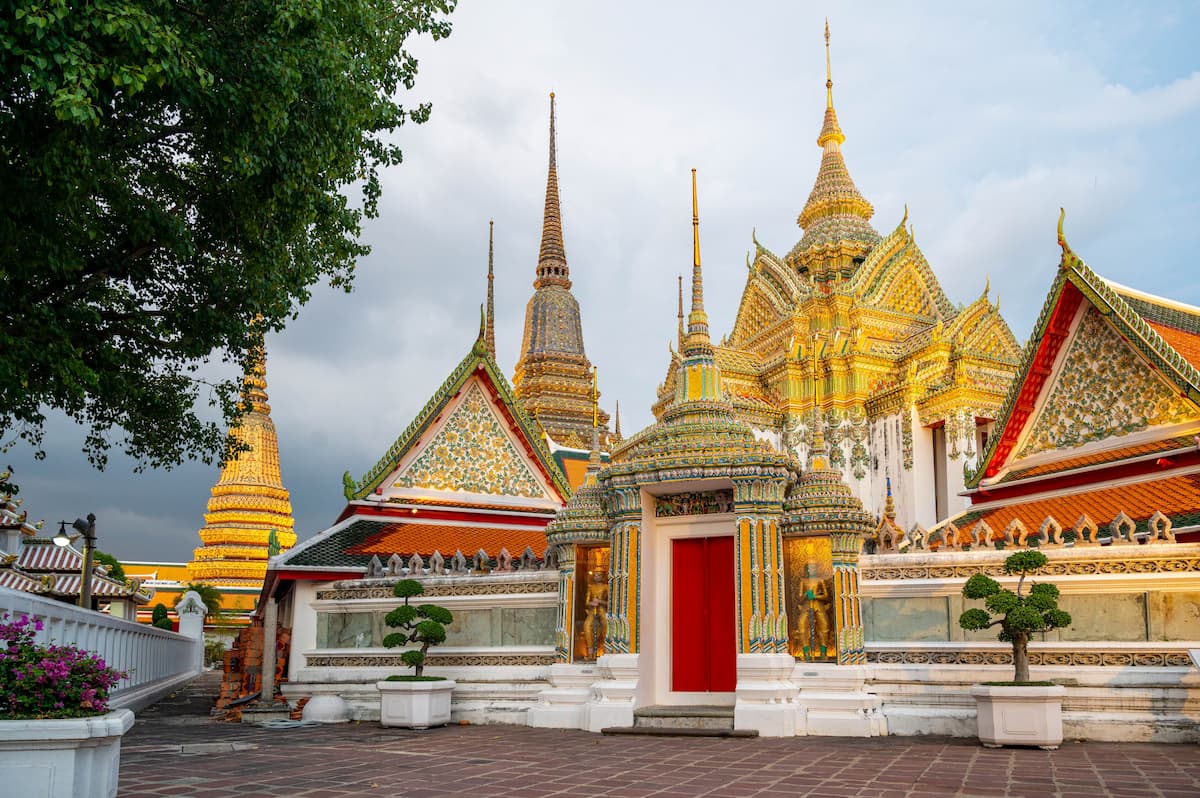
7 Best Temples in Central Thailand for Different Experiences
Choosing the best temples in Central Thailand is not simply a matter of identifying the region’s most famous or visually impressive landmarks. With so many historically and spiritually important sites, reducing them to a definitive list of seven is neither simple nor especially useful.
Rather than creating another listicle dominated by the same famous landmarks found across search results, we have taken a different approach. These best temples in Central Thailand were chosen because each provides a distinctly different reason to visit—not simply because it is well known or visually impressive.
Together, they reveal royal splendour at Wat Phra Kaew, traditional knowledge at Wat Pho, Buddhist cosmology at Wat Arun and the ruins of ancient Ayutthaya at Wat Mahathat. The selection also reaches beyond the most familiar visitor routes to include a monumental pilgrimage site, a hilltop temple surrounded by rice fields and an intimate ordination hall embraced by living tree roots.
This is not intended as an objective ranking of Central Thailand’s most beautiful temples. Instead, it is a carefully balanced introduction to the region’s remarkably varied Buddhist heritage, helping you choose the temples that offer the experiences most meaningful to you.
Quick Summary: Best Temples in Central Thailand
Each of these temples offers a different experience, so the best choice depends on what interests you most. Bangkok’s three selections are essential for royal heritage, traditional knowledge and architecture, while the remaining temples reveal ancient ruins, pilgrimage, countryside landscapes and less familiar regional history.
| Temple | Location | Best reason to visit |
|---|---|---|
| Wat Phra Kaew | Bangkok | Royal heritage, the Emerald Buddha and Thai national identity |
| Wat Pho | Bangkok | Traditional knowledge, medicine and the Reclining Buddha |
| Wat Arun | Bangkok | Riverside architecture and Buddhist cosmology |
| Wat Mahathat | Ayutthaya | Ancient ruins and the history of Thailand’s former capital |
| Wat Phra Pathom Chedi | Nakhon Pathom | Pilgrimage and Central Thailand’s early Buddhist heritage |
| Wat Tham Suea | Kanchanaburi | Monumental architecture and panoramic countryside views |
| Wat Bang Kung | Samut Songkhram | A tree-covered shrine combining worship and military history |
If this is your first visit to Central Thailand, Wat Phra Kaew, Wat Pho and Wat Arun provide the strongest introduction to Bangkok’s religious and royal heritage. Beyond the capital, Wat Mahathat is the natural choice for ancient history, while the remaining three reward travellers who want to explore a more varied side of the region.
How We Chose These Seven Temples
Selecting only seven temples from Central Thailand inevitably means leaving out many remarkable places. Rather than trying to produce a definitive ranking, we considered what each temple contributes to the experience of understanding the region.
Historical and religious importance formed part of the decision, but fame alone was not enough. We also considered architectural distinction, continuing significance as a place of worship, geographical variety and whether a temple offered an experience absent from the other selections.
This approach explains why the list includes three internationally recognised Bangkok landmarks alongside temples in Ayutthaya, Nakhon Pathom, Kanchanaburi and Samut Songkhram. It also prevents the guide from becoming overly dominated by royal temples or ancient ruins, however impressive those sites may be.
The result is a deliberately varied collection. Each temple reveals a different expression of Central Thailand’s Buddhist heritage and provides a clear reason to include it in your journey.
1. Wat Phra Kaew, Bangkok — Royal Heritage and the Emerald Buddha
Best for: Understanding the relationship between Buddhism, the Thai monarchy and national identity
Wat Phra Kaew is not simply Bangkok’s most ornate temple. Located within the Grand Palace, it occupies a unique place in Thai religious and royal life as the home of the Emerald Buddha, one of the country’s most revered sacred images.
King Rama I established the temple after Bangkok became the new Siamese capital in 1782. Although its enclosed layout resembles a traditional Buddhist monastery, Wat Phra Kaew has no resident monks or monastic living quarters. It functions instead as a royal chapel where important ceremonies connect Buddhist belief with the monarchy and the nation.
The Emerald Buddha appears surprisingly small when viewed from the entrance of the ordination hall, but its physical size bears little relationship to its significance. Carved from a green semi-precious stone rather than emerald, the image travelled through several Southeast Asian kingdoms before King Rama I installed it here in 1785. Its earlier origins remain uncertain, and traditional legends should not be confused with established history.
Three sets of gold regalia represent Thailand’s summer, rainy and cool seasons. The costume is changed during a royal ceremony at the beginning of each season, reinforcing the image’s continuing importance rather than treating it as a static museum object.
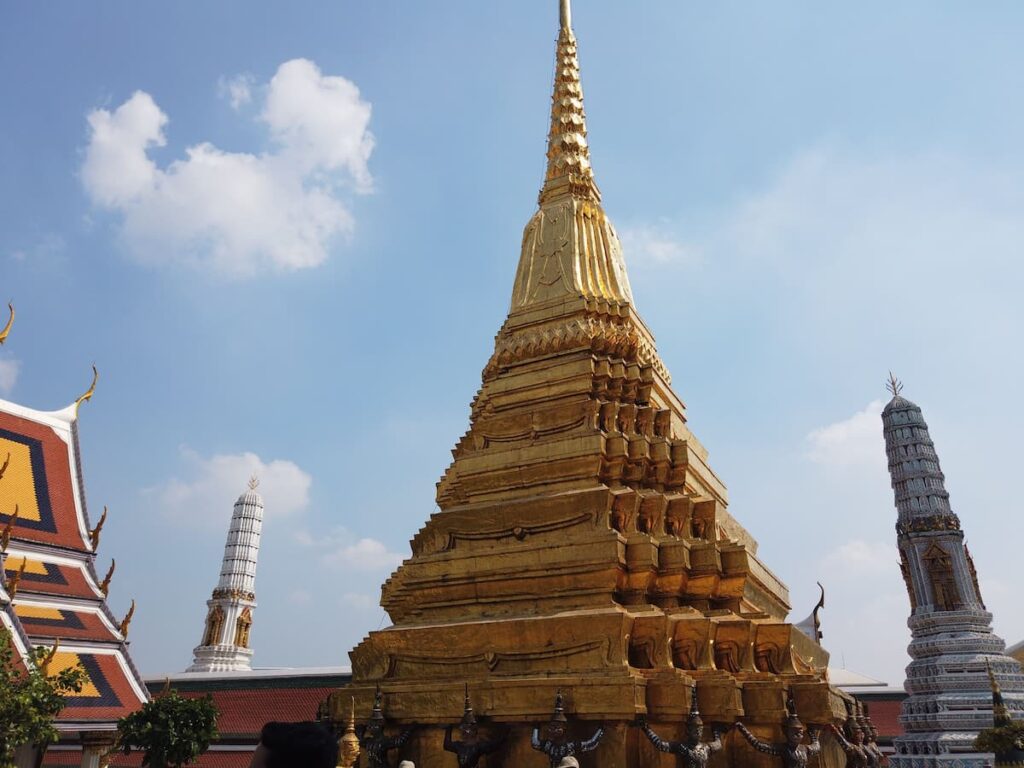
What to Look For at Wat Phra Kaew
The Emerald Buddha naturally receives the most attention, but the wider complex contains an extraordinary concentration of symbolic architecture and decorative art.
The long galleries are covered with murals illustrating the Ramakien, Thailand’s version of the Ramayana epic. Read sequentially, they depict battles, journeys and supernatural figures while also revealing how literature, kingship and religious ideas became intertwined within Thai culture.
Elsewhere, Phra Si Rattana Chedi provides one of the complex’s most recognisable golden forms, while the richly decorated Phra Mondop houses sacred Buddhist scriptures. The Royal Pantheon commemorates monarchs of the Chakri dynasty, and pairs of giant guardian figures stand watch over important entrances.
It is easy to be overwhelmed by the amount of gold, mirrored decoration and intricate detail. Rather than attempting to photograph everything, spend time observing how the buildings, guardians, murals and sacred objects work together to express an idealised royal and spiritual universe.
Planning Your Visit
Admission to Wat Phra Kaew is included with entry to the Grand Palace rather than sold as a separate temple ticket. Foreign visitor admission is currently 500 baht, although prices and access arrangements should always be checked before travelling.
A strict dress code applies. Shoulders and knees must be covered, and clothing considered excessively tight, torn, transparent or revealing may be refused. Shoes must be removed before entering the ordination hall, and photography is not permitted inside the chamber containing the Emerald Buddha.
The complex is busiest from late morning into the afternoon. Arriving near opening time generally provides cooler conditions and a more manageable experience, although royal ceremonies can occasionally alter access.
Allow at least 90 minutes to two hours for the Grand Palace and Wat Phra Kaew together. Wat Pho is within walking distance, making the two temples a natural combination, but rushing directly from one headline attraction to the next can make both visits feel superficial.
Choose Wat Phra Kaew if: you want to understand why a Buddhist temple can hold religious, royal and national importance simultaneously.
2. Wat Pho, Bangkok — Traditional Knowledge and the Reclining Buddha
Best for: Discovering how Buddhist temples preserved medicine, education, literature and traditional Thai knowledge
Wat Pho is often introduced simply as the Temple of the Reclining Buddha, but its significance extends far beyond its most famous image. This extensive royal monastery was deliberately developed as a place where religious and secular knowledge could be preserved and made accessible to the public.
An earlier temple known as Wat Photharam occupied the site during the Ayutthaya period. After Bangkok became the capital, King Rama I ordered a major restoration beginning in 1788 and established it as an important royal monastery close to the Grand Palace. Some of his ashes were later placed beneath the principal Buddha image in the ordination hall.
The temple underwent another extensive transformation during the reign of King Rama III. Scholars, craftspeople and religious authorities assembled knowledge covering Buddhism, traditional medicine, massage, language, literature, history and cultural customs. This information was inscribed onto stone panels and placed throughout the complex where ordinary people could study it.
Created between 1831 and 1841, the collection contains 1,431 inscriptions. UNESCO added the Epigraphic Archives of Wat Pho to its Memory of the World register in 2011, recognising both the breadth of the knowledge and the deliberate effort to make it publicly accessible.
Beyond the Reclining Buddha
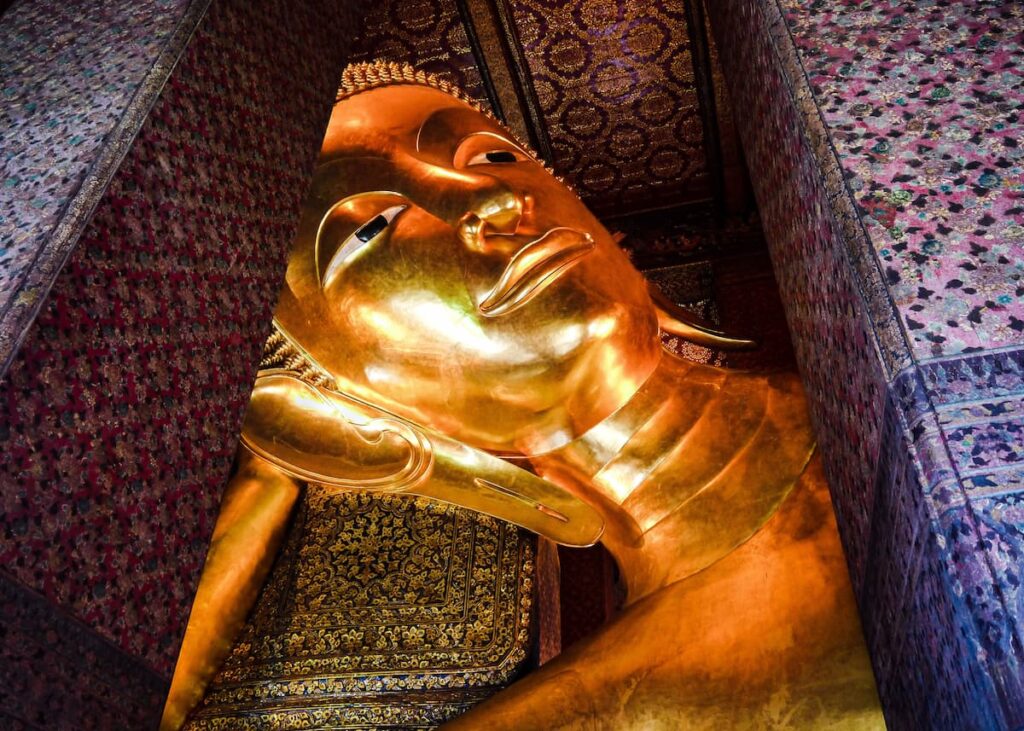
The enormous gilded Reclining Buddha remains an essential part of the visit. Measuring approximately 46 metres long, it depicts the Buddha approaching final nirvana rather than resting or sleeping.
Its mother-of-pearl feet are among its most meaningful details. The soles contain 108 auspicious symbols associated with the Buddha, including animals, flowers, royal objects and cosmological imagery. Because the figure almost completely fills its hall, visitors experience it gradually—from the head and serene facial expression to the decorated feet at the opposite end.
However, leaving immediately after viewing the Reclining Buddha means missing much of what makes Wat Pho exceptional.
The temple’s inscriptions appear on walls and pillars throughout the grounds. Illustrations connected with traditional healing and ruesi dat ton exercises show the relationship between physical movement, medicine and wellbeing. These traditions contributed to Wat Pho’s continuing reputation as an important centre for traditional Thai medicine and massage.
The main ordination hall contains Phra Buddha Theva Patimakorn, the temple’s principal Buddha image. Its doors include mother-of-pearl scenes from the Ramakien, while the surrounding murals and decorative work reflect the ambition of the royal craftsmen involved in Wat Pho’s restoration.
The courtyards also contain four large chedis associated with the first four Chakri kings, numerous smaller chedis, Chinese stone figures and peaceful areas that receive considerably less attention than the Reclining Buddha hall.
Planning Your Visit
Wat Pho is currently open daily until the evening, with foreign admission priced at 300 baht. As opening times and fees can change, check the temple’s official information before visiting.
Allow approximately 90 minutes if you want to explore the complex rather than see only the Reclining Buddha. The grounds can still be busy, but visitors disperse more widely here than at the Grand Palace.
Respectful temple clothing is required, and shoes must be removed before entering religious halls. Wat Pho’s traditional massage school also provides massage services, but this should be treated as an additional activity requiring extra time rather than something automatically included with admission.
Wat Pho is within walking distance of the Grand Palace and directly across the river from Wat Arun. All three can technically be visited in one day, although concentrating on only two will usually create a more rewarding and less hurried experience.
Choose Wat Pho if: you want to see how a Buddhist temple became a centre for preserving and sharing Thailand’s traditional knowledge.
3. Wat Arun, Bangkok — Riverside Architecture and Buddhist Cosmology
Best for: Experiencing one of Thailand’s most distinctive architectural landmarks and understanding the beliefs expressed through its design
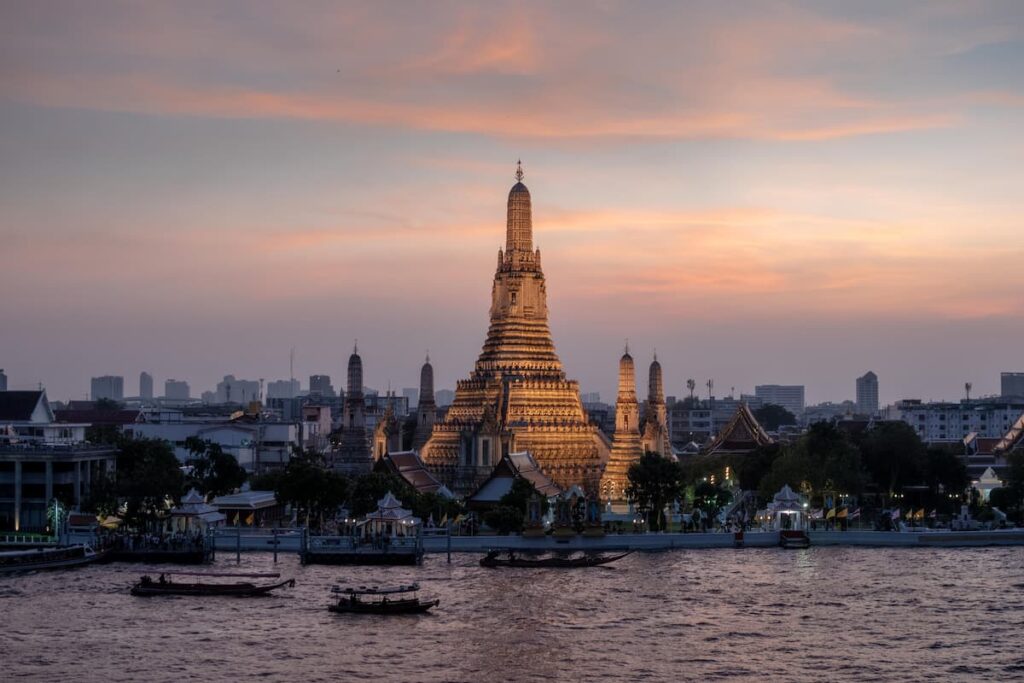
Wat Arun rises above the western bank of the Chao Phraya River, its central prang creating one of Bangkok’s most recognisable silhouettes. Yet its significance extends beyond its riverside appearance. The temple’s architecture represents a Buddhist conception of the universe, transforming religious belief into an immense three-dimensional composition.
A temple existed here during the Ayutthaya period, when it was known as Wat Makok. It later became closely associated with King Taksin and the short-lived Thonburi capital established on this side of the river after Ayutthaya’s fall. The Emerald Buddha was also housed nearby before King Rama I transferred the sacred image to Wat Phra Kaew in the new capital across the Chao Phraya.
Wat Arun’s appearance changed substantially under the early Chakri kings. King Rama II initiated the expansion of the central prang, major construction continued during the reign of Rama III, and the work was completed under Rama IV. The result was not merely a taller version of an older Ayutthaya monument, but a distinctive development of the prang form associated with the early Rattanakosin period.
Understanding Wat Arun’s Central Prang
The central prang represents Mount Meru, the sacred mountain at the centre of the Buddhist universe. Four smaller prangs surround it, creating a symbolic arrangement in which architecture, sculpture and cosmology work together.
Figures of demons, monkeys and celestial beings appear to support different levels of the structure. Garudas decorate elevated tiers, while representations of the deity Indra riding the three-headed Erawan elephant appear within the prang’s elaborate facades. These figures are not random decoration; they help express different levels and inhabitants of the Buddhist cosmos.
The surface is covered with glazed porcelain, ceramic fragments and shells arranged into intricate floral and geometric designs. From across the river, these materials give the tower its pale, almost luminous appearance. Up close, the decoration becomes far more textured and colourful, revealing flowers, leaves and repeated patterns assembled from thousands of individual pieces.
Access to the upper levels has varied over time, but visitors can generally climb to at least part of the raised terraces. The stairs are steep, and the experience provides a much closer view of the porcelain decoration as well as perspectives across the temple and river.
What Else to See at Wat Arun
The central prang understandably dominates most visits, but Wat Arun remains an active royal monastery containing several other important structures.
The ordination hall houses the temple’s principal Buddha image and is surrounded by galleries containing rows of seated Buddhas. Its entrance is guarded by two enormous yaksha figures, familiar characters from the Ramakien. Murals, roof decoration and quieter monastic areas provide a useful contrast with the monumental prang outside.
The river should also be considered part of the experience. Wat Arun can look dramatically different when viewed from its own terraces, from a passing boat and from the opposite bank of the Chao Phraya. Although its English name is the Temple of Dawn, some of its most memorable views occur during late-afternoon light and after sunset when the illuminated prang reflects across the water.
Planning Your Visit
Wat Arun is currently open daily from approximately 8:00 am until 6:00 pm, with foreign admission around 200 baht. Opening arrangements, fees and access to the prang terraces can change, so check current conditions before travelling.
The simplest approach from Wat Pho is the short cross-river ferry from Tha Tien. This journey takes only a few minutes but creates a far more atmospheric arrival than approaching entirely by road.
Allow approximately 60–90 minutes to explore the temple without rushing. Early morning generally provides cooler conditions and fewer visitors, while late afternoon offers warmer light. If photography is a priority, consider visiting the temple itself first and then returning to the eastern riverbank for a wider sunset or illuminated view.
Shoulders and knees should be covered, and footwear must be removed before entering religious halls. Visitors attempting the terraces should be prepared for steep steps and intense heat, particularly around midday.
Choose Wat Arun if: you want to see Buddhist cosmology transformed into monumental architecture within one of Bangkok’s most memorable riverside settings.
4. Wat Mahathat, Ayutthaya — The Ruins of a Lost Religious Centre
Best for: Experiencing the remains of ancient Ayutthaya and understanding the former capital’s religious importance
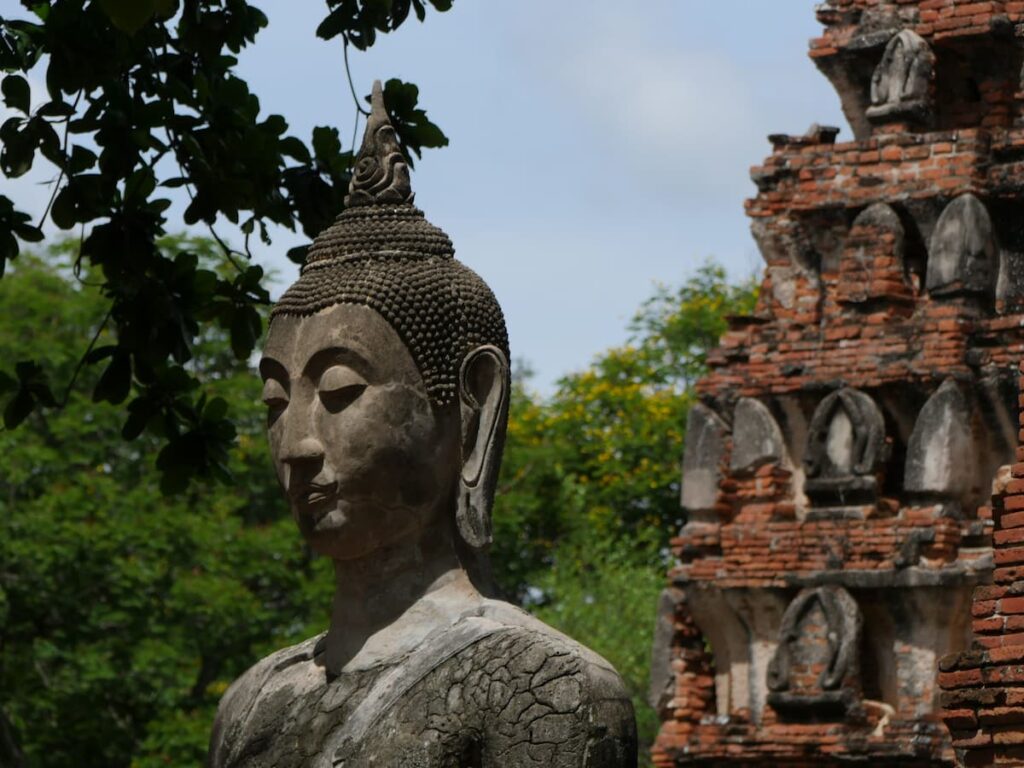
Wat Mahathat is best known for the stone Buddha head enclosed within tree roots, but concentrating only on that image risks overlooking the importance of the surrounding ruins. This was once one of Ayutthaya’s most significant monasteries, positioned close to the royal palace at the symbolic and political centre of the capital.
The temple developed during the late 14th century, although surviving chronicles offer different accounts of its precise foundation. One tradition associates the construction of its great reliquary with King Borommaracha I around 1374, while later records connect the monastery’s development with King Ramesuan. It is therefore safer to understand Wat Mahathat as a major royal complex that evolved during Ayutthaya’s early growth rather than assign it one uncontested founding moment.
Its name refers to a great sacred relic, reflecting the purpose of the central prang as a place for enshrining relics of the Buddha. The monastery was also associated with senior Buddhist authority and served as a residence of the Supreme Patriarch, placing it close to both the religious and royal administration of the kingdom.
Ayutthaya prospered for more than four centuries before Burmese forces destroyed the capital in 1767. Wat Mahathat was abandoned along with much of the city, and its principal buildings gradually collapsed. What survives today is only a fragment of the original monastery, but its brick foundations, chedis, prangs and damaged Buddha images still communicate the scale of the former complex.
The Buddha Head Among the Tree Roots
The sandstone Buddha head entwined within the roots of a tree has become one of Thailand’s most recognisable historical images. Its peaceful expression contrasts with the broken statues and weathered brickwork surrounding it, making it an especially powerful symbol of Ayutthaya’s survival through destruction and abandonment.
Exactly how the head came to rest in its present position is unknown. It may have become separated from a nearby statue during the destruction of the city or the long period of abandonment that followed. As the tree grew, its roots gradually enclosed and lifted the image.
Visitors who pose beside the Buddha head should crouch or sit so their own head remains lower than the sacred image. This is not merely a photographic convention but an expression of respect within Thai Buddhist culture.
What Else to Look For at Wat Mahathat
The remains of the central prang reveal where the temple’s most sacred structure once stood. Although it no longer reaches its former height, surrounding foundations help show how subsidiary towers, galleries and religious halls were organised around it.
Rows of damaged Buddha statues provide visible evidence of the complex’s history, but they should be approached as sacred remains rather than photographic props. Smaller chedis and fragments of decorative stucco also reveal how much richer and more elaborate the monastery would once have appeared.
Archaeological work undertaken during the 20th century uncovered relics, Buddha images, votive tablets, gold objects and other valuables from beneath the central structure. Important discoveries from Wat Mahathat and other Ayutthaya sites can be seen at the Chao Sam Phraya National Museum, making the museum a valuable addition for visitors who want to understand what has been recovered from the ruins.
Planning Your Visit
Wat Mahathat is individually ticketed within Ayutthaya Historical Park. Admission prices and combination passes have changed over time, so current charges should be checked at the historical park or ticket office.
Allow approximately 60–90 minutes to explore the ruins carefully. There is limited shade across much of the site, making early morning or later afternoon considerably more comfortable than midday. Respectful clothing remains appropriate even though this is an archaeological site rather than an active monastery.
Wat Ratchaburana stands almost opposite Wat Mahathat and forms the easiest immediate combination. Wat Phra Si Sanphet, the former royal palace area and other major ruins can then be included as part of a wider day exploring Ayutthaya.
Choose Wat Mahathat if: you want to look beyond a single famous image and experience the remains of Ayutthaya’s former religious heart.
5. Wat Phra Pathom Chedi, Nakhon Pathom — Pilgrimage and Early Buddhist Heritage
Best for: Experiencing a living pilgrimage site connected with Central Thailand’s deeper Buddhist history
Phra Pathom Chedi rises more than 120 metres above Nakhon Pathom, dominating the city’s skyline from almost every direction. Unlike the compact royal architecture of Bangkok or the abandoned monasteries of Ayutthaya, the experience here centres upon a single monumental stupa surrounded by active worship, circumambulation and local religious life.
The full temple name is Wat Phra Pathom Chedi Ratchaworamahawihan, and it is classified as a first-class royal monastery. Its name is commonly interpreted as the first or principal sacred stupa, reflecting traditions that connect Nakhon Pathom with the early arrival of Buddhism in the region.
The precise age of the original monument is uncertain. Religious traditions sometimes trace it to missionaries sent during the reign of the Indian emperor Ashoka, but that account cannot be treated as established archaeological history. Physical evidence more securely connects ancient Nakhon Pathom with the Buddhist Dvaravati civilisation, which flourished across parts of Central Thailand during the first millennium.
The enormous stupa visible today is principally a 19th-century creation. Prince Mongkut encountered the ruined earlier monument while living as a monk and recognised its religious and historical importance. After becoming King Rama IV, he ordered the construction of a vast new bell-shaped stupa enclosing and preserving the older structure. The work continued beyond his lifetime and was completed during the reign of King Rama V.
This layered history is central to understanding the site. Phra Pathom Chedi is simultaneously an ancient sacred location, a major achievement of the Chakri period and a living place of Buddhist worship.
Experiencing Phra Pathom Chedi
The scale of the stupa is difficult to appreciate until you enter the temple grounds and begin walking around its base. A covered gallery encircles the monument, allowing worshippers and visitors to perform circumambulation—walking clockwise around a sacred object as an act of reverence.
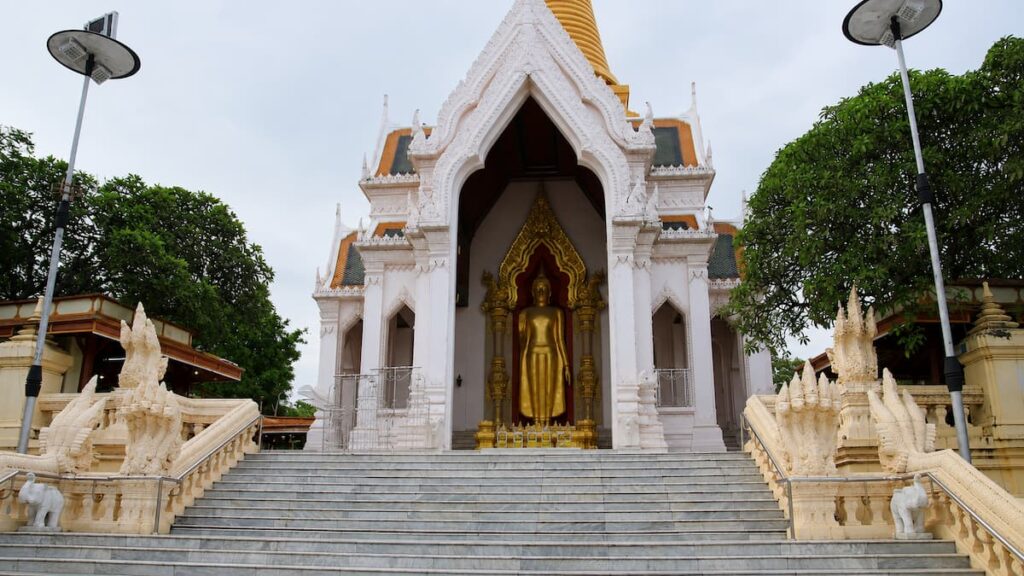
Several viharns face the stupa from different directions, each contributing to the religious life of the complex. The northern viharn contains Phra Ruang Rochanarit, an important standing Buddha image with one hand raised in a gesture of reassurance or protection.
The image was assembled during the reign of King Rama VI. Its surviving head, hands and feet originated from Si Satchanalai, while a new body was created to complete the figure. The king’s ashes were later placed beneath its pedestal, strengthening the site’s royal associations.
Numerous smaller Buddha images, bells, shrines and devotional spaces surround the central monument. Visiting during the morning or early evening often reveals the temple at its most meaningful, when local worshippers arrive to make offerings, pray or walk around the stupa.
Exploring the Dvaravati History
The nearby Phra Pathom Chedi National Museum adds valuable historical context. Its collections include Buddhist images, stone Wheels of the Law, inscriptions, architectural fragments and other objects excavated from ancient Nakhon Pathom and surrounding archaeological sites.
These artefacts help separate evidence from tradition. They demonstrate that Nakhon Pathom was a major Dvaravati centre with significant Buddhist activity, even though they do not prove every legend associated with the original stupa.
Museum opening days are more limited than access to the temple, so visitors who consider it an important part of their experience should check the current schedule before travelling.
Planning Your Visit
Phra Pathom Chedi stands in central Nakhon Pathom, approximately a 10-minute walk from the railway station. This makes it one of the easier major temples outside Bangkok to visit independently. Road journeys from the capital generally take around one to one and a half hours, depending heavily on traffic.
The temple opens early and remains accessible into the evening, although individual halls and the museum operate shorter hours. Allow around 60–90 minutes for the temple itself and additional time if visiting the museum or exploring the surrounding market.
The annual Phra Pathom Chedi festival, normally held around November according to the Thai lunar calendar, attracts pilgrims, market stalls and large crowds. It provides a more energetic cultural experience, while an ordinary weekday offers a quieter opportunity to appreciate the site.
Choose Wat Phra Pathom Chedi if: you want to experience an active pilgrimage centre that connects Dvaravati archaeology, royal restoration and contemporary Buddhist worship.
6. Wat Tham Suea, Kanchanaburi — A Hilltop Temple Above the Rice Fields
Best for: Combining monumental Buddhist architecture with panoramic views across rural Central Thailand
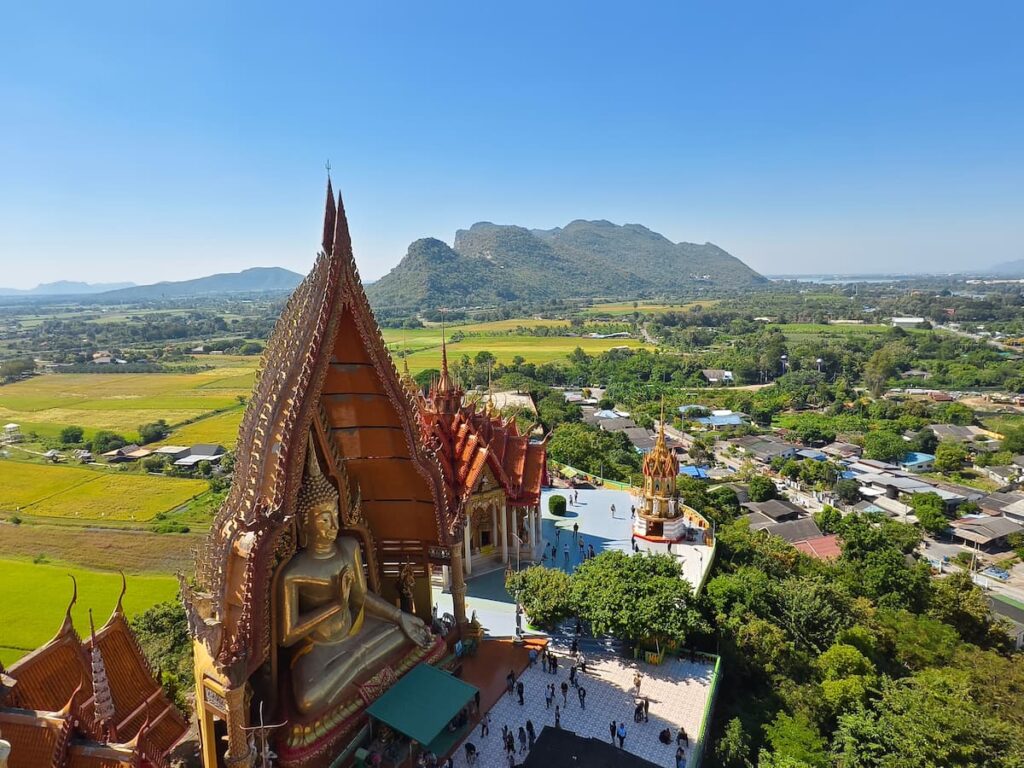
Wat Tham Suea rises from a low hill above the rice fields of Tha Muang district, creating a temple experience shaped as much by the surrounding landscape as by its religious architecture. From its elevated terraces, visitors can look across the Mae Klong River, agricultural plains and distant hills—a marked contrast to Bangkok’s dense royal complexes and Ayutthaya’s archaeological ruins.
This is Wat Tham Suea in Kanchanaburi, not the Tiger Cave Temple near Krabi with which it is frequently confused. The Kanchanaburi temple requires a much shorter ascent and offers an entirely different experience.
Wat Tham Suea began as a modest place of worship associated with a cave below the hill. The present complex was developed principally during the 1970s, making it considerably newer than the other temples in this guide. Its inclusion demonstrates that Central Thailand’s important Buddhist heritage is not limited to ancient monuments or royal foundations.
The temple’s dominant image is Luang Pho Chin Prathanphon, an immense seated Buddha covered with golden mosaic tiles. The figure sits in a blessing posture within an ornate open-sided structure decorated with protective naga imagery. Visible from across the surrounding fields, it gives the entire hillside a powerful religious presence.
The Pagoda and Countryside Views
Beside the Buddha rises Ket Kaew Maha Prasat, a tall, multi-level orange pagoda that provides the temple’s other defining landmark. Its contrasting geometric form, arched openings and elevated position create some of Wat Tham Suea’s most interesting perspectives.
Visitors able to climb through the pagoda can see Buddha images and devotional spaces on different levels while gaining increasingly expansive views through its windows. From the upper areas, the patchwork of fields spreads towards the Mae Klong River and mountains beyond.
The landscape changes significantly throughout the year. During parts of the growing season, the rice fields can appear intensely green, while mature crops may turn golden before harvesting. At other times, fields may be brown, recently cut or covered with water. Photographs promising permanent green scenery therefore provide a misleading impression of what every visitor will encounter.
The views are still worthwhile outside the green season, but the experience should be approached as a changing agricultural landscape rather than a fixed postcard scene.
Wat Tham Khao Noi Next Door
A second temple, Wat Tham Khao Noi, occupies the neighbouring hill and is often mistakenly treated as part of Wat Tham Suea. Its Chinese-influenced architecture, tiered tower and colourful detailing create a striking contrast with the Thai Buddhist forms of Wat Tham Suea.
Seeing the two temples together helps explain why the wider complex appears so architecturally varied when viewed from the surrounding countryside. Visitors with sufficient time can explore both, but should remember that they are separate places of worship with their own religious identities.
Planning Your Visit
Wat Tham Suea is located in Tha Muang district, approximately 20–30 minutes by road from central Kanchanaburi. Independent public transport is limited, so most visitors arrive by private vehicle, taxi, hired driver or organised excursion.
Access to the upper temple requires climbing a steep staircase, although a small cable-car or inclined-lift service may operate for a modest charge. Its availability should not be assumed, particularly for visitors with mobility limitations. Additional stairs inside the pagoda also require reasonable fitness.
Allow around 60–90 minutes for Wat Tham Suea, or longer if also exploring Wat Tham Khao Noi. Early morning offers cooler conditions, while later afternoon can provide softer light across the fields. The exposed terraces become extremely hot around midday.
There is generally no substantial temple admission charge, although donations and small fees for transport to the upper level may apply. As an active place of worship, modest clothing remains necessary despite the heat and informal countryside setting.
Choose Wat Tham Suea if: you want a temple where monumental architecture, active worship and Central Thailand’s rural landscape form one connected experience.
7. Wat Bang Kung, Samut Songkhram — A Shrine Enclosed by Living Tree Roots
Best for: Experiencing an intimate temple where Buddhist worship, nature and military history have become inseparable
Wat Bang Kung provides the most unusual and intimate experience among our seven selections. Its principal attraction is not an immense stupa or elaborate royal complex, but a small Ayutthaya-period ordination hall almost completely enclosed by the trunks and roots of living trees.
The temple stands within the historic Bang Kung Camp near the Mae Klong River in Samut Songkhram. Its location gave the area strategic importance during the turbulent final years of the Ayutthaya Kingdom and the emergence of the Thonburi Kingdom under King Taksin.
During the conflict preceding Ayutthaya’s fall in 1767, forces were stationed around the temple to defend the Mae Klong river route. After the capital was destroyed, the camp was abandoned. King Taksin later re-established a defensive force here, including Chinese soldiers, and Bang Kung became associated with an important confrontation against Burmese forces.
Historical accounts differ in some of their chronology and military detail, but the essential story is clear: this was both a Buddhist temple and a spiritual centre within a strategically important fortified camp.
The Tree-Covered Ordination Hall
The surviving ordination hall is commonly described as being enclosed by a banyan tree, but its living covering is more complex. Four types of trees—Bodhi, banyan, krai and krang—have grown around the walls and roof, their trunks and roots helping support the historic structure.
Local people refer to it as Bot Prok Pho, meaning the ordination hall covered by the Bodhi tree. From outside, parts of the original brick and stucco walls appear almost absorbed into the vegetation. Doorways and small sections of architecture remain visible between thick roots, creating the impression that the building and trees have gradually become one structure.
Unlike the abandoned ruins of Wat Mahathat, this remains an active sacred space. Inside is a revered gilded Buddha image commonly known as Luang Pho Bot Noi, before which worshippers pray, make offerings and attach small squares of gold leaf.
Fragments of old murals depicting episodes from the Buddha’s life survive on the interior walls. They are faded and considerably less dramatic than the surrounding roots, but they remind visitors that the chapel was created for worship rather than as an architectural curiosity.
The interior is small and can become crowded. Visitors should avoid blocking the entrance or standing directly between worshippers and the Buddha image while taking photographs.
Exploring Bang Kung Camp
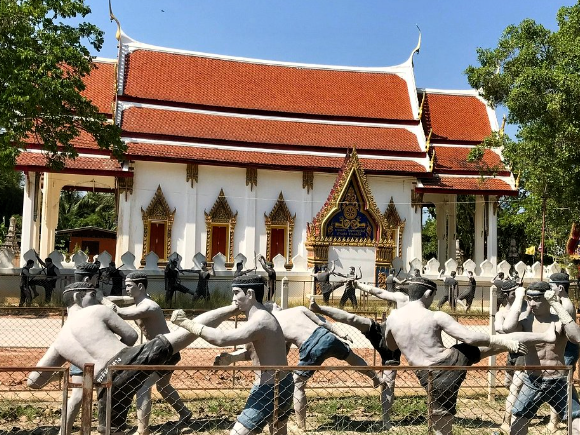
The surrounding grounds contain a memorial to King Taksin, figures representing soldiers and rows of life-sized statues demonstrating different Muay Thai postures. These additions interpret the area through its military history and Thailand’s traditional martial culture.
They should not be mistaken for surviving objects from the original camp. Instead, they form part of the modern commemoration of the soldiers who defended the area and the wider struggle to restore Siamese independence after Ayutthaya’s fall.
The military displays create a very different atmosphere from the tree-covered shrine. Together, however, they explain why Wat Bang Kung was selected: the site combines continuing Buddhist devotion with natural growth, historic architecture and national memory.
Planning Your Visit
Wat Bang Kung is located in Bang Khonthi district, within the wider Amphawa and Samut Songkhram area. There is generally no admission charge, although donations to the temple are welcome.
The temple itself is relatively small, and approximately 45–60 minutes is normally sufficient. Early morning provides a quieter atmosphere and makes it easier to appreciate the chapel without competing with larger tour groups.
Public transport directly to the temple is limited. Most independent visitors arrive by car, taxi or hired driver, while organised excursions often combine Wat Bang Kung with Amphawa Floating Market, the Mae Klong River communities or Maeklong Railway Market.
The floating market is most active on particular days and during the late afternoon or evening, so the suitability of that combination depends on when you travel. Wat Bang Kung remains worthwhile outside market hours and should not be treated merely as an additional photo stop on a floating-market tour.
Choose Wat Bang Kung if: you prefer a small, atmospheric place of worship where architecture, living trees and Thailand’s military history have grown together.
Other Central Thailand Temples Worth Visiting
Limiting the main selection to seven means excluding many temples that could reasonably appear in a broader guide. The following sites are particularly worthwhile when they fit naturally into your destination or interests.
Wat Saket, Bangkok: Climb the Golden Mount for elevated views across Bangkok’s historic centre and a more relaxed atmosphere than the city’s major royal temples. The hilltop golden chedi is especially important during the annual temple fair associated with the Loi Krathong period.
Wat Suthat, Bangkok: Best known for its elegant ordination hall, extensive murals and position beside the Giant Swing. It is an excellent choice for visitors interested in classical Rattanakosin architecture without the intensity of the Grand Palace crowds.
Wat Benchamabophit, Bangkok: Commonly called the Marble Temple because of the pale Italian marble used throughout its main buildings. Its symmetrical courtyard, red roofs and collection of Buddha images make it one of Bangkok’s most photogenic royal monasteries.
Wat Chaiwatthanaram, Ayutthaya: A monumental riverside complex constructed during the reign of King Prasat Thong in the 17th century. Its central prang and surrounding towers make it particularly atmospheric in the softer light of late afternoon.
Wat Phra Si Sanphet, Ayutthaya: Once the most important temple within Ayutthaya’s royal palace compound and used exclusively for royal ceremonies. Its three aligned chedis create one of the former capital’s most recognisable architectural compositions.
Wat Yai Chai Mongkhon, Ayutthaya: An active monastery distinguished by its large chedi, rows of seated Buddha images and elevated views across the grounds. It provides a useful contrast with Ayutthaya’s abandoned archaeological temples.
Wat Phanan Choeng, Ayutthaya: Home to an immense seated Buddha image that predates the official foundation of Ayutthaya. The active worship, incense and fabric-offering ceremonies create a more immediate religious experience than the nearby ruins.
Wat Niwet Thammaprawat, Bang Pa-In: A remarkable royal Buddhist temple designed with the appearance of a European Gothic church. Reached across the Chao Phraya River, it can be combined naturally with a visit to Bang Pa-In Palace.
Planning a Central Thailand Temple Journey
The seven temples are spread across Bangkok and four surrounding provinces, so they should not be treated as a checklist for one short visit. A more rewarding approach is to choose the temples that complement your route and divide them into realistic day trips.
Exploring Bangkok’s Three Temples
Wat Phra Kaew, Wat Pho and Wat Arun can be visited on the same day because they are concentrated around Bangkok’s historic centre and connected by walking routes and a short river ferry.
However, completing all three creates a full and potentially tiring day, particularly in Bangkok’s heat. Begin with Wat Phra Kaew when the Grand Palace opens, continue to Wat Pho and cross the river to Wat Arun later in the afternoon. If you prefer slower travel, divide them across two days and combine each temple with other attractions in its surrounding neighbourhood.
Visiting Ayutthaya
Wat Mahathat should be included within a dedicated Ayutthaya day rather than approached as an isolated temple. Wat Ratchaburana stands nearby, while Wat Phra Si Sanphet, Wat Chaiwatthanaram and several active monasteries can be added according to your available time.
A day trip from Bangkok covers the principal sites, but staying overnight allows you to explore during the cooler early morning and late afternoon periods when the ruins are most atmospheric.
Travelling to Nakhon Pathom
Wat Phra Pathom Chedi is one of the easiest regional selections to reach independently. The temple stands close to Nakhon Pathom railway station and can be visited as a focused half-day or combined with other attractions around the city.
Check the opening schedule of the Phra Pathom Chedi National Museum before travelling if its Dvaravati collection is important to you.
Visiting Kanchanaburi
Wat Tham Suea is located outside Kanchanaburi city and works best as part of a broader Kanchanaburi itinerary. It can be combined with Wat Tham Khao Noi and other attractions around Tha Muang, rather than forcing it into a day already dominated by the Bridge on the River Khwae and Death Railway history.
Private transport is the most convenient option, and an early visit reduces both the heat and the difficulty of climbing exposed stairs.
Exploring Samut Songkhram
Wat Bang Kung can be incorporated into a journey through Amphawa and the Mae Klong communities. Possible combinations include orchards, riverside villages, Amphawa Floating Market and Maeklong Railway Market.
Market days and operating hours should be checked separately. The temple remains an active place of worship throughout the week, even when the surrounding visitor attractions are quiet.
Temple Etiquette
Central Thailand’s temples range from heavily visited royal landmarks to small community monasteries, but the same principles of respectful behaviour apply throughout.
Cover your shoulders and knees, remove footwear before entering religious halls and avoid pointing your feet towards Buddha images. Do not climb on sacred structures or statues for photographs, and keep your head lower than Buddha images when posing nearby.
Speak quietly around worshippers and religious ceremonies. Women should avoid physical contact with monks, while all visitors should ask permission before photographing monks at close range.
Most importantly, remember that active temples are not simply tourist attractions. Allowing space for worship and observing how local people use the temple will usually create a more meaningful experience than concentrating entirely on photographs.
Frequently Asked Questions
What is the most important temple in Central Thailand?
Wat Phra Kaew is generally considered the most important because it houses the Emerald Buddha and plays a central role in Thai royal and national ceremonies. However, religious importance cannot be reduced to one universal ranking, and other temples hold particular significance for their own communities and traditions.
What are the three best temples to visit in Bangkok?
Wat Phra Kaew, Wat Pho and Wat Arun provide the strongest introduction for a first visit. Together, they reveal royal Buddhism, traditional Thai knowledge, the Reclining Buddha, riverside architecture and Buddhist cosmology.
Can Wat Phra Kaew, Wat Pho and Wat Arun be visited in one day?
Yes. Begin at Wat Phra Kaew and the Grand Palace, walk to Wat Pho and then take the short ferry across the Chao Phraya River to Wat Arun. It creates a busy day, so visitors who prefer a slower pace may find it more rewarding to divide the temples across two days.
Which Central Thailand temple is best for ancient ruins?
Wat Mahathat is the best choice for experiencing Ayutthaya’s ruined religious heritage. Its central location also makes it easy to combine with Wat Ratchaburana, Wat Phra Si Sanphet and other sites within Ayutthaya Historical Park.
Which temple outside Bangkok should I visit?
Choose Wat Mahathat for ancient history, Wat Phra Pathom Chedi for pilgrimage and early Buddhist heritage, Wat Tham Suea for countryside views or Wat Bang Kung for an unusual tree-covered shrine. The best choice depends more on your interests and route than on a single ranking.
Is there a dress code for temples in Central Thailand?
Yes. Shoulders and knees should be covered, and clothing should not be excessively tight, transparent or revealing. Wat Phra Kaew and the Grand Palace enforce particularly strict requirements, but respectful clothing is appropriate at every active temple and archaeological religious site.
Are temples in Central Thailand free to visit?
Some community temples are free or request only a donation, while major royal temples and managed historical sites charge admission. Prices can change, and additional charges may apply for museums, transport within a complex or access to particular areas.
Continue Exploring Central Thailand
Use our Thailand Travel Guide to place Central Thailand within a wider journey through the country’s regions, destinations and different holiday experiences.
Our Central Thailand Travel Guide brings together the region’s principal destinations, attractions and planning information, helping you explore beyond Bangkok and Ayutthaya.
If you are still deciding which destinations best match your interests, Where to Go in Central Thailand compares Bangkok, Ayutthaya, Kanchanaburi, Nakhon Pathom and other worthwhile locations across the region.
Related Reading
- Must-See Attractions in Central Thailand — Discover royal palaces, historic cities, cultural landmarks and other defining regional attractions.
- Historical Places in Thailand — Explore ancient capitals, archaeological sites and locations that reveal different periods of Thai history.
- Making the Most of Your Central Thailand Holiday — Build a realistic journey combining major landmarks with less familiar regional experiences.
- Best Temples in Thailand — Compare exceptional Buddhist sites from Central, Northern, Northeastern and Southern Thailand.
About the Author
David Hibbins is a travel publisher, destination researcher and the creator of Travel With Insight.
Through years of travel, tourism and publishing projects across Southeast Asia, he has developed a particular interest in how travellers research destinations, compare experiences and make travel decisions.
His work focuses on helping travellers move beyond popularity rankings, marketing claims and generic “best of” lists by providing balanced, research-driven destination guides. Rather than telling people where they should travel, his goal is to help readers understand the strengths, limitations and unique character of each destination so they can choose the places that best match their own interests, travel style and goals.
As the creator of Travel With Insight, David researches destinations throughout Southeast Asia, exploring not only where travellers go, but why they choose certain places, how destinations differ and what creates genuinely memorable travel experiences.
His work covers destination research, regional travel planning, traveller behaviour and the decision-making frameworks that help people plan more rewarding journeys.
Explore More Travel Resources
Every great journey begins with informed decisions. The more you understand a destination before you arrive, the more rewarding your travel experience becomes.
Whether you’re still researching Southern Thailand or you’re ready to start planning your itinerary, these additional resources can help.
Travel With Insight
Continue exploring our in-depth destination guides, travel inspiration and practical planning advice designed to help you make informed travel decisions throughout Thailand and Southeast Asia.
Go Find Asia
Looking for even more travel inspiration? Go Find Asia explores destinations, experiences and travel ideas across Asia, helping you discover where to go, what to see and how to plan your next adventure.
Resurgence Travel
When you’re ready to turn your research into reality, Resurgence Travel offers curated itineraries, personalised travel planning and local expertise to help you experience the very best of Thailand and Southeast Asia.
One Comment
Comments are closed.