UNESCO World Heritage Sites in Thailand: A Guide to All Nine Sites
Thailand is home to nine UNESCO World Heritage Sites, encompassing ancient capitals, prehistoric settlements, sacred landscapes, important Buddhist monuments and some of Southeast Asia’s most valuable protected forests.
The country’s six cultural and three natural World Heritage Sites reveal very different chapters of Thailand’s story. Visitors can explore the magnificent ruins of Ayutthaya and Sukhothai, encounter the prehistoric discoveries of Ban Chiang, discover the distinctive Dvaravati heritage of Si Thep and Phu Phrabat, or experience forest landscapes that protect elephants, tigers and an extraordinary diversity of wildlife.
Thailand’s newest addition, Wat Phra Mahathat Woramahawihan in Nakhon Si Thammarat, was inscribed in 2026. The recognition reflects the monastery’s importance as a Buddhist centre for more than 1,500 years and brings greater international attention to the cultural heritage of Southern Thailand.
These places have not been selected simply because they are beautiful or popular. Each has been recognised for its outstanding universal value and its importance to humanity’s shared cultural or natural heritage. This guide introduces all nine UNESCO World Heritage Sites in Thailand, explains why each was inscribed and helps you decide which ones may be most rewarding to include in your journey.
UNESCO World Heritage Sites In Thailand – Quick Summary
Thailand’s nine UNESCO World Heritage Sites range from easily accessible ancient capitals to remote forest landscapes where conservation takes priority over tourism.
Use this quick comparison to identify which site best matches your interests and travel plans.
| UNESCO World Heritage Site | Location | Visit If You Want To… |
|---|---|---|
| Historic City of Ayutthaya | Ayutthaya | Explore impressive temple ruins on an easy trip from Bangkok |
| Historic Town of Sukhothai and Associated Historic Towns | Sukhothai, Si Satchanalai and Kamphaeng Phet | Cycle through peaceful ruins and explore the foundations of early Siamese culture |
| Ban Chiang Archaeological Site | Udon Thani | Discover prehistoric pottery, burials, agriculture and metalworking |
| Thungyai–Huai Kha Khaeng Wildlife Sanctuaries | Western Thailand | Understand wildlife conservation within one of Southeast Asia’s great wilderness areas |
| Dong Phayayen–Khao Yai Forest Complex | Central and northeastern Thailand | Combine accessible wildlife watching, waterfalls and forest trails |
| Kaeng Krachan Forest Complex | Phetchaburi, Prachuap Khiri Khan and Ratchaburi | Experience outstanding birdwatching, forests and responsible elephant viewing |
| Ancient Town of Si Thep | Phetchabun | Explore a quiet Dvaravati town with Buddhist and Hindu monuments |
| Phu Phrabat | Udon Thani | Walk among unusual rock formations, ancient paintings and sacred Sīma stones |
| Wat Phra Mahathat Woramahawihan | Nakhon Si Thammarat | Experience a living Buddhist monastery and the cultural heritage of Southern Thailand |
What Is a UNESCO World Heritage Site?
A UNESCO World Heritage Site is a place recognised as having outstanding universal value to humanity. Its cultural or natural importance extends beyond the country in which it is located, making its protection and preservation a shared international responsibility.
UNESCO—the United Nations Educational, Scientific and Cultural Organization—established the World Heritage Convention in 1972 to identify and safeguard places of exceptional importance. Today, more than 1,200 properties across over 170 countries are included on the World Heritage List.
World Heritage Sites fall into three categories:
- Cultural World Heritage Sites recognise places of exceptional historical, archaeological, architectural, artistic or spiritual importance, including ancient cities, temples and monuments.
- Natural World Heritage Sites protect landscapes, ecosystems and habitats recognised for their biodiversity, geological importance or outstanding natural beauty.
- Mixed World Heritage Sites possess significant cultural and natural value. Thailand does not currently have any sites in this category.
UNESCO recognition does not necessarily mean that a place is the country’s most famous or most visited attraction. Instead, it confirms that the site meets strict international criteria and possesses qualities considered important to people throughout the world.
Thailand’s World Heritage Sites reflect thousands of years of human history alongside some of mainland Southeast Asia’s most important natural environments. Together, they help preserve the ancient kingdoms, religious traditions, archaeological discoveries, forests and wildlife that form an irreplaceable part of the country’s heritage..
How Many UNESCO World Heritage Sites Are There in Thailand?
Thailand currently has nine UNESCO World Heritage Sites, comprising six cultural sites and three natural sites. They range from ancient capitals and prehistoric settlements to sacred Buddhist landscapes and vast protected forests.
Cultural World Heritage Sites
- Historic City of Ayutthaya – The former capital of the Kingdom of Siam, renowned for its monumental temple ruins and influence on Thai history and culture.
- Historic Town of Sukhothai and Associated Historic Towns – Three connected historic towns that reveal the development of the early Kingdom of Sukhothai and distinctive Siamese art and architecture.
- Ban Chiang Archaeological Site – An important prehistoric settlement and burial site that provides evidence of early agriculture, pottery production and metalworking in Southeast Asia.
- The Ancient Town of Si Thep and its Associated Dvaravati Monuments – A distinctive twin-town settlement and associated monuments representing the religious diversity and artistic achievements of the Dvaravati period.
- Phu Phrabat, a Testimony to the Sīma Stone Tradition of the Dvaravati Period – A sacred landscape combining unusual rock formations, ancient rock paintings, modified shelters and the world’s largest collection of Dvaravati-period Sīma stones preserved in their original positions.
- Wat Phra Mahathat Woramahawihan, Nakhon Si Thammarat – A major Buddhist monastery whose architecture, religious traditions and regional influence have continued for more than 1,500 years.
Natural World Heritage Sites
- Thungyai–Huai Kha Khaeng Wildlife Sanctuaries – An extensive protected wilderness supporting exceptional biodiversity and populations of numerous rare and threatened animals.
- Dong Phayayen–Khao Yai Forest Complex – A network of protected forests providing vital habitat for elephants, gibbons, hornbills and many other species.
- Kaeng Krachan Forest Complex – A biologically rich forest landscape along the Tenasserim mountain range where several major wildlife regions converge.
Each site presents a distinctly different side of Thailand. Some allow visitors to explore ancient cities, archaeological discoveries and living religious traditions, while others protect remote forests where conservation takes priority over tourism. The best ones to visit will depend on your interests, location and how much time you have available.
1. Historic City of Ayutthaya
Located approximately 80 kilometres north of Bangkok, Ayutthaya became the second capital of the Kingdom of Siam around 1350. For more than four centuries, it developed into one of Asia’s most prosperous and cosmopolitan cities before being attacked and largely destroyed by the Burmese army in 1767.
Positioned on an island surrounded by three rivers, Ayutthaya benefited from extensive trade connections with China, Japan, India, Persia and Europe. Foreign merchants, diplomats and religious communities established settlements around the capital, while its rulers constructed magnificent palaces, monasteries, prangs and Buddha images that reflected the kingdom’s wealth and influence.
Today, the archaeological remains are spread throughout Ayutthaya Historical Park and the surrounding city. Towering temple ruins, rows of weathered Buddha statues and the foundations of former royal buildings provide a powerful impression of the scale and splendour of the old capital.
Why Is Ayutthaya a UNESCO World Heritage Site?
UNESCO inscribed the Historic City of Ayutthaya on the World Heritage List in 1991 because it preserves the remains of one of the world’s most important historic cities.
Ayutthaya developed a distinctive architectural and artistic tradition influenced by earlier cultures and adapted to local conditions. The city also became a model for the planning and development of Bangkok after the Siamese capital moved south.
Although much of Ayutthaya was destroyed in the eighteenth century, its surviving monuments provide exceptional evidence of the political, economic, religious and cultural importance of the former kingdom.
Highlights
Some of Ayutthaya’s most notable attractions include:
- Wat Mahathat and its famous Buddha head surrounded by tree roots.
- Wat Phra Si Sanphet, once the most important temple within the royal palace grounds.
- Wat Ratchaburana and its impressive central prang.
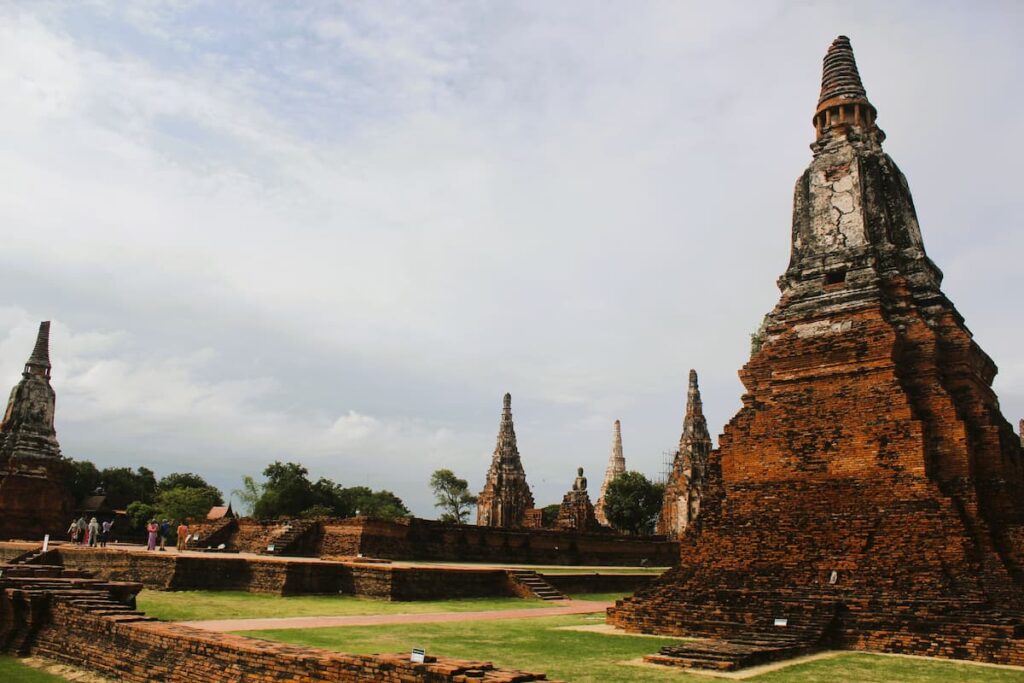
- Wat Chaiwatthanaram, one of Ayutthaya’s most visually striking temple complexes.
- The reclining Buddha at Wat Lokayasutharam.
- Exploring the historical park by bicycle, tuk-tuk or boat.
Best For
Ayutthaya is an excellent choice for travellers interested in:
- Thai history
- Ancient architecture
- Temple ruins
- Cultural photography
- Day trips from Bangkok
- UNESCO cultural heritage
Ayutthaya can be visited as a day trip from Bangkok, but staying overnight allows you to explore at a slower pace and experience the historical park during the quieter early morning and late afternoon periods.
2. Historic Town of Sukhothai and Associated Historic Towns
Located in lower northern Thailand, the Historic Town of Sukhothai and Associated Historic Towns preserves the remains of three important centres of the Sukhothai Kingdom: Sukhothai, Si Satchanalai and Kamphaeng Phet.
The kingdom flourished during the thirteenth and fourteenth centuries and played an important role in the development of Siamese culture, government, religion, language and artistic identity. Its builders created a distinctive architectural style characterised by elegant stupas, graceful Buddha images, carefully planned settlements and sophisticated systems for managing water.
Sukhothai Historical Park is the best-known and most frequently visited part of the World Heritage property. Its ancient temples, lotus-filled ponds, tree-lined pathways and relatively peaceful atmosphere make it one of Thailand’s most rewarding places to explore by bicycle.
Si Satchanalai and Kamphaeng Phet receive considerably fewer visitors but are integral parts of the UNESCO listing. Together, the three historic towns demonstrate the political reach, strategic organisation and cultural development of the Sukhothai Kingdom.
Why Is Sukhothai a UNESCO World Heritage Site?
UNESCO inscribed the Historic Town of Sukhothai and Associated Historic Towns on the World Heritage List in 1991 because the three settlements preserve exceptional evidence of the beginnings of Siamese architecture, art, language, religion and urban planning.
The surviving monuments reveal how local traditions were combined with influences from neighbouring cultures to create what became known as the Sukhothai style. These artistic and architectural developments later influenced other Thai kingdoms, including Ayutthaya.
The site is particularly significant because its temples, roads, fortifications, reservoirs, canals and other public works reveal not only the kingdom’s religious achievements but also the sophistication of its wider urban organisation.
Highlights
Some of the most notable attractions include:
- Wat Mahathat, the spiritual and ceremonial centre of ancient Sukhothai.
- Wat Si Chum and its enormous seated Buddha image.
- Wat Sa Si, picturesquely positioned beside a reservoir.
- Wat Saphan Hin and its standing Buddha overlooking the surrounding landscape.
- Cycling among the monuments of Sukhothai Historical Park.
- Exploring the quieter ruins of Si Satchanalai Historical Park.
- Discovering the forest temples and laterite monuments of Kamphaeng Phet.
Best For
Sukhothai and its associated historic towns are excellent choices for travellers interested in:
- Thai history
- Ancient temple architecture
- Archaeology
- Cultural photography
- Cycling through historical parks
- Peaceful, slower-paced exploration
Most visitors begin with Sukhothai Historical Park, but travellers with additional time should consider Si Satchanalai and Kamphaeng Phet. Visiting more than one of the three towns provides a much clearer understanding of the size and influence of the former kingdom.
3. Ban Chiang Archaeological Site
Located in Udon Thani Province in northeastern Thailand, Ban Chiang Archaeological Site preserves evidence of one of Southeast Asia’s most important prehistoric settlements and burial grounds.
The site became internationally known after the discovery of distinctive red-painted pottery and subsequent archaeological excavations revealed human remains, tools, ornaments, animal bones and bronze artefacts. Together, these discoveries provide valuable insight into the development of settled village life, wet-rice agriculture, pottery production and metalworking in the region.
Ban Chiang offers a very different experience from Thailand’s ancient capitals. Rather than exploring monumental temples and royal ruins, visitors encounter the everyday objects and burial traditions of prehistoric communities that lived in the area thousands of years ago.
The principal visitor attractions are the Ban Chiang National Museum and the preserved excavation site at Wat Pho Si Nai, where archaeological remains are displayed in the location where they were uncovered.
Why Is Ban Chiang a UNESCO World Heritage Site?
UNESCO inscribed Ban Chiang Archaeological Site on the World Heritage List in 1992 because it provides exceptional evidence of prehistoric human settlement and technological development in Southeast Asia.
The archaeological record reveals a long sequence of cultural, agricultural and technological change. Its burials, ceramics, tools and metal objects have contributed significantly to understanding how early communities in the region lived, produced food, organised their society and developed new technologies.
Although interpretations of the site’s precise chronology have evolved as archaeological research has continued, Ban Chiang remains one of the most important sources of information about prehistoric life in Southeast Asia.
Highlights
Some of Ban Chiang’s principal attractions include:
- Ban Chiang National Museum and its archaeological collections.
- The preserved excavation site at Wat Pho Si Nai.
- Distinctive red-painted pottery decorated with swirling patterns.
- Prehistoric burial remains and ceremonial objects.
- Bronze tools, ornaments and other evidence of early metalworking.
- Displays explaining how the site was discovered and excavated.
Best For
Ban Chiang is an excellent choice for travellers interested in:
- Archaeology
- Prehistoric cultures
- Museums
- Ancient pottery and metalworking
- Educational travel
- Lesser-visited cultural destinations
Ban Chiang is less visually dramatic than Ayutthaya or Sukhothai, but its importance lies in the story revealed by its archaeological discoveries. Visitors who take time to explore the museum and excavation site will gain a deeper understanding of life in Thailand long before the emergence of its historic kingdoms.
4. Thungyai–Huai Kha Khaeng Wildlife Sanctuaries
Extending across parts of Uthai Thani, Tak and Kanchanaburi provinces along Thailand’s border with Myanmar, the Thungyai–Huai Kha Khaeng Wildlife Sanctuaries protect one of mainland Southeast Asia’s largest and least-disturbed forest landscapes.
The World Heritage property combines the adjoining Thung Yai Naresuan and Huai Kha Khaeng wildlife sanctuaries, covering more than 6,200 square kilometres. Its mountains, valleys, rivers, grasslands and different forest types create habitats for an extraordinary variety of plants and animals.
The sanctuaries support many of Thailand’s most important wildlife populations, including tigers, Asian elephants, leopards, banteng, gaur, Malayan tapirs, wild water buffalo and numerous species of birds. Their size and connection with surrounding protected forests make the area critically important to long-term wildlife conservation.
Unlike a typical national park, much of the property is not developed for recreational tourism. Access is carefully controlled, and large sections remain remote or restricted to conservation work and scientific research.
Why Are Thungyai–Huai Kha Khaeng UNESCO World Heritage Sites?
UNESCO inscribed the Thungyai–Huai Kha Khaeng Wildlife Sanctuaries on the World Heritage List in 1991, making them Thailand’s first natural World Heritage property.
The sanctuaries were recognised for their exceptional natural beauty, intact ecological processes and remarkable biodiversity. Their location brings together plant and animal life associated with several different biogeographical regions, creating an unusually rich mixture of species.
The property also protects important watersheds and some of the most extensive remaining examples of dry tropical forest in Southeast Asia. Its large, connected habitats allow wide-ranging animals to move through the landscape with considerably less human disturbance than in many other protected areas.
Highlights
Experiences associated with the more accessible parts of the property include:
- Visiting the conservation and education areas near Huai Kha Khaeng.
- Learning about Thailand’s endangered wildlife and forest ecosystems.
- Walking designated nature trails where access is permitted.
- Visiting the memorial to conservationist Sueb Nakhasathien.
- Observing animal tracks, birds and other signs of wildlife with authorised guidance.
- Experiencing one of Thailand’s most important conservation landscapes.
Best For
Thungyai–Huai Kha Khaeng is particularly significant for travellers interested in:
- Wildlife conservation
- Forest ecology
- Environmental education
- Birdwatching
- Remote natural landscapes
- Thailand’s protected-area history
Visitors should not approach the property expecting conventional wildlife tourism or unrestricted jungle exploration. Huai Kha Khaeng provides the most practical introduction, while much of Thungyai remains difficult to access. Regulations should always be checked with the Department of National Parks, Wildlife and Plant Conservation before travelling.
5. Dong Phayayen–Khao Yai Forest Complex
Stretching across central and northeastern Thailand, the Dong Phayayen–Khao Yai Forest Complex protects more than 6,100 square kilometres of connected tropical forest.
The World Heritage property comprises Khao Yai, Thap Lan, Pang Sida and Ta Phraya national parks together with Dong Yai Wildlife Sanctuary. Collectively, these protected areas form an important refuge for wildlife in a region affected by agricultural development, roads and expanding settlements.
The complex supports more than 800 animal species, including Asian elephants, gaur, gibbons, hornbills, dholes, clouded leopards and several threatened primates. Tigers also survive within the wider forest landscape, although sightings are exceptionally rare.
For most travellers, Khao Yai National Park provides the easiest and most developed introduction to the World Heritage property. Its forest trails, waterfalls, grasslands, viewpoints and opportunities to observe wildlife make it one of Thailand’s most popular national parks.
Why Is the Dong Phayayen–Khao Yai Forest Complex a UNESCO World Heritage Site?
UNESCO inscribed the Dong Phayayen–Khao Yai Forest Complex on the World Heritage List in 2005 because of its exceptional biodiversity and importance to the survival of threatened wildlife.
Its forests create a vital habitat corridor extending from Khao Yai towards the Cambodian border. This connected landscape allows animals to move between different habitats and helps maintain ecological processes across a much larger area than any single national park could protect.
The complex is especially important for the conservation of mammals, birds and reptiles whose populations have declined elsewhere in Southeast Asia because of habitat loss, hunting and illegal wildlife trade.
Highlights
Visitor experiences within the more accessible parts of the complex include:
- Wildlife watching in Khao Yai National Park.
- Haew Narok and Haew Suwat waterfalls.
- Forest trails and scenic viewpoints.
- Observing hornbills, gibbons, macaques and deer.
- Joining authorised night wildlife-viewing activities.
- Exploring the quieter forests and waterfalls of Pang Sida National Park.
- Visiting Thap Lan National Park and its extensive fan-palm forests.
Best For
The Dong Phayayen–Khao Yai Forest Complex is an excellent choice for travellers interested in:
- Wildlife
- National parks
- Hiking
- Waterfalls
- Birdwatching
- Nature photography
- Accessible forest experiences from Bangkok
Khao Yai is the most practical destination for first-time visitors, but it represents only one part of the much larger World Heritage property. Access, trail conditions and seasonal closures can change, so visitors should check current national park regulations before travelling.
6. Kaeng Krachan Forest Complex
Located along Thailand’s border with Myanmar, the Kaeng Krachan Forest Complex protects an extensive landscape of mountains, tropical forests and river valleys within the Tenasserim Range.
The World Heritage property covers approximately 4,700 square kilometres and comprises Kaeng Krachan National Park, Kui Buri National Park, Chalerm Phrakiat Thai Prachan National Park and Mae Nam Phachi Wildlife Sanctuary.
Its location at the meeting point of the Himalayan, Indochinese and Sumatran biogeographical regions contributes to an exceptional variety of plants and wildlife. The forests provide habitat for Asian elephants, gaur, banteng, Malayan tapirs, dholes, gibbons and an unusually diverse range of wild cat species.
The complex is also one of Thailand’s most important birdwatching regions, supporting hornbills, broadbills, pittas and hundreds of other resident and migratory species.
Why Is the Kaeng Krachan Forest Complex a UNESCO World Heritage Site?
UNESCO inscribed the Kaeng Krachan Forest Complex on the World Heritage List in 2021 because of its exceptional biodiversity and the importance of its connected forest ecosystems.
The property protects habitats ranging from lowland evergreen and deciduous forests to higher-elevation montane environments. This variety allows species associated with several different ecological regions to coexist within the same protected landscape.
Its connection with forests across the border in Myanmar also increases its conservation importance. Protecting movement routes across this wider landscape is essential for animals such as elephants and large carnivores that require extensive territories.
Highlights
Visitor experiences within the accessible parts of the complex include:
- Birdwatching in Kaeng Krachan National Park.
- Mountain and forest views from elevated areas of the park.
- Camping and exploring designated nature trails.
- Visiting Kaeng Krachan Reservoir outside the core forest area.
- Joining responsible wildlife-viewing activities in Kui Buri National Park.
- Looking for wild elephants and gaur with authorised local guides.
- Experiencing one of Thailand’s richest butterfly and bird habitats.
Best For
The Kaeng Krachan Forest Complex is an excellent choice for travellers interested in:
- Birdwatching
- Wildlife conservation
- Forest landscapes
- Nature photography
- Camping
- National parks
- Less-developed outdoor experiences
Kaeng Krachan National Park is the best-known part of the property, while Kui Buri is generally the more practical choice for organised elephant watching. Access to roads, campsites and higher areas can change seasonally, so visitors should confirm current conditions before travelling.
7. The Ancient Town of Si Thep and Its Associated Dvaravati Monuments
Located in Phetchabun Province, the Ancient Town of Si Thep preserves the remains of an important Dvaravati cultural centre that flourished between the sixth and tenth centuries.
The World Heritage property consists of three connected components: the moated Ancient Town of Si Thep, the monumental Khao Klang Nok structure and the Khao Thamorrat Cave complex. Together, they demonstrate the town’s distinctive urban planning, religious diversity and artistic development.
Si Thep is especially notable for its unusual twin-town layout. The inner town, known as Muang Nai, is almost circular, while the larger outer town, Muang Nok, extends alongside it. Both sections were surrounded by moats and contained religious buildings, reservoirs and other evidence of an organised urban community.
The monuments and sculptures found around Si Thep reveal the coexistence of Theravada Buddhism, Mahayana Buddhism and Hinduism. These traditions were adapted to local conditions and contributed to the emergence of a distinctive artistic identity known as the Si Thep School of Art.
Why Is Si Thep a UNESCO World Heritage Site?
UNESCO inscribed the Ancient Town of Si Thep and its Associated Dvaravati Monuments on the World Heritage List in 2023.
The site was recognised because it provides exceptional evidence of the Dvaravati culture and the exchange of religious and artistic ideas across Southeast Asia. Influences originating in India were interpreted locally, producing distinctive architecture, sculpture and town planning.
Si Thep’s artistic traditions later influenced other parts of Thailand, while its religious monuments demonstrate how Buddhist and Hindu communities existed within the same cultural landscape.
Highlights
Some of Si Thep’s principal attractions include:
- The moats and earthworks surrounding the ancient twin town.
- Khao Klang Nai and its surviving decorative stucco figures.
- Prang Si Thep and its Hindu architectural influences.
- Prang Song Phi Nong and its later Khmer-style additions.
- Khao Klang Nok, the largest surviving Dvaravati monument of its kind.
- The Si Thep Historical Park visitor centre and archaeological displays.
- Learning about the sculptures and sacred remains associated with Khao Thamorrat Cave.
Best For
Si Thep is an excellent choice for travellers interested in:
- Archaeology
- Dvaravati history
- Ancient town planning
- Buddhist and Hindu art
- Lesser-visited historical parks
- Cultural photography
Si Thep receives fewer international visitors than Ayutthaya or Sukhothai and offers a quieter archaeological experience. Its monuments can appear less immediately dramatic, but the site becomes far more rewarding once visitors understand its age, religious diversity and influence on later Thai art.
8. Phu Phrabat and the Sīma Stone Tradition
Located on Phu Phan Mountain in Udon Thani Province, Phu Phrabat is a remarkable cultural landscape where unusual sandstone formations, prehistoric rock art and sacred Buddhist structures reveal more than two thousand years of human activity.
Natural erosion created an extraordinary landscape of balanced boulders, mushroom-shaped rocks, cliffs and shelters. Over time, people adapted these formations for ceremonial, religious and practical purposes, adding rock paintings, stone boundary markers and modifications that transformed the mountain into a sacred landscape.
Phu Phrabat is particularly important for its collection of Sīma stones. These stones marked the sacred boundaries within which Buddhist monastic ceremonies could be performed. The site preserves the world’s largest collection of Dvaravati-period Sīma stones still standing in their original locations.
The combination of natural formations and human additions gives Phu Phrabat a character unlike any of Thailand’s other World Heritage Sites.
Why Is Phu Phrabat a UNESCO World Heritage Site?
UNESCO inscribed Phu Phrabat, a Testimony to the Sīma Stone Tradition of the Dvaravati Period on the World Heritage List in 2024.
The site was recognised for its exceptional evidence of the Sīma stone tradition that developed across the Khorat Plateau between approximately the seventh and eleventh centuries. At Phu Phrabat, the scale of the stone placements and modifications to existing rock shelters transformed the natural landscape into an important religious centre.
Rock paintings found across dozens of shelters also demonstrate that people occupied and used the mountain long before the arrival of Buddhism. Together, these features preserve a long sequence of changing spiritual beliefs and cultural practices.
Highlights
Some of Phu Phrabat’s most notable features include:
- Hor Nang Usa, the park’s best-known mushroom-shaped rock formation.
- Dvaravati-period Sīma stones preserved in their original locations.
- Prehistoric paintings on rock walls and beneath shelters.
- Sacred spaces created around natural sandstone formations.
- Forest trails connecting archaeological and religious sites.
- Elevated viewpoints across the surrounding countryside.
- The visitor centre and displays explaining the landscape’s cultural history.
Best For
Phu Phrabat is an excellent choice for travellers interested in:
- Unusual geological formations
- Prehistoric rock art
- Buddhist history
- Dvaravati culture
- Archaeology
- Hiking through cultural landscapes
- Lesser-visited destinations in northeastern Thailand
Exploring Phu Phrabat involves walking between widely scattered features, sometimes over uneven ground. Allowing several hours and understanding the purpose of the Sīma stones before setting out will make the experience considerably more meaningful.
9. Wat Phra Mahathat Woramahawihan, Nakhon Si Thammarat
Located in the historic centre of Nakhon Si Thammarat, Wat Phra Mahathat Woramahawihan is one of Southern Thailand’s most important Buddhist monasteries and the country’s newest UNESCO World Heritage Site.
The monastery has served as a major regional Buddhist centre since its foundation in the eighth century. Its position on the Thai Peninsula allowed it to benefit from maritime trading networks connecting India, Sri Lanka, Java, the Mon regions of present-day Myanmar and other parts of Southeast Asia.
These connections brought different religious, artistic and architectural influences, including Brahmanism, Hinduism, Mahayana Buddhism and Theravada Buddhism. Rather than simply copying outside traditions, the monastery incorporated them into a distinctive local identity that later influenced religious architecture and practice elsewhere in Thailand.
At the centre of the complex stands the Great Reliquary, or Phra Borommathat Chedi, whose tall bell-shaped form reflects strong Sri Lankan influence. The monastery remains an active place of worship, pilgrimage and cultural tradition rather than an archaeological ruin.
Why Is Wat Phra Mahathat Woramahawihan a UNESCO World Heritage Site?
UNESCO inscribed Wat Phra Mahathat Woramahawihan on the World Heritage List in 2026.
The monastery was recognised for the way it absorbed religious and architectural ideas carried through transoceanic trading networks and transformed them into traditions that influenced Thailand and the wider Southeast Asian region.
Its importance also extends beyond its buildings. Religious and cultural practices have continued at the monastery across many centuries, including the Nakhon Si Thammarat chronicle tradition, the ceremonial wrapping of the Great Reliquary with cloth and connections with the distinctive Southern Thai Nora dance tradition.
Highlights
Some of the monastery’s most significant features and experiences include:
- The Phra Borommathat Chedi and its surrounding smaller stupas.
- The monastery’s collection of religious buildings and Buddha images.
- Architectural details reflecting Sri Lankan and regional influences.
- The cloister surrounding the principal reliquary.
- Learning about the annual Hae Pha Khuen That cloth-wrapping tradition.
- Observing the monastery as a living centre of worship and pilgrimage.
- Exploring the wider historic and cultural heritage of Nakhon Si Thammarat.
Best For
Wat Phra Mahathat Woramahawihan is an excellent choice for travellers interested in:
- Buddhist history
- Living religious traditions
- Temple architecture
- Southern Thai culture
- Pilgrimage sites
- Cultural photography
- Lesser-visited historic cities
Because this is an active monastery, visitors should dress respectfully, speak quietly and avoid interrupting worshippers or ceremonies. Combining the temple with Nakhon Si Thammarat’s museums, historic neighbourhoods and local food provides a much broader understanding of Southern Thailand’s cultural identity.
Which UNESCO World Heritage Site Should You Visit?
Thailand’s nine UNESCO World Heritage Sites offer very different experiences, so the right choice depends on your interests, location and available time.
For travellers visiting Bangkok, the Historic City of Ayutthaya is the easiest option. It can be reached as a day trip and offers an impressive introduction to Thailand’s royal history, temple architecture and ancient capitals.
Those prepared to travel farther north may find the Historic Town of Sukhothai and Associated Historic Towns even more immersive. Sukhothai’s spacious historical park, peaceful atmosphere and cycle-friendly layout make it particularly rewarding for travellers who want to explore at a slower pace.
For archaeology and lesser-known history, Ban Chiang, Si Thep and Phu Phrabat each reveal a different period of Thailand’s past. Ban Chiang reaches back to prehistoric settlement, Si Thep explores the urban and religious culture of the Dvaravati period, while Phu Phrabat combines ancient rock art, natural formations and sacred Buddhist boundary stones.
Ban Chiang and Phu Phrabat are both located in Udon Thani Province and can be combined by travellers planning a deeper exploration of northeastern Thailand. Si Thep is better suited to an overland journey through central or lower northern Thailand.
In Southern Thailand, Wat Phra Mahathat Woramahawihan is the clear choice for visitors interested in living Buddhist traditions and regional culture. Rather than exploring abandoned ruins, visitors experience an active monastery that has remained an important religious centre across many centuries.
Nature and wildlife enthusiasts also have three very different options. The Dong Phayayen–Khao Yai Forest Complex, particularly Khao Yai National Park, provides the most accessible combination of hiking, waterfalls and wildlife watching.
The Kaeng Krachan Forest Complex is especially rewarding for birdwatchers and experienced nature travellers, while Kui Buri National Park offers one of the more practical opportunities to observe wild elephants responsibly.
Thungyai–Huai Kha Khaeng Wildlife Sanctuaries are arguably the most important wilderness areas on the list, but they are not conventional tourist destinations. They are best suited to visitors with a serious interest in conservation, forest ecology and Thailand’s protected-area history.
There is no single best UNESCO World Heritage Site in Thailand. Ayutthaya and Khao Yai are the easiest to include in a first visit, while Sukhothai, Ban Chiang, Si Thep, Phu Phrabat and Nakhon Si Thammarat reward travellers prepared to explore beyond the country’s most familiar routes.
Tips for Visiting Thailand’s UNESCO World Heritage Sites
Thailand’s World Heritage Sites range from active monasteries and extensive archaeological parks to tightly protected wildlife sanctuaries. A little planning will help you enjoy them responsibly and avoid arriving unprepared.
- Check current opening conditions. Opening hours, road access, trail availability and seasonal closures can change, particularly within national parks and wildlife sanctuaries.
- Allow enough time. Ayutthaya, Sukhothai and Si Thep cover large areas, while Phu Phrabat involves walking between scattered features. Trying to see everything quickly can make the experience feel rushed.
- Start early when possible. Morning temperatures are generally more comfortable for exploring ruins, temples and walking trails. Early visits may also provide quieter conditions and better opportunities to observe wildlife.
- Dress respectfully at religious sites. Cover your shoulders and knees when entering active temples and sacred areas. Remove your shoes where requested and avoid posing disrespectfully with Buddha images.
- Do not climb on ancient structures. Stay behind barriers, follow marked routes and avoid touching carvings, paintings or fragile surfaces. Even apparently solid ruins can be easily damaged.
- Bring water and sun protection. Historical parks can offer limited shade, while Thailand’s heat and humidity can make outdoor exploration tiring throughout much of the year.
- Use authorised guides and activities. Within protected forests, join recognised guides, follow ranger instructions and never enter restricted areas without permission.
- Observe wildlife from a safe distance. Do not approach, feed or attempt to attract wild animals. Sightings should occur naturally without changing the animal’s behaviour.
- Learn a little before visiting. Sites such as Ban Chiang, Si Thep and Phu Phrabat become much more meaningful when you understand what archaeologists discovered and why the surviving features are important.
- Support local communities. Hiring local guides, staying nearby and purchasing locally produced food or crafts can help spread the benefits of heritage tourism beyond the principal attraction.
Responsible visits help protect these irreplaceable places while ensuring they remain meaningful cultural landscapes, active religious centres and functioning natural ecosystems for future generations.
A Travel With Insight Perspective
I have been fortunate enough to visit all nine of Thailand’s UNESCO World Heritage Sites over time. What has stayed with me most is how unexpectedly overwhelmed I have sometimes felt by the history, scale and passage of time represented by these places.
When I first began visiting them, I often approached the experience as another attraction to see or another item to cross off a travel list. I was not prepared for how different it would feel to stand among structures created centuries ago, encounter evidence of communities that lived thousands of years before us or experience forests that have survived while the world around them has continually changed.
I have never considered myself a dedicated history enthusiast, which may be why these sites surprised me so much. They are far more than collections of old ruins, protected monuments or recognised landscapes. Each provides a physical connection to another period of human or natural history that can be difficult to appreciate through photographs and written descriptions alone.
If your itinerary allows, I recommend setting aside time to experience at least one of Thailand’s World Heritage Sites. Do not approach it only as another attraction to complete. Slow down, learn a little about its story and allow yourself enough time to absorb where you are. The experience may stay with you far longer than you expect.
Frequently Asked Questions: UNESCO World Heritage Sites In Thailand
How many UNESCO World Heritage Sites are there in Thailand?
Thailand currently has nine UNESCO World Heritage Sites: six cultural properties and three natural properties.
What is Thailand’s newest UNESCO World Heritage Site?
Wat Phra Mahathat Woramahawihan in Nakhon Si Thammarat became Thailand’s newest World Heritage Site when it was inscribed in 2026. It is an active Buddhist monastery with religious and cultural traditions extending across many centuries.
Which UNESCO site is easiest to visit from Bangkok?
Ayutthaya is the easiest cultural World Heritage Site to visit from Bangkok and is approximately 80 kilometres north of the capital. Khao Yai National Park, part of the Dong Phayayen–Khao Yai Forest Complex, is the most accessible natural World Heritage destination from Bangkok.
Which UNESCO sites can be visited together?
Ban Chiang and Phu Phrabat are both located in Udon Thani Province and can be combined within a northeastern Thailand itinerary. Ayutthaya and Khao Yai can also be included in a longer journey through central Thailand, although they are in different directions from Bangkok.
Do Thailand’s UNESCO World Heritage Sites charge entrance fees?
Many historical parks, museums and national parks charge admission fees, which may differ for Thai citizens and international visitors. Active temples may be free or request a small admission or donation. Fees and access arrangements can change, so check current information before travelling.
Can visitors enter all parts of Thailand’s natural World Heritage Sites?
No. Thailand’s natural World Heritage properties include national parks and wildlife sanctuaries with different access regulations. Some areas provide visitor facilities, while others are restricted for conservation, research or safety reasons.
Does Thailand have any mixed UNESCO World Heritage Sites?
No. Thailand’s current World Heritage properties are classified as either cultural or natural. None are presently listed in UNESCO’s mixed category.
Are UNESCO World Heritage Sites the same as national parks?
No. UNESCO World Heritage status is an international recognition based on outstanding universal value, while national parks are protected areas established under Thai law. Some World Heritage properties include several national parks and wildlife sanctuaries, but the two designations are not interchangeable.
Continue Exploring Thailand
Continue planning your journey with these broader destination guides:
- Thailand Travel Guide – Explore Thailand’s regions, destinations, cultural experiences and practical travel information as you plan your trip.
- Southern Thailand Travel Guide – Discover the beaches, islands, cities, national parks and cultural heritage of Thailand’s southern provinces.
Related Reading
- Historical Places in Thailand – Explore ancient capitals, archaeological sites, temples and landmarks that reveal different periods of Thailand’s history.
- Must-See Attractions in Thailand – Discover the cultural landmarks, natural wonders and memorable experiences that belong on a first Thailand itinerary.
- Best National Parks in Thailand – Compare Thailand’s leading national parks for wildlife, hiking, waterfalls, marine scenery and rainforest adventures.
About the Author
David Hibbins is a travel publisher, destination researcher and the creator of Travel With Insight.
Through years of travel, tourism and publishing projects across Southeast Asia, he has developed a particular interest in how travellers research destinations, compare experiences and make travel decisions.
His work focuses on helping travellers move beyond popularity rankings, marketing claims and generic “best of” lists by providing balanced, research-driven destination guides. Rather than telling people where they should travel, his goal is to help readers understand the strengths, limitations and unique character of each destination so they can choose the places that best match their own interests, travel style and goals.
As the creator of Travel With Insight, David researches destinations throughout Southeast Asia, exploring not only where travellers go, but why they choose certain places, how destinations differ and what creates genuinely memorable travel experiences.
His work covers destination research, regional travel planning, traveller behaviour and the decision-making frameworks that help people plan more rewarding journeys.
Explore More Travel Resources
Every great journey begins with informed decisions. The more you understand a destination before you arrive, the more rewarding your travel experience becomes.
Whether you’re still researching Southern Thailand or you’re ready to start planning your itinerary, these additional resources can help.
Travel With Insight
Continue exploring our in-depth destination guides, travel inspiration and practical planning advice designed to help you make informed travel decisions throughout Thailand and Southeast Asia.
Go Find Asia
Looking for even more travel inspiration? Go Find Asia explores destinations, experiences and travel ideas across Asia, helping you discover where to go, what to see and how to plan your next adventure.
Resurgence Travel
When you’re ready to turn your research into reality, Resurgence Travel offers curated itineraries, personalised travel planning and local expertise to help you experience the very best of Thailand and Southeast Asia.