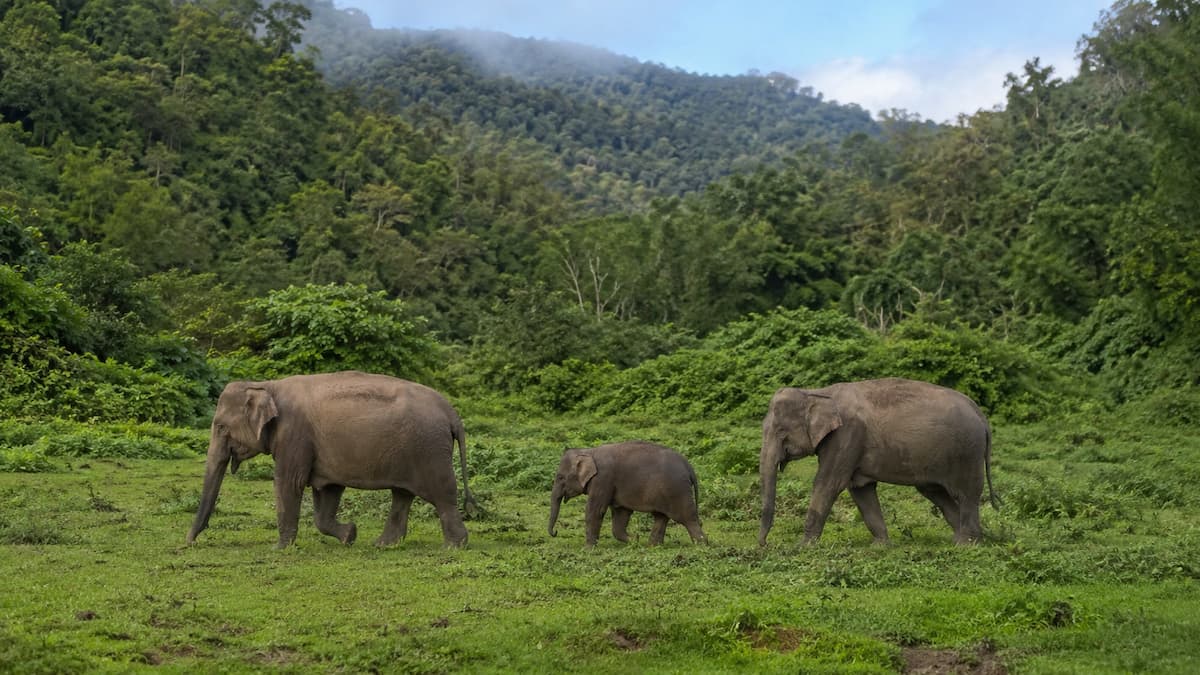
7 Ethical Elephant Sanctuaries in Thailand: Welfare-First Experiences
Thailand offers countless opportunities to see elephants, but choosing a genuinely responsible experience can be surprisingly difficult. Words such as sanctuary, rescue centre and ethical are widely used across the elephant tourism industry, yet they do not necessarily tell you how the elephants actually live or interact with visitors.
The strongest welfare-focused experiences increasingly prioritise observation over riding, bathing, performances and other close-contact activities. They give elephants greater freedom to move, forage, socialise and behave naturally, with visitors adapting to the elephants rather than the other way around.
For this guide, we started with elephant venues and projects independently recognised under current welfare guidelines rather than relying on marketing claims or traveller reviews alone. From these, we selected seven experiences across Thailand that combine strong welfare practices with meaningful opportunities for travellers to observe elephants.
These sanctuaries are not ranked from best to worst. Each offers something different, from accessible half-day experiences in Phuket and Chiang Mai to remote forest settings and multi-day sanctuary stays.
Quick Summary: Ethical Elephant Sanctuaries in Thailand
Thailand has hundreds of elephant tourism venues, but the word sanctuary does not automatically mean an experience provides high standards of elephant welfare. We selected these seven from independently recognised elephant-friendly projects, prioritising elephant autonomy, natural behaviour and observation over riding, bathing and other close-contact activities.
The sanctuaries are not ranked from best to worst. Each provides a different option depending on where you are travelling and the type of elephant experience you want.
| Elephant Sanctuary | Location | Go Here If You… |
|---|---|---|
| Phuket Elephant Sanctuary | Phuket | Want an accessible, observation-only elephant experience while staying in Phuket |
| Following Giants | Krabi & Koh Lanta | Are travelling through Southern Thailand and want to observe elephants without riding or tourist bathing |
| ChangChill | Chiang Mai | Want a convenient welfare-focused elephant day trip from Chiang Mai |
| BEES | Mae Chaem, Chiang Mai | Prefer a slower, rural experience with opportunities for longer sanctuary stays |
| Boon Lott’s Elephant Sanctuary | Sukhothai | Want an immersive multi-day experience with very limited visitor numbers |
| Elephant Forest Phitsanulok | Phitsanulok | Want a newer forest-based experience away from Thailand’s major elephant tourism centres |
| Somboon Legacy Foundation | Kanchanaburi | Are exploring Kanchanaburi and want a hands-off elephant experience in western Thailand |
Our key takeaway: responsible elephant tourism increasingly means asking for less interaction rather than more. The strongest experiences allow elephants greater freedom to choose when they walk, forage, socialise, bathe or move away from visitors.
What Makes an Elephant Sanctuary Ethical?
An elephant sanctuary should provide more than an alternative to elephant riding. Good welfare depends on how elephants live throughout the day, not simply on which activities visitors are allowed to see.
Elephants need sufficient space to move and explore, opportunities to forage, appropriate food and veterinary care, suitable social contact with other elephants and an environment that allows them to make meaningful choices. Restraint should be minimised, performances and forced behaviours avoided, and interactions with tourists should not determine how an elephant spends its day.
This is why observation-led experiences have increasingly become the benchmark for responsible elephant tourism. Instead of bathing, riding or repeatedly touching elephants, visitors watch them walk, forage, socialise, rest and bathe on their own terms.
However, an observation-only policy does not automatically make a sanctuary ethical. An elephant could still experience poor welfare away from visitors through excessive chaining, isolation, inadequate space or inappropriate care.
For this guide, we therefore look beyond individual tourist activities. We favour sanctuaries that give elephants greater autonomy, provide environments where natural behaviours are encouraged and place the animals’ long-term welfare ahead of creating close-contact experiences for visitors.
How We Chose These 7 Elephant Sanctuaries
With so many elephant camps, rescue centres and sanctuaries operating across Thailand, we did not want to create another list based largely on online reviews, popularity or businesses describing themselves as ethical.
Our starting point was independent welfare assessment. World Animal Protection’s latest research assessed 2,849 elephants across 236 tourism venues in Thailand. Its current Elephant Friendly guide identifies just 13 Thai venues and projects as meeting its highest elephant-friendly guidelines.
We used these independently recognised operations as our initial shortlist and then considered geographical diversity, accessibility, the type of visitor experience offered and how useful each option would be for travellers planning different Thailand itineraries.
Several of the 13 recognised entries are also connected. ChangChill has two recognised experiences, Following Giants operates in both Krabi and Koh Lanta, and Mahouts Elephant Foundation has separate community-based projects. For this reason, simply turning the 13 entries into a ranked list would give a misleading impression of the choices available.
Our final seven instead represent different ways to experience responsible elephant tourism around Thailand — from accessible half-day visits to remote forest projects and multi-day sanctuary stays.
They are recommendations rather than rankings. Being first or seventh on this list does not imply better or worse elephant welfare.
Phuket Elephant Sanctuary — Best for Phuket Visitors
For travellers staying in Phuket, Phuket Elephant Sanctuary offers one of the easiest ways to experience observation-led elephant tourism without travelling elsewhere in Thailand. Located in the island’s northeast, near Paklok, the sanctuary provides a very different setting from Phuket’s busy west-coast resort areas.
Established as a retirement and rescue sanctuary for elephants previously used in tourism and logging, Phuket Elephant Sanctuary has continued to move towards a more hands-off visitor model. From April 2026, it stopped tourist feeding, meaning visitors now observe elephants rather than controlling their behaviour with food.
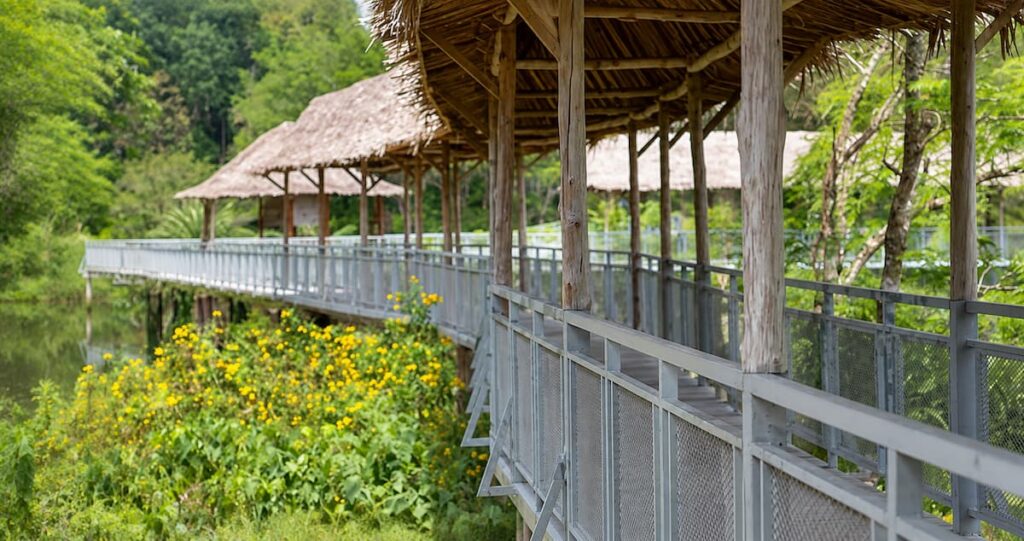
Elephants spend their time moving through forested areas where they can forage, socialise, rest and bathe independently. Visitors follow from a respectful distance, while the sanctuary’s elevated canopy walkway provides another opportunity to watch elephants moving through the landscape without entering their immediate space.
Several programmes make the sanctuary relatively easy to incorporate into a Phuket itinerary. The shortest experiences focus on observation from the canopy walkway, while longer half-day and full-day programmes provide more time to explore the sanctuary and learn about the individual elephants, their histories and their ongoing care.
The experience is particularly suitable for travellers who want to see elephants while visiting Phuket but do not want an excursion built around riding, bathing, feeding or posing for photographs.
It is worth allowing for the location when planning your day. Paklok is on the quieter northeastern side of Phuket, so travelling from Patong, Kata or Karon takes considerably longer than travelling from Phuket Town or the island’s east coast.
Best for: Travellers staying in Phuket
Location: Paklok, northeastern Phuket
Typical visit: 90 minutes to a full day
Interaction: Observation only
Good to know: Tourist feeding was discontinued in April 2026 as the sanctuary moved further towards an elephant-led, observation-focused experience.
Following Giants — Best for Krabi and Koh Lanta
Following Giants gives travellers in Southern Thailand two convenient opportunities to experience observation-led elephant tourism, with locations in both Krabi and on Koh Lanta. Rather than treating them as separate recommendations, we have included Following Giants once because both operate around the same welfare-first philosophy.
The experience is built around following elephants through their environment rather than asking the elephants to participate in scheduled tourist activities. There is no riding or tourist bathing, and visitors observe elephants as they walk, forage and spend time within the surrounding forest.
This approach makes Following Giants particularly interesting in a region where elephant experiences are commonly sold alongside island tours, beaches and other short excursions. Visitors can still include elephants in a Southern Thailand itinerary without choosing an attraction centred around close physical interaction.
The two locations also make the experience practical for different journeys. The Krabi operation is the more convenient choice for travellers staying around Ao Nang, Krabi Town and the surrounding mainland, while the Koh Lanta sanctuary works naturally for visitors spending several days on the island.
Programmes vary in length, with shorter observation experiences suitable for travellers who want to dedicate part of a day to the sanctuary and longer options providing more time in the elephants’ environment. Some programmes also introduce visitors to the wider conservation and community work connected with caring for captive elephants.
Following Giants is particularly valuable because its development towards an observation-led model has involved collaboration with World Animal Protection, making it a useful example of how existing elephant tourism can transition away from direct visitor interaction.
Best for: Krabi, Ao Nang and Koh Lanta travellers
Locations: Krabi mainland and Koh Lanta
Typical visit: Around two hours to a half or full day, depending on the programme
Interaction: Observation-led, without riding or tourist bathing
Good to know: Choose the Krabi or Koh Lanta location according to your itinerary rather than travelling between them specifically for the experience.
ChangChill — Best Ethical Elephant Day Trip from Chiang Mai
Chiang Mai has one of Thailand’s largest concentrations of elephant tourism venues, which can make choosing between them particularly difficult. ChangChill stands out because its story is not simply about establishing a new sanctuary — it demonstrates how an existing elephant tourism operation can change the way it works.
Beginning in 2017, the project transitioned away from activities such as elephant riding, tourist bathing and direct feeding, with support from World Animal Protection and other partners. The focus shifted towards allowing elephants greater freedom to behave naturally while visitors became observers rather than participants in their daily routines.
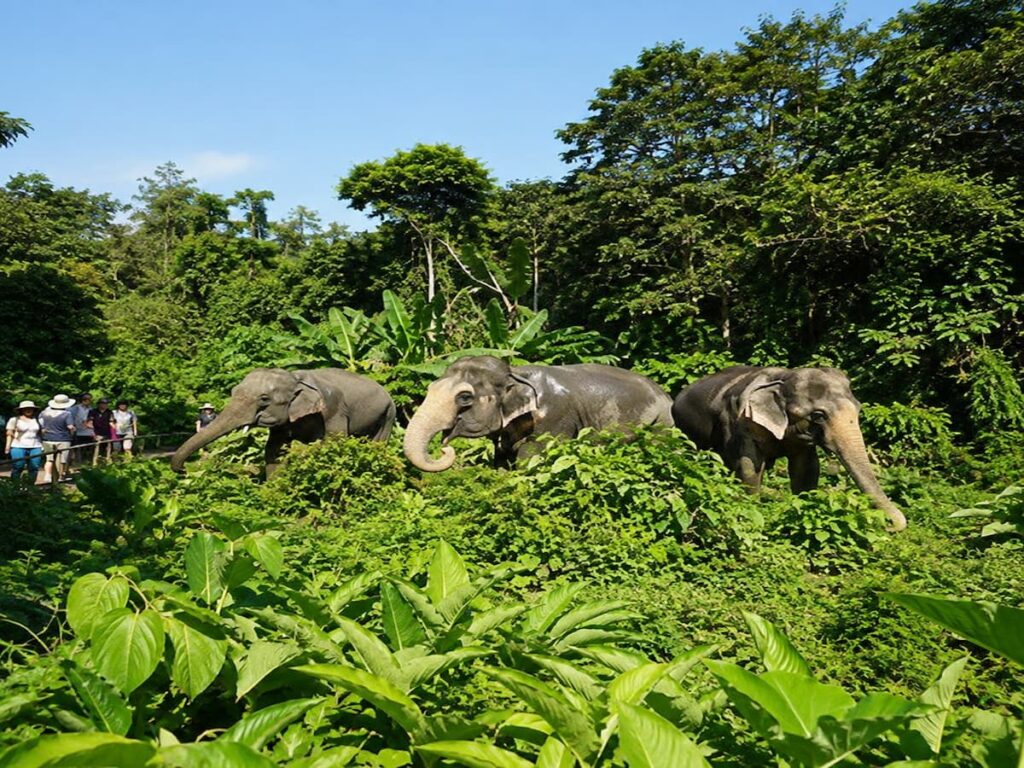
Today, visitors can watch elephants moving through the surrounding hills and forest, foraging for vegetation, socialising and covering themselves in mud or bathing when they choose. Rather than approaching the elephants for physical interaction, guests learn about their behaviour, individual histories and the role of their mahouts while observing from an appropriate distance.
ChangChill currently operates two independently recognised experiences, View Doi and Hillside. Both follow the same broader welfare-first approach, while offering slightly different settings and programmes. Half-day visits are particularly convenient for travellers who want a responsible elephant experience without committing several days of their Chiang Mai itinerary.
Transport options from Chiang Mai also make ChangChill more accessible than some of the remote community and forest projects elsewhere in northern Thailand. The journey itself takes visitors away from the city and into the mountainous countryside south of Chiang Mai, adding considerably to the experience.
For travellers looking for an elephant day trip from Chiang Mai, ChangChill offers a strong balance between accessibility and an observation-led approach — while its transition from conventional elephant tourism provides an encouraging example of how the wider industry can evolve.
Best for: Travellers wanting an accessible elephant day trip from Chiang Mai
Location: Chiang Mai Province
Typical visit: Half day or full day
Interaction: Observation-led, without riding or tourist bathing
Good to know: ChangChill’s View Doi and Hillside experiences are separately recognised under current elephant-friendly welfare guidelines.
BEES — Best for a Rural Elephant Experience
Burm and Emily’s Elephant Sanctuary, better known as BEES, offers a much slower and more immersive experience than the typical elephant excursion from Chiang Mai. Located near Mae Chaem in the countryside southwest of the city, the sanctuary is designed around observing elephants in a spacious rural environment rather than bringing visitors into close contact with them.
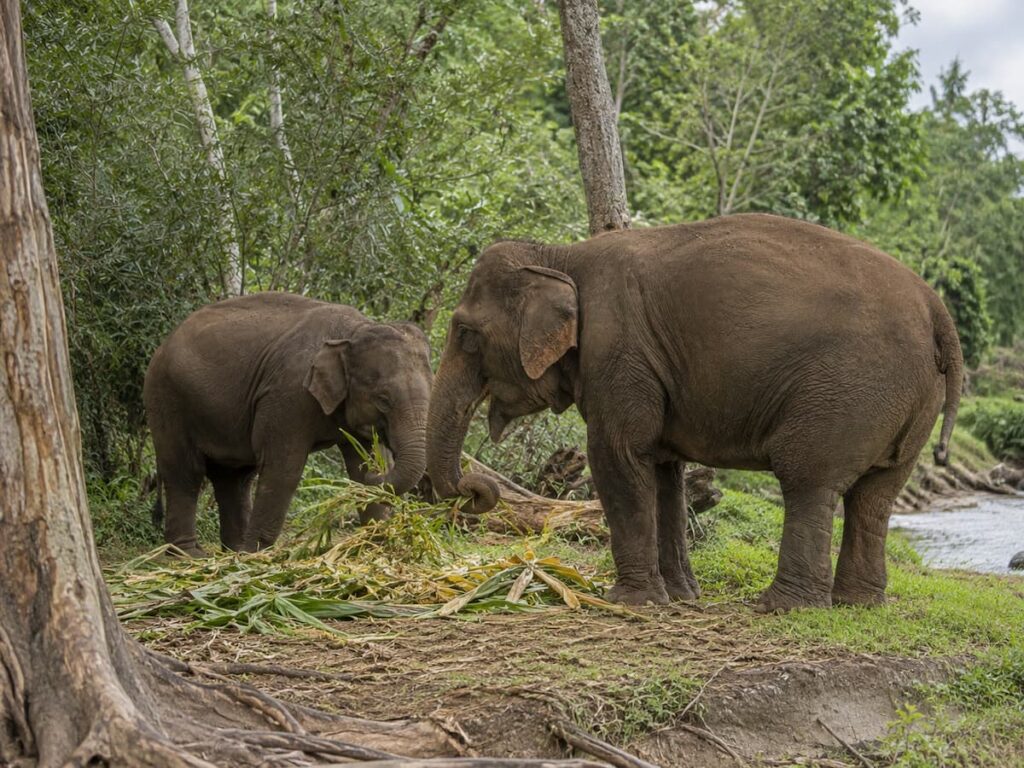
BEES follows a hands-off approach. There is no elephant riding, tourist bathing or scheduled physical interaction. Instead, the elephants spend their days moving through forest, fields and streams, foraging and choosing how they use their surroundings while visitors observe from a respectful distance.
The sanctuary extends across more than 300 acres, providing considerably more opportunity for movement and exploration than visitors might associate with a conventional elephant camp. Time here is consequently less about completing a sequence of activities and more about watching how elephants behave when they are given greater control over their day.
BEES is particularly distinctive for its longer programmes. Two-, four- and seven-day stays allow travellers to experience the sanctuary at a slower pace and learn more about elephant care, the surrounding environment and the realities of providing lifelong support for captive elephants. Limited shorter observation experiences may also be available for travellers arranging their own transport.
The remote location is part of both the appeal and the practical consideration. Mae Chaem is several hours from central Chiang Mai, so BEES is not the most convenient choice for someone looking to fit elephants between other city attractions. It is much better suited to travellers prepared to make the sanctuary and surrounding countryside a meaningful part of their northern Thailand itinerary.
Best for: Travellers wanting a slower, rural elephant experience
Location: Mae Chaem, Chiang Mai Province
Typical visit: Short observation visits may be available, with two-, four- and seven-day programmes offering the fuller experience
Interaction: Hands-off observation
Good to know: BEES is considerably more remote than the elephant venues commonly visited on day trips from Chiang Mai, so allow additional time for the journey.
Boon Lott’s Elephant Sanctuary — Best for a Multi-Day Sanctuary Stay
Boon Lott’s Elephant Sanctuary, commonly known as BLES, is one of the most distinctive choices on this list. Located in rural Sukhothai Province, it operates less like a conventional tourist attraction and more like a place where a small number of guests temporarily become observers of everyday sanctuary life.
Visitor numbers are deliberately limited, with a maximum of around ten guests at a time. Rather than organising the elephants around a fixed programme of feeding, bathing or photographs, BLES allows their movements and behaviour to influence how each day unfolds. Guests may spend time walking through the landscape observing elephants forage, explore and interact, but close contact is not the objective of the experience.
This slower approach is reflected in the way visits are organised. BLES encourages stays of several nights rather than quick day trips, with accommodation and meals forming part of the sanctuary experience. Time is also spent learning about the individual elephants, their histories and the practical realities of providing long-term care.
The setting makes BLES particularly attractive for travellers who want to incorporate elephant conservation into a broader journey through Sukhothai rather than simply adding an elephant activity to an already busy sightseeing day. It also offers a useful contrast with Thailand’s increasingly common half-day sanctuary programmes.
Visitors should, however, consider the physical nature of the experience. Following elephants can involve walking several kilometres over uneven rural terrain, and the elephants will not necessarily appear exactly where or when visitors expect them to. That unpredictability is part of the point: the experience adapts to the elephants rather than requiring the elephants to adapt to a tourist schedule.
Best for: Travellers wanting an immersive multi-day sanctuary experience
Location: Sukhothai Province
Typical visit: Two to four nights
Interaction: Hands-off observation
Good to know: Visitor numbers are deliberately small, so advance planning is important. This is also better suited to travellers comfortable walking through rural terrain than those looking for an easy, short elephant excursion.
Elephant Forest Phitsanulok — Best New Forest-Based Experience
Elephant Forest Phitsanulok is one of the newest additions to Thailand’s welfare-focused elephant tourism landscape. Officially opened in 2025, the project was developed through cooperation between the Sappraiwan Elephant Foundation and World Animal Protection, with the aim of creating a forest-based environment where elephants can spend more of their time behaving naturally.
The experience differs noticeably from a conventional elephant camp. Rather than presenting a schedule of rides, performances or tourist bathing, the emphasis is on observing elephants as they move through a large forest environment, forage and interact with their surroundings.
Its location also makes Elephant Forest particularly useful for this guide. Phitsanulok sits between the heavily visited elephant-tourism region around Chiang Mai and the historic destinations of central Thailand, giving travellers another option without concentrating every northern recommendation around Chiang Mai.
Several programmes are available, ranging from shorter observation experiences to half- and full-day visits. Depending on the programme, visitors may also learn about elephant nutrition and help prepare food. This should not be confused with an attraction built around hand-feeding elephants: the focus remains on supporting their care while allowing the elephants greater control over their behaviour.
Because Elephant Forest Phitsanulok is comparatively new, it does not yet have the decades-long visitor history of some better-known Thai sanctuaries. However, its inclusion in World Animal Protection’s current Elephant Friendly guide gives it an important independent welfare benchmark from the outset.
For travellers passing through Phitsanulok or looking for a less conventional addition to a northern or central Thailand itinerary, it offers an interesting opportunity to see what the next generation of elephant tourism may look like.
Best for: Travellers looking for a forest-based elephant experience away from the major sanctuary centres
Location: Phitsanulok Province
Typical visit: Around one hour to a full day, depending on the programme
Interaction: Primarily observation-led
Good to know: The sanctuary only opened in 2025, making it one of the newest independently recognised elephant-friendly experiences in Thailand.
Somboon Legacy Foundation — Best for a Kanchanaburi Itinerary
For travellers exploring western Thailand, Somboon Legacy Foundation provides an observation-led elephant experience that fits particularly well into a Kanchanaburi itinerary. Rather than offering elephant rides, bathing or direct tourist interaction, the foundation follows a hands-off approach designed to give its elephants greater control over their daily lives.
The elephants can move, forage, socialise and enter the water on their own terms while visitors observe from an appropriate distance. The experience focuses on learning about elephant behaviour, individual histories and long-term care rather than creating opportunities for touching or posing with the animals.
There is an important recent change for travellers planning a visit. In April 2026, Somboon Legacy Foundation relocated to a new sanctuary site in Sai Yok District. This places it within one of Kanchanaburi Province’s most interesting areas, where a sanctuary visit can be combined with the River Kwai, Hellfire Pass, Sai Yok National Park and other historical and natural attractions.
The location also requires some realistic planning. Although Kanchanaburi is commonly visited from Bangkok, Somboon should not be treated as a quick excursion from the capital. The sanctuary is roughly another hour beyond Kanchanaburi city, while travelling directly from Bangkok by road can take around three hours each way.
It therefore makes much more sense as part of an overnight or multi-day Kanchanaburi journey. For travellers already heading west from Bangkok, however, Somboon provides something our other recommendations do not: an independently recognised, hands-off elephant experience that can be incorporated naturally into a broader exploration of western Thailand.
Best for: Travellers spending time in Kanchanaburi and Sai Yok
Location: Sai Yok District, Kanchanaburi Province
Typical visit: Half-day and longer experiences, depending on the programme
Interaction: Hands-off observation
Good to know: Somboon moved to its new Sai Yok sanctuary in April 2026. Allow around three hours by road from Bangkok and consider staying in Kanchanaburi rather than attempting a rushed return trip.
Why “No Elephant Riding” Isn’t Enough
For many travellers, avoiding elephant riding has become the starting point for choosing a responsible elephant experience in Thailand. That change in visitor attitudes has helped reduce demand for rides and traditional elephant shows, but it has not necessarily removed close-contact tourism.
Instead, much of the industry has changed the experience it sells.
Elephant bathing, washing, hand-feeding, walking alongside elephants and “mahout for a day” programmes are now commonly promoted as gentler alternatives. Some venues that once focused heavily on riding have adopted words such as sanctuary, rescue and ethical while replacing rides with opportunities for visitors to interact directly with elephants.
This is why looking for a simple “no riding” statement is no longer enough.
World Animal Protection’s latest assessment of elephant tourism in Thailand found that riding has declined substantially, but washing and other close-contact experiences have expanded. More than half of the elephants assessed were at venues offering washing or caretaking-style interactions, demonstrating how quickly the industry has adapted to changing traveller expectations.
The issue is not simply whether a particular activity looks cruel or compassionate. A more useful question is how much choice the elephant has.
An elephant repeatedly required to enter water with successive groups of tourists, stand for photographs or approach visitors for food may still have much of its day determined by a tourism schedule, even though nobody is riding it.
By contrast, an observation-led experience asks visitors to adapt. An elephant may forage, disappear into vegetation, interact with another elephant, cover itself in mud, enter the water or simply stand somewhere inconvenient for photography.
That can make the visitor experience less predictable — but the unpredictability is precisely what greater elephant autonomy should look like.
Responsible elephant tourism therefore requires looking beyond the activity advertised on the brochure. Consider how the elephants live, how freely they can move and socialise, what happens when visitors are not present and whether tourism is organised around the elephants’ behaviour or the elephants are organised around tourism.
Should You Feed or Bathe Elephants at a Sanctuary?
Feeding and bathing elephants can appear far more compassionate than riding or watching them perform, which is why these activities have become so popular at sanctuaries across Thailand. The welfare question, however, is more complicated than whether brief physical contact is automatically good or bad.
Bathing is particularly worth considering. Elephants naturally use water and mud to cool themselves, protect their skin and socialise, but an elephant choosing to enter a river is very different from one expected to enter the water several times each day so successive groups of tourists can wash, touch and photograph it.
The same principle applies to feeding. Providing appropriate food is obviously an essential part of caring for captive elephants, but repeated hand-feeding by tourists can encourage elephants to remain close to visitors and make food a mechanism for controlling where they stand and how they behave. Tourist favourites such as bananas and sugar cane are also energy-rich foods that should form only an appropriate part of an elephant’s overall diet.
This does not mean that seeing a visitor briefly feed or touch an elephant proves that the animal is experiencing poor welfare. Elephant welfare is influenced by its overall environment, diet, health, social relationships, freedom of movement, restraint and daily management rather than a single interaction viewed in isolation.
For travellers, a better question is therefore not simply “Can I feed or bathe the elephants?” but “Does the elephant get to choose what it does?”
At the strongest observation-led sanctuaries, visitors may still watch elephants eating, bathing or covering themselves in mud. The difference is that these behaviours happen because the elephants choose to do them, rather than because they are scheduled as activities for tourists.
If close physical interaction is the main attraction being advertised, it is worth looking more carefully at the sanctuary’s wider welfare practices before booking.
Red Flags When Choosing an Elephant Sanctuary in Thailand
The word sanctuary is not a guarantee of good elephant welfare. When comparing elephant experiences in Thailand, look beyond the name of the venue and the photographs on its booking page.
Some warning signs are obvious. Elephant riding, circus-style performances, painting, tricks and elephants trained to pose for photographs are difficult to reconcile with a welfare-first experience. However, other practices can be harder for travellers to recognise.
Be cautious when a venue’s main selling point is repeated close contact, including scheduled tourist bathing, hugging, constant touching or large-group hand-feeding. An experience marketed primarily around what you can do with an elephant may give the animal considerably less choice than one centred on observing what the elephant chooses to do.
Also look at the environment. Elephants should have room to move, opportunities to forage, access to shade and water, and appropriate opportunities to interact with other elephants. Long periods on short chains, highly restricted spaces and elephants kept continually isolated from one another deserve further scrutiny.
Claims about rescued elephants should also be considered carefully. Many reputable sanctuaries genuinely provide lifelong care for elephants previously used in logging or tourism, but the word rescued does not by itself explain how an elephant was acquired, how it now lives or what activities it is expected to perform.
Useful questions to investigate before booking include:
- Does the venue offer riding, performances or tricks?
- Are elephants required to bathe or interact with every visitor group?
- Can elephants move away from tourists when they choose?
- Do they have substantial space to walk and forage?
- Are appropriate social relationships with other elephants encouraged?
- How and when are elephants restrained?
- Does the venue explain its veterinary care and long-term welfare practices?
- Is its welfare model supported by credible independent assessment?
Perhaps the simplest rule is to be sceptical of experiences promising extraordinary physical access. Getting closer to an elephant does not necessarily mean having a better encounter.
At a genuinely welfare-focused venue, there may be moments when an elephant walks away, disappears behind vegetation or simply does nothing particularly photogenic. Allowing it that choice is part of the experience.
What Happens to Thailand’s Captive Elephants If Tourists Stop Riding Them?
Avoiding elephant riding raises an important question: what happens to the thousands of elephants already living in captivity in Thailand if traditional elephant tourism continues to decline?
The answer is not as simple as releasing them into a national park.
Many captive elephants have spent years or decades living alongside people. Some were born in captivity, while others previously worked in logging or tourism. They may depend on mahouts for food, veterinary treatment and daily management, and some have physical or behavioural problems resulting from their previous lives.
Releasing captive elephants can also create risks for wild populations and surrounding communities. Asian elephants require extensive habitat and large quantities of food, while Thailand already experiences human-elephant conflict where wild elephant ranges overlap with farms, roads and settlements. Introducing additional captive animals into these landscapes requires far more than opening a gate.
Responsible sanctuaries therefore address a difficult transitional problem. They provide lifelong care for elephants that cannot simply return to independent wild lives while attempting to give them greater space, social opportunities and control over how they spend their days.
This care is expensive. Elephants eat substantial quantities of vegetation every day and require land, trained mahouts, veterinary support and long-term financial security. Tourism can help fund those costs, which is why the objective is not necessarily to eliminate all tourism involving captive elephants.
Instead, the challenge is to change the relationship.
Rather than elephants generating income through rides, performances or repeated physical interaction, observation-led tourism allows visitors to contribute financially while placing less emphasis on controlling elephant behaviour.
In the longer term, better welfare for Thailand’s captive elephants must also be accompanied by responsible breeding policies, habitat conservation and protection of wild populations. Sanctuaries can improve the lives of elephants already dependent on human care, but preventing future generations from becoming dependent on tourism is an equally important part of the solution.
Other Elephant-Friendly Projects Worth Considering
Our seven recommendations are intended to provide useful choices across different parts of Thailand rather than suggest that only seven responsible elephant projects exist. Several other operations meet the same current Elephant Friendly guidelines and are particularly interesting for travellers willing to venture beyond conventional sanctuary visits.
Kindred Spirit Elephant Sanctuary
Located in the mountains of Chiang Mai Province, Kindred Spirit Elephant Sanctuary combines elephant welfare with community-based tourism in a Karen village. Rather than operating as a conventional attraction, the project works with elephant-owning families to create an economic alternative that allows elephants to spend their time in a more natural forest environment.
Visits generally involve an overnight stay within the community, hiking into the forest and observing elephants from a respectful distance. This makes Kindred Spirit particularly suitable for travellers interested in both elephant welfare and local community life rather than a short excursion from Chiang Mai.
Mahouts Elephant Foundation LIFE Project
Mahouts Elephant Foundation takes the community model even further. Its LIFE Project works with a remote Karen community to support elephants living within an extensive forest environment while creating sustainable income for their mahouts and local families.
Visitors hike into the forest to observe the elephants rather than expecting them to appear at a tourist facility on demand. The project demonstrates an important principle of responsible elephant tourism: improving elephant welfare can also require addressing the economic realities faced by the people who have traditionally cared for them.
Mahouts Elephant Foundation Palatha Project
The Palatha Project operates in a remote community near Umphang in western Thailand. Its objective is preventative as much as restorative — helping locally owned elephants remain in their forest environment rather than being moved into more intensive forms of tourism because their owners need income.
For travellers, these projects require considerably more time and effort than visiting an easily accessible sanctuary. However, they also demonstrate where responsible elephant tourism may increasingly be heading: away from creating attractions for elephants and towards supporting elephants, mahouts, communities and forests together.
These projects were not excluded because we consider them less ethical than our seven recommendations. We simply chose the main seven to provide a broader range of locations and visitor experiences around Thailand.
What About Elephant Nature Park?
Elephant Nature Park near Chiang Mai is one of Thailand’s best-known elephant rescue organisations and has played an important role in changing international attitudes towards elephant tourism. Its work has helped move the conversation away from riding and performances and towards rescue, rehabilitation and more observation-led experiences.
Given that reputation, its absence from our seven recommendations may be surprising.
The reason comes down to the methodology used for this guide rather than an attempt to dismiss Elephant Nature Park’s wider contribution. We began our shortlist with venues currently included in World Animal Protection’s highest Elephant Friendly category.
At the time of writing, World Animal Protection lists Elephant Nature Park separately among its other high-welfare venues, rather than within the Elephant Friendly group used as the starting point for our seven selections. Its current visitor experiences remain largely observation-focused, but this difference in independent classification means we have not quietly applied a different selection standard simply because the sanctuary is famous.
Elephant Nature Park therefore remains an important organisation for travellers researching responsible elephant experiences around Chiang Mai. Its omission from our main seven should not be interpreted as a ranking of it below every sanctuary included above.
It instead illustrates one of the central points of this guide: rather than relying on reputation, popularity or the word sanctuary, travellers should consider current welfare practices and independent assessments when deciding where to visit.
Is Seeing Elephants in the Wild More Ethical?
For elephants that are already captive and dependent on human care, a well-managed sanctuary can provide a far better life than one centred around riding, performances or constant tourist interaction. But if your main goal is simply to see elephants in Thailand, there is another option: observe genuinely wild elephants in protected habitat.
Where wildlife tourism is properly managed, this is the most natural way to encounter them. Wild elephants decide where they travel, what they eat, which elephants they associate with and whether they appear at all. There is no bathing session, feeding schedule or guarantee that an elephant will conveniently stand where visitors can see it.
That distinction is important. Responsible sanctuaries and wild-elephant conservation address different problems. Sanctuaries provide care for animals that are already captive and generally cannot simply be released, while protected habitats help keep wild elephant populations living independently of tourism.
Seeing Wild Elephants at Kui Buri National Park
Kui Buri National Park in Prachuap Khiri Khan Province is one of Thailand’s best-known destinations for observing wild Asian elephants. Rather than entering an elephant sanctuary, visitors travel into designated wildlife-viewing areas with authorised local guides and vehicles and look for elephants moving naturally through the landscape.
Wild gaur can also be seen in the park, while the forest and grassland habitat make the experience worthwhile beyond any single wildlife sighting.
There is an important difference from visiting a sanctuary: seeing an elephant is never guaranteed.
An elephant might appear in an open area, remain partially hidden among vegetation or not appear during your visit at all. That uncertainty can initially seem like a disadvantage, particularly for travellers with limited time, but it is also evidence that these are genuinely wild animals whose behaviour is not being organised around visitors.
Travellers should maintain the required distance, remain with authorised guides and never attempt to approach or feed wild elephants. Asian elephants are powerful wild animals, and responsible wildlife watching depends on minimising disturbance as well as protecting visitors.
Choosing between a sanctuary and Kui Buri therefore does not necessarily mean deciding which is more ethical. Visiting a responsible sanctuary can help fund lifelong care for elephants already dependent on humans, while visiting protected wild-elephant habitat can support communities and landscapes where elephants remain wild.
In the long term, both matter — but the ultimate conservation goal is a future in which more elephants can live naturally without ever becoming dependent on tourism.
A Travel With Insight Perspective
Researching this article changed some of my own assumptions about elephant tourism in Thailand.
I grew up at a time when riding an elephant was widely presented as an exciting travel experience. For many travellers, sitting high on the back of an elephant and moving through a tropical landscape represented adventure rather than an animal-welfare question. Like many people, as I learned more about how elephants were trained and managed for these experiences, my thinking changed.
Over the years, I watched the tourism industry change as well. Elephant riding gradually became less acceptable to many international travellers, while sanctuaries, rescue centres and retirement homes offered what appeared to be a much better answer. No riding, rescued elephants, feeding them by hand and helping to bathe them seemed to represent a compassionate new relationship between visitors and elephants.
Before researching this guide, I had largely arrived at the same conclusion: responsible sanctuaries were solving much of the welfare problem associated with traditional elephant tourism.
What surprised me was discovering how much the understanding of responsible elephant tourism has continued to evolve.
The question is no longer simply whether we should ride an elephant. Increasing attention is now being given to how much control elephants have over their entire day. An experience can remove riding while still requiring elephants to repeatedly approach visitors, accept food, enter water for bathing sessions or remain available for close physical interaction.
That distinction changed the way I looked at the experience.
Watching an elephant walk into a river and bathe because it chooses to is fundamentally different from paying for an experience in which an elephant is expected to enter the river with each new group of visitors. Watching elephants forage through vegetation may seem less exciting than feeding them directly, but it gives the animals something increasingly recognised as central to good welfare: choice.
This does not mean that travellers who previously rode elephants, or who have visited a sanctuary offering feeding or bathing, deliberately supported poor welfare. Our understanding changes as better information becomes available, and elephant tourism itself has been evolving in response.
It also does not mean that every question surrounding captive elephant welfare has a simple answer. These are intelligent, powerful animals living within a complicated relationship with people that has developed over generations in Thailand.
What the research for this guide reinforced for me is that responsible travel is not about finding a label that allows us to stop asking questions. It is about being prepared to change our choices as our understanding improves.
For elephant tourism today, that increasingly means asking for less rather than more: less touching, less control and fewer staged interactions — while giving elephants more space, more opportunity to behave naturally and, wherever possible, more choice over how they spend their day.
Frequently Asked Questions About Ethical Elephant Sanctuaries in Thailand
Are elephant sanctuaries in Thailand ethical?
Some are, but the word sanctuary does not guarantee good welfare. Thailand has hundreds of elephant tourism venues operating under many different models. Look at how the elephants actually live, whether they can move and socialise freely, how much tourist interaction is expected and whether the venue has credible independent welfare recognition.
What is the most ethical elephant sanctuary in Thailand?
There is no reliable way to name one sanctuary as Thailand’s single most ethical. Welfare depends on many factors, and responsible organisations operate under different circumstances. The seven sanctuaries in this guide were selected from independently recognised elephant-friendly projects and are recommendations for different destinations and types of traveller rather than a best-to-worst ranking.
Can you ride elephants at an ethical sanctuary?
The welfare-first sanctuaries recommended in this guide do not offer elephant riding. Observation-led experiences instead allow visitors to watch elephants forage, walk, socialise and bathe without requiring them to carry tourists.
Is bathing with elephants ethical?
Tourist bathing can reduce an elephant’s autonomy when animals are repeatedly expected to enter the water and interact with successive groups of visitors. Seeing elephants choose to bathe naturally is different from participating in a scheduled bathing activity. For this reason, many welfare-focused sanctuaries have moved towards observation rather than tourist bathing.
Is feeding elephants ethical?
Feeding alone does not determine an elephant’s overall welfare, but repeated tourist hand-feeding can influence behaviour and encourage elephants to remain close to visitors. Foods commonly offered to tourists, including bananas and sugar cane, are also energy-rich and should form an appropriate rather than excessive part of an elephant’s diet. Observation-led sanctuaries increasingly avoid tourist feeding altogether.
Can captive elephants in Thailand be released into the wild?
Usually not simply or safely. Many have lived around humans for decades or were born in captivity, while some require continuing veterinary or behavioural support. Suitable habitat is also limited, and wild elephant populations already experience conflict with surrounding communities in parts of Thailand. Responsible sanctuaries therefore provide long-term care while allowing captive elephants as much autonomy as practicable.
Where can you see wild elephants in Thailand?
Kui Buri National Park in Prachuap Khiri Khan Province is one of Thailand’s best-known places for observing wild Asian elephants. Visitors enter designated wildlife-viewing areas with authorised guides rather than interacting with the elephants. Sightings are never guaranteed because the animals remain genuinely wild.
What is the best ethical elephant sanctuary near Bangkok?
For travellers heading west from Bangkok, Somboon Legacy Foundation in Sai Yok District is one of the strongest independently recognised options. However, it is around three hours from Bangkok by road, so it works better as part of a Kanchanaburi stay than as a rushed return excursion from the capital.
What is the best ethical elephant sanctuary in Phuket?
Phuket Elephant Sanctuary is our recommended choice for Phuket. Its visitor model is observation-led, and tourist feeding was discontinued in April 2026, further reducing direct interaction between visitors and elephants.
What is the best ethical elephant sanctuary in Chiang Mai?
There is no single choice suitable for everyone. ChangChill is particularly convenient for travellers looking for an accessible day experience, while BEES offers a more remote and immersive rural stay. Kindred Spirit and the community-based projects supported by Mahouts Elephant Foundation are also worth considering for travellers with additional time.
Continue Exploring Thailand
Planning more of your journey through Thailand? Start with our Thailand Travel Guide, where you can explore the country’s destinations, islands, beaches, temples, attractions and practical travel information.
Several of the elephant sanctuaries featured in this guide are in Phuket, Krabi and Koh Lanta. Our Southern Thailand Travel Guide can help you explore these destinations as part of a wider journey through the region.
Related Reading
Why Visit Thailand? – Discover what makes Thailand one of the world’s most rewarding travel destinations, from its culture and cuisine to tropical islands, historic cities and extraordinary landscapes.
What Are the Must-See Attractions in Thailand? – Explore some of Thailand’s most memorable attractions and experiences, including cultural landmarks, natural wonders and places that help define a first journey through the country.
Which Temples Should You Visit in Thailand? – Discover remarkable Buddhist temples across Thailand, from ancient ruins and important royal sites to distinctive contemporary temples.
About the Author
David Hibbins is a travel publisher, destination researcher and the creator of Travel With Insight.
Through years of travel, tourism and publishing projects across Southeast Asia, he has developed a particular interest in how travellers research destinations, compare experiences and make travel decisions.
His work focuses on helping travellers move beyond popularity rankings, marketing claims and generic “best of” lists by providing balanced, research-driven destination guides. Rather than telling people where they should travel, his goal is to help readers understand the strengths, limitations and unique character of each destination so they can choose the places that best match their own interests, travel style and goals.
As the creator of Travel With Insight, David researches destinations throughout Southeast Asia, exploring not only where travellers go, but why they choose certain places, how destinations differ and what creates genuinely memorable travel experiences.
His work covers destination research, regional travel planning, traveller behaviour and the decision-making frameworks that help people plan more rewarding journeys.
Explore More Travel Resources
Every great journey begins with informed decisions. The more you understand a destination before you arrive, the more rewarding your travel experience becomes.
Whether you’re still researching Southern Thailand or you’re ready to start planning your itinerary, these additional resources can help.
Travel With Insight
Continue exploring our in-depth destination guides, travel inspiration and practical planning advice designed to help you make informed travel decisions throughout Thailand and Southeast Asia.
Go Find Asia
Looking for even more travel inspiration? Go Find Asia explores destinations, experiences and travel ideas across Asia, helping you discover where to go, what to see and how to plan your next adventure.
Resurgence Travel
When you’re ready to turn your research into reality, Resurgence Travel offers curated itineraries, personalised travel planning and local expertise to help you experience the very best of Thailand and Southeast Asia.