
What to Eat in Phuket: 10 Thai Food Experiences to Try
Deciding what to eat in Phuket can quickly become as overwhelming as deciding where to eat. Between local Phuket specialities, Southern Thai cooking, familiar favourites such as Pad Thai and Tom Yum, fresh Andaman seafood and thousands of restaurants spread across the island, there is far more worth trying than you could realistically fit into one holiday.
The good news is that you don’t need to.
In this guide, we’ve taken a different approach. We’ve chosen 10 different Thai food experiences across 10 of Phuket’s main destinations, from Hokkien noodles in Phuket Town and fresh seafood in Rawai to Massaman curry in Kata and roti in Bang Tao. Together, they offer an accessible introduction to the different flavours, influences and styles of eating you’ll encounter around the island.
Some have particularly strong connections to the areas we’ve paired them with, while others are simply excellent opportunities to try a classic Thai dish during your travels. Phuket’s food culture has been shaped by Southern Thai traditions alongside Hokkien Chinese, Peranakan and Muslim influences, giving the island a much broader culinary identity than the standard resort menu might suggest.
We’ve also suggested a good place to try each recommendation, but don’t treat this as a restaurant checklist. Most of these dishes are available throughout Phuket, often in countless variations. If you’re staying in Patong and fancy a Massaman curry, there is no reason to travel across the island simply because we’ve recommended one in Kata.
Instead, use these 10 choices as inspiration as you explore Phuket. Try the ones that appeal to you, discover others along the way, and remember that eating well in Phuket should be one of the enjoyable parts of your holiday — not another list you have to complete.
Quick Summary: What to Eat in Phuket
Phuket offers everything from familiar Thai favourites to dishes shaped by the island’s Hokkien, Peranakan, Southern Thai and Muslim influences. You don’t need to try everything — use these 10 food experiences as a starting point and choose the ones that appeal to you.
| Destination | What to Try | What to Expect |
|---|---|---|
| Phuket Town | Mee Hokkien | Rich, savoury wok-fried noodles reflecting Phuket’s Hokkien heritage |
| Patong | Tom Yum Goong | Hot, sour and aromatic prawn soup with plenty of Thai flavour |
| Karon | Pad Thai | Stir-fried noodles balancing sweet, sour, savoury and nutty flavours |
| Kata | Massaman Curry | Rich, aromatic and generally milder than many Thai curries |
| Rawai | Fresh Andaman Seafood | Choose fresh fish, prawns or crab and have it cooked to your preference |
| Nai Harn | Garlic-Chilli Soft-Shell Crab | Crispy crab with bold garlic, chilli and savoury flavours |
| Kamala | Khao Mok Gai | Fragrant Thai-Muslim spiced chicken and rice |
| Surin | Som Tam & Grilled Food | Fresh, spicy papaya salad paired with something hot from the grill |
| Bang Tao | Fresh Roti | Soft, crisp-edged flatbread served sweet or alongside savoury curry |
| Mai Khao | Volcano Egg | An unusual hotpot-style egg dish and one of the guide’s wildcard choices |
How We Chose These Phuket Food Experiences
The foods in this guide haven’t been chosen because they can only be found in the destinations we’ve paired them with. In most cases, they can’t. Pad Thai, Tom Yum, Massaman curry, som tam and many other Thai favourites are widely available across Phuket.
Instead, we’ve used 10 of Phuket’s main destinations as a simple way to explore different sides of the island’s food scene. Some pairings have a particularly strong local connection — such as Hokkien noodles in Phuket Town or fresh seafood in Rawai — while others give you a good opportunity to try a classic Thai dish as part of your holiday.
For each stop, we’ve also suggested somewhere you can look for a quality version. Treat these as useful starting points rather than restaurants you need to cross the island to visit. If you find a good version closer to where you’re staying, enjoy it there.
The aim isn’t to complete all 10. It’s to make choosing what to eat in Phuket easier — while hopefully encouraging you to try a few things you might otherwise have overlooked.
Phuket Town: Try Mee Hokkien
If you’re going to start anywhere, Phuket Town makes sense. Its historic streets reflect generations of Chinese migration and Peranakan culture, and that influence remains particularly easy to experience through food.
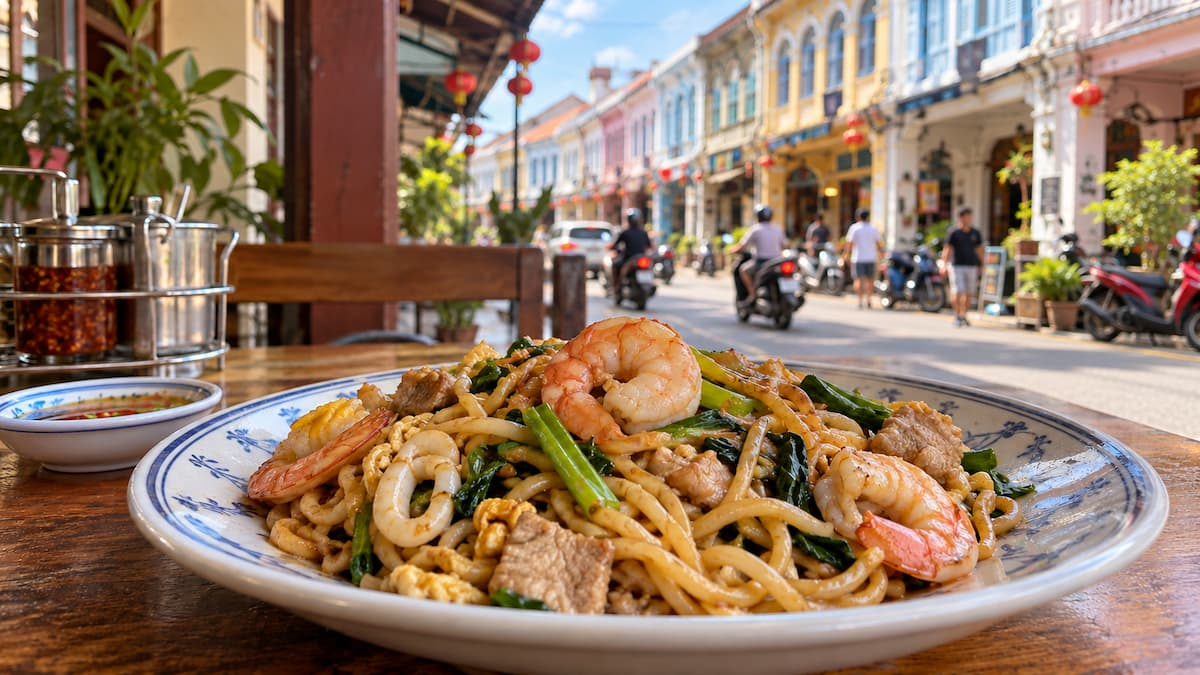
Mee Hokkien, or Phuket-style Hokkien noodles, is one of the island’s best-known local dishes. Thick yellow wheat-and-egg noodles are cooked quickly in a hot wok, usually with a combination of pork, seafood and vegetables. Depending on the cook, they may arrive relatively dry or with enough rich sauce or broth to coat the noodles, often finished with an egg.
The result is savoury, slightly smoky and considerably richer than many of the lighter noodle dishes you may have tried elsewhere in Thailand. Chilli and other condiments are usually available if you want to adjust the flavour yourself.
Hokkien noodles also tell part of Phuket’s story. Chinese Hokkien migrants settled on the island during its tin-mining era, and their cooking gradually mixed with local ingredients and Thai and Malay influences. The noodles that remain popular around Phuket Town today are one of the most accessible ways to taste that heritage.
Where to Try Mee Hokkien in Phuket Town
Mee Ton Poe is a long-established Phuket Town noodle shop closely associated with Hokkien mee. Its thick yellow noodles can be ordered with pork, seafood, vegetables and egg, making it an easy introduction to the Phuket version of the dish.
You don’t need to visit this particular restaurant to try Mee Hokkien — there are several established noodle shops around Phuket Town, and versions can be found elsewhere on the island. But if you’re already exploring Old Town, this is one food worth making room for.
Patong: Try Tom Yum Goong
Patong has restaurants serving almost every cuisine imaginable, but if you’re looking for a classic Thai dish during your stay, Tom Yum Goong is an excellent place to start.
Tom Yum is Thailand’s famous hot-and-sour soup, while goong means prawns. The broth is typically built around lemongrass, galangal, makrut lime leaves, chilli and lime, with mushrooms and fresh prawns completing the dish. The result should be fragrant and refreshing as well as spicy, with sourness playing just as important a role as the heat.
You’ll encounter different versions around Phuket. Nam sai is the clearer style, while nam khon is richer and creamier. Restaurants also vary considerably in how much chilli they use, so don’t assume every bowl of Tom Yum will have the same level of heat.
If you’re cautious with spicy food, ask for it milder when ordering. You should still get the characteristic sour, aromatic flavours without turning dinner into an endurance test.
Where to Try Tom Yum Goong in Patong
Da No.1 Seafood&Thaifood on Prachanukhro Road is a well-established Thai and seafood restaurant and a practical place to look for traditional Thai dishes while staying in Patong.
Tom Yum Goong is also extremely easy to find elsewhere in Patong and across Phuket — current Patong restaurant menus continue to list versions built around prawns, lemongrass, galangal, lime leaves and chilli.
So don’t feel you need to seek out one particular restaurant. The important part of this stop is trying a properly balanced bowl of Tom Yum: hot, sour, aromatic and unmistakably Thai.
Karon: Try Pad Thai
Pad Thai may be one of Thailand’s most internationally recognised dishes, but that doesn’t make it one to skip. If you’ve only tried versions outside Thailand, eating it freshly cooked in a simple local restaurant can be a very different experience.
At its heart, Pad Thai is a stir-fried rice noodle dish built around balance. Tamarind provides sourness, palm sugar brings sweetness, and fish sauce adds salt and savoury depth. Egg, bean sprouts and garlic chives commonly join the noodles, with crushed peanuts, lime and chilli allowing you to adjust the finished dish to your taste. Prawns, chicken and tofu are among the common variations you’ll encounter.
A good Pad Thai shouldn’t simply taste sweet. The tamarind should give it enough acidity to keep the sauce lively, while the noodles should remain distinct rather than becoming a sticky mass. Add some lime at the table and chilli only if you want the extra heat.
Where to Try Pad Thai in Karon
The Pad Thai Shop on Patak Road is an established local restaurant where Pad Thai remains one of the dishes people specifically come to eat. Current menus continue to feature Pad Thai alongside other straightforward Thai dishes, making it a particularly easy place to try a freshly cooked version while you’re in the Karon area.
You certainly don’t need to travel to Karon just for Pad Thai — you’ll find it throughout Phuket. But if Karon is already part of your holiday, this small local restaurant gives you a good excuse to try one of Thailand’s most famous dishes where the food, rather than the setting, is the main attraction.
Kata: Try Massaman Curry
If fiery Thai curries make you hesitate, Massaman curry is a good one to try. Rich, aromatic and usually relatively mild, it gets much of its character from warm spices rather than intense chilli heat.
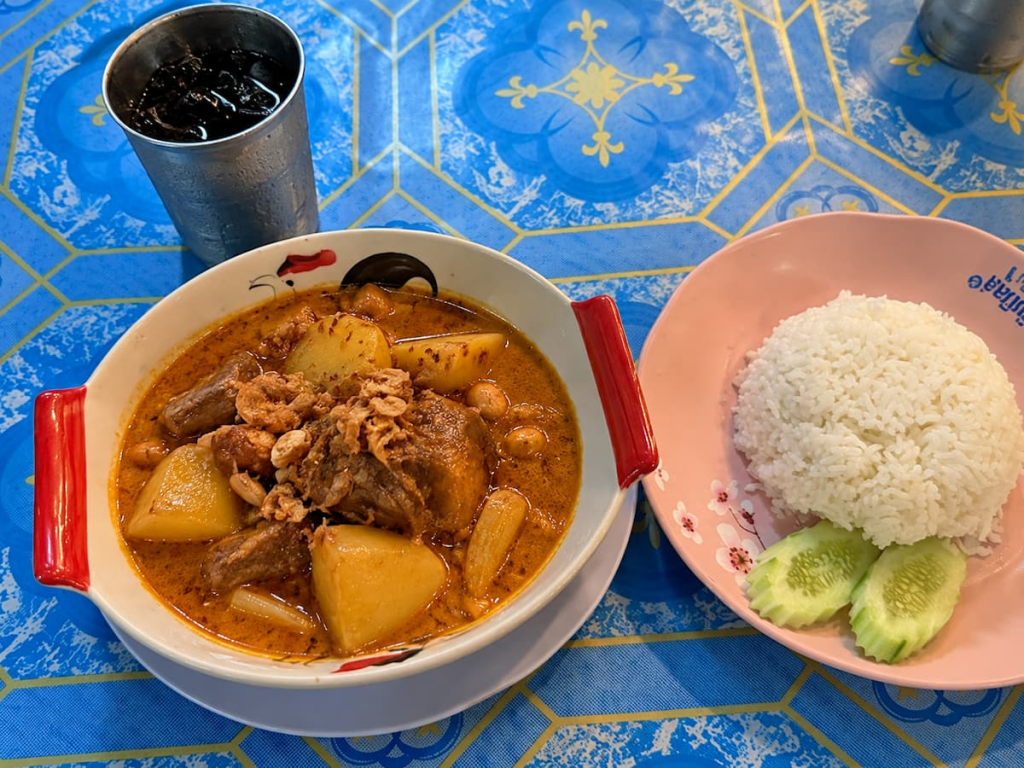
Massaman is commonly made with chicken or beef slowly cooked in coconut milk with potatoes, onions and peanuts. Tamarind and palm sugar help create the familiar sweet-and-sour balance, while spices such as cardamom, cinnamon, cumin and cloves give the sauce a deeper aroma than you might expect from many other Thai curries.
Those spices also hint at the dish’s history. Massaman has strong Muslim influences, with its precise origins debated between the old trading ports of Southern Thailand and the cosmopolitan royal kitchens of Ayutthaya. What is clear is that centuries of trade brought spices and cooking influences from Persia, India and the wider Muslim world into what became a distinctly Thai curry.
It’s filling, comforting and generally one of the easier Thai curries for newcomers to approach. Order it with steamed rice and let the sauce do most of the work.
Where to Try Massaman Curry in Kata
Kata On Fire Bar & Grill is one local option where you can look for Massaman curry while staying in the Kata area.
As with most of the dishes in this guide, however, Massaman isn’t something you need to travel across Phuket to find. It appears on Thai menus throughout the island, and recipes vary considerably from kitchen to kitchen.
If you’re unsure how much spice you can handle, Massaman is a particularly forgiving place to begin — aromatic and complex without needing to be fiercely hot.
Rawai: Try Fresh Andaman Seafood
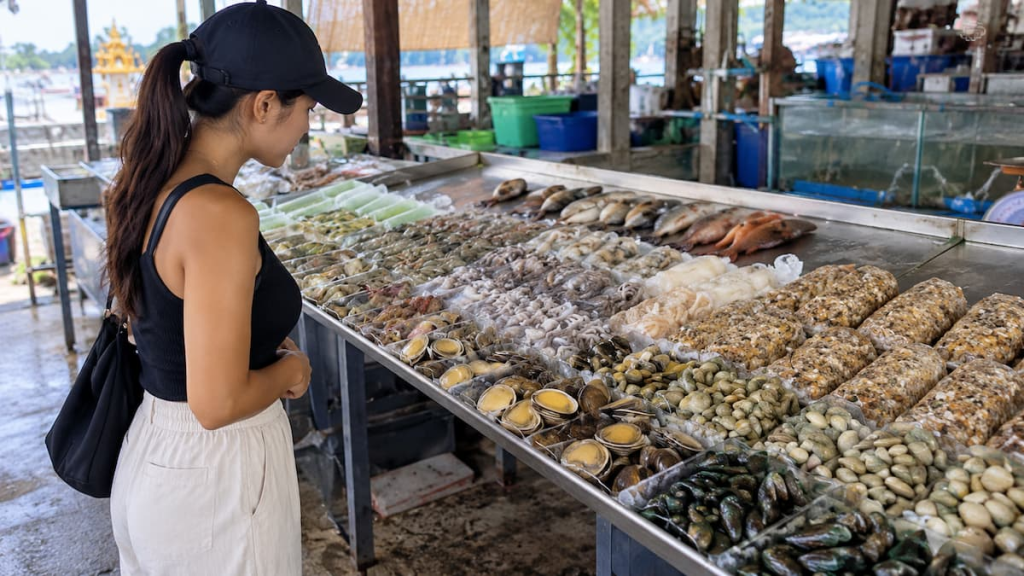
For seafood, Rawai gives you something more interesting than simply choosing a dish from a restaurant menu. Here, part of the experience can be choosing the seafood yourself and deciding exactly how you want it cooked.
At Rawai Seafood Market, stalls display fresh fish, tiger prawns, squid, crab and shellfish, generally sold by weight. Once you’ve chosen what you want, you can take it to one of the nearby restaurants and pay separately to have it prepared.
That makes Rawai a good place to experiment with different Thai seafood preparations rather than looking for one particular signature dish. A whole fish steamed with lime, chilli and garlic gives you something fresh, sour and spicy; prawns work beautifully grilled; squid can be stir-fried with garlic and pepper; while crab opens the door to richer curry preparations.
If you’re unsure what to choose, keep it simple. A whole fish or some prawns prepared in a straightforward Thai style lets the freshness of the seafood remain the main attraction.
Where to Try Fresh Seafood in Rawai
Rawai Seafood Market is the obvious place to experience the choose-your-own approach. Buy from one of the seafood stalls, confirm the price and weight before purchasing, and then choose one of the restaurants nearby to cook it for you.
There is no need to hunt for one particular stall or restaurant. Look at what appears fresh, ask prices before committing and choose the cooking style that appeals to you.
If the market experience doesn’t interest you, Rawai also has plenty of conventional seafood restaurants where you can simply sit down and order. The important thing here isn’t completing a particular ritual — it’s taking advantage of being on an Andaman island and enjoying fresh seafood in whatever way suits you.
Nai Harn: Try Garlic-Chilli Soft-Shell Crab
Soft-shell crab is one of those foods that can look more complicated than it actually is. Because the crab is harvested while its new shell is still soft, the entire thing can be cooked and eaten — shell, claws and all.
Fried until crisp and combined with garlic, chilli and pepper, it gives you a very different seafood experience from the fresh fish and prawns we recommended in Rawai. The outside becomes crunchy while the crab inside remains tender, with the garlic and chilli adding plenty of flavour without completely hiding the seafood.
It is usually eaten as part of a shared Thai meal rather than necessarily as a dish on its own. Add steamed rice and perhaps a vegetable dish or something fresher and more acidic alongside it, particularly if the crab has been generously fried.
Where to Try Soft-Shell Crab in Nai Harn
Mama Seafood is a casual seafood restaurant beside Nai Harn Beach and a useful place to explore Thai-style crab, prawns, squid and fish while you’re in the area.
The exact crab preparations available can change, so rather than arriving determined to order one particular version, check the current menu and ask what is available. Garlic-and-pepper, chilli, black-pepper and curry preparations are all common ways of serving crab in Thai seafood restaurants.
And if soft-shell crab isn’t available that day, don’t worry about completing the list. Choose another freshly cooked Thai seafood dish that appeals to you — the point of this stop is to try a bolder seafood preparation, not to turn lunch into a treasure hunt.
Kamala: Try Khao Mok Gai
Kamala gives you an opportunity to explore a different side of Thai food. The area has a long-established Muslim community, and that influence can still be found in the local food around the village.
Khao Mok Gai is one of the easiest dishes with which to start. Often loosely described as Thai chicken biryani, it combines chicken with fragrant yellow rice seasoned with spices such as turmeric, cumin, coriander and cardamom. Fried shallots, cucumber and a fresh dipping sauce commonly accompany the rice, creating a meal that is aromatic and savoury rather than dominated by chilli.
Its flavours reflect the Muslim culinary influences found across parts of Southern Thailand. The dish shares obvious similarities with biryani and other spiced rice dishes found across South and Southeast Asia, but generations of adaptation have produced a distinctly Thai version.
Khao Mok Gai is also a useful choice if you’ve been finding some Thai food hotter than expected. Individual recipes vary, but the rice itself is generally fragrant and warmly spiced rather than fiercely hot. The accompanying sauce is where you are more likely to encounter chilli.
Where to Try Khao Mok Gai in Kamala
Kamala has several small Muslim-owned and halal restaurants around the village, including Kamala Halal Food and Amena halal food by Amena’s daughter.
Rather than sending you across Kamala in search of one supposedly definitive plate of Khao Mok Gai, look for it on the menu at a local halal restaurant and ask what is available that day.
Even if Khao Mok Gai isn’t available, exploring one of Kamala’s local Muslim restaurants is worthwhile. Roti, curries, grilled seafood and other Thai-Muslim dishes offer another glimpse of just how varied eating in Phuket can be.
Surin: Try Som Tam with Grilled Food
For something lighter, fresher and potentially much hotter, try som tam with something from the grill while you’re around Surin.
Som tam is Thailand’s famous green papaya salad. Unripe papaya is shredded and pounded with ingredients such as lime, chilli, fish sauce, palm sugar, garlic and tomatoes, creating the sweet, sour, salty and spicy balance that appears throughout Thai cooking. Depending on the version, you may also find dried shrimp, peanuts or other additions mixed through the salad.
The important word here is spicy. Som tam can be considerably hotter than its fresh appearance suggests because the chillies are pounded directly into the dressing. If you’re unsure of your tolerance, ask for fewer chillies when ordering rather than discovering your limits halfway through lunch.
Pairing it with grilled chicken, pork or fish makes it a more substantial meal. The smoky, savoury flavours from the grill work particularly well against the sharp freshness of the papaya salad, while sticky rice is another excellent addition if it’s available.
Where to Try Som Tam in Surin
Tukta Food & Drink, at the southern end of Surin Beach, is one current option for straightforward Thai food including som tam, grilled fish and other familiar dishes.
Surin’s beachfront food scene has changed considerably over the years, so don’t rely on older guides showing rows of food stalls and restaurants directly on the sand. Food options are now more limited around the beach itself, with additional Thai restaurants available on the streets behind it.
And, as always, you don’t need to wait until Surin to try som tam. You’ll find versions throughout Phuket. The bigger decision is how many chillies you’re prepared to negotiate with.
Bang Tao: Try Fresh Roti
After the fragrant rice of Khao Mok Gai in Kamala, Bang Tao offers another easy introduction to Phuket’s Thai-Muslim food traditions: freshly cooked roti.
Roti starts with a simple piece of dough, but much of the pleasure is in watching it being made. The dough is stretched remarkably thin, folded and cooked on a hot griddle until the outside develops crisp, golden layers while the centre remains soft and slightly chewy.
What you order next depends on whether you’re hungry for something savoury or sweet.
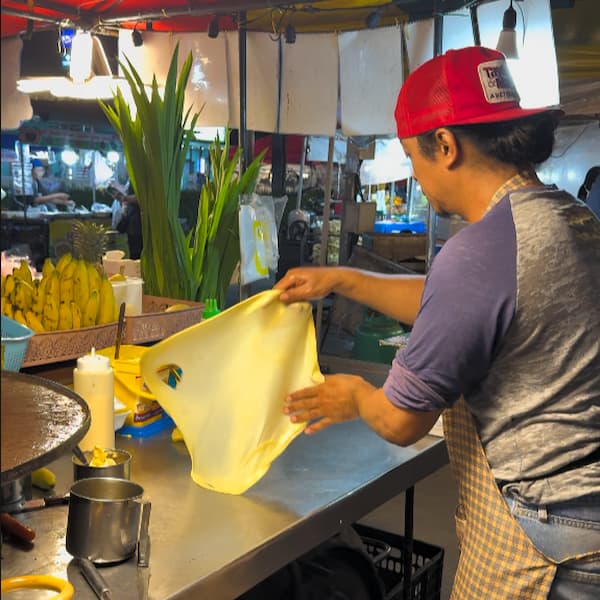
For a more traditional meal, try plain roti alongside a chicken, beef or Massaman-style curry, tearing pieces from the bread and using them to scoop up the sauce. For something sweeter, roti can be filled with banana or egg and finished with condensed milk and sugar — closer to a dessert or indulgent snack than a full meal.
Both versions are worth knowing about, because roti in Phuket isn’t simply the sweet banana pancake you may see at tourist markets. Its place in the island’s food culture is closely connected with the Muslim communities that have long been part of Phuket and Southern Thailand.
Where to Try Roti in Bang Tao
Bang Tao and neighbouring Cherng Talay have a substantial Muslim community, so local roti shops and halal restaurants are a good place to look rather than relying on one particular venue.
If you see roti being stretched and cooked fresh on a hotplate, that’s your opportunity. Start with a plain roti and curry if you want the savoury experience, or choose banana and condensed milk if dessert sounds more appealing.
Roti is widely available elsewhere in Phuket too, particularly in areas with established Muslim communities. Bang Tao simply gives you a good opportunity to try it as part of the island’s everyday food culture rather than treating it only as a tourist-market sweet.
Mai Khao: Try the Volcano Egg
Our final recommendation is a little different from the others. Volcano Egg isn’t a traditional Phuket dish that you’ll find on menus across the island. It’s a signature dish at Kin Dee in Mai Khao — and we’ve included it precisely because not everything worth eating in Phuket needs to be famous.
The dish arrives in a heated hotpot, with soft egg and seafood including prawns cooked together in a rich, savoury mixture. The hot vessel keeps everything warm at the table and gives the dish the dramatic presentation behind its name.
It’s also one to consider sharing. Portions can be substantial, and this makes more sense as one dish within a Thai meal than something everyone at the table necessarily needs to order individually.
Including a restaurant-specific creation might seem unusual in a guide otherwise built around established Thai foods, but that’s part of the point. Eating around Phuket isn’t only about working through the classics. Sometimes it’s worth ordering the dish a particular kitchen has become known for.
Where to Try the Volcano Egg in Mai Khao
The answer here is unusually simple: Kin Dee restaurant.
Kin Dee is a long-established Thai restaurant in Mai Khao serving local Phuket and Thai cooking, with seafood, curries and other dishes alongside its Volcano Egg. The restaurant describes its cooking as using produce from the surrounding village and Phuket where possible.
Unlike Pad Thai or Tom Yum, this isn’t a dish we’d suggest trying somewhere closer to your hotel. The Volcano Egg recommendation is specifically about Kin Dee.
If Mai Khao isn’t part of your Phuket plans, don’t make a special journey simply to complete our list. But if you’re staying in the north of the island or already exploring the area, it gives you something rather different to order — and a fitting wildcard to finish our 10 food experiences.
Other Phuket Foods Worth Trying
Our 10 recommendations are only a starting point. Phuket has its own distinctive food heritage, particularly around Phuket Town, and several local dishes are worth looking for if you want to explore beyond the choices above.
Moo Hong
Moo Hong is slow-braised pork belly cooked with soy sauce, garlic, black pepper and other seasonings until the meat becomes exceptionally tender. Rich, slightly sweet and deeply savoury, it reflects Phuket’s Peranakan food heritage and is best enjoyed with steamed rice.
O-Tao
One of Phuket’s more unusual local specialities, O-Tao combines small oysters with taro, egg and a sticky starch-based batter, typically cooked together on a hot griddle. Crispy pork crackling, spring onions and chilli sauce can add crunch and heat to the soft, chewy mixture.
The texture may be unfamiliar at first, but that’s also what makes O-Tao worth trying — there isn’t much else in the typical Thai visitor’s food repertoire quite like it.
O-Aew
If Phuket’s heat has you looking for something cold, O-Aew is a traditional local dessert made with jelly, shaved ice and sweet syrup, often served with additions such as red beans.
Its roots lie in Phuket’s Hokkien Chinese community, and it remains one of the island’s most distinctive ways to cool down after a meal.
Lo Ba
Lo Ba reflects another side of Phuket’s Chinese-influenced food heritage. Pork and offal are braised with spices before different pieces are fried and served with a sweet-and-sour dipping sauce.
It won’t appeal to everyone, particularly if offal isn’t normally part of your diet, but adventurous eaters looking specifically for traditional Phuket food should keep an eye out for it.
Kanom Jeen
Kanom Jeen consists of soft fermented rice noodles served with a choice of curries and plenty of fresh vegetables, herbs and accompaniments.
In Phuket it is particularly associated with breakfast and morning eating, with curry choices ranging from relatively approachable sauces to powerful Southern Thai preparations involving fish, crab or fermented flavours.
If your idea of breakfast doesn’t have to involve toast and coffee, this is one local habit well worth trying.
How Spicy Is the Food in Phuket?
Thai food has a reputation for being spicy, but that doesn’t mean everything you eat in Phuket will be hot. Pad Thai, Mee Hokkien, Khao Mok Gai and Massaman curry are generally approachable choices, while dishes such as som tam, Tom Yum and some Southern Thai curries can contain considerably more chilli.
Even then, there isn’t a universal spice level. The same dish can be relatively gentle in one restaurant and surprisingly hot in another, and many dishes are adjusted when they’re cooked.
If you prefer less heat, simply ask. Mai phet means not spicy, while phet nit noi means a little spicy. With something such as som tam, you can also ask for only one or two chillies because the salad is prepared to order.
Don’t feel that ordering food milder somehow means you’re eating it incorrectly. Chilli is only one part of Thai cooking. Sour lime and tamarind, salty fish sauce, sweetness, fresh herbs, aromatics and different textures are just as important to many dishes.
If you’re uncertain, start gently. You can always become more adventurous as your holiday progresses; recovering from an unexpectedly enthusiastic plate of som tam is rather harder.
Vegetarian and Dietary Considerations
Vegetarian food is widely available in Phuket, but don’t assume that a dish is vegetarian simply because you can’t see any meat in it. Fish sauce, oyster sauce, shrimp paste and meat-based stocks are commonly used in Thai cooking and may appear in sauces, curries, soups and stir-fries.
If you eat a strict vegetarian or vegan diet, make that clear when ordering rather than simply asking for a dish without meat. Restaurants in Phuket’s main tourist areas are generally accustomed to dietary requests, although communication can be more limited at small local stalls.
People with food allergies should take similar care. Peanuts, shellfish, fish sauce, soy and other common allergens appear frequently in Thai cooking, sometimes in sauces or garnishes where they may not be immediately obvious.
For serious allergies or strict dietary requirements, carrying a translated explanation of exactly what you cannot eat can make ordering considerably easier.
None of this should discourage you from exploring Thai food. Phuket has everything from dedicated vegetarian restaurants to local dishes that can sometimes be adapted — it simply pays to ask rather than assume.
Do You Need to Travel Across Phuket for a Particular Dish?
Usually, no.
We’ve paired each of our 10 food experiences with a different Phuket destination to make the choices easier and to show some of the variety available around the island. That doesn’t mean you need to travel to Karon for Pad Thai, Kata for Massaman curry or Kamala every time you want Khao Mok Gai.
Most popular Thai dishes are available throughout Phuket, and travelling from one side of the island to another can take considerably longer than the map suggests, particularly when traffic is heavy.
There are a few exceptions where the place forms a bigger part of the experience. Exploring Phuket Town gives you a natural opportunity to discover the island’s Hokkien and Peranakan food heritage, while choosing fresh seafood at Rawai is as much about the market experience as the seafood itself. The Volcano Egg in Mai Khao is different again because it is a specific restaurant creation.
For everything else, use our recommendations as inspiration rather than instructions. If you find an excellent-looking local restaurant near your hotel serving the dish you want to try, eat it there.
A Phuket holiday doesn’t become better because you managed to tick all 10 foods off a list. Try what interests you, order something unfamiliar occasionally and leave enough room for the meals you discover by accident.
FAQs About What to Eat in Phuket
What food is Phuket famous for?
Phuket is particularly known for dishes influenced by its Hokkien Chinese and Peranakan heritage, including Mee Hokkien, Moo Hong, O-Tao, Lo Ba and O-Aew. Southern Thai seafood, curries and Muslim-influenced foods also form an important part of the island’s wider food culture.
What is the most traditional Phuket dish?
There isn’t one dish that can definitively be called Phuket’s most traditional food. Mee Hokkien is one of the most recognisable and accessible local choices, while Moo Hong, O-Tao, Lo Ba and O-Aew each represent different parts of Phuket’s culinary heritage.
If you want to concentrate specifically on traditional Phuket food, Phuket Town is the easiest place to begin.
Is food in Phuket very spicy?
Some of it can be, but certainly not all of it. Som tam, Tom Yum and Southern Thai curries can be very hot, while dishes such as Massaman curry, Khao Mok Gai, Pad Thai and Mee Hokkien are generally easier choices for people who prefer less chilli.
Spice levels also vary between restaurants, and many dishes can be adjusted when you order.
Is Phuket Town or the beach areas better for local food?
For traditional Phuket dishes and Hokkien-Peranakan food heritage, Phuket Town has the strongest concentration of choices. The beach destinations still have plenty of excellent Thai food, however, and areas such as Rawai, Kamala and Bang Tao offer their own worthwhile food experiences.
You don’t need to stay in Phuket Town to eat well or to find authentic Thai food.
Is Phuket good for seafood?
Yes. Phuket’s Andaman Sea location makes fish, prawns, squid, crab and shellfish widely available around the island.
Rawai is particularly interesting if you want to choose fresh seafood yourself and have it cooked nearby, but good Thai seafood restaurants can be found throughout Phuket. As always with seafood sold by weight, check the price before ordering.
Continue Exploring Phuket
Trying different Thai dishes is only one part of experiencing the island. Our Phuket Travel Guide brings together the bigger picture, including where to stay, beaches, attractions, getting around and practical advice for planning your time in Phuket.
If your travels extend beyond the island, our Southern Thailand Travel Guide explores the wider region, including its islands, beaches, destinations and travel experiences.
Related Reading
- Best Things to Do in Phuket — Build your food discoveries into a wider Phuket holiday with beaches, cultural sights, viewpoints, islands and other experiences worth considering.
- Best Island Day Trips from Phuket — Compare Phuket’s main island excursions and decide which day trip best fits the way you want to spend your time.
- Making the Most of Your Phuket Holiday — Practical ideas for balancing sightseeing, beaches, food and downtime without trying to squeeze everything into one trip.
About the Author
David Hibbins is the founder and principal writer of Travel With Insight. Based in Phuket, Thailand, he combines first-hand experience with detailed research to create practical travel guides designed to help visitors make informed decisions without becoming overwhelmed by choice.
His writing focuses particularly on Phuket, Southern Thailand and destinations across Asia, with an emphasis on how places work in the real world — from choosing where to stay and what to do to understanding local food, transport and everyday travel.
Explore Phuket Your Way
If you’d prefer some help turning Phuket’s beaches, food, culture and experiences into a trip that works for you, Resurgence Travel creates personalised Thailand itineraries and private travel experiences.
Rather than trying to fit every recommendation into one holiday, your itinerary can be shaped around the places and experiences that genuinely interest you — with enough flexibility left to enjoy Phuket once you’re here.