Thai Food and Culinary Experiences
Thai food is one of Thailand’s great travel experiences, but there is far more to it than the familiar dishes found on restaurant menus around the world. Travel from Chiang Mai to Isan, through the Central Plains and down to Southern Thailand, and the ingredients, cooking techniques and flavours begin to change with the landscape.
That diversity has developed over centuries. Thailand’s food traditions have been shaped by fertile river plains, tropical coastlines, mountain communities and local agriculture, but also by trade, migration and contact with neighbouring cultures. Chinese noodles and cooking techniques, Lao and Burmese influences, Muslim trading networks, Indian spices and ingredients that originally travelled from the Americas have all found their way into Thai kitchens. Rather than simply being adopted, they were adapted to local ingredients and tastes until they became part of distinctly Thai regional cuisines.
Today, those histories can still be tasted. Northern khao soi reflects the old trading routes of the Lanna region, som tam tells a much wider story of Isan and Lao food culture, boat noodles grew alongside the waterways of Central Thailand, while the curries of the South reveal a cuisine shaped by tropical ingredients, seafood, spice and centuries of maritime exchange.
This guide explores Thai Food and Culinary Experiences through those regional differences and the stories behind them, but also through the experience of eating in Thailand today. From morning markets and roadside grills to shophouse restaurants, night markets, cooking classes and shared family-style meals, discovering Thai cuisine is not simply about deciding what dishes to try. It is another way to understand the places, people and cultures you encounter as you travel through Thailand.
Quick Summary: Thai Food and Culinary Experiences
Thai cuisine is far more diverse than the familiar dishes found on menus around the world. Travel through Thailand and the food changes with the geography, local ingredients, history and communities of each region.
Centuries of trade and migration also brought new ingredients and cooking traditions to Thailand, where they were adapted into distinctive regional cuisines that continue to evolve today.
| Region | Food Character | Signature Experience |
|---|---|---|
| Northern Thailand | Aromatic, herbal and influenced by Lanna traditions and historic trading routes | Try khao soi in Chiang Mai |
| Isan / Northeast | Bold, spicy and sour, with sticky rice, fermented flavours and charcoal grilling | Share som tam, gai yang and sticky rice |
| Central Thailand | Diverse cuisine shaped by fertile river plains, waterways, migration and historic royal centres | Eat boat noodles in Bangkok or Central Thailand |
| Southern Thailand | Powerful chilli, turmeric and sour flavours alongside abundant seafood | Try Southern gaeng som |
Our tip: Don’t arrive with a checklist of famous Thai dishes. Try the foods Thailand is known for, but leave room to eat according to the region you are actually travelling through. Some of the country’s best culinary experiences begin with simply ordering what the people around you are eating.
Understanding Thai Food: More Than One Cuisine
It is easy to talk about “Thai food” as though it were a single cuisine. In reality, what you eat can change considerably as you travel across the country.
Thailand is generally divided into four broad culinary regions: Northern, Northeastern or Isan, Central and Southern Thailand. Each has developed around its own geography, climate, locally available ingredients and cultural influences, creating regional food traditions that can be surprisingly different from one another.
Northern Thai cuisine grew from the traditions of the historic Lanna region, where sticky rice, herbs, vegetables, pork and relatively mild but deeply aromatic flavours are common. Coconut milk features less prominently than many visitors expect from Thai food, while centuries of contact with communities in present-day Myanmar, Laos and southern China can still be recognised in some of the region’s best-known dishes.
Across Isan in Northeastern Thailand, sticky rice remains fundamental, but the flavours become increasingly bold. Chilli, lime, toasted rice, fresh herbs and fermented fish appear frequently, alongside grilled meats and fresh vegetables. The cuisine shares deep cultural connections with neighbouring Laos, and dishes such as som tam and larb are part of a food tradition that extends beyond Thailand’s modern borders.
The fertile plains and waterways of Central Thailand produced another culinary tradition. Rice, freshwater fish and prawns, coconut milk, aromatic herbs and an enormous variety of vegetables became important ingredients, while Ayutthaya and later Bangkok brought royal cooking traditions together with food introduced through migration and international trade. Many dishes now recognised internationally simply as “Thai food” have particularly strong connections with Central Thailand.
Travel south and the character changes again. Southern Thai cuisine makes extensive use of seafood, turmeric, chilli, coconut and intensely flavoured curry pastes. With coastlines facing both the Andaman Sea and Gulf of Thailand, the region was connected for centuries to maritime trading routes, while Malay-Muslim and Chinese communities added further layers to an already distinctive food culture.
These are useful divisions, but they are not culinary borders. People moved, recipes travelled and ingredients were exchanged. A dish might have roots in one community, be adapted in another and eventually become popular throughout the country.
That movement is an important part of understanding Thai cuisine. Its identity was not created by remaining isolated from outside influences, but through generations of Thai cooks adapting new ingredients and techniques to local tastes.
The result is not simply four different ways of cooking. It is a collection of regional food cultures that together have created what the world now knows as Thai cuisine.
How Thailand Made Its Cuisine Its Own
Thai cuisine has never developed in isolation. For centuries, the lands that make up modern Thailand sat between major trading routes and neighbouring cultures, allowing ingredients, cooking techniques and food traditions to move with merchants, migrants and communities.
Some influences came from close to home. Lao food traditions remain deeply connected with the cuisine of Isan, while Burmese and Shan influences can be recognised in parts of Northern Thai cooking. The Malay Peninsula helped shape the food of the South, particularly within Muslim communities, while Khmer and other regional traditions contributed to a much wider exchange of ingredients and techniques across mainland Southeast Asia.
Trade brought influences from much farther away. Indian and Persian connections introduced spices and Muslim culinary traditions, particularly through cosmopolitan trading centres such as Ayutthaya. Chinese migration had an enormous influence, bringing noodle traditions, stir-frying, braising and other techniques that were gradually adapted to Thai ingredients and preferences.
Even some ingredients that now seem inseparable from Thai cooking originally came from the other side of the world. Chillies are native to the Americas, reaching Southeast Asia through international trade following European contact with the Americas. Papaya, tomatoes and several other crops followed similar journeys.
Thailand did not simply reproduce the food arriving from elsewhere. Recipes changed as cooks substituted local ingredients, adjusted flavours and combined new techniques with existing traditions. Over generations, those adaptations became embedded within regional food cultures of their own.
Boat noodles provide a good example. Noodles have strong Chinese roots, but in Central Thailand they became part of a distinctly Thai canal-side food culture. Khao soi reflects the movement of people and ingredients along Northern trading routes, yet today it is one of the dishes most closely associated with Chiang Mai and the Lanna region. Massaman curry carries historical Muslim and international influences but evolved into something unmistakably associated with Thai cooking.
The process continues today. Thai cuisine is not a collection of recipes frozen at a particular moment in history. It has continually changed as people, ingredients and ideas have moved around the country.
Understanding that history makes travelling through Thailand for food considerably more interesting. Behind many familiar dishes is a story not only of what Thailand borrowed, but of how Thailand transformed it and made it its own.
Northern Thai Food: The Flavours of Lanna
Northern Thai cuisine reflects the history and landscape of the former Lanna Kingdom. Mountainous terrain, cooler conditions and historic trading routes connecting the region with present-day Myanmar, Laos and southern China helped create a food culture quite different from the coconut-rich curries many visitors associate with Thailand.
Sticky rice has traditionally been a staple, accompanied by vegetables, chilli dips, grilled meats, sausages and curries rich in herbs and aromatics. Coconut milk is generally less dominant than in Central and Southern cooking, while several celebrated Northern dishes reveal the influence of communities that travelled through or settled in the region.
Khao Soi — A Dish Shaped by the Trade Routes
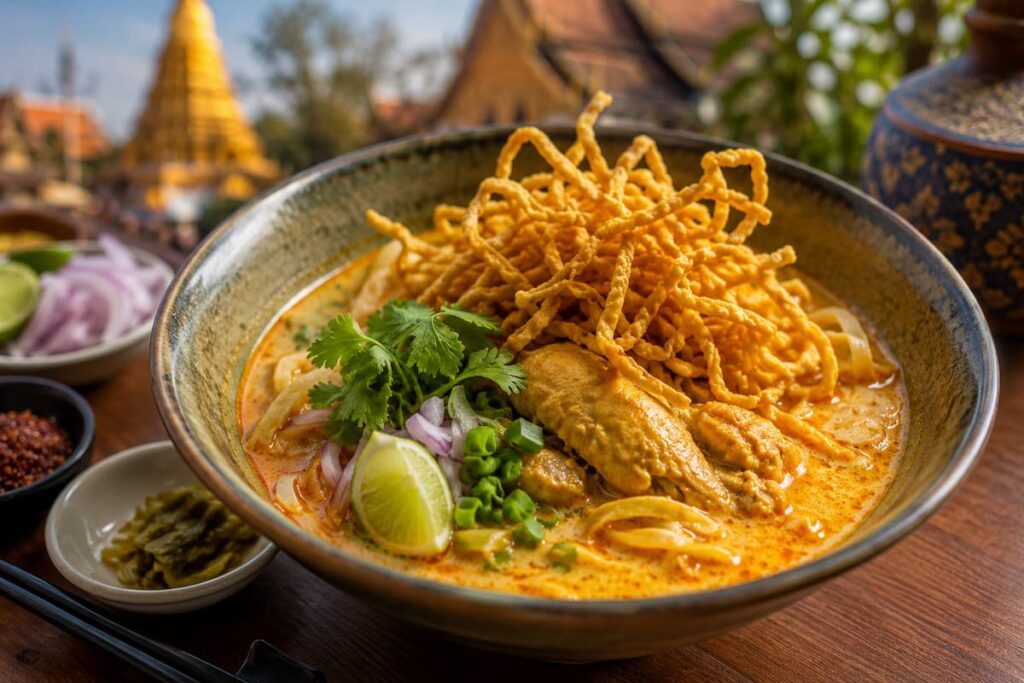
Few dishes are now more closely associated with Northern Thailand than khao soi. Particularly famous in Chiang Mai, it combines soft egg noodles with a rich curry broth, usually topped with crispy noodles and served alongside pickled mustard greens, shallots, lime and chilli.
Its history, however, reaches beyond modern Thai borders.
Khao soi is generally connected with the historic movement of Chinese-Muslim and Yunnanese communities through the trading routes linking southern China, Myanmar and the Lanna region. Those influences met local ingredients and cooking traditions, with the dish evolving over time into the coconut-enriched Northern Thai version widely eaten today.
There is no reliably documented moment when somebody “invented” modern khao soi, and several accounts of its precise origin compete with one another. What is much clearer is the cultural exchange behind it. A bowl now considered quintessentially Northern Thai carries traces of the people and trade routes that once connected Chiang Mai with a much wider region.
Gaeng Hang Lay — Burma Meets Lanna
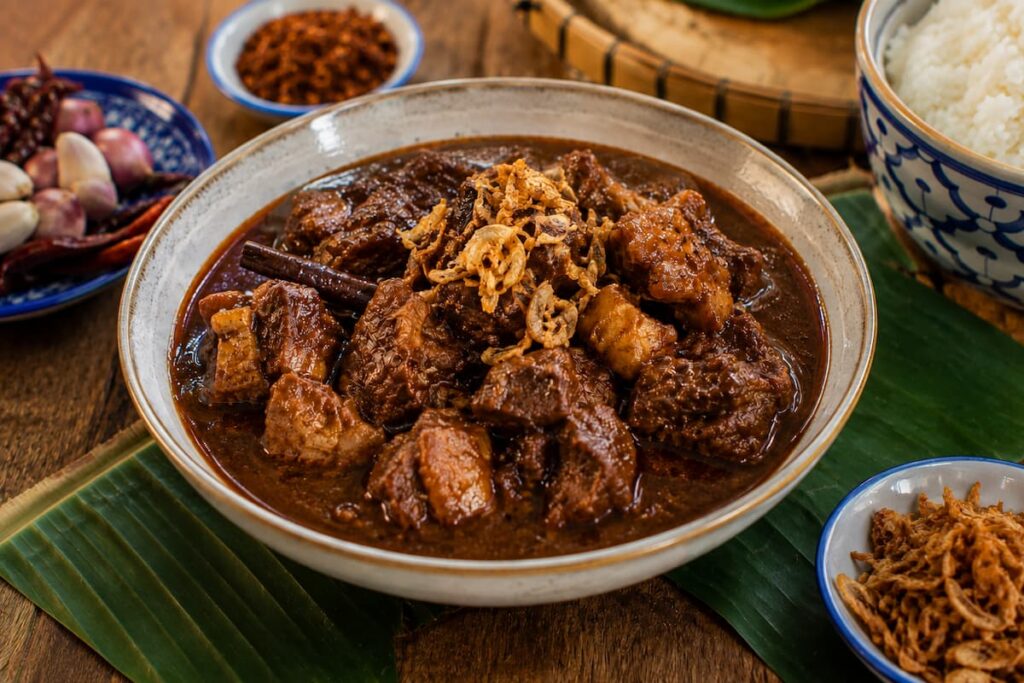
Gaeng hang lay tells another story of food travelling across borders. This slow-cooked pork curry has strong Burmese and Shan influences but has long since become established within Northern Thai cuisine.
Unlike many familiar Central Thai curries, gaeng hang lay normally contains no coconut milk. Pork is slowly cooked with ginger, garlic, tamarind and a mixture of dried spices, producing a rich curry combining sweetness, acidity and aromatic warmth without relying heavily on fresh chilli.
The dish is a particularly good example of how neighbouring culinary traditions were absorbed into Lanna cooking rather than simply copied. Different Northern communities developed their own variations, and gaeng hang lay eventually became part of the region’s food identity.
Sai Ua — The Sausage of Northern Thailand
If khao soi illustrates historic trade and gaeng hang lay reflects cross-border influence, sai ua provides a taste of the ingredients that give Northern cooking its distinctive character.
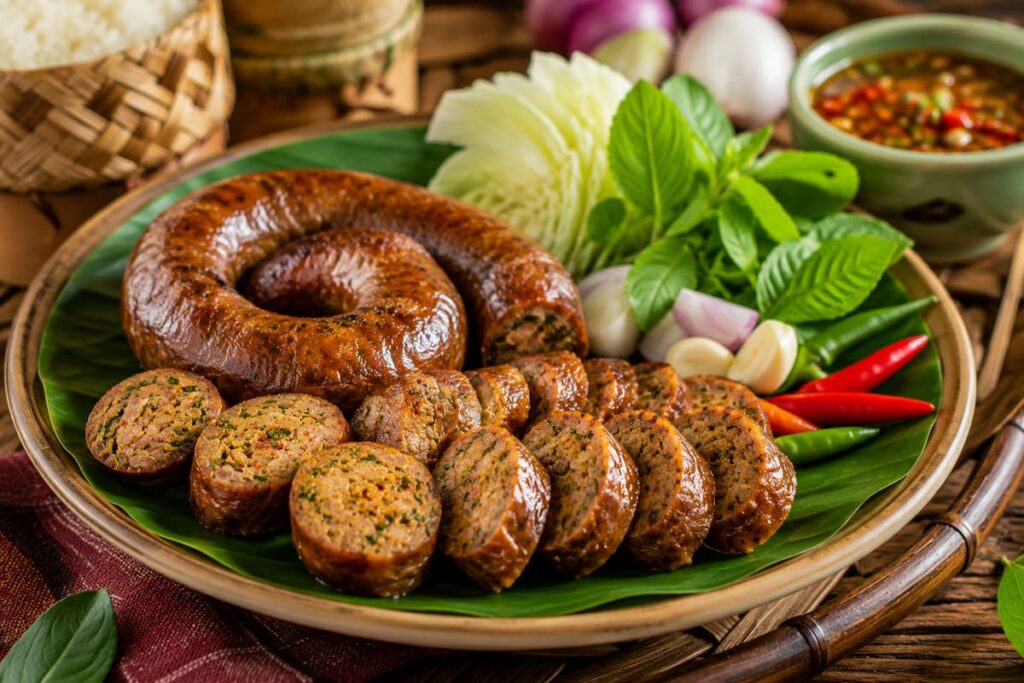
The coiled pork sausage is packed with aromatics that can include lemongrass, makrut lime leaves, galangal, garlic, chilli and fresh herbs. Grilling releases the oils and fragrances of those ingredients, producing something considerably more complex than an ordinary pork sausage.
Sai ua is commonly found in markets and food stalls across Northern Thailand and is particularly associated with Chiang Mai. Rather than needing an elaborate origin story, its importance comes from the way it brings many characteristic Northern flavours together in something remarkably simple.
If You Try One: Khao Soi
All three dishes reveal something different about Northern Thailand, but khao soi is the one we would choose if you have time to try only one.
Eating it in Chiang Mai also puts the dish back into the landscape and culture that helped shape it. What initially appears to be a bowl of curry noodles becomes something more interesting once you understand the centuries of migration, trade and adaptation behind it.
Isan Food: Bold Flavours of Northeast Thailand
Travel into Isan, the vast northeastern region of Thailand, and the food changes noticeably. Sticky rice replaces steamed jasmine rice as the traditional staple, while chilli, lime, fresh herbs, toasted rice and fermented ingredients create some of the boldest flavours in Thai cuisine.
Isan food also illustrates why modern national borders do not always explain culinary traditions particularly well. Northeastern Thailand shares deep linguistic and cultural connections with neighbouring Laos, and many foods eaten on either side of the Mekong belong to a much older regional food culture.
Meals are typically communal. Sticky rice is eaten alongside salads, grilled meats, vegetables, soups and chilli dips, with several dishes placed in the centre of the table. Perhaps no combination captures the experience better than som tam, larb and gai yang served with sticky rice.
Som Tam — A Thai Favourite With a Complicated History
Few foods demonstrate the movement of ingredients and cultures quite like som tam, the famous pounded green papaya salad.
Its essential technique belongs to the wider Lao-Isan tradition of pounding ingredients together in a mortar, but even its two most recognisable ingredients reveal a much bigger story. Neither papaya nor chilli originated in Southeast Asia. Both came from the Americas and reached this part of the world through international trade.
Local cooks incorporated those new ingredients into existing food traditions. Green papaya provided the crisp texture, while chilli joined lime, garlic and other seasonings to create the hot, sour and salty character now immediately associated with som tam.
The precise origin of modern green papaya som tam is disputed, and its history is shared across what are now Thailand and Laos. What is clear is that it became deeply embedded in Isan food culture before spreading throughout Thailand, helped in part by the movement of Northeastern people to Bangkok and other parts of the country.
There are now numerous versions. Som tam pla ra, with fermented fish seasoning, remains closely associated with Isan tastes, while the sweeter som tam Thai familiar in many tourist restaurants generally uses fish sauce and often includes peanuts.
The story therefore runs in several directions: ingredients travelled halfway around the world, entered an older regional cooking tradition, and eventually produced something now recognised internationally as quintessentially Thai.
Larb — A Dish That Crosses Modern Borders
Larb provides another reminder that food cultures are often older than the borders surrounding them.
Versions of the minced meat salad are found across Laos, Isan and other neighbouring regions, but the Isan interpretation has become one of Northeastern Thailand’s defining foods.
Meat — commonly pork, chicken, beef or duck — is combined with lime juice, chilli, shallots and fresh herbs. One particularly important ingredient is khao khua, toasted rice ground into a coarse powder, which contributes both fragrance and texture.
Larb can appear deceptively simple, but its combination of acidity, heat, herbs and roasted rice makes it an excellent introduction to the way Isan cuisine builds flavour without relying heavily on coconut milk or rich sauces.
Served with sticky rice and fresh vegetables, it also makes considerably more sense as part of a shared meal than as an isolated restaurant dish.
Gai Yang — The Grill at the Centre of an Isan Meal
Walk through markets or along roadsides in Northeastern Thailand and charcoal grills are a familiar sight. Gai yang, or grilled chicken, is one of the foods most strongly associated with this style of everyday Isan eating.
Chicken is marinated with combinations of garlic, coriander root, pepper, fish sauce and other seasonings before being slowly grilled over charcoal. Recipes vary considerably from place to place, and some communities have developed particularly famous local versions.
Its importance is less about tracing a single point of invention and more about the role grilling plays within Northeastern food culture.
Gai yang also demonstrates something easily missed when Thai dishes are presented individually on restaurant menus. It is the combination that matters.
Tear off some grilled chicken, take a little sticky rice, add the sharp heat of som tam and perhaps a spoonful of larb, and suddenly the individual dishes become a balanced meal.
If You Try One: Som Tam — But Don’t Eat It Alone
If there is one dish that introduces travellers to Isan food, som tam is the obvious starting point. But rather than ordering a plate by itself, experience it as it is commonly enjoyed: alongside gai yang, sticky rice and another shared dish such as larb.
Together they offer something much more revealing than a checklist of famous Thai foods — they provide a glimpse of how Northeastern Thailand actually eats.
Central Thai Food: Rivers, Royal Courts and Migration
Central Thai cuisine developed around some of the country’s most fertile landscapes. The Chao Phraya River and its network of canals supported rice cultivation, orchards and communities with ready access to freshwater fish and prawns, while the great trading centres of Ayutthaya and later Bangkok brought people, ingredients and cooking traditions from much farther afield.
The result is an enormously diverse cuisine. Coconut milk, jasmine rice, freshwater seafood, herbs and vegetables appear alongside dishes shaped by Chinese migration, international trade and the cooking traditions associated with Thailand’s historic royal courts.
Many foods now recognised internationally simply as “Thai” have strong connections with Central Thailand. But some of the region’s most interesting dishes also tell the story of the waterways and communities from which modern Bangkok emerged.
Boat Noodles — Born Along Thailand’s Waterways
Kuai tiao ruea, better known as boat noodles, takes us back to a time when rivers and canals were essential transport routes through Central Thailand.
Noodles themselves have deep Chinese roots, and Chinese migration had an enormous influence on Thailand’s noodle culture. In Central Thailand, however, those traditions were adapted to a society in which commerce and everyday life frequently took place on the water.
Vendors prepared and sold bowls of noodles from boats travelling along canals, creating the tradition from which boat noodles take their name. The dish developed into an intensely flavoured Thai noodle soup, typically combining meat, noodles, herbs and a dark, aromatic broth.
Boat noodles are famous today for their small serving bowls. A frequently repeated explanation is that smaller bowls were easier and safer for vendors to handle while simultaneously preparing food and controlling a boat. It is a plausible story, although the precise reason is less firmly documented than the historic connection between the dish and canal vendors.
The boats have largely disappeared from everyday service, but the food survived. Specialist boat-noodle restaurants continue to serve small bowls, sometimes encouraging diners to stack them as they work through several portions.
It is a wonderful example of adaptation on several levels: Chinese noodle traditions became Thai, and the resulting dish was then shaped by the practical realities of life along Central Thailand’s waterways.
Tom Yum Goong — From the Central Plains to a Global Icon
Few dishes represent Thailand internationally as successfully as tom yum goong, yet its origins are closely connected with the rivers and agricultural communities of the Central Plains.
Freshwater prawns were readily available from the region’s rivers and canals, while lemongrass, galangal, makrut lime leaves and other aromatics could be grown locally. Combined in a broth sharpened with chilli and lime, they created the characteristic hot, sour and aromatic profile of tom yum.
Unlike the creamy versions sometimes encountered overseas, tom yum does not necessarily contain coconut milk. Clear versions remain important, while richer preparations may use evaporated milk or other additions.
The dish eventually travelled far beyond the Central Plains to become one of the world’s most recognisable expressions of Thai cuisine. Its cultural importance was formally recognised in 2024 when Tomyum Kung was inscribed by UNESCO on the Representative List of the Intangible Cultural Heritage of Humanity.
Behind that international reputation, however, remains a fundamentally local story: communities taking ingredients available from their rivers, gardens and farms and combining them into something distinctive.
Green Curry — Tradition Doesn’t Have to Be Ancient
Gaeng khiao wan, or Thai green curry, feels so firmly established within Thai cuisine that it is easy to assume it must be centuries old.
Evidence suggests otherwise.
The curry appears to have emerged in Central Thailand during the early decades of the twentieth century, developing from existing Thai curry traditions through the use of fresh green chillies and other ingredients that give the paste its characteristic colour.
Coconut milk provides richness, while the curry paste typically brings together green chilli, lemongrass, galangal, makrut lime, garlic, shallots and other aromatics. Thai basil, vegetables and meat complete a dish in which sweetness, fragrance, saltiness and chilli heat sit within the richness of coconut.
Its relatively recent history makes green curry particularly useful for understanding Thai cuisine.
“Traditional” does not necessarily mean ancient. Food cultures continue to evolve, and dishes can become deeply embedded within national identity remarkably quickly. In little more than a century, green curry progressed from a developing Central Thai preparation to one of the foods most immediately associated with Thailand around the world.
If You Try One: Boat Noodles
Tom yum goong and green curry may be more internationally famous, but boat noodles would be our choice for travellers wanting to understand Central Thailand through its food.
They connect several strands of the region’s history in a single bowl: Chinese migration, Thai adaptation and the rivers and canals that once functioned as the streets and marketplaces of Central Thailand.
Try them in an old Bangkok neighbourhood or around the waterways of Central Thailand and they become more than another noodle soup. They provide a small taste of how people once lived, traded and ate along Thailand’s rivers.
Southern Thai Food: Spice, Seafood and the Maritime South
Southern Thai cuisine reflects a region surrounded by water and connected for centuries to the wider maritime world. Stretching between the Andaman Sea and the Gulf of Thailand, Southern Thailand has abundant seafood, tropical produce and a food culture shaped by Thai Buddhist, Malay-Muslim and Chinese communities.
The flavours can be intense. Turmeric gives many Southern dishes their distinctive yellow colour, while fresh and dried chillies, black pepper, lemongrass, galangal and other aromatics create curries that can be considerably hotter than those found elsewhere in Thailand. Seafood is naturally prominent, and coconut appears in everything from curries to sweets.
Yet Southern food is not uniform. The dishes of Phuket reveal centuries of Chinese migration and the island’s tin-mining history, while travelling towards the Malaysian border brings increasingly visible Malay and Muslim influences. Once again, geography, migration and trade have produced a cuisine that could only have developed where it did.
Gaeng Som — The Taste of Southern Thailand
If one curry demonstrates how different Southern Thai food can be, it is gaeng som.
The Southern version is an intensely hot and sour curry commonly prepared with fish or seafood and vegetables. Turmeric gives the broth its characteristic yellow colour, which is why it is often called gaeng lueang, or yellow curry, elsewhere in Thailand to distinguish it from the very different Central Thai version of gaeng som.
Unlike many Thai curries familiar to international visitors, Southern gaeng som generally contains no coconut milk. Instead, the emphasis is on sourness, chilli heat, turmeric and the flavour of the fish or seafood itself.
The sour component can vary according to local ingredients and recipes, while vegetables are chosen partly for the way they absorb and balance the powerful broth.
This is not necessarily the easiest introduction to Thai curry for someone accustomed to sweeter coconut-based versions. But that is exactly why it belongs here. Gaeng som demonstrates that Southern Thai cooking follows its own flavour traditions rather than simply producing hotter versions of dishes found elsewhere.
Khua Kling — When Southern Thailand Turns Up the Heat
Khua kling takes the intensity of Southern curry paste and removes almost all the liquid.
Usually prepared with minced or finely chopped pork, beef or chicken, the meat is stir-fried with curry paste until the mixture becomes relatively dry. Chilli, turmeric, lemongrass, galangal, garlic and other aromatics create an exceptionally concentrated flavour, often finished with finely sliced makrut lime leaves.
There is no coconut-rich sauce to soften the chilli.
The result can be seriously spicy, even by Thai standards, but heat alone is not what makes good khua kling distinctive. Beneath it should be the fragrance of the herbs, spices and curry paste rather than simply an overwhelming blast of chilli.
It is commonly eaten with rice and fresh vegetables, which provide some balance to the concentrated curry.
Khua kling may lack the neat migration story attached to some of Thailand’s other famous foods, but it serves another purpose in understanding regional cuisine: it tastes unmistakably Southern.
Moo Hong — Phuket’s Chinese Heritage on a Plate
Southern Thailand’s food story is not solely about curry and seafood.
In Phuket, moo hong provides a delicious reminder of the Chinese communities that helped shape the island during its development as an important tin-mining and trading centre.
The dish consists of pork slowly braised until tender in a dark, aromatic sauce, typically seasoned with ingredients such as soy sauce, garlic, pepper and sugar. Its cooking technique and flavour profile reflect the influence of Hokkien Chinese food traditions brought to Phuket by migrants who settled in the region.
Those traditions did not remain separate from local food culture. Over generations, Chinese cooking techniques and ingredients blended with those already present in Southern Thailand, becoming part of the distinctive cuisine now associated with Phuket and the Andaman coast.
Moo hong therefore tells a very different story from gaeng som or khua kling. It is generally rich and savoury rather than aggressively spicy, demonstrating how culturally diverse Southern Thai cooking really is.
Phuket’s culinary heritage extends far beyond moo hong, with Hokkien noodles, snacks, sweets and other dishes continuing to reflect this meeting of Chinese and Southern Thai cultures.
If You Try One: Gaeng Som
All three dishes reveal a different side of Southern Thailand, but gaeng som is perhaps the clearest introduction to the region’s distinctive flavour profile.
Its combination of seafood, turmeric, sourness and serious chilli heat immediately separates it from the sweeter coconut curries many travellers first associate with Thai food.
But if you are travelling through Phuket, make room for moo hong as well. Eating the two dishes in the same region reveals something important about Southern Thai cuisine: one speaks strongly of the tropical peninsula and its local ingredients, while the other carries the story of communities who arrived from across the sea and eventually became part of Southern Thailand itself.
When Foreign Food Became Thai Food
Some of Thailand’s most familiar flavours began with ingredients or cooking traditions that originated somewhere else. That does not make them any less Thai. In many cases, the way those influences were absorbed, adapted and combined with local ingredients is precisely what created the dishes recognised as Thai today.
Trade and migration brought new ideas into the country over centuries. Chinese communities introduced and developed noodle, stir-frying and braising traditions. Muslim merchants connected Siam with culinary influences extending towards Persia, India and the Malay world. European trade opened another route for ingredients and techniques, while crops arriving from the Americas eventually transformed everyday cooking.
Few ingredients demonstrate this better than the chilli. Chillies originated in the Americas and only reached Asia following European contact with the New World. They arrived relatively late in Thailand’s long history, yet today it is almost impossible to imagine Thai cuisine without them.
Massaman Curry — A Taste of the Trading World
Massaman curry is one of the clearest examples of international influences becoming distinctly Thai.
Rather than belonging neatly to Southern Thailand as is sometimes assumed, its historical story is strongly connected with Central Thailand and cosmopolitan Ayutthaya, where Persian and other Muslim communities played important roles in international trade and court life.
Massaman differs noticeably from many other Thai curries. Alongside familiar Thai aromatics, it incorporates dried spices such as cinnamon, cloves, cardamom and cumin associated with the international spice trade and Muslim cooking traditions. These are combined with coconut milk, meat and other ingredients to produce the rich, gently spiced curry recognised today.
Its precise origin remains debated, and it would be misleading to attribute the modern dish to a single person or community. What its history demonstrates more convincingly is how international ingredients and Muslim culinary traditions entered Siam and were gradually adapted within Thai cooking.
By the nineteenth century, massaman was sufficiently established to appear in Thai culinary records. What may once have seemed foreign had become part of the cuisine.
From Chinese Noodles to Thai Noodle Culture
Noodles provide another example of adaptation on an enormous scale.
Chinese migration contributed significantly to noodle culture in Thailand, particularly in Bangkok and other commercial centres. But the dishes that subsequently developed were not simply reproductions of Chinese food.
Thai cooks incorporated local broths, herbs, chilli, fish sauce, lime, sugar and condiments. Different communities developed their own combinations, while noodle stalls became part of everyday street and market life.
Boat noodles are one result of that process, but they are far from the only one. Today noodle shops are so thoroughly integrated into Thailand’s food landscape that their historical connections with migration can easily disappear behind their familiarity.
Chilli and Papaya — Ingredients From the Other Side of the World
Perhaps the greatest transformation involved ingredients rather than complete dishes.
Before the Columbian Exchange, Thailand had no chillies. Capsicum peppers are native to the Americas and spread around the world through international maritime trade from the late fifteenth and sixteenth centuries onwards.
Papaya followed a similar journey from tropical America into Asia.
Eventually the two met in dishes such as som tam.
The significance is easy to overlook. A food now deeply associated with Isan and Thailand depends upon two ingredients whose ancestors grew thousands of kilometres away. Thai cooks did not simply receive those ingredients — they incorporated them into existing techniques and flavour traditions until their foreign origins became almost invisible.
A Portuguese Connection in Thailand’s Desserts
European influence also left an unexpected mark on Thai sweets.
During the Ayutthaya period, Portuguese contact introduced new ingredients and confectionery techniques. The story is particularly associated with Maria Guyomar de Pinha, a woman of mixed Japanese, Portuguese and Bengali ancestry who became connected with the royal court in Ayutthaya.
She is traditionally associated with popularising egg-yolk and sugar-based sweets that developed into desserts including thong yip, thong yot and foi thong.
As with many culinary origin stories, it is safer not to claim that one person single-handedly invented an entire family of Thai desserts. Portuguese confectionery traditions clearly influenced their development, however, and those techniques were subsequently adapted within Siamese court cooking.
Today the resulting sweets are unmistakably part of Thai culinary culture.
Adaptation Is Part of the Tradition
These stories challenge a simple idea of what makes food “authentic”.
Khao soi can reflect historic trading communities and still be Northern Thai. Boat noodles can have Chinese ancestry and still belong to Central Thailand. Moo hong can carry Hokkien cooking traditions while being part of Phuket’s culinary heritage. Som tam can depend upon crops from the Americas while remaining fundamental to Isan food culture.
Thai cuisine did not develop despite these outside influences.
It developed partly because of them.
Generations of cooks took ingredients and techniques arriving through trade, migration and cultural exchange and adjusted them to local produce, regional tastes and existing ways of eating. Eventually the distinction between something borrowed and something local became increasingly irrelevant.
The result is one of the most distinctive characteristics of Thai food: a cuisine continually shaped by the wider world, yet unmistakably its own.
How Thai People Eat
Understanding Thai food is not only about knowing what to order. The way a meal is eaten can be just as important as the individual dishes on the table.
In many Thai restaurants, particularly when eating with family or friends, the Western idea of everyone ordering an individual main course does not really apply. Several dishes are ordered for the table and shared, usually with rice, allowing everyone to move between different flavours throughout the meal.
A typical table might include a curry, a stir-fried dish, vegetables, a soup or salad and something grilled or fried. The aim is not necessarily to make every individual dish perfectly balanced between sweet, sour, salty and spicy flavours. Instead, much of that balance can happen across the meal.
A fiery curry might sit alongside a mild vegetable dish. A sour som tam works beautifully with grilled chicken and sticky rice. A rich dish can be followed by a spoonful of clear soup or something fresh and herbal.
This is one reason Thai food can make more sense when several dishes are experienced together rather than treated as individual items on a checklist.
Rice Is at the Centre of the Meal
For much of Thailand, steamed jasmine rice forms the foundation of a shared meal. Dishes are placed in the middle of the table and eaten with rice rather than treated as separate courses.
In Northern Thailand and Isan, sticky rice has traditionally played that central role. Small portions can be shaped by hand and eaten alongside grilled meats, chilli dips, larb and som tam.
Noodles are different. A bowl of noodle soup, pad Thai or another noodle dish is often eaten as a complete meal in its own right rather than being ordered to accompany rice and several shared dishes.
Spoon, Fork or Chopsticks?
One of the easiest misconceptions for first-time visitors is assuming that Thai food is generally eaten with chopsticks.
For most rice-based meals, a spoon and fork are standard. The spoon is normally the main eating utensil, while the fork is used to guide food onto it rather than being routinely brought to the mouth.
Chopsticks are most commonly associated with particular noodle dishes and foods influenced by Chinese eating traditions.
Knives are rarely needed at the table because meat and vegetables are generally prepared in bite-sized pieces before being served.
Don’t Expect Western-Style Courses
Thai meals also tend not to follow a rigid sequence of starter, main course and side dishes.
Food is commonly brought to the table when it is ready. A soup might arrive first, followed by a stir-fry, with the curry appearing several minutes later. This does not necessarily mean the kitchen has forgotten part of the order.
The dishes are intended to accumulate into a shared meal.
This can take a little adjustment if you are accustomed to everyone receiving a complete plate at the same time, but it also makes Thai dining wonderfully social. Instead of committing to one flavour for an entire meal, everyone gets to try a little of everything.
Condiments Are Part of the Experience
Many noodle shops and casual restaurants place condiments directly on the table. Depending on the dish, these might include chilli flakes, chilli vinegar, fish sauce, sugar or other seasonings.
Adding them is not an insult to the cook. For certain dishes, adjusting the final balance to your own preference is simply part of how the food is eaten.
There is no requirement to use everything, either. Taste the food first and adjust it if you want to.
The Best Thai Meal May Be the One You Share
For travellers, one of the easiest ways to explore Thai food is therefore surprisingly simple: eat with other people whenever you can.
Four people can order several contrasting dishes and experience far more of the cuisine than four people separately ordering a plate of pad Thai.
It also brings you closer to the way much of Thai food is intended to be enjoyed — rice on the plate, several dishes in the middle and everyone sharing from the same table.
Once you begin eating Thai food this way, the relationship between the dishes becomes almost as interesting as the dishes themselves.
Where to Experience Thai Food
One of the pleasures of eating in Thailand is that memorable food is not confined to any particular type of restaurant. A morning market, roadside grill, shopping-centre food court and carefully restored shophouse can all provide completely different windows into the country’s food culture.
For travellers, that makes where you eat almost as interesting as what you eat.
Morning Markets — See the Day Begin
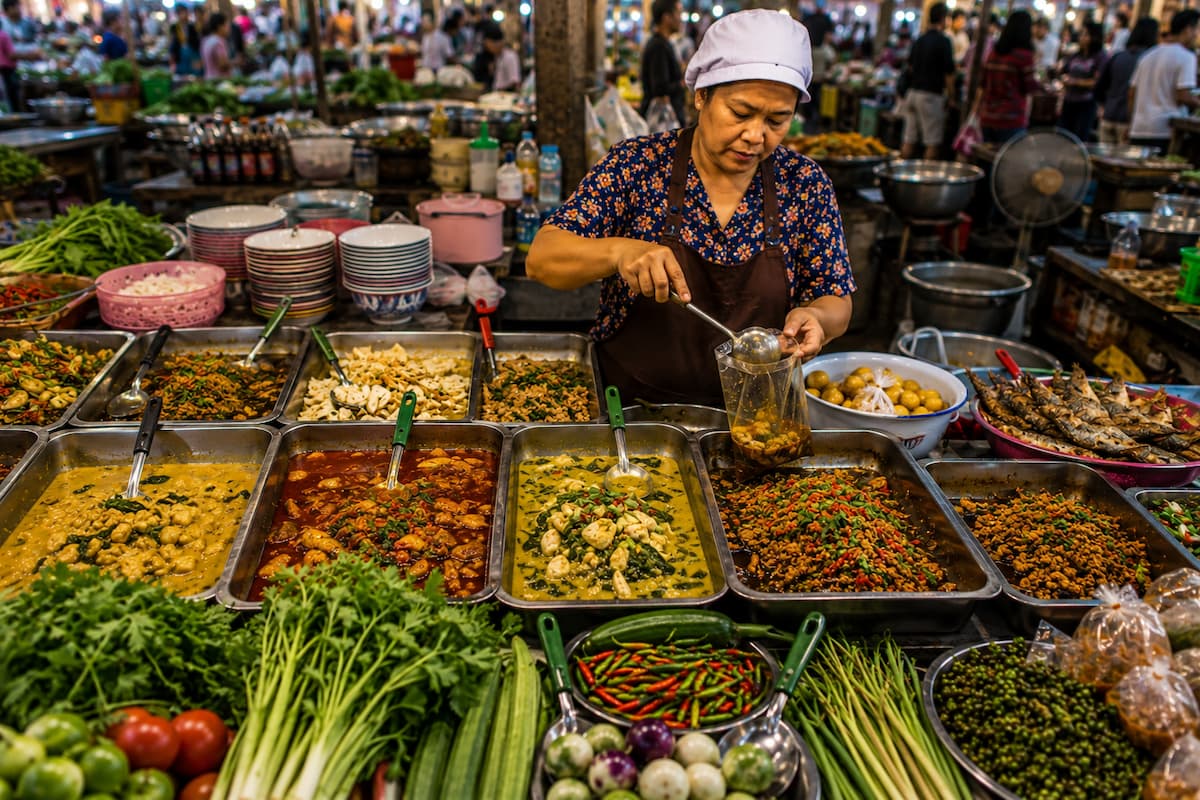
Morning markets offer one of the best opportunities to see everyday Thai food before it becomes a restaurant meal.
Alongside fresh vegetables, herbs, fruit, seafood and meat, you will often find vendors selling prepared breakfasts, curries, grilled meats, rice dishes, snacks and sweets. The selection changes from region to region, making markets particularly useful for understanding what people actually cook locally.
Arriving early is part of the experience. These are working markets rather than attractions created specifically for visitors, and much of the activity can be finished by late morning.
Street Food — Everyday Thailand
Thailand’s street food deserves its reputation, but it is worth thinking about it as more than simply cheap food.
Street stalls developed around places where people needed convenient meals: markets, transport routes, workplaces, schools and busy neighbourhoods. Many vendors specialise in only one dish or a small number of closely related foods, sometimes preparing the same thing every day for years.
That specialisation can be part of what makes a simple street-food meal so good.
Look beyond the stalls concentrated entirely around visitor areas. A busy vendor serving local residents can provide a very different experience, whether it is grilled chicken in Isan, noodles in Bangkok or a curry-and-rice stall in Southern Thailand.
Night Markets — Food as an Evening Out
Night markets turn eating into something more social.
Rather than choosing one restaurant, you can wander between stalls, order small portions and try several different things over the course of an evening. Alongside established Thai dishes, you will usually encounter snacks, grilled seafood, sweets, fruit, drinks and increasingly creative modern street food.
Some night markets are heavily orientated towards visitors while others primarily serve their surrounding communities. Both can be enjoyable, but they provide different experiences.
For someone discovering Thai food for the first time, a good night market is one of the easiest places to start exploring.
Shophouse Restaurants — Don’t Judge the Food by the Furniture
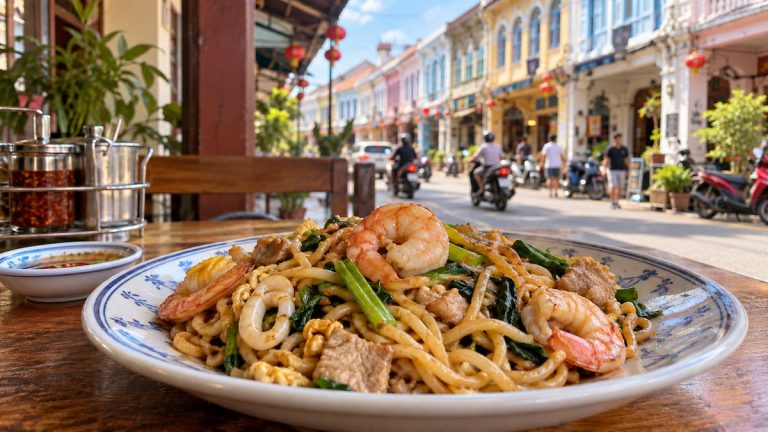
Some of Thailand’s most interesting restaurants occupy simple open-fronted shophouses that are easy to walk past.
There may be fluorescent lighting, metal tables, plastic chairs and little attempt at decoration. The menu might concentrate on one family speciality that has been prepared in essentially the same way for decades.
These restaurants are particularly interesting when exploring regional cuisine. They often sit somewhere between street food and conventional restaurant dining, providing inexpensive everyday cooking without needing to package the experience for travellers.
A polished dining room is not a reliable measure of how good the food will be in Thailand.
Local Restaurants — Order for the Table
Sit-down Thai restaurants are where understanding shared dining becomes especially useful.
Rather than everybody choosing an individual main course, order several contrasting dishes with rice and share them. A curry, vegetables, soup, salad and something grilled or fried can produce a much more interesting meal than four separate plates.
Regional restaurants are particularly worthwhile. An Isan restaurant, for example, gives you the opportunity to combine som tam, larb, gai yang and sticky rice as they are intended to work together rather than sampling each dish in isolation.
Food Courts — An Underrated Introduction to Thai Food
Food courts are easy to dismiss as shopping-centre convenience, but in Thailand they can be remarkably useful for travellers.
They bring numerous specialist vendors into one place, making it possible for a group to choose completely different foods while still eating together. Prices are usually clearly displayed, ordering is relatively straightforward and you can often see the dish before deciding what to try.
Some are very modern, while others feel closer to indoor collections of traditional food stalls.
They may not provide the atmosphere of an old market or neighbourhood shophouse, but for someone beginning to explore Thai cuisine, a good Thai food court can be one of the easiest places to become more adventurous.
Fine Dining — Tradition Continues to Evolve
At the opposite end of the spectrum, Thailand has developed an increasingly sophisticated contemporary dining scene.
Chefs are revisiting historic recipes, regional ingredients and traditional techniques while presenting them in new ways. Others are researching dishes that have become uncommon or working directly with farmers, fishing communities and small-scale producers.
Bangkok naturally has the greatest concentration, but ambitious restaurants can increasingly be found in destinations including Chiang Mai and Phuket.
Fine dining does not replace markets, street stalls or family restaurants as a way of understanding Thai food. It provides another perspective on the same story.
Thailand’s cuisine has always evolved as ingredients, people and ideas have moved. Contemporary Thai cooking demonstrates that the process of adaptation we have traced through centuries of culinary history is still happening today.
Thai Culinary Experiences Worth Trying
Eating your way through Thailand does not have to mean moving from one famous restaurant to another. Some of the most rewarding culinary experiences allow you to understand where the ingredients come from, how dishes are prepared and the role food plays in everyday Thai life.
You do not need to do everything on this list. Even adding one or two food-focused experiences to a trip can reveal a side of Thailand that is easily missed when every meal is simply somewhere to eat between attractions.
Take a Thai Cooking Class
Cooking classes are available throughout Thailand, but the best experiences go beyond learning how to reproduce pad Thai or green curry.
Look for classes that teach regional dishes and explain the ingredients being used. A Northern cooking class in Chiang Mai should feel different from one in Southern Thailand, just as the food itself does.
Many classes begin with a market visit, where ingredients such as galangal, lemongrass, Thai basil, fresh chillies, makrut lime, shrimp paste and different vegetables can be seen before they reach the kitchen.
Even if you rarely cook at home, understanding how curry pastes are made or how Thai cooks balance seasoning can change the way you appreciate meals for the rest of your trip.
Explore a Fresh Market With Someone Who Knows It
Walking independently through a Thai market is worthwhile, but exploring one with a knowledgeable local guide or cook can add another layer.
Ingredients that initially appear unfamiliar suddenly have a purpose. You begin to recognise different herbs, vegetables, noodles, fermented products, curry pastes and regional specialities rather than simply seeing rows of colourful produce.
Markets also provide an opportunity to understand how regional cuisine begins with regional ingredients.
The experience can be particularly valuable early in a trip because you will recognise those same ingredients repeatedly afterwards.
Join a Food Tour
A good food tour should introduce you to places you might otherwise walk straight past.
That could mean a family-run shophouse, an old market stall, a specialist noodle shop or a neighbourhood known for food connected with a particular migrant community.
The best tours provide context rather than simply quantities of food. Why is this dish associated with this neighbourhood? Who brought the technique here? Why does this version taste different from one elsewhere in Thailand?
For travellers interested in the history behind Thai cuisine, those explanations can be as valuable as the tastings themselves.
Have an Isan Meal the Way It Is Meant to Be Shared
One of the simplest culinary experiences requires no tour or organised activity at all.
Find an Isan restaurant and order som tam, gai yang, larb and sticky rice for the table.
Rather than treating them as four foods to tick off a list, eat them together. The acidity and chilli of the som tam, smoky grilled chicken, herbs and toasted rice of the larb and relatively neutral sticky rice balance one another.
It is a small change in how you order, but it demonstrates beautifully why understanding a cuisine involves more than knowing the names of its dishes.
Eat Seafood Where the Boats Come In
With thousands of kilometres of coastline, seafood is naturally an important part of eating in Thailand, particularly throughout the South.
Fishing communities, local markets and restaurants near working harbours can offer a very different experience from ordering seafood in a major resort restaurant.
Depending on the location and season, you might encounter fish, prawns, squid, crab, shellfish and other catches prepared remarkably simply — grilled, steamed, fried or incorporated into curries and soups.
The point is not that seafood must always be eaten beside the sea to be good. It is that travelling through Thailand gives you opportunities to experience food close to the landscape and communities producing it.
Try a Thai Breakfast
Hotel breakfast buffets can make it surprisingly easy to spend an entire trip without discovering what Thailand eats in the morning.
Breakfast might mean jok, a soft rice porridge commonly served with pork and an egg, or khao tom, rice soup with meat or seafood. Elsewhere you may find grilled pork with sticky rice, fried dough, noodle dishes or simply foods that would not be considered specifically “breakfast” at all.
An early visit to a local market or neighbourhood restaurant is one of the easiest ways to experience this side of everyday Thai life.
Spend an Evening Eating Through a Night Market
Instead of arriving at a night market immediately after dinner, make the market the dinner.
Start with something small, walk for a while, try something else and leave room for a dessert or fruit at the end. Sharing portions makes it possible to taste considerably more without turning the evening into an endurance event.
Night markets are also excellent places to follow curiosity. Something cooking over charcoal or being prepared in front of you may prove far more memorable than whichever famous dish you intended to find.
Let the Destination Decide What You Eat
Perhaps the most rewarding culinary experience in Thailand is also the simplest: eat the food of the region you are travelling through.
Order khao soi or sai ua while exploring Northern Thailand. Make time for an Isan meal in the Northeast. Try boat noodles around Bangkok or the Central Plains. In Southern Thailand, explore the curries, seafood and dishes shaped by the region’s Thai, Muslim and Chinese communities.
Famous Thai dishes can now be found almost anywhere in the country.
But eating regional food where it developed connects the meal with its climate, ingredients, history and people. After exploring how profoundly those forces have shaped Thai cuisine, that connection may be the most memorable culinary experience of all.
Ordering Thai Food Without Speaking Thai
You do not need to speak Thai to eat well in Thailand. In major destinations, English-language menus are common, while photographs, translation apps and a little patience make ordering relatively straightforward even in smaller local restaurants.
Learning a few simple words can still make the experience easier — particularly once you begin moving beyond restaurants aimed primarily at international visitors.
A Few Useful Thai Food Phrases
Mai phet (ไม่เผ็ด) means “not spicy”, while phet nit noi (เผ็ดนิดหน่อย) asks for just a little spice. If you enjoy spicy food, phet dai (เผ็ดได้) indicates that you can eat it spicy.
There is an important catch.
“Not spicy” does not always mean absolutely no chilli. Curry pastes, marinades and prepared sauces may already contain chilli, and removing it can fundamentally change some dishes. If chilli is a serious problem rather than simply a preference, it is better to make that clear rather than relying solely on mai phet.
Mai sai… (ไม่ใส่…) means “don’t add…” and can be useful when followed by a particular ingredient.
A simple ao an nee (เอาอันนี้) — roughly “I’ll have this one” — accompanied by pointing can also solve a surprising number of ordering problems.
Don’t Be Afraid to Point
Restaurants with limited English frequently have photographs, food displayed at the front or other customers eating dishes you can see.
Pointing is perfectly practical.
At curry-and-rice shops, much of the food is already prepared in trays, so you can simply choose the dishes that look appealing. Noodle stalls may display different noodle types or ingredients, and vendors accustomed to serving people quickly are usually very good at working out what you want.
Translation apps are helpful for more complicated questions, but ordering food does not always require a complete conversation.
Understand What Kind of Dish You Are Ordering
One useful distinction is whether a dish is intended as an individual meal or part of a shared table.
A bowl of noodle soup, pad Thai or khao pad (fried rice) is commonly ordered for one person.
Curries, soups, stir-fries, salads and grilled dishes at a Thai restaurant are more often ordered for sharing with rice.
If portions seem unexpectedly large or several dishes arrive without individual plates arranged as complete meals, the restaurant has not necessarily misunderstood your order. You may simply be encountering a different style of dining.
Spice Levels Are Difficult to Translate
“Thai spicy” and “Western spicy” are not useful scientific measurements.
Tolerance varies enormously between individuals, and Thai people themselves do not all eat food at the same level of heat. Regional differences matter too. A Southern curry prepared at its normal level can be considerably hotter than many dishes encountered in tourist restaurants.
Start cautiously if you are unsure.
You can always add chilli to many dishes, but removing it after the food has been cooked is considerably more difficult.
At the same time, do not assume that authentic Thai food must be painfully hot. Many traditional dishes are mild, aromatic, sour, savoury or slightly sweet rather than dominated by chilli.
Ask When You Are Unsure
Menus do not always tell the entire story.
A dish that appears vegetarian might contain fish sauce, oyster sauce or shrimp paste. A mild-looking curry may contain considerable chilli. Meat may be incorporated into a broth even when it is not obvious from the photograph.
When an ingredient matters because of an allergy, dietary restriction or religious requirement, make the requirement explicit rather than assuming that the English description covers every ingredient.
Most importantly, don’t allow a language barrier to restrict you entirely to familiar international restaurants.
Some of Thailand’s most enjoyable meals begin with little more than a menu you cannot completely read, something on another table that looks delicious and a friendly point in its direction.
Vegetarian, Vegan, Halal and Dietary Requirements
Thailand can accommodate a wide range of dietary requirements, but knowing what to look for makes eating considerably easier. A dish that appears meat-free may still contain fish sauce, shrimp paste or oyster sauce, while soups and noodle dishes can use meat-based stocks that are not obvious from the menu.
For travellers with allergies or strict dietary requirements, it is therefore better to communicate the requirement clearly rather than judge a dish by appearance alone.
Vegetarian and Vegan Food in Thailand
Vegetables, tofu, rice, noodles, fruit and plant-based ingredients are everywhere in Thai cooking, but that does not automatically make vegetarian food straightforward.
Fish sauce is one of the most common seasonings in Thai cuisine. Oyster sauce appears frequently in stir-fries, while shrimp paste is an important ingredient in many curry pastes and chilli dips.
One particularly useful term to recognise is jay (เจ).
Jay food follows a stricter Chinese-influenced plant-based tradition and excludes meat, seafood and animal-derived seasonings. It also traditionally avoids several pungent ingredients such as garlic and onion. Restaurants and stalls serving jay food are often identified by distinctive yellow signs carrying red Thai or Chinese characters.
This is not exactly the same as Western veganism, but for travellers avoiding animal products it can provide one of the clearest ways to identify suitable Thai food.
Elsewhere, asking for a dish without meat may not be enough if fish sauce or another animal-derived seasoning also needs to be excluded.
Halal Food and Thailand’s Muslim Communities
Halal food is widely available in Thailand, particularly in areas with established Muslim communities.
It becomes especially visible across Southern Thailand, where Islam has played an important role in the culture and food traditions of provinces closer to Malaysia. Phuket, Krabi and other southern destinations also have significant Muslim communities and numerous halal restaurants.
Bangkok and Chiang Mai have long-established Muslim communities as well, reflecting the same historic movements of traders and migrants that helped shape parts of Thai cuisine.
Looking for a recognised halal certification or choosing a clearly identified Muslim restaurant is more reliable than assuming that a dish is halal simply because it contains chicken or seafood.
For travellers interested in food culture rather than dietary requirements alone, seeking out Muslim Thai cooking can also reveal another dimension of the country’s culinary history.
Food Allergies Require More Care
Food allergies deserve considerably more caution than ordinary preferences.
Common Thai ingredients include peanuts, tree nuts, shellfish, fish, soy, egg and wheat, sometimes in sauces, curry pastes, stocks or garnishes where they may not be immediately obvious.
Cross-contact is also possible in small kitchens and street stalls where the same wok, utensils or cooking oil may be used for multiple dishes.
If an allergy is serious, carrying a clearly written Thai allergy card explaining exactly what must be avoided can be extremely useful. Translation apps can help, but a prepared statement reduces the chance of an important detail being lost during a busy meal service.
Do not rely solely on asking for an ingredient to be removed if even trace exposure presents a risk.
Dietary Requirements Shouldn’t Stop You Exploring
Having dietary restrictions may require more preparation, but it does not mean missing Thailand’s food culture entirely.
Vegetarian restaurants, jay food, halal restaurants and businesses accustomed to international visitors are increasingly easy to find, particularly in larger destinations. Cooking classes and organised food experiences can often accommodate dietary requirements when informed in advance.
The key is distinguishing between a preference, where some flexibility may be possible, and a requirement, where the ingredients and preparation method genuinely matter.
With that understood, Thailand still offers an enormous range of opportunities to explore its regional cuisines rather than spending an entire trip searching for the same handful of familiar dishes.
Food Safety and Eating With Confidence
Thailand’s markets, street stalls and small local restaurants are an important part of experiencing the country’s food culture. There is no reason to avoid them simply because they look different from the restaurants you might normally choose at home.
At the same time, sensible precautions are worthwhile anywhere food is being prepared.
Look for Freshly Cooked, High-Turnover Food
A busy stall can be a reassuring sign. Ingredients are being used regularly, prepared food is less likely to sit around for long periods, and you can often watch your meal being cooked.
Food served piping hot and freshly prepared is generally a better choice than something that has been sitting at ambient temperature for an uncertain amount of time.
Use the same judgement you would anywhere else. Look at how ingredients are stored, whether raw and cooked foods appear to be handled separately and whether the cooking area looks reasonably organised and clean.
Ice Is Not Automatically a Problem
One piece of outdated advice still repeated about Thailand is to avoid ice completely.
Commercial drinking ice is widely produced from treated water and routinely delivered to restaurants, cafés and food vendors across the country. In established businesses, ice in drinks is part of normal everyday life.
That does not mean every water source should be treated the same way. Tap water is generally not the best choice for drinking directly, and bottled or properly filtered drinking water is readily available throughout Thailand.
Take More Care With Raw Food and Seafood
Raw seafood, shellfish and dishes containing uncooked ingredients require more confidence in how the food has been stored and handled.
Thailand has an enormous seafood culture, particularly in coastal regions, and freshness can be exceptional. But seafood is also highly perishable in a tropical climate.
Choose busy, reputable vendors and restaurants, particularly when ordering raw or lightly cooked seafood. If something smells wrong, looks as though it has been sitting unrefrigerated or simply makes you uncomfortable, choose something else.
Fruit and Fresh Produce
Thailand’s tropical fruit is one of the pleasures of travelling here.
Fruit that is peeled or cut freshly in front of you is an easy option, and busy fruit vendors typically have rapid turnover. As with other prepared foods, use basic judgement when buying fruit that has already been cut and displayed.
Fresh herbs and raw vegetables are also common accompaniments to Thai meals. Travellers who know they are particularly sensitive to changes in food or water may prefer cooked vegetables during their first few days rather than avoiding local food altogether.
Don’t Confuse Spicy Food With Food Poisoning
Thai food can be significantly hotter, richer or simply different from what your digestive system normally encounters.
Large quantities of chilli, unfamiliar ingredients, alcohol, dehydration and suddenly changing your normal diet can all contribute to an unsettled stomach without food necessarily being contaminated.
This does not mean genuine foodborne illness should be dismissed. It simply means that feeling uncomfortable after an extremely spicy meal does not automatically prove that the street stall you visited was unsafe.
Use Judgement, Not Fear
It would be a shame to travel through Thailand while avoiding markets, street stalls and family-run restaurants because of a general fear of food safety.
Be observant. Choose places with good turnover. Favour freshly cooked food, take additional care with raw ingredients and seafood, drink safe water and walk away if something does not look right.
Those simple precautions allow you to approach Thai food with confidence rather than suspicion — and leave room for some of the most memorable meals of the journey to come from places you never planned to visit.
Where to Travel in Thailand for Food
You can eat excellent Thai food almost anywhere in the country, but travelling specifically for food becomes much more interesting when the destination reflects the cuisine around it. Markets, local ingredients, migration and regional history all influence what appears on the table.
If food is an important part of your trip, these destinations offer particularly rewarding places to explore.
Bangkok — Thailand on One Plate
No destination offers greater variety than Bangkok.
Central Thai cooking sits alongside generations of Chinese-Thai food culture, historic Muslim communities, regional restaurants serving dishes from across the country and one of Asia’s most ambitious contemporary dining scenes.
Explore old neighbourhoods and you can move between noodle shops, curry-and-rice stalls, markets and family-run shophouses that have specialised in particular dishes for generations. Move into modern Bangkok and the same culinary traditions are being reconsidered by a new generation of Thai chefs.
Bangkok’s greatest strength is therefore not one signature dish. It is the opportunity to experience many different chapters of Thailand’s food story within a single city.
Chiang Mai — Discover the Food of Lanna
For Northern Thai cuisine, Chiang Mai is the natural starting point.
Khao soi may receive most of the attention, but stopping there would miss much of what makes Lanna food distinctive. Markets and Northern restaurants introduce sai ua, gaeng hang lay, chilli dips, sticky rice, vegetables, herbs and dishes rarely encountered on typical Thai menus overseas.
Chiang Mai is also particularly well suited to cooking classes and market experiences, making it an excellent destination for travellers who want to understand the ingredients as well as eat the finished dishes.
Isan — Follow the Food Northeast
Isan cuisine can now be found throughout Thailand, but travelling through the Northeast puts it back into its cultural landscape.
Cities such as Khon Kaen, Udon Thani and Ubon Ratchathani provide excellent bases for discovering regional markets and restaurants, while smaller towns and roadside food stalls reveal how deeply grilling, sticky rice, fermented ingredients, herbs and seasonal produce remain part of everyday eating.
This is where som tam, larb and gai yang stop feeling like three famous dishes and begin to make sense as parts of a wider food culture.
Phuket — More Than Seafood and Tourist Restaurants
Phuket’s reputation as an international resort destination can obscure just how interesting its food history is.
The island’s position on historic maritime trading routes and the migration of Hokkien Chinese communities associated with the tin-mining era created a culinary culture unlike much of the rest of Thailand.
In Phuket Old Town, dishes such as moo hong and Hokkien-style noodles sit alongside Southern Thai curries, seafood, sweets and foods influenced by the island’s Chinese and Muslim communities.
Phuket’s culinary heritage was one reason it became Thailand’s first UNESCO Creative City of Gastronomy in 2015.
For travellers staying around the island’s beaches, spending some time eating through the old town provides a very different perspective on Phuket.
Hat Yai and the Deep South — Where Food Cultures Meet
Travel farther south and the influence of the Malay Peninsula becomes increasingly apparent.
Hat Yai is an excellent gateway to this food culture, combining Southern Thai, Thai-Chinese and Muslim influences in a city known for markets and everyday eating.
Continue towards Pattani, Yala and Narathiwat and Malay-Muslim culinary traditions become even more prominent. Rice dishes, grilled meats, curries, roti and sweets demonstrate that Southern Thai food becomes increasingly diverse as you approach the Malaysian border.
For travellers already exploring Southern Thailand, food provides another compelling reason to look beyond the major island destinations.
Ayutthaya — Eat Where Cultures Once Met
Ayutthaya provides something different again.
As the capital of Siam from 1351 to 1767, the city was one of Southeast Asia’s great international trading centres. Persian, Chinese, Japanese, Portuguese and other communities lived and traded there, leaving influences that extended into Siamese food culture.
Today Ayutthaya remains known for river prawns and local dishes, but its greater significance to this story is historical.
Eating beside the rivers after exploring the temples provides a tangible connection between the landscape and the centuries of trade and cultural exchange that helped shape Thai cuisine.
Let Your Journey Shape What You Eat
There is no single “best” destination for food in Thailand because each region tells a different part of the story.
Choose Chiang Mai for Lanna cuisine, travel through Isan for Northeastern food culture, explore Bangkok and Ayutthaya for the food of the Central Plains and its historic trading communities, or head south through Phuket, Hat Yai and the Deep South for seafood, powerful curries and Chinese and Malay-Muslim influences.
Better still, don’t choose only one.
As you travel through Thailand, allow the food to change with the journey. The differences between one region and the next are precisely what make exploring Thai cuisine so rewarding.
Travel With Insight
One of the things I have come to appreciate after travelling extensively around Thailand is that Thai food becomes much more interesting when you stop thinking about it as a collection of famous dishes.
I have eaten many of the foods covered in this guide in different parts of the country, and the experiences that stay with me are often connected as much to the place as the food itself. A bowl of khao soi in Chiang Mai, an Isan meal shared around a table, seafood in Southern Thailand or something unfamiliar discovered in a local market all feel different when they are part of the journey rather than simply another dish ordered from a menu.
Over time, I have also become much more willing to order something I do not recognise, eat in simple local restaurants and explore markets without needing to know beforehand exactly what I am going to find. Not every discovery becomes a favourite, but that is part of the experience.
My advice is not to arrive in Thailand with a checklist of ten dishes you need to eat. Try the famous ones, of course, but also let the region you are travelling through decide some of your meals.
Eat Northern food while you are in the North. Share som tam, larb, gai yang and sticky rice when you encounter a good Isan restaurant. Explore the food heritage of Phuket rather than assuming the island is only about seafood and resort restaurants. And when you see a busy market stall or small shophouse filled with local customers, occasionally choose curiosity over familiarity.
Thai cuisine makes considerably more sense that way.
The dishes begin to connect with landscapes, communities and histories you have experienced yourself — and food becomes another way of discovering Thailand rather than simply something you eat along the way.
Frequently Asked Questions About Thai food and culinary experiences
What are the four main regional cuisines of Thailand?
Thai cuisine is commonly divided into Northern, Northeastern or Isan, Central and Southern Thai cuisine. Each reflects different landscapes, ingredients and cultural influences. Northern food developed around Lanna traditions, Isan shares strong connections with Laos, Central cuisine reflects the fertile Central Plains and historic trading centres, while Southern food has been shaped by its coastlines and Chinese, Malay-Muslim and maritime influences.
What is Thailand’s national dish?
Thailand does not have a single officially designated national dish in the way the term is sometimes used by travellers. Pad Thai is frequently described internationally as Thailand’s national dish, while foods such as tom yum goong, som tam and Thai curries are equally important parts of the country’s culinary identity.
Rather than looking for one dish to represent Thailand, exploring its regional cuisines provides a much better understanding of Thai food.
Is all Thai food spicy?
No. Although chilli is important to Thai cuisine, many traditional Thai dishes are mild or only moderately spicy.
Heat also varies considerably between regions and individual dishes. Southern Thai cuisine contains some particularly fiery curries, while Northern Thailand has numerous dishes built more around herbs and aromatics. Even within the same region, Thai people have different preferences for chilli.
If you are sensitive to spicy food, ask for mai phet (ไม่เผ็ด) or phet nit noi (เผ็ดนิดหน่อย), while remembering that chilli may already be incorporated into some curry pastes and prepared ingredients.
What Thai food should I try on my first trip?
There is nothing wrong with beginning with internationally familiar dishes such as tom yum goong, green curry or pad Thai, but try at least one regional dish from wherever you are travelling.
In Northern Thailand that might be khao soi or sai ua. In Isan, try som tam with gai yang and sticky rice. Central Thailand is a great place for boat noodles, while Southern Thailand offers gaeng som, khua kling and an enormous variety of seafood.
The location can be as important as the dish.
Is street food safe to eat in Thailand?
Street food is part of everyday life throughout Thailand, and avoiding it completely would mean missing an important part of the country’s food culture.
Choose busy stalls with good turnover, favour food that is freshly cooked and served hot, and use common sense when looking at how ingredients are stored and handled. Additional caution is sensible with raw seafood and food that appears to have been sitting unrefrigerated for extended periods.
Is Thailand good for vegetarian and vegan travellers?
Yes, although some care is required. Thai cooking uses enormous quantities of vegetables, tofu, rice and noodles, but apparently vegetarian dishes can contain fish sauce, oyster sauce, shrimp paste or meat-based stock.
Dedicated vegetarian restaurants are increasingly common, while jay (เจ) food follows a stricter Chinese-influenced plant-based tradition and can be particularly useful for travellers avoiding animal products.
If your diet is strict, make the requirement clear rather than assuming that removing visible meat makes a dish vegetarian or vegan.
Which region of Thailand has the spiciest food?
Southern Thailand is generally associated with some of the country’s hottest regional cooking. Dishes such as khua kling and Southern gaeng som can contain substantial amounts of chilli alongside turmeric and powerful aromatic curry pastes.
Isan cuisine can also be extremely spicy, particularly som tam and certain salads.
However, spice levels vary by cook and individual preference, so no regional label guarantees how hot a particular plate will be.
Where is the best place in Thailand for food?
There isn’t one.
Bangkok offers extraordinary variety, Chiang Mai is an excellent introduction to Northern Lanna cuisine, Isan puts Northeastern food into its cultural home, while Phuket and the wider South combine Southern Thai cooking with seafood and Chinese and Malay-Muslim influences.
If your journey takes you through several regions, the best approach is to allow the food to change with your location. That diversity is one of the great pleasures of travelling through Thailand.
Continue Exploring
Thai food is only one part of experiencing the country. Continue planning your journey with our Thailand Travel Guide, or explore the landscapes, islands, culture and distinctive regional character of the Southern Thailand Travel Guide.
Related Reading
Thai Festivals and Celebrations
Discover the traditions, religious events and community celebrations that bring Thailand’s culture to life throughout the year.
Thailand’s Historical Sites
Explore ancient capitals, temple complexes and archaeological sites that reveal the kingdoms, cultures and international influences that shaped Thailand.
Thailand’s Most Popular Islands
Discover Thailand’s most popular islands and compare the different landscapes, experiences and styles of holiday each destination offers.
About the Author
David Hibbins is a travel publisher, destination researcher and the creator of Travel With Insight.
Through years of travel, tourism and publishing projects across Southeast Asia, he has developed a particular interest in how travellers research destinations, compare experiences and make travel decisions.
His work focuses on helping travellers move beyond popularity rankings, marketing claims and generic “best of” lists by providing balanced, research-driven destination guides. Rather than telling people where they should travel, his goal is to help readers understand the strengths, limitations and unique character of each destination so they can choose the places that best match their own interests, travel style and goals.
As the creator of Travel With Insight, David researches destinations throughout Southeast Asia, exploring not only where travellers go, but why they choose certain places, how destinations differ and what creates genuinely memorable travel experiences.
His work covers destination research, regional travel planning, traveller behaviour and the decision-making frameworks that help people plan more rewarding journeys.
Explore More Travel Resources
Every great journey begins with informed decisions. The more you understand a destination before you arrive, the more rewarding your travel experience becomes.
Whether you’re still researching Southern Thailand or you’re ready to start planning your itinerary, these additional resources can help.
Travel With Insight
Continue exploring our in-depth destination guides, travel inspiration and practical planning advice designed to help you make informed travel decisions throughout Thailand and Southeast Asia.
Go Find Asia
Looking for even more travel inspiration? Go Find Asia explores destinations, experiences and travel ideas across Asia, helping you discover where to go, what to see and how to plan your next adventure.
Resurgence Travel
When you’re ready to turn your research into reality, Resurgence Travel offers curated itineraries, personalised travel planning and local expertise to help you experience the very best of Thailand and Southeast Asia.