Best Temples in Southern Thailand
Southern Thailand’s temples reveal a side of the region that is often overshadowed by tropical islands, beaches and limestone landscapes. Some preserve evidence of ancient maritime connections across Southeast Asia, while others remain important centres of pilgrimage, meditation, local devotion and deeply held spiritual belief.
With thousands of Buddhist temples across the southern provinces, selecting only seven is inevitably difficult. We have not attempted to identify the seven largest, most photographed or most famous temples. Instead, this guide brings together seven places that offer distinctly different experiences and reveal something meaningful about the region’s religious history and living culture.
The selection ranges from Wat Phra Mahathat Woramahawihan—Southern Thailand’s first UNESCO World Heritage Site—and the Srivijaya-influenced architecture of Chaiya to the forest teachings of Suan Mokkh and the demanding mountaintop pilgrimage at Krabi’s Tiger Cave Temple. It also explores Phuket’s local devotion, Thai-Chinese Buddhist expression on Koh Samui and the contemporary folk beliefs surrounding Ai Khai in Nakhon Si Thammarat.
These temples are not interchangeable attractions or places to collect quickly on a sightseeing checklist. Each rewards a different kind of traveller, and most people will visit only those that fit naturally into their Southern Thailand itinerary. The purpose of this guide is to help you understand what makes each temple different, choose the experiences that interest you most and visit these active religious places with appropriate respect.
Quick Summary: Seven Temples, Seven Different Experiences
The temples in this guide are not ranked from first to seventh. Each has been selected because it offers a different perspective on Southern Thailand’s Buddhist heritage, religious traditions and living culture.
| Temple | Province | Best for | What makes it different |
|---|---|---|---|
| Wat Phra Mahathat Woramahawihan | Nakhon Si Thammarat | Historic and spiritual importance | A major Buddhist centre for approximately 1,500 years and Southern Thailand’s first UNESCO World Heritage Site |
| Wat Phra Borommathat Chaiya | Surat Thani | Srivijaya heritage | Distinctive architecture reflecting Southern Thailand’s ancient maritime connections |
| Suan Mokkh | Surat Thani | Meditation and Buddhist teaching | An influential forest monastery centred on simplicity, contemplation and practical engagement with the Dhamma |
| Wat Chalong | Phuket | Local history and devotion | Phuket’s most revered temple, closely associated with respected monks and the island’s nineteenth-century history |
| Wat Tham Suea | Krabi | Mountain pilgrimage and scenery | A demanding staircase leading to a mountaintop shrine above Krabi’s limestone landscape |
| Wat Plai Laem | Koh Samui, Surat Thani | Thai-Chinese Buddhist culture | A colourful contemporary temple combining Thai architecture with Chinese Buddhist imagery |
| Wat Chedi (Ai Khai) | Nakhon Si Thammarat | Folk belief and modern pilgrimage | A nationally popular place of worship associated with vows, offerings and the protective spirit known as Ai Khai |
The most rewarding choice will depend on where you are travelling and what you hope to understand. Wat Phra Mahathat offers the greatest historical and religious importance, Suan Mokkh provides the most reflective experience, Wat Tham Suea demands the greatest physical effort, and Wat Chedi offers the clearest encounter with contemporary popular belief. Few travellers will need—or realistically want—to visit all seven.
How We Selected These Temples
Any list of the best temples in Southern Thailand is necessarily selective. The region contains ancient religious monuments, small community temples, forest monasteries, cave sanctuaries and increasingly elaborate modern complexes. Choosing only the most visually impressive examples would overlook much of what makes Southern Thailand’s Buddhist culture distinctive.
Our selection considered each temple’s historical or religious importance, its continuing relationship with local worshippers and the experience it offers visitors. We also looked for places that reveal different periods and expressions of Buddhism rather than repeating similar architecture seven times.
Some temples were included because of their exceptional heritage. Others earned their place through their association with influential monks, meditation, pilgrimage, regional identity or contemporary spiritual belief. Accessibility and relevance to travellers were also considered, although a temple did not need to be located beside a major resort to qualify.
Several beautiful and significant temples were left outside the final seven because their strongest qualities were represented more clearly elsewhere. This is therefore not a definitive ranking of Southern Thailand’s sacred places. It is a carefully limited guide to seven temples that help visitors encounter the region from genuinely different historical, cultural and spiritual perspectives.
Wat Phra Mahathat Woramahawihan: Southern Thailand’s Great Buddhist Centre
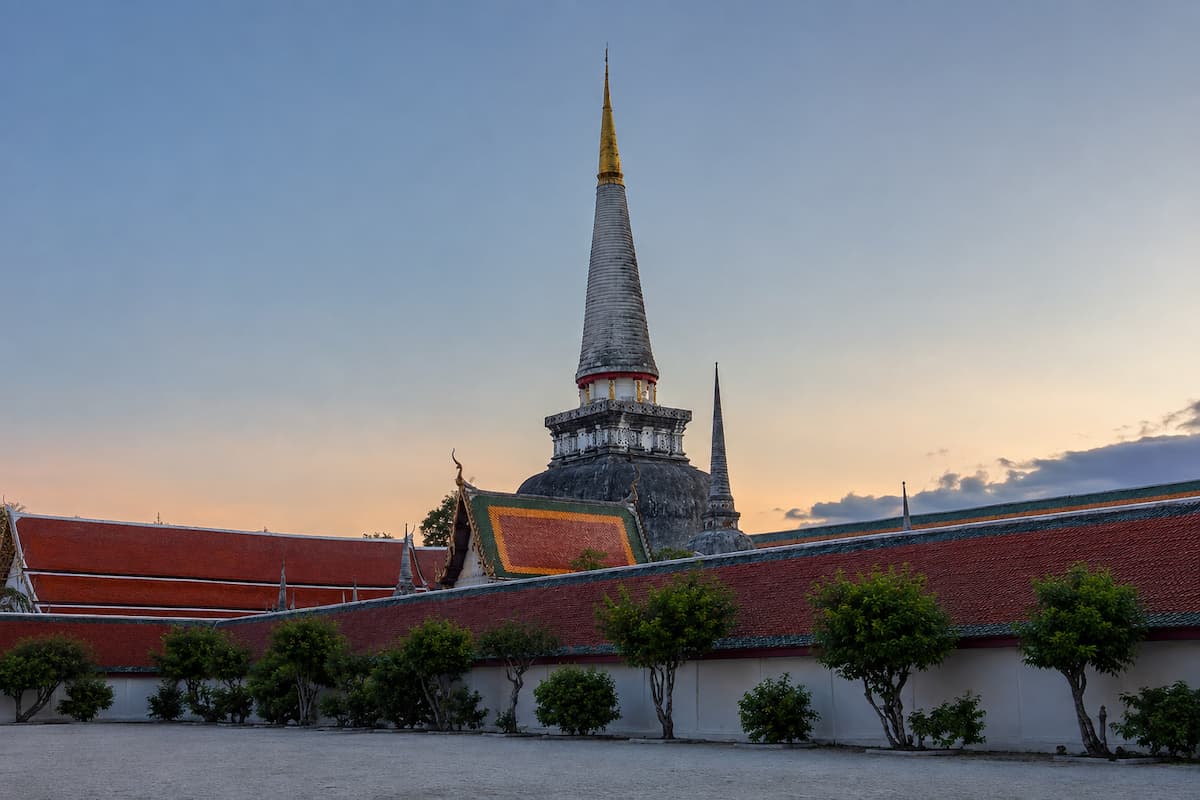
Wat Phra Mahathat Woramahawihan is the most historically and spiritually significant temple in Southern Thailand. Located in the old heart of Nakhon Si Thammarat, it has remained an important Buddhist centre for approximately 1,500 years and continues to attract worshippers from across the southern provinces.
Its international importance was formally recognised on 25 July 2026, when Wat Phra Mahathat became Southern Thailand’s first UNESCO World Heritage Site. It was inscribed not simply because of its age or monumental architecture, but because it demonstrates centuries of religious and artistic exchange while remaining closely connected with living traditions and the surrounding community.
A Buddhist Centre Shaped by Maritime Connections
The monastery was founded during the eighth century on a site where a Hindu shrine had previously stood. Its location on the Thai Peninsula placed Nakhon Si Thammarat between the Indian and Pacific oceans and within maritime networks connecting South and Southeast Asia.
Over time, the temple absorbed influences associated with Brahmanism, Hinduism, Mahayana Buddhism and Theravada Buddhism. Artistic and religious traditions reached the region from northeastern India, Sri Lanka, Java and the Mon areas of what is now southern Myanmar. These influences were gradually incorporated into local architecture, rituals and cultural practices rather than simply copied from a single external tradition.
The result is a religious complex that helps explain Southern Thailand’s historic position as a meeting point between different parts of Asia. Its influence also travelled outward, contributing to the development of Buddhist architecture and practice elsewhere in Thailand and the wider region.
The Great Reliquary
The monastery is organised around the Phra Borommathat Chedi, usually described in English as the Great Reliquary. Its tall bell-shaped form dominates the complex and remains the principal focus of worship.
The chedi is believed to enshrine a relic of the Buddha, commonly described as a tooth relic. This belief has made Wat Phra Mahathat an important pilgrimage destination, although the relic tradition should be understood as a matter of religious faith rather than independently verified archaeological history.
Smaller stupas surround the principal structure, while Buddha images, religious halls, Bodhi-tree shrines and monastic buildings extend through the complex. Visitors will also notice elephant heads appearing to support parts of the reliquary platform, alongside layers of architectural detail accumulated through different periods of construction and restoration.
This is not an eighth-century temple preserved in a single untouched form. Buildings have been rebuilt, repaired and adapted over many centuries. That continuity is part of its significance: Wat Phra Mahathat has developed as an active religious institution rather than surviving as an abandoned monument.
Living Traditions and Community Faith
One of the temple’s most important traditions is Hae Pha Khuen That, during which worshippers carry long pieces of cloth to be wrapped around the Great Reliquary. The practice expresses reverence for the Buddha and reinforces the connection between the sacred monument and the communities that continue to care for it.
The temple is also associated with the chronicles of Nakhon Si Thammarat and with Nora, Southern Thailand’s distinctive dance-drama tradition. These relationships between religion, local history, performance and community identity contributed to UNESCO’s recognition of the site.
Visitors therefore encounter more than historic architecture. People arrive to make offerings, light candles, pray, seek blessings and participate in established religious practices. The temple can be busy and energetic, particularly on Buddhist observance days and during important festivals, but this activity is evidence of its continuing purpose rather than an interruption to the visitor experience.
Planning Your Visit
Wat Phra Mahathat is situated within Nakhon Si Thammarat city and is considerably easier to visit than several other temples in this guide. Allow approximately 60–90 minutes for an unhurried exploration, although visitors with a strong interest in Buddhist history and architecture may want longer.
Early morning generally offers cooler temperatures and an opportunity to experience the monastery before the largest visitor groups arrive. Major religious days can be considerably busier, but they may also reveal traditions that are not visible during an ordinary visit.
Although the grounds are open to visitors, this remains one of Southern Thailand’s most sacred active monasteries. Dress modestly, remove footwear where instructed and avoid positioning yourself between worshippers and the Great Reliquary for photographs.
Best for: Travellers seeking Southern Thailand’s most important combination of Buddhist history, living pilgrimage and regional cultural identity.
Wat Phra Borommathat Chaiya: A Window into the Srivijaya Period
Wat Phra Borommathat Chaiya offers one of Southern Thailand’s clearest connections with the maritime world that existed long before the rise of Sukhothai, Ayutthaya and Bangkok. Located in Chaiya District in Surat Thani Province, the temple is centred on a distinctive chedi associated with the artistic and religious influence of Srivijaya.
The temple is smaller and quieter than Wat Phra Mahathat in Nakhon Si Thammarat. Its importance is not immediately communicated through scale or spectacle. The visit becomes far more rewarding when the chedi is understood within the history of Chaiya and its connections across maritime Southeast Asia.
Chaiya and Maritime Southeast Asia
Between approximately the seventh and thirteenth centuries, Srivijaya developed into an influential maritime power connecting parts of Sumatra, the Malay Peninsula and important trading routes across Southeast Asia. Buddhism, religious art, commercial activity and political influence travelled through these networks alongside valuable goods.
Chaiya occupied a strategic position on the eastern side of the Thai Peninsula. Archaeological discoveries indicate that the area participated in wider exchanges involving the Indonesian archipelago, India and other parts of Asia. Wat Phra Borommathat Chaiya preserves one of the most important visible expressions of this early period in Southern Thailand.
The temple should not be presented as evidence that every detail of Srivijaya’s political history is fully understood. Historians continue to debate the precise relationships between Chaiya, regional centres and the wider Srivijaya world. What is clear is that the area was a significant religious and cultural centre shaped by maritime exchange.
The Srivijaya-Influenced Chedi
The temple’s principal chedi has proportions and architectural details that differ from the bell-shaped stupas commonly associated with later Thai kingdoms. Its square form, layered structure, projecting elements and decorative treatment reflect religious architecture connected with the Srivijaya period and the broader Buddhist world of maritime Southeast Asia.
The chedi is believed to enshrine relics of the Buddha and remains an object of active worship. Smaller chedis and covered walkways surround the principal monument, creating a compact sacred enclosure where visitors can examine the architecture at close range.
However, the structure visible today is not an untouched eighth-century monument. It has undergone restoration and reconstruction during different periods. It is therefore more accurate to describe it as a historic chedi preserving exceptionally important Srivijaya-influenced architecture rather than claiming that every visible surface is original.
This continuity does not diminish its value. The combination of ancient architectural form, later restoration and continuing worship shows how Southern Thailand’s early religious heritage has been preserved within an active temple.
Visit Chaiya National Museum
Chaiya National Museum stands within or immediately beside the temple area and greatly improves the experience. The museum contains archaeological and artistic material associated with Chaiya and other parts of Southern Thailand, including Buddhist and Hindu sculpture from different historical periods.
Visiting the museum helps place the chedi within a much broader story. Objects recovered around Chaiya reveal cultural connections that cannot be understood from the temple architecture alone. They also demonstrate that religious traditions in the peninsula developed through continuing contact with different parts of Asia.
The museum is normally open from Wednesday to Sunday and closes on Mondays, Tuesdays and public holidays. Opening arrangements and admission prices occasionally differ between official listings, so check the current schedule before travelling—particularly if the museum is an important reason for your visit.
What to Expect
Wat Phra Borommathat Chaiya does not require a long visit. Travellers arriving without historical context may walk around the chedi in 20 minutes and wonder why it is considered so important. Those who examine its architectural form, visit the museum and consider Chaiya’s role in maritime Southeast Asia will find considerably more meaning.
The temple also provides a welcome contrast with the heavily visited religious landmarks of Phuket, Krabi and Koh Samui. Its atmosphere is generally local and contemplative, and worship remains more prominent than organised sightseeing.
Allow approximately 30–60 minutes for the temple alone or 90 minutes to two hours when including Chaiya National Museum. Wat Phra Borommathat Chaiya can also be combined with Suan Mokkh, which is located in the same wider district but presents a completely different expression of Buddhism.
Best for: Travellers interested in archaeology, early Buddhist architecture and Southern Thailand’s historic connections with maritime Southeast Asia.
Suan Mokkh: Experiencing Buddhism Beyond Temple Architecture
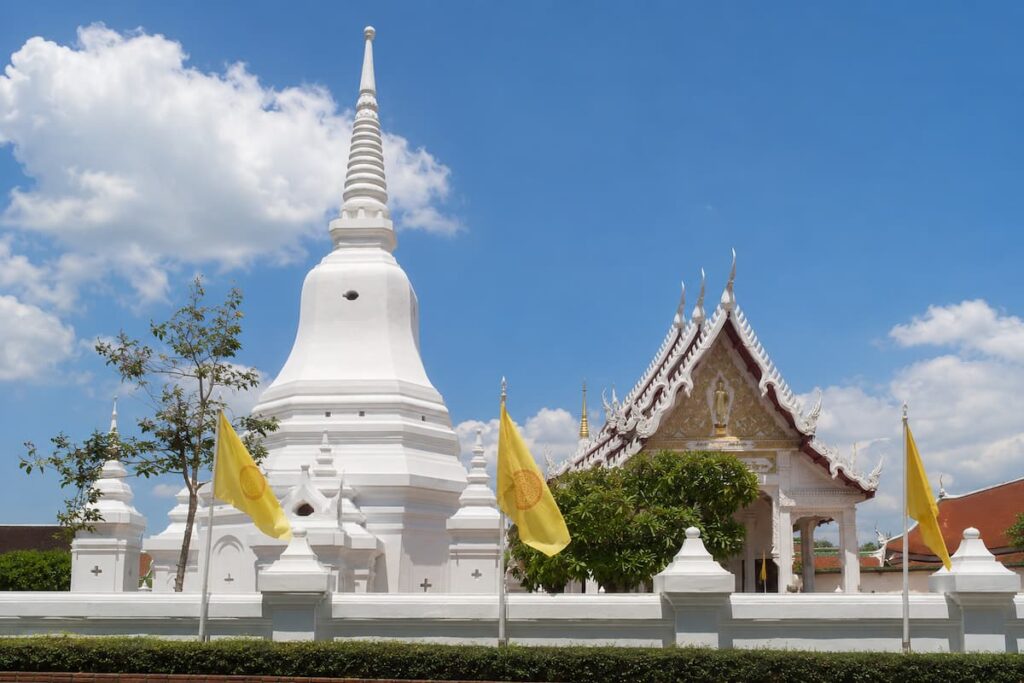
Suan Mokkh offers the least conventional temple experience in this guide. There is no monumental golden chedi, demanding mountaintop staircase or sequence of elaborate halls designed to impress visitors. Instead, this forest monastery near Chaiya invites people to encounter Buddhism through simplicity, meditation, study and time spent in nature.
The monastery was founded in 1932 by Buddhadasa Bhikkhu, one of modern Thailand’s most influential Buddhist teachers. Its name is commonly translated as the “Garden of Liberation,” reflecting Buddhadasa’s intention to create an environment where people could study and practise the Dhamma without becoming distracted by ceremony or unnecessary complexity.
The Ideas Behind Suan Mokkh
Buddhadasa Bhikkhu returned to his native Chaiya after spending time studying in Bangkok. He believed Buddhist teaching should be expressed clearly and applied directly to ordinary life rather than remaining confined within formal religious scholarship.
Nature was central to this approach. Buddhadasa considered a simple forest environment particularly suitable for meditation, reflection and understanding the causes of suffering. Suan Mokkh therefore developed differently from many urban monasteries, with relatively restrained buildings distributed through wooded grounds.
His teachings eventually reached audiences throughout Thailand and internationally. Buddhadasa also encouraged understanding between religious traditions, arguing that people should look beyond labels and recognise shared efforts to address suffering, selfishness and human conflict.
Visitors do not need detailed knowledge of Buddhist philosophy to appreciate Suan Mokkh. However, understanding its purpose prevents the monastery from being misjudged as architecturally plain or lacking in attractions. Its simplicity is intentional and forms an important part of the experience.
What You Can See at the Main Monastery
The principal monastery contains forest paths, open gathering spaces, meditation areas and buildings used for teaching and religious study. Among its most distinctive features is the Spiritual Theatre, where murals and other visual material communicate Buddhist ideas through imagery drawn from different artistic and cultural traditions.
Another prominent structure takes the symbolic form of a vessel carrying people across suffering through the Dhamma. The monastery also maintains a collection of books and teaching materials in multiple languages.
The open-sided meditation hall, simple monastic buildings and surrounding trees create an atmosphere that feels markedly different from the highly decorated temple complexes elsewhere in Southern Thailand. Visitors may see monks, residents or independent practitioners studying and meditating, but there is no guarantee of organised teaching during a casual visit.
Suan Mokkh is best approached slowly. Walk quietly, pause to examine the teaching images and allow time to experience the environment rather than searching for a single famous monument.
Visiting the Monastery and Joining a Retreat Are Different Experiences
The main monastery can be visited independently, but the associated International Dharma Hermitage operates separately and should not be confused with a casual temple visit.
The hermitage conducts structured ten-day silent meditation retreats in English. These usually begin on the first day of each month, with in-person registration on the final day of the preceding month. Advance reservations are not normally accepted, places are allocated on a first-come basis and participants are expected to complete the entire programme.
The retreat follows a demanding daily schedule beginning at approximately 4:00 am. Sitting and walking meditation are combined with Dhamma talks, chanting, simple meals, communal tasks and extended silence. Participants observe monastic rules and accept basic accommodation rather than joining a flexible wellness holiday.
Travellers interested in attending should read the current programme carefully and consider whether they can meet its physical and psychological demands. Those who simply want to understand Suan Mokkh’s history and atmosphere can visit the main monastery without committing to a retreat.
Planning Your Visit
Suan Mokkh is situated close enough to Chaiya to combine with Wat Phra Borommathat Chaiya, although the two experiences could hardly be more different. One preserves monumental architecture connected with Southern Thailand’s ancient maritime history; the other represents a modern effort to return attention to Buddhist teaching and practice.
Allow at least one to two hours to explore without rushing. Wear modest clothing, remain quiet around meditation areas and avoid photographing monks or practitioners without permission. Some buildings may be closed or in use during your visit, and casual visitors should not expect private instruction.
Suan Mokkh will not suit everyone. Travellers primarily seeking ornate architecture or dramatic photographs may find relatively little to hold their attention. Those interested in meditation, Buddhist philosophy or quieter forms of travel may consider it one of the most meaningful religious places in Southern Thailand.
Best for: Reflective travellers interested in Buddhist teaching, meditation and the relationship between spiritual practice and nature.
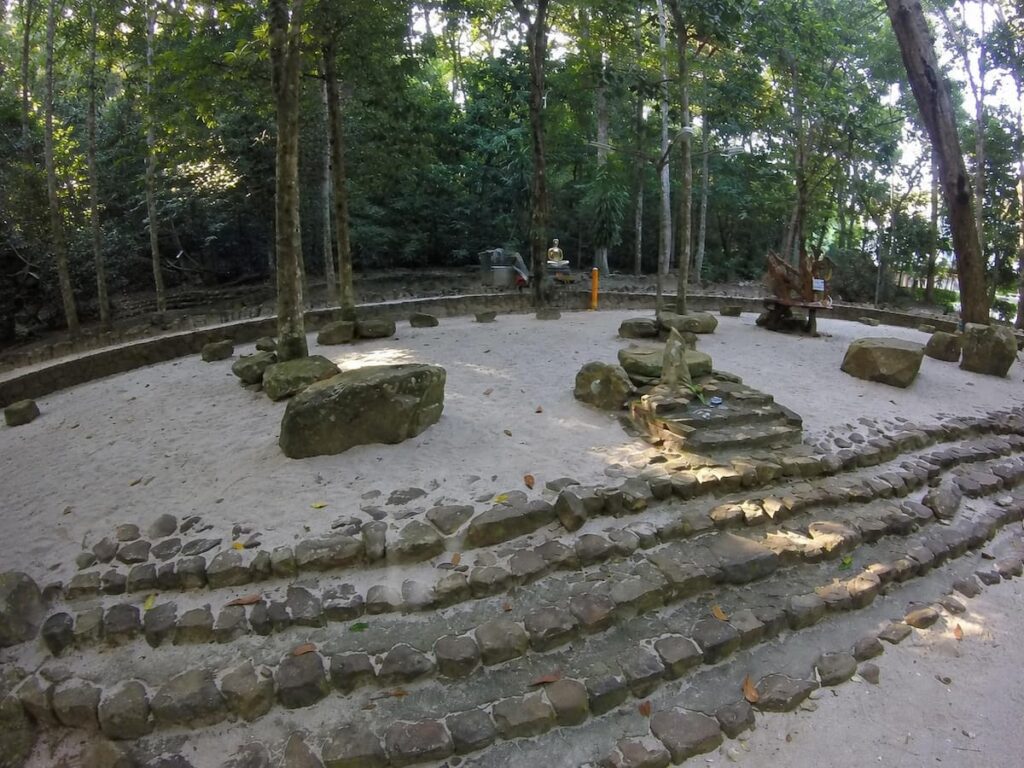
Wat Chalong: Understanding Phuket Through Its Most Revered Temple
Wat Chalong is frequently included on Phuket sightseeing itineraries, but its importance extends well beyond its ornate buildings and popularity with tour groups. Officially named Wat Chai Thararam, it is Phuket’s most revered Buddhist temple and remains closely connected with the island’s history, local devotion and belief in the protective qualities of respected monks.
For travellers who know Phuket primarily through its beaches, resorts and nightlife, Wat Chalong provides an accessible introduction to a different side of the island. Its courtyards may become busy with visitors, but residents continue to come here to make merit, seek blessings and pay their respects to monks whose stories remain deeply embedded in Phuket’s identity.
Luang Por Chaem and Phuket’s Tin-Mining History
The temple is particularly associated with Luang Por Chaem and Luang Por Chuang. Both became respected for their religious leadership and knowledge of traditional herbal medicine, but Luang Por Chaem’s role during unrest in 1876 made him one of the most revered figures in Phuket history.
During the nineteenth century, Phuket’s economy depended heavily on tin mining, which attracted large numbers of Chinese migrant workers and contributed to the development of influential secret societies. Economic hardship and conflict eventually led to serious unrest involving Chinese mining groups and local communities.
Popular accounts sometimes simplify this episode into a story in which two monks led residents to defeat “Chinese rebels.” The history was more complicated than this description suggests. Luang Por Chaem became revered for offering leadership and encouragement, providing refuge and using traditional medicine to treat injured people.
His reputation continued to grow after the conflict. Worshippers came to associate him with healing, protection and good fortune, and King Rama V later granted him a formal ecclesiastical title. His importance explains why visitors see people applying small pieces of gold leaf to representations of the revered monks inside the temple.
What to See at Wat Chalong
The temple complex contains several religious buildings, but two areas are particularly important for understanding its continuing devotional role.
The principal monks’ hall contains representations of Luang Por Chaem, Luang Por Chuang and Luang Por Gluem. Worshippers kneel before them, make offerings and attach gold leaf to the figures as an expression of respect. Watching quietly from the side provides a far better sense of Wat Chalong than moving immediately toward the most photogenic building.
The temple’s most prominent structure is Phra Mahathat Chedi, a relatively modern building rising approximately 60 metres above the grounds. Its walls and ceilings contain colourful paintings depicting episodes from the Buddha’s life, while numerous Buddha images occupy its different levels.
Visitors can climb through the chedi to an upper terrace overlooking the surrounding complex. A small chamber at the top contains what is venerated as a fragment of the Buddha’s bone. As with other relic traditions, this should be understood through its religious importance rather than presented as an independently authenticated historical object.
Why You May Hear Firecrackers
Sudden explosions frequently surprise first-time visitors. Firecrackers are set off inside a purpose-built brick enclosure and are associated with gratitude, fulfilled requests and devotional promises.
Worshippers may return after believing that a prayer or request has been answered and commission firecrackers as part of giving thanks. The sound is therefore not simply entertainment for tourists, even though it has become one of Wat Chalong’s most recognisable experiences.
Visitors can observe from a safe distance but should avoid blocking worshippers, entering restricted areas or treating the ceremony as a staged performance.
Finding the Temple Beyond the Crowds
Wat Chalong is one of Phuket’s most visited cultural attractions, and its atmosphere changes considerably through the day. Tour buses and organised excursions commonly arrive from mid-morning, producing periods when the temple feels more like a sightseeing stop than a place for reflection.
Arriving between approximately 7:00 and 9:00 am usually offers cooler conditions and a quieter experience. It may also provide an opportunity to observe morning temple activity before the largest visitor groups appear. Late afternoon can also be calmer, although visitors should leave sufficient time before the buildings close.
The annual Wat Chalong Fair creates a completely different experience, combining worship and merit-making with food stalls, performances, markets and popular entertainment. It provides insight into how Thai temple grounds function as community spaces, but travellers seeking tranquillity should avoid the festival period.
Planning Your Visit
Wat Chalong is located between Phuket Town and the southern beaches. It is approximately nine kilometres from Phuket Town and around 16 kilometres from Patong, making it realistic to include in a half-day exploration of southern Phuket.
Entry is normally free, with donations welcomed, and the temple buildings are generally open from approximately 7:00 am until 5:00 pm. Allow around one hour, or up to 90 minutes if you want to explore the chedi slowly and spend time observing the devotional areas.
Cover your shoulders and knees, remove shoes before entering temple buildings and avoid standing directly in front of people who are praying. Photography is generally accepted, but worshippers should never become unwilling subjects in an effort to capture a more “authentic” image.
Best for: Travellers who want to understand Phuket’s local history, religious devotion and cultural identity beyond its resort areas.
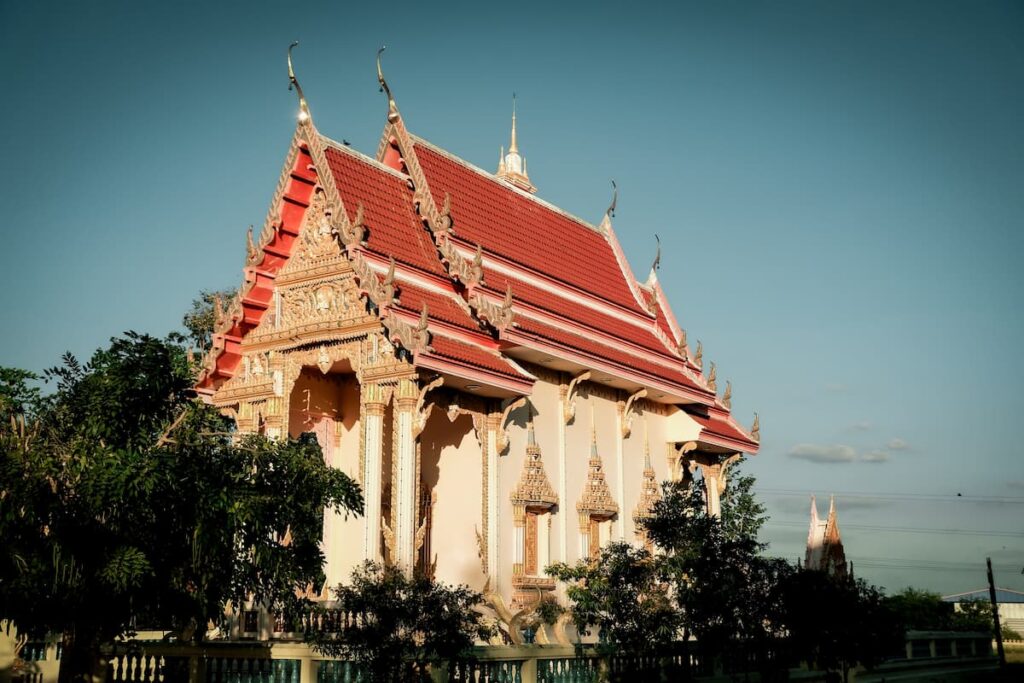
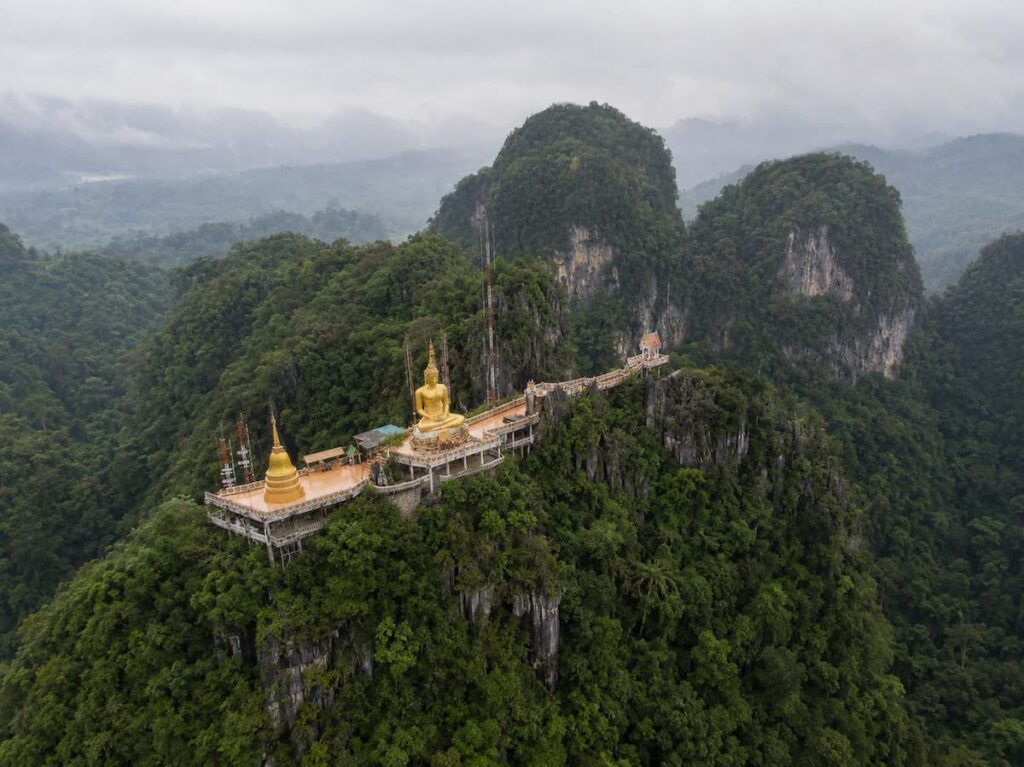
Wat Tham Suea: A Mountain Pilgrimage Above Krabi
Wat Tham Suea is best known for the steep staircase leading to a golden Buddha image high above Krabi’s limestone landscape. The climb is physically demanding, the views are exceptional and reaching the summit can become one of the most memorable experiences of a visit to the province.
However, reducing Wat Tham Suea to a viewpoint with 1,260 steps misses much of its meaning. Commonly called Tiger Cave Temple, it developed as a centre for meditation and Vipassana practice. The caves, forest, monastic areas and lower religious complex remain important even for visitors who cannot—or do not want to—complete the climb.
How Tiger Cave Temple Received Its Name
The temple was established as a meditation centre during the 1970s. It was previously known as Samnak Song Na Ching before becoming Wat Tham Suea.
Several traditions explain its present name. One account describes a monk encountering or seeing tigers while meditating in the cave. Others refer to a tiger that once lived among the caves or to marks and rock formations resembling a tiger’s paw.
These stories form part of the temple’s identity, but they should be understood as local and religious traditions rather than conclusively documented history. Despite the English name, this is also unrelated to the controversial tiger attraction formerly operating at a temple in Kanchanaburi. There are no captive tigers at Wat Tham Suea in Krabi.
More Than the Summit Staircase
The lower complex contains the cave associated with the temple’s name, prayer halls, Buddha images and active monastic areas. Forest paths lead through a landscape of limestone formations, mature tropical trees and smaller caves used for religious practice.
This lower area can be visited independently of the summit. It provides a more contemplative experience and helps visitors understand why monks were drawn to the site before it became famous for panoramic views.
Those with sufficient time can explore the forested valley as well as the principal cave and temple buildings. Remain quiet around monastic accommodation and do not enter spaces marked as private or restricted.
Climbing to the Summit
Older signs and travel accounts frequently describe 1,237 steps. Sections of the staircase have since been changed or extended, and the current route is generally counted as approximately 1,260 steps.
The number alone does not communicate the difficulty. The staircase climbs sharply, with steps that vary considerably in height and depth. Some risers are unusually high, and the combination of tropical heat, humidity and limited recovery space makes the ascent more strenuous than many visitors expect.
Fit travellers may reach the summit in approximately 30–45 minutes, but 45–90 minutes is more realistic for many people. There is no reason to rush. Regular breaks are sensible, and turning around is preferable to continuing when experiencing dizziness, chest pain or unusual shortness of breath.
At the summit, a large golden Buddha image overlooks the surrounding countryside. A chedi and smaller religious features occupy the limited mountaintop space, while the views extend across Krabi’s limestone formations, forest, agricultural land and distant settlements.
The summit remains a sacred space. Reaching it may feel like a personal achievement, but loud celebrations, revealing clothing and intrusive photography are inappropriate around worshippers and Buddha images.
Is the Climb Suitable for You?
The staircase may be unsuitable for visitors with significant cardiovascular, knee, joint or mobility problems. People affected by severe vertigo or poor heat tolerance should also consider whether the summit is necessary.
Secure footwear is strongly recommended. Flip-flops provide little support on the irregular steps, particularly during the descent or after rain. Carry sufficient drinking water, but keep your hands free where possible to use the railings.
Begin early in the morning to avoid the most intense heat. A late-afternoon ascent can offer softer light, but you must allow enough time to descend before darkness. Avoid the exposed summit during thunderstorms, heavy rain or strong winds.
Allow approximately two to three hours for the complete summit experience, including breaks, time at the top and the descent. Visitors exploring the lower complex and forest paths may require additional time.
Be Cautious Around Macaques
Macaques are frequently encountered around the lower complex and sections of the staircase. They may grab food, plastic bags, bottles, sunglasses and loose items.
Do not feed them or encourage them to approach for photographs. Keep food completely out of sight, secure loose belongings and avoid direct staring, which can be interpreted as threatening. If a monkey takes hold of an object, do not start a physical struggle that risks a bite or scratch.
Anyone bitten or scratched should clean the wound immediately and seek medical advice because macaques can transmit serious infections.
Planning Your Visit
Wat Tham Suea is located northeast of Krabi Town and can be reached by taxi, private vehicle or organised excursion. It is also regularly visited from Ao Nang, although travelling time and fares should be agreed before departure if your driver is expected to wait.
There is normally no compulsory admission charge, although donations are welcomed. Visitors should cover their shoulders and knees throughout the religious areas. Lightweight, breathable clothing can satisfy temple etiquette without making the climb unnecessarily uncomfortable.
The summit is the temple’s most famous experience, but completing it is optional. Visiting the original cave, exploring the lower religious complex and walking through the forest remain worthwhile alternatives.
Best for: Active travellers seeking a demanding physical pilgrimage combined with some of Krabi’s most expansive inland views.
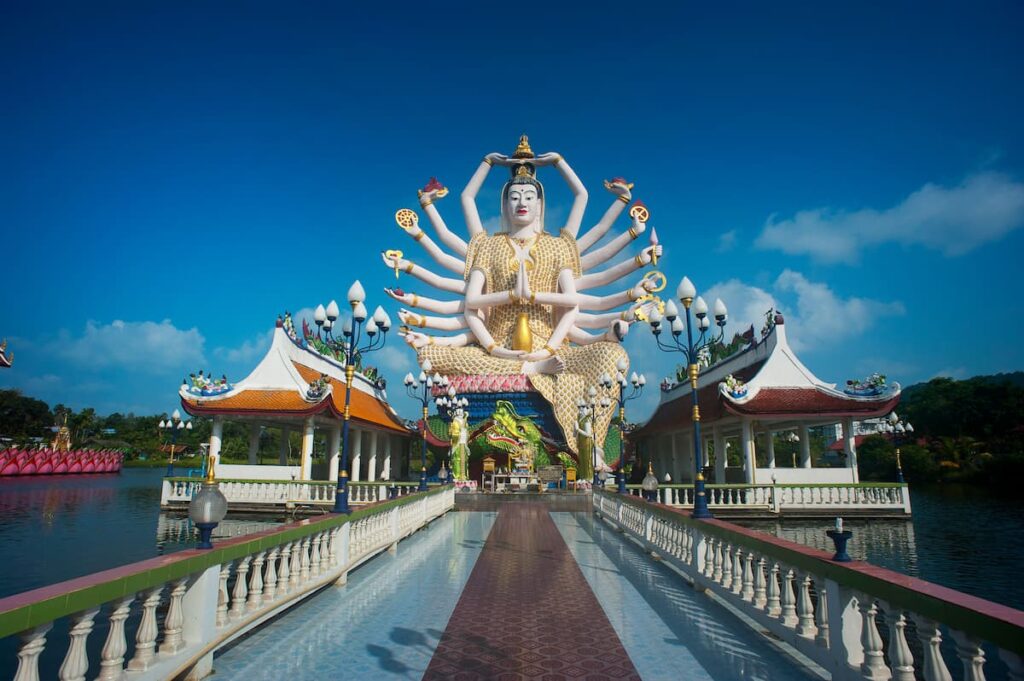
Wat Plai Laem: Thai-Chinese Buddhist Culture on Koh Samui
Wat Plai Laem provides the most colourful and contemporary temple experience in this guide. Located in northeastern Koh Samui, the active temple combines Thai religious architecture with monumental Chinese Buddhist imagery, elaborate murals and buildings positioned over a lake.
Its present visual identity was largely created during the early 2000s with the involvement of Thai artist Jarit Phumdonming. This makes Wat Plai Laem substantially newer than the historic temples of Nakhon Si Thammarat and Chaiya, but its modern construction does not make it culturally insignificant. The complex demonstrates how religious art continues to develop in response to local identity, community patronage and changing forms of devotion.
A Modern Temple Built on Established Traditions
The temple’s most recognisable features are arranged around a lake and connected by bridges and raised platforms. Bright colours, decorative rooflines, painted surfaces and large religious figures produce an appearance markedly different from the restrained forest environment of Suan Mokkh or the historic chedis found elsewhere in Southern Thailand.
Although much of the monumental complex is modern, its imagery draws upon much older Buddhist, Chinese and Brahmanical traditions. Wat Plai Laem should therefore not be described as an ancient temple preserved unchanged through the centuries. It is better understood as an active local temple whose modern expansion expresses the diverse religious influences present on Koh Samui.
The buildings and statues are exceptionally photogenic, but worship continues throughout the complex. Visitors should pay attention to people making offerings and entering the central shrine rather than treating the surrounding lake as an ornamental theme park.
The Multi-Armed Image of Guanyin
The temple’s most distinctive figure is a large white image of Guanyin with multiple arms, commonly counted as 18. It is frequently misidentified online as a many-armed Buddha or a Thai goddess.
Guanyin is the Chinese expression of Avalokiteshvara, the bodhisattva associated with compassion. The multiple arms symbolise the ability to extend compassionate assistance in many directions and respond to the suffering of numerous beings.
The image reflects the strength of Chinese cultural and religious influence within many communities in Southern Thailand. It also demonstrates why Buddhist sites cannot always be divided neatly into “Thai” and “Chinese” categories. Ideas, figures and devotional practices frequently overlap and are adapted to local settings.
The Smiling Figure Across the Lake
Another monumental white figure is often introduced to international visitors as the Laughing Buddha. It represents the smiling, large-bellied figure associated with happiness, contentment and prosperity, commonly identified locally with Phra Sangkachai.
The relationship between Phra Sangkachai and the Chinese figure Budai is more complicated than most brief tourism descriptions suggest. They developed from different religious traditions but have become visually and popularly associated with one another. For visitors, the important point is that this is not an image of Gautama Buddha simply shown in an unusual form.
Smaller shrines and decorations around the complex also draw from Buddhist and Brahmanical traditions, including figures associated with Ganesha, Vishnu and Shiva. Together, they illustrate how religious practice in Thailand often incorporates several layers of belief without worshippers necessarily seeing them as contradictory.
The Temple Buildings and Lake
The central ubosot is positioned above the water and decorated with elaborate exterior details, carved doors and colourful interior paintings. Bridges lead between the temple buildings and large religious figures, creating changing views across the lake.
Fish and turtles inhabit the water, and visitors can commonly obtain food for them in exchange for a small donation. While feeding the fish has become a popular family activity, it should remain secondary to the religious purpose of the complex.
The surrounding water creates attractive reflections and helps separate the sacred structures from the road and developed areas nearby. Early morning and late afternoon generally provide the most comfortable conditions and the best light for appreciating the colours and architectural detail.
Planning Your Visit
Wat Plai Laem is close to Koh Samui Airport and the island’s northeastern resort areas. It can be reached easily from Chaweng, Bophut, Choeng Mon and Bang Rak. Wat Phra Yai, commonly called the Big Buddha Temple, is also nearby, making the two temples easy to combine.
Allow approximately 45–75 minutes to explore without rushing. Entry is normally free, although donations are welcomed. The complex is generally accessible during daylight hours, but individual buildings may close earlier than the surrounding grounds.
Cover shoulders and knees, remove shoes before entering shrine buildings and avoid blocking bridges or doorways while composing photographs. Visitors arriving directly from the beach should change or carry appropriate clothing rather than assuming island temples apply a more relaxed dress code.
Wat Plai Laem is an excellent reminder that Southern Thailand’s religious culture is not valuable only when it is ancient. Its contemporary architecture, active worship and combination of Thai and Chinese imagery reveal a living tradition that continues to evolve.
Best for: Travellers interested in contemporary temple architecture, Thai-Chinese Buddhist imagery and an accessible cultural experience on Koh Samui.
Wat Chedi and Ai Khai: Folk Belief, Promises and Modern Pilgrimage
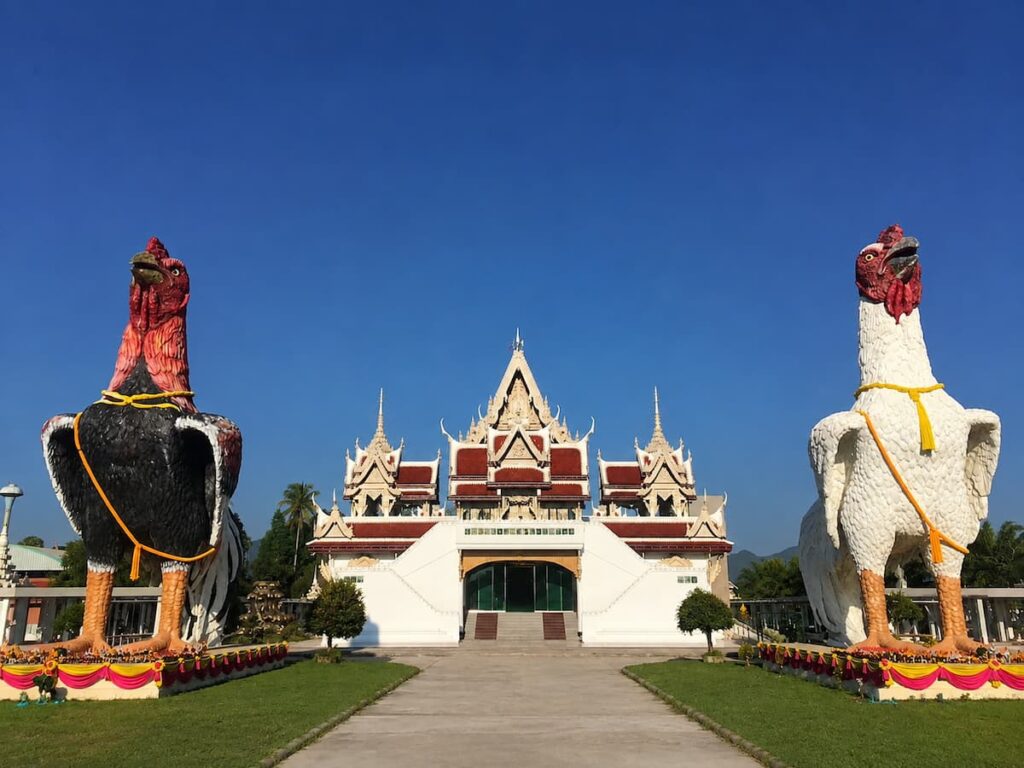
Wat Chedi offers the most unconventional temple experience in this guide. Located in Sichon District in Nakhon Si Thammarat Province, the temple has become a nationally known pilgrimage destination associated with Ai Khai, the protective spirit of a young boy believed to help worshippers with business, employment, fortune and other personal concerns.
This is not a quiet architectural monument. The temple can be crowded, noisy and highly commercial around its principal devotional areas. Rooster figures fill parts of the complex, firecrackers announce promises believed to have been fulfilled, and shops sell offerings to the steady flow of visitors.
For travellers interested in living belief rather than visual serenity, Wat Chedi provides a revealing encounter with the ways formal Buddhism, local spirit traditions, personal vows and sacred tourism can coexist in contemporary Thailand.
Who Is Ai Khai?
Several versions of the Ai Khai story circulate, and the details should not be treated as independently verified history.
According to the most widely repeated tradition, Ai Khai was a young temple attendant or disciple associated with Luang Pu Thuat, one of Southern Thailand’s most revered monks. The boy was left to guard a sacred place, religious property or treasure and is believed to remain at Wat Chedi as a protective spirit.
Ai Khai is represented by a carved wooden figure of a boy approximately nine or ten years old. Worshippers frequently address him in familiar language, reflecting a relationship that can appear more personal and direct than devotion surrounding distant historical figures.
It is important to describe these accounts as belief and tradition. Saying that Ai Khai “is believed to help worshippers” respects the religious meaning of the practice without presenting supernatural claims as established fact.
Why Worshippers Come to Wat Chedi
People travel to Wat Chedi to request assistance with practical and immediate concerns. These may include:
- Finding employment
- Improving a business
- Passing an examination
- Resolving financial problems
- Receiving protection
- Achieving a personal goal
- Obtaining fortunate lottery numbers
A worshipper may state a request and promise to return with a particular offering if the desired outcome occurs. When the person believes that Ai Khai has helped, completing that promise becomes an important part of the relationship.
The purpose is therefore not simply to place an offering and leave. The return journey, expression of gratitude and fulfilment of the vow are central to understanding what visitors see at the temple.
Roosters, Toys and Firecrackers
The most visible offerings are rooster figures, which appear in enormous numbers and in many different sizes. Their precise relationship with the earliest Ai Khai traditions is not consistently documented, but they have become the temple’s defining visual symbol.
Other offerings may include:
- Children’s toys
- Military-style clothing
- Slingshots
- Red soft drinks
- Sweets
- Donations
- Firecrackers
These objects reflect Ai Khai’s identity as a young boy as well as the particular promises made by worshippers. Military clothing and slingshots also express a playful but protective character commonly associated with him.
Firecrackers are set off after requests are believed to have been answered. The resulting explosions can be frequent and extremely loud, particularly during busy periods. Visitors should observe from the designated areas and avoid treating the practice as entertainment staged for photographs.
From Local Belief to National Pilgrimage
Ai Khai worship expanded dramatically beyond its local origins, particularly during periods of economic uncertainty. Visitors began arriving from across Thailand, while stories of successful requests circulated through television, social media and personal testimony.
The temple’s rise has generated considerable economic activity in the surrounding community. Accommodation, restaurants, parking areas, transport services and shops selling offerings have developed around the flow of pilgrims.
This commercialisation can make the temple feel very different from Suan Mokkh or Wat Phra Borommathat Chaiya. However, dismissing Wat Chedi as merely commercial would overlook why people continue to travel long distances, fulfil promises and return with their families.
The temple demonstrates how a local spiritual tradition can develop into a contemporary national pilgrimage. It also shows that religious experience in Thailand frequently extends beyond the boundaries outsiders may expect between Buddhism, spirit belief, personal fortune and economic life.
What Visitors Should Expect
Wat Chedi is most rewarding when approached with curiosity rather than expectations of tranquillity. The principal devotional areas may be busy with worshippers following particular sequences of offerings, prayers and promised actions.
Weekends, public holidays and auspicious dates can produce substantial crowds and traffic. Visitors seeking a calmer experience should arrive early on an ordinary weekday. Even then, the temple is likely to feel active rather than meditative.
Allow approximately one hour, although more time may be useful if you want to observe the rituals carefully. The temple is some distance from Nakhon Si Thammarat city and is most conveniently reached by private vehicle or hired transport. Its location may fit naturally into a journey through Sichon or between Nakhon Si Thammarat and the northern Gulf coast.
Published opening hours vary considerably between sources. The temple is generally accessible throughout the daytime and into the early evening, but check current arrangements before making a dedicated journey.
Visiting Respectfully
Do not imitate worship practices simply to create photographs or social-media content. If you wish to participate, observe other visitors, ask politely for guidance and understand what an offering represents before purchasing one.
Photography should not interfere with people making requests, completing vows or spending private moments before the Ai Khai figure. Avoid dismissive descriptions such as “the chicken temple,” which reduce a complex living tradition to its most visually unusual feature.
Wat Chedi may not appeal to travellers seeking refined historic architecture, but that is precisely why it belongs in this selection. It reveals a form of religious life that is immediate, personal, contemporary and deeply meaningful to many Thai worshippers.
Best for: Travellers interested in folk belief, personal vows and the development of a modern Thai pilgrimage tradition.
Which Southern Thailand Temple Should You Visit?
The seven temples in this guide are spread across a large region, and attempting to visit them all would require substantial travel. For most people, the best choice will combine personal interest with the destinations already included in their itinerary.
| If you are most interested in… | Choose… | Why |
|---|---|---|
| Southern Thailand’s most important Buddhist monument | Wat Phra Mahathat Woramahawihan | It combines approximately 1,500 years of religious history, continuing pilgrimage and UNESCO World Heritage recognition |
| Srivijaya history and early maritime connections | Wat Phra Borommathat Chaiya | Its distinctive chedi preserves one of Thailand’s clearest expressions of Srivijaya-influenced architecture |
| Meditation and Buddhist philosophy | Suan Mokkh | The forest monastery emphasises teaching, contemplation and practical engagement with the Dhamma |
| Phuket’s local culture and history | Wat Chalong | It remains closely associated with revered monks, traditional medicine and Phuket’s nineteenth-century tin-mining history |
| A demanding climb and panoramic scenery | Wat Tham Suea | The approximately 1,260-step ascent leads to a mountaintop shrine overlooking Krabi’s limestone landscape |
| Contemporary Thai-Chinese religious art | Wat Plai Laem | Its modern lakeside complex combines Thai temple architecture with Chinese Buddhist imagery |
| Folk belief and modern pilgrimage | Wat Chedi | Worship surrounding Ai Khai reveals the continuing importance of personal vows, spirit belief and sacred tourism |
The Best Choice for First-Time Visitors
Wat Phra Mahathat Woramahawihan offers the most complete encounter with Southern Thailand’s Buddhist history and spiritual importance. However, it requires travelling to Nakhon Si Thammarat, which is not included in every first-time southern itinerary.
Travellers remaining in major resort areas can still make a meaningful choice. Wat Chalong is the most accessible option in Phuket, Wat Tham Suea provides the strongest temple experience near Krabi, and Wat Plai Laem is the most convenient selection on Koh Samui.
The Best Combination of Two Temples
Wat Phra Borommathat Chaiya and Suan Mokkh can be combined particularly effectively because they are located within the same wider district but offer completely different experiences.
The first reveals Southern Thailand’s early Buddhist history through monumental Srivijaya-influenced architecture. The second represents a modern return to simplicity, meditation and direct engagement with Buddhist teaching. Together, they demonstrate how religious practice in the region has developed across more than a millennium.
Choose According to Your Route
It is rarely sensible to cross Southern Thailand solely to complete a temple checklist. Travel between Phuket, Krabi, Koh Samui, Chaiya and Nakhon Si Thammarat can involve long road journeys, ferries or flights.
One carefully chosen temple that fits naturally into your itinerary will generally provide a more rewarding experience than rushing through several. The purpose of this guide is not to encourage visitors to collect all seven, but to help each traveller find the temple experience that offers the greatest meaning for them.
Other Important Temples in Southern Thailand
Limiting this guide to seven temples inevitably excludes several places with considerable religious, architectural or historical importance. The following temples were not overlooked; they were left outside the main selection because their defining experiences are represented more strongly elsewhere or because current travel considerations make them difficult to recommend broadly.
Wat Mahathat Wachiramongkol, Krabi
Commonly called Wat Bang Thong, Wat Mahathat Wachiramongkol is centred on an approximately 95-metre golden stupa inspired by the Mahabodhi Temple at Bodh Gaya in India, where the Buddha is believed to have attained enlightenment.
The scale, symmetry and gold-covered surfaces make this one of Southern Thailand’s most visually impressive modern temple complexes. It is particularly worthwhile for travellers exploring mainland Krabi beyond Ao Nang and the province’s island excursions.
However, its strongest appeal is monumental architecture. Wat Phra Mahathat Woramahawihan and Wat Phra Borommathat Chaiya provide greater historical depth, while Wat Plai Laem offers a more distinctive contemporary religious experience. Wat Bang Thong therefore narrowly missed the final seven.
Wat Rat Uppatham, Phang Nga
Wat Rat Uppatham, more commonly known as Wat Bang Riang, occupies a hilltop setting in Phang Nga Province. Its elaborate bell-shaped chedi overlooks forested hills, while a large Buddha image and a monumental representation of Guanyin stand within the surrounding landscape.
The temple combines religious architecture with expansive scenery and remains considerably less visited than the major temples of Phuket and Krabi. It is a rewarding detour for travellers exploring inland Phang Nga.
Wat Bang Riang was excluded because Wat Tham Suea provides the stronger mountain-pilgrimage experience and Wat Plai Laem offers a clearer introduction to Guanyin and Thai-Chinese religious imagery. Nevertheless, travellers prioritising a peaceful hilltop setting may prefer it to either.
Wat Khuha Phimuk, Yala
Wat Khuha Phimuk, also known as Wat Na Tham, is one of the most historically interesting Buddhist sites in Thailand’s far south. Its limestone cave contains a reclining image almost 25 metres long, believed to date from approximately the eighth-century Srivijaya period.
The cave’s natural opening allows light into the religious chamber, while the site reflects the long history of Buddhism in an area now more commonly associated with the predominantly Malay Muslim culture of Thailand’s southern border provinces.
Its omission is based primarily on travel practicality and safety rather than cultural importance. Several foreign governments currently apply elevated travel warnings to Yala because of continuing insurgent activity. Travellers considering a visit should consult current official advice, assess insurance implications and seek reliable local guidance rather than relying on a general tourism article.
Wat Chang Hai, Pattani
Wat Chang Hai, officially Wat Rat Burana, is one of Thailand’s most important temples associated with Luang Pu Thuat. The highly revered monk is remembered for wisdom, compassion and miraculous traditions, and images and amulets bearing his likeness are found throughout Thailand.
The temple remains an important pilgrimage destination, particularly for worshippers seeking protection. Its association with the production and consecration of Luang Pu Thuat amulets gives it a significance extending well beyond Pattani Province.
Like Wat Khuha Phimuk, Wat Chang Hai lies within a province covered by elevated foreign-government travel warnings. Its religious importance deserves recognition, but it cannot be presented as a routine sightseeing excursion for all international travellers without substantial safety context.
These omissions reinforce why the main seven should not be interpreted as a definitive hierarchy. Southern Thailand contains many important temples, but the most suitable places for a travel guide must balance cultural significance, distinctiveness, accessibility and responsible visitor advice.
Visiting Temples Respectfully
The temples in this guide welcome visitors, but they remain active religious places rather than architectural displays created for tourism. A few simple practices will help you avoid interrupting worship and allow the experience to remain comfortable for everyone.
Dress Modestly
Cover your shoulders and knees throughout the temple grounds, even when visiting from a nearby beach or climbing in hot weather. Lightweight trousers, a long skirt or shorts extending below the knees are generally suitable when combined with a shirt that covers the shoulders.
A sarong can be useful as a temporary covering, but arriving already dressed appropriately is more respectful than depending on clothing provided at the entrance.
Remove Shoes Where Required
Shoes must normally be removed before entering an ubosot, viharn or other shrine building. Look for footwear left beside the entrance or signs indicating where shoes should be placed.
Hats and sunglasses should also be removed inside principal religious buildings. Socks are generally acceptable unless instructions state otherwise.
Be Aware of Your Feet
Feet are considered the lowest and least respectful part of the body in Thai culture. Avoid pointing them toward Buddha images, monks, altars or other people.
When sitting on the floor, place your legs to one side or kneel with your feet directed behind you. Do not sit with your legs stretched toward the principal shrine.
Do Not Climb on Sacred Structures
Never climb onto Buddha images, chedis, altars, walls or religious platforms to improve a photograph. A low barrier or raised base still marks a boundary, even when no member of staff is present to enforce it.
Avoid touching Buddha images or applying gold leaf unless the temple clearly allows visitors to participate in that particular practice.
Photograph With Restraint
Photography is permitted in many Thai temples, but permission to photograph a building is not permission to intrude upon every person inside it.
Do not stand immediately in front of worshippers, interrupt rituals or photograph monks and individuals at close range without consent. Turn off flash where it may disturb people or damage sensitive artwork, and respect all signs prohibiting photography.
Images showing active worship can be meaningful, but they should be created from a respectful distance rather than treating private devotion as a performance.
Behave Quietly Around Monks and Worshippers
Keep conversations low, silence phone notifications and avoid loud commentary inside religious buildings. Give priority to worshippers when approaching Buddha images, monks’ halls and offering areas.
Women should avoid touching monks or handing objects directly to them. If an item must be passed, place it on an available cloth, table or neutral surface and follow the monk’s guidance.
Understand Before Participating
Visitors are often welcome to light incense, make a donation or join simple merit-making activities. If you do not understand the sequence, observe first or ask politely for assistance.
At Wat Chalong and Wat Chedi, firecrackers and promised offerings have particular devotional meanings. Do not reproduce rituals solely for photographs or entertainment.
Donations Are Optional Unless a Fee Is Displayed
Many active temples do not charge admission, although donation boxes support maintenance, religious activities and community programmes. Contribute if you wish, but do not feel pressured by unofficial guides or vendors.
Where a museum or protected historical area charges admission, use the official ticket counter and retain your ticket.
Respectful temple visits require little specialised knowledge. Modest clothing, quiet observation and awareness that worship takes priority over sightseeing are usually enough to ensure you are welcomed appropriately.
Planning Temple Visits in Southern Thailand
Southern Thailand covers a long peninsula divided between the Andaman Sea and the Gulf of Thailand. Distances that appear manageable on a map can involve mountain roads, ferry connections or several hours of driving. Temple visits are therefore best planned around the destinations already included in your itinerary.
Visit Early When Possible
Early morning is generally the most comfortable time to visit. Temperatures are cooler, tour groups are less common and active temples may feel more connected with their ordinary daily rhythms.
This is particularly important at Wat Tham Suea, where the staircase becomes considerably more difficult in the midday heat. Wat Chalong and Wat Plai Laem are also quieter before organised sightseeing groups begin arriving.
Late afternoon can provide softer light and lower temperatures, but check when individual buildings close. Temple grounds may remain accessible after shrine halls, museums or upper levels have closed.
Allow for Southern Thailand’s Rain
Rain can occur throughout the year, although seasonal patterns differ between the Andaman and Gulf coasts. Phuket and Krabi generally experience their wettest conditions at a different time from Koh Samui and the eastern Gulf provinces.
A short tropical shower does not necessarily prevent a temple visit, but rain can make tiled courtyards, cave entrances and stone staircases extremely slippery. Avoid climbing Wat Tham Suea during heavy rain, thunderstorms or when visibility is deteriorating.
A compact umbrella can be useful in open temple grounds, while respectful lightweight clothing will provide better comfort than relying on beachwear in humid conditions.
Plan Around Your Existing Destination
The most practical temple choices are:
- From Phuket: Wat Chalong
- From Krabi Town or Ao Nang: Wat Tham Suea
- From Koh Samui: Wat Plai Laem
- From Chaiya or northern Surat Thani: Wat Phra Borommathat Chaiya and Suan Mokkh
- From Nakhon Si Thammarat city: Wat Phra Mahathat Woramahawihan
- From Sichon or the northern Nakhon Si Thammarat coast: Wat Chedi
Wat Phra Borommathat Chaiya and Suan Mokkh form the easiest two-temple combination because they are located in the same wider district and offer strongly contrasting experiences.
Check Transport Before Travelling
Public transport rarely delivers visitors conveniently to every temple entrance. Taxis, ride-hailing services and private vehicles are usually the simplest options around Phuket, Krabi and Koh Samui.
Transport becomes less predictable around Chaiya, Sichon and rural parts of Nakhon Si Thammarat. If using a taxi or hired driver, agree whether the driver will wait or return at a specified time. Finding a vehicle for the return journey may be more difficult at temples outside major tourism centres.
Travellers riding scooters should consider their experience, weather conditions and the distance involved. A quiet rural road is not automatically safe, particularly after rain or when returning near darkness.
Check Museums, Festivals and Religious Days
Active temple grounds may open daily, but associated museums often close on Mondays, Tuesdays or public holidays. Chaiya National Museum should be checked separately from Wat Phra Borommathat Chaiya before planning the journey.
Buddhist observance days and temple festivals can provide an opportunity to witness ceremonies, markets and community traditions. They also bring crowds, altered traffic arrangements and reduced parking availability.
Visitors seeking a peaceful architectural experience may prefer an ordinary weekday. Those interested in living religious culture may find a festival or observance day more rewarding, provided they are prepared for congestion and approach ceremonies respectfully.
How Many Temples Should You Visit?
One carefully chosen temple is usually enough for a beach or island holiday. Travellers with a deeper interest in history or Buddhist culture may want to visit two or three across a longer Southern Thailand itinerary.
Visiting large numbers in quick succession can make distinctive places begin to feel interchangeable. Allowing time to observe worship, understand the principal structures and learn why a temple matters will provide considerably more value than completing a checklist.
Choose according to your route and interests, leave space for an unhurried visit and remember that the most important parts of an active temple may not be its most photographed features.
Frequently Asked Questions
What is the most important temple in Southern Thailand?
Wat Phra Mahathat Woramahawihan in Nakhon Si Thammarat is generally the strongest choice. It has served as a major regional Buddhist centre for approximately 1,500 years, remains an important pilgrimage destination and became Southern Thailand’s first UNESCO World Heritage Site in 2026.
Its significance extends beyond the age of its architecture. The temple reflects centuries of religious exchange involving South and Southeast Asia while remaining closely connected with active worship, local traditions and the surrounding community.
What is the oldest temple on this list?
There is no simple answer because the age of a religious site, the foundation of a monastery and the construction date of its surviving buildings may be different.
Wat Phra Mahathat Woramahawihan was founded in approximately the eighth century, while Wat Phra Borommathat Chaiya preserves architecture associated with the Srivijaya period. Both have been restored, rebuilt and expanded over many centuries. It is therefore more accurate to describe them as two of Southern Thailand’s most important early Buddhist sites than to declare one unequivocally the oldest surviving temple.
What is the best temple to visit in Phuket?
Wat Chalong is the best general recommendation in Phuket. It is the island’s most revered Buddhist temple and combines accessible architecture with local history, active worship and traditions associated with Luang Por Chaem and other respected monks.
It is approximately nine kilometres from Phuket Town and around 16 kilometres from Patong, making it relatively easy to include in a half-day exploration of southern Phuket.
Is Tiger Cave Temple suitable for everyone?
No. The lower complex at Wat Tham Suea can be visited by most travellers, but the staircase to the summit is exceptionally demanding. The approximately 1,260 steps vary in height and become considerably more difficult in heat, humidity or rain.
Visitors with cardiovascular, knee, joint or mobility problems should consider remaining within the lower temple and cave areas. Completing the summit climb is not required to experience the monastery.
Can tourists visit Suan Mokkh without joining a meditation retreat?
Yes. Visitors can explore the main monastery respectfully without participating in the ten-day retreat offered by the associated International Dharma Hermitage.
The retreat is a separate structured programme with fixed registration, silence, a demanding daily schedule and a requirement to complete the entire ten days. It should not be confused with a casual visit to the principal monastery.
Are temples in Southern Thailand free to visit?
Many active temples request no compulsory admission fee, although donations are welcomed. Associated museums, protected historical areas or special exhibitions may charge separately.
Opening arrangements and fees can change, so check current information before travelling—particularly when a museum is an important part of the visit.
What should I wear when visiting a temple?
Cover your shoulders and knees, remove shoes before entering shrine buildings and avoid beachwear. Lightweight trousers, a long skirt or sufficiently long shorts combined with a sleeved shirt are generally suitable for Southern Thailand’s climate.
The same expectations apply at temples located near beaches and resorts. Phuket and Koh Samui temples do not adopt a different dress code simply because many visitors arrive from coastal areas.
Can I photograph monks and worshippers?
Temple architecture can generally be photographed unless signs indicate otherwise. Monks and worshippers should not be treated as automatic photographic subjects.
Ask before taking close photographs of individuals, avoid using flash around religious images and never interrupt prayer or ceremonies to obtain a clearer composition. Worship takes priority over sightseeing.
Is it safe to visit temples in Pattani or Yala?
Several governments currently apply elevated travel warnings to Pattani, Yala and Narathiwat because of continuing insurgent activity. Advice levels and affected areas can change.
Consult the current guidance issued by your own government, consider whether travelling against that advice would affect your insurance and seek reliable local information before planning a visit. Wat Chang Hai and Wat Khuha Phimuk are culturally important, but they should not be treated as routine excursions without considering present conditions.
Final Thoughts: Choosing Meaning Over Fame
Southern Thailand’s temples are sometimes treated as secondary attractions to visit between beaches, islands and boat trips. In reality, they reveal a history shaped by maritime exchange, regional kingdoms, influential teachers, local communities and religious traditions that continue to develop.
The seven temples in this guide were not selected because they produce the most recognisable photographs. Each offers a different way to encounter the region. Wat Phra Mahathat preserves living heritage extending across approximately 1,500 years, while Chaiya reveals the influence of the Srivijaya period. Suan Mokkh turns attention away from monumental architecture and toward Buddhist teaching, and Wat Tham Suea transforms a temple visit into a demanding physical pilgrimage.
Wat Chalong connects Phuket’s religious life with the island’s tin-mining history. Wat Plai Laem demonstrates how Thai and Chinese Buddhist imagery continues to shape contemporary temples, while Wat Chedi reveals the personal vows, spirit beliefs and modern pilgrimage practices that remain meaningful to many Thai worshippers.
The best temple is therefore not necessarily the oldest, largest or most elaborate. It is the one that fits your route and helps you understand something you genuinely want to explore. Visit slowly, observe before participating and remember that these are active places of faith rather than backgrounds created for travel photography.
One thoughtfully chosen temple can reveal more about Southern Thailand than several hurried stops. The value lies not in completing all seven, but in recognising why each place matters to the people who continue to worship there.
Continue Exploring
Complete Southern Thailand Travel Guide
Explore Southern Thailand’s islands, beaches, historic towns, national parks and regional cultures while comparing the Andaman Coast with the Gulf of Thailand.
Plan a broader journey through Thailand’s different regions, landscapes and cultural experiences.
Related Reading
Where to Go in Southern Thailand
Compare Phuket, Krabi, Koh Samui, Khao Lak and other destinations to find the part of Southern Thailand that best suits your interests.
Must-See Attractions in Southern Thailand
Discover remarkable natural landscapes, cultural landmarks and memorable attractions across Thailand’s southern provinces.
Best Historical Places in Thailand
Explore ancient cities, archaeological sites and important monuments that reveal different periods of Thailand’s history.
Best Temples in Thailand: Which Should You Visit?
Compare some of Thailand’s most significant and distinctive temples to choose the religious and cultural experiences that best fit your journey.
About the Author
David Hibbins is a travel publisher, destination researcher and the creator of Travel With Insight.
Through years of travel, tourism and publishing projects across Southeast Asia, he has developed a particular interest in how travellers research destinations, compare experiences and make travel decisions.
His work focuses on helping travellers move beyond popularity rankings, marketing claims and generic “best of” lists by providing balanced, research-driven destination guides. Rather than telling people where they should travel, his goal is to help readers understand the strengths, limitations and unique character of each destination so they can choose the places that best match their own interests, travel style and goals.
As the creator of Travel With Insight, David researches destinations throughout Southeast Asia, exploring not only where travellers go, but why they choose certain places, how destinations differ and what creates genuinely memorable travel experiences.
His work covers destination research, regional travel planning, traveller behaviour and the decision-making frameworks that help people plan more rewarding journeys.
Explore More Travel Resources
Every great journey begins with informed decisions. The more you understand a destination before you arrive, the more rewarding your travel experience becomes.
Whether you’re still researching Southern Thailand or you’re ready to start planning your itinerary, these additional resources can help.
Travel With Insight
Continue exploring our in-depth destination guides, travel inspiration and practical planning advice designed to help you make informed travel decisions throughout Thailand and Southeast Asia.
Go Find Asia
Looking for even more travel inspiration? Go Find Asia explores destinations, experiences and travel ideas across Asia, helping you discover where to go, what to see and how to plan your next adventure.
Resurgence Travel
When you’re ready to turn your research into reality, Resurgence Travel offers curated itineraries, personalised travel planning and local expertise to help you experience the very best of Thailand and Southeast Asia.