
Must-See Attractions in Central Thailand
Central Thailand contains many of the country’s most recognisable and historically significant attractions. Bangkok’s royal palaces and riverside temples reveal the foundations of the modern capital, while the ruined monasteries of Ayutthaya preserve the scale and influence of an earlier Siamese kingdom. Beyond these celebrated landmarks, the region offers wartime history in Kanchanaburi, colourful canal communities, unusual working markets, limestone waterfalls and remarkable caves hidden within coastal mountains.
This guide explores seven must-see attractions in detail, chosen for their significance, visitor experience and ability to reveal different sides of Central Thailand. It also introduces eight more remarkable places worth considering, helping you look beyond a checklist of famous sights and choose the attractions that best match your interests, available time and preferred pace of travel.
Quick Summary: Central Thailand’s Must-See Attractions
Central Thailand’s leading attractions range from royal complexes and ancient capitals to waterfalls, caves and living markets. The best choices depend on whether you are most interested in history, architecture, nature or everyday Thai culture—and how far you want to travel from Bangkok.
| Attraction | Location | Best for |
|---|---|---|
| Grand Palace and Wat Phra Kaew | Bangkok | Royal history and architecture |
| Ayutthaya Historical Park | Ayutthaya | Ancient temples and historical ruins |
| Death Railway and Hellfire Pass | Kanchanaburi | Second World War history |
| Erawan Waterfall | Kanchanaburi | Waterfalls, swimming and nature |
| Wat Arun | Bangkok | Riverside architecture and temple views |
| Maeklong Railway Market | Samut Songkhram | Markets and local culture |
| Phraya Nakhon Cave | Prachuap Khiri Khan | Scenery, walking and adventure |
| Wat Pho | Bangkok | Buddhist art and the Reclining Buddha |
| Bang Pa-In Royal Palace | Ayutthaya | Royal architecture and gardens |
| Damnoen Saduak Floating Market | Ratchaburi | Iconic floating-market scenes |
| Amphawa Floating Market | Samut Songkhram | Food and evening atmosphere |
| Phra Nakhon Khiri Historical Park | Phetchaburi | Palace history and elevated views |
| Phra Pathom Chedi | Nakhon Pathom | Buddhist and Dvaravati heritage |
| Phra Prang Sam Yot | Lopburi | Khmer architecture and local history |
| Mon Bridge | Sangkhlaburi | Community culture and sunrise views |
Seven Must-See Attractions in Central Thailand
The following seven attractions were selected for more than their fame. Together, they reveal Central Thailand’s royal heritage, ancient kingdoms, wartime history, religious traditions, natural landscapes and everyday culture. Some are easily visited within Bangkok, while others reward travellers who allow enough time to explore beyond the capital.
1. The Grand Palace and Wat Phra Kaew, Bangkok
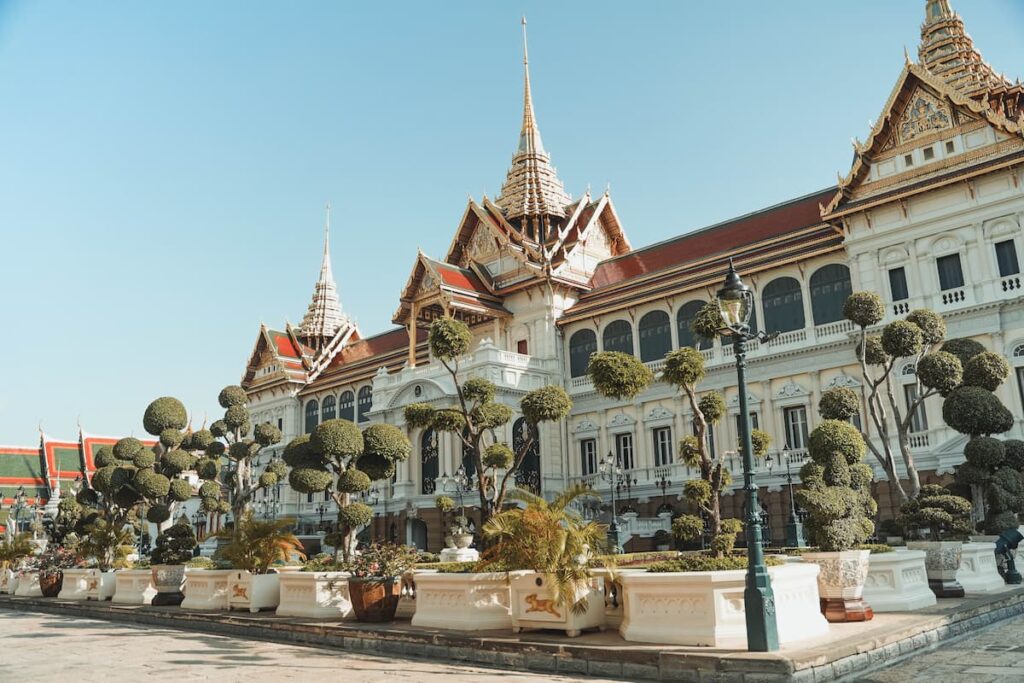
The Grand Palace is one of Thailand’s most important cultural landmarks and an essential introduction to the country’s royal history. Established after Bangkok became the capital in 1782, the vast complex contains ceremonial halls, royal buildings, courtyards and intricately decorated structures that reflect the authority and artistic ambition of the early Rattanakosin period.
Within the palace grounds stands Wat Phra Kaew, or the Temple of the Emerald Buddha. The temple houses Thailand’s most revered Buddha image, which is carved from a single piece of jade and dressed in seasonal robes changed during ceremonies led by the King. Unlike most Thai temples, Wat Phra Kaew has no resident monks and was created primarily as a royal chapel.
Although the palace’s gilded surfaces and elaborate architecture make an immediate impression, the details reward closer attention. Mythical guardians stand beside gateways, scenes from the Ramakien cover long gallery walls, and mirrored mosaics, coloured tiles and golden chedi create an extraordinary density of decoration throughout the compound.
The Grand Palace is understandably busy, particularly during late morning when tour groups arrive. Visiting close to opening time generally provides cooler conditions and a less hurried experience. Shoulders and knees must be covered, and visitors should wear clothing appropriate for entering one of Thailand’s most sacred sites. Sarongs or loose coverings may not always be accepted as substitutes for suitable clothing, so it is better to arrive properly dressed.
Allow at least two hours for the palace and temple complex, although travellers interested in Thai history, architecture or photography may want longer. Wat Pho is within walking distance, while a short ferry journey across the Chao Phraya River connects the area with Wat Arun. Combining these three attractions creates one of Bangkok’s most rewarding cultural days, provided enough time is allowed to experience each without rushing.
Best for: First-time visitors, royal history, architecture and Thai cultural heritage.
Allow: Approximately two to three hours.
Best time: Close to opening, before the strongest heat and largest crowds.
Consider if: You are comfortable with crowds, extensive walking and strict dress requirements.
2. Ayutthaya Historical Park, Ayutthaya
Ayutthaya Historical Park preserves the remains of a city that was once among the most powerful and cosmopolitan capitals in Asia. Founded in 1350, Ayutthaya became the centre of a kingdom that influenced much of the region and maintained trading relationships with merchants and diplomats from across Asia, Europe and the Middle East.
At its height, the city contained hundreds of temples, monasteries and palaces connected by roads, canals and rivers. Much of Ayutthaya was destroyed when the Burmese army captured the capital in 1767, but the surviving prang, chedi, Buddha images and monastic ruins still convey the scale and importance of the former kingdom. The historic city was recognised as a UNESCO World Heritage Site in 1991.
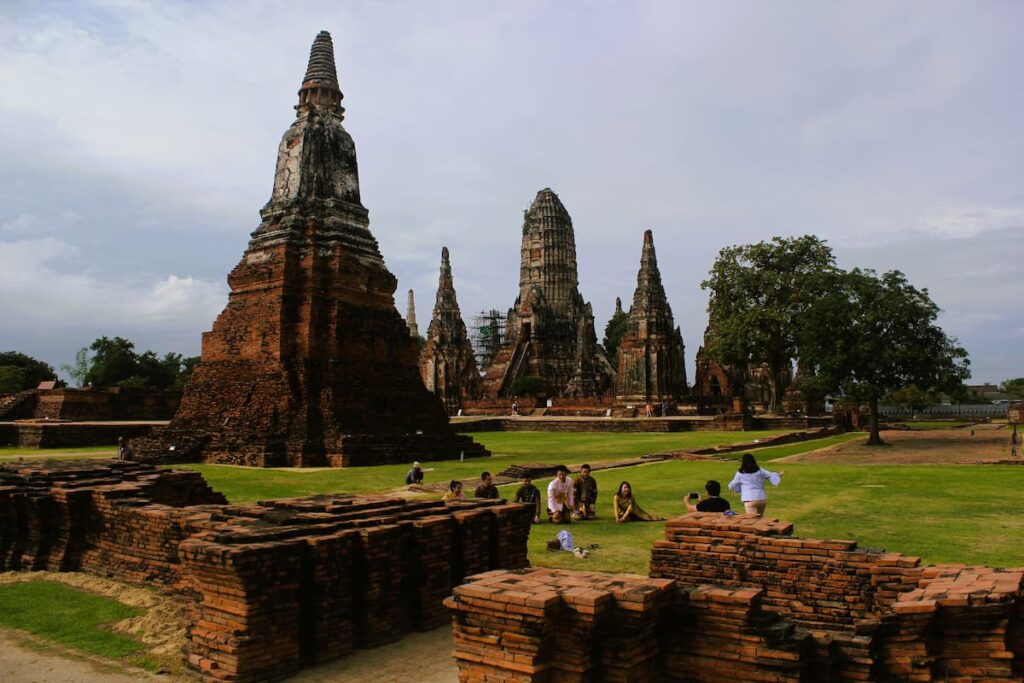
Ayutthaya Historical Park is not a single enclosed attraction. Its monuments are distributed across the old city island and surrounding areas, making it important to decide how you want to explore. Wat Mahathat is known for the stone Buddha head embraced by tree roots, while Wat Ratchaburana has an imposing central prang and surviving decorative details. Wat Phra Si Sanphet, once part of the royal palace complex, is distinguished by three elegant chedi that have become one of Ayutthaya’s defining images.
Beyond the central island, Wat Chaiwatthanaram stands beside the Chao Phraya River and is particularly atmospheric in the late afternoon. Wat Yai Chai Mongkhon offers a different experience, with a large chedi that visitors can climb and rows of seated Buddha images lining its courtyard. Trying to see every major temple in one visit can become repetitive and exhausting, so selecting four or five meaningful sites usually produces a more rewarding day.
Bicycles provide freedom and suit travellers comfortable riding in the heat and around traffic. Tuk-tuks are more practical for reaching widely separated temples, while a knowledgeable guide can explain how the structures relate to Ayutthaya’s royal, religious and political history. Simply moving between ruins without this context can make the city feel like a collection of similar monuments rather than the remains of a functioning capital.
Ayutthaya can be visited as a day trip from Bangkok, but staying overnight creates a slower and often more memorable experience. The major ruins become quieter after day-trippers leave, and the softer morning and evening light reveals a different side of the historical park.
Best for: Ancient history, temple ruins, architecture and photography.
Allow: At least half a day, preferably a full day or overnight stay.
Best time: Early morning and late afternoon, when conditions are cooler.
Consider if: You enjoy historical sites and are prepared to travel between separate temple complexes.
3. The Death Railway and Hellfire Pass, Kanchanaburi
Kanchanaburi’s Death Railway sites preserve one of the most confronting chapters of Central Thailand’s modern history. During the Second World War, the Imperial Japanese Army forced Allied prisoners of war and large numbers of Asian civilian labourers, known as rōmusha, to construct a railway connecting Thailand with Burma. Thousands died from disease, starvation, exhaustion, violence and appalling working conditions.
The Bridge over the River Khwae is the railway’s most famous landmark, although visiting the bridge alone reveals only a small part of the story. It remains part of an operating railway, and visitors can walk across it when trains are not approaching. Its international fame owes much to the 1957 film The Bridge on the River Kwai, but the film’s story and landscape should not be mistaken for an accurate account of the railway’s construction.
Nearby, Kanchanaburi War Cemetery contains the graves of almost 7,000 Allied prisoners who died during the railway’s construction. The Thailand–Burma Railway Centre, located opposite the cemetery, provides valuable historical context through maps, photographs, personal accounts and exhibits explaining how the railway was built. Visiting the museum before travelling farther along the route helps transform the remaining tracks and cuttings into something more meaningful than isolated landmarks.
The railway journey west from Kanchanaburi crosses the famous bridge before continuing through rural landscapes towards the Wang Po Viaduct, where the track follows a narrow ledge above the River Khwae Noi. The journey offers beautiful scenery, but it is important to remember that the railway was created through forced labour and immense human suffering.
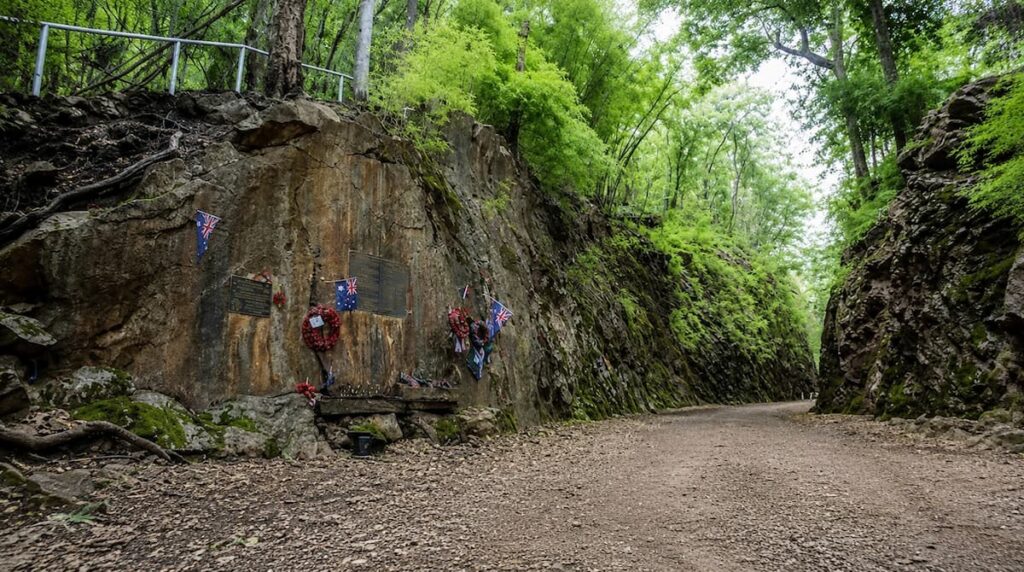
Approximately 80 kilometres beyond Kanchanaburi town, the Hellfire Pass Interpretive Centre provides the region’s most powerful and complete account of that history. Exhibits explain the experiences of Allied prisoners and Asian labourers, while an audio-guided trail leads into Konyu Cutting, where workers carved a route through solid rock using basic tools. The cutting became known as Hellfire Pass because torchlight illuminating exhausted workers at night was said to resemble a scene from hell.
Hellfire Pass is too far from Kanchanaburi town to be treated as a quick addition after visiting the bridge. Travellers who want to understand the railway properly should dedicate most of a day to the museum, walking trail and journey through the surrounding area. The experience can be emotionally difficult, but it is one of Central Thailand’s most important historical visits.
Best for: Second World War history, remembrance and travellers seeking deeper historical understanding.
Allow: Half a day for the bridge, cemetery and museum; a full day if including Hellfire Pass.
Best time: Early morning for outdoor sites, with sufficient time for the museums and walking trail.
Consider if: You are prepared for emotionally confronting history and considerable travel between the principal sites.
4. Erawan Waterfall, Kanchanaburi
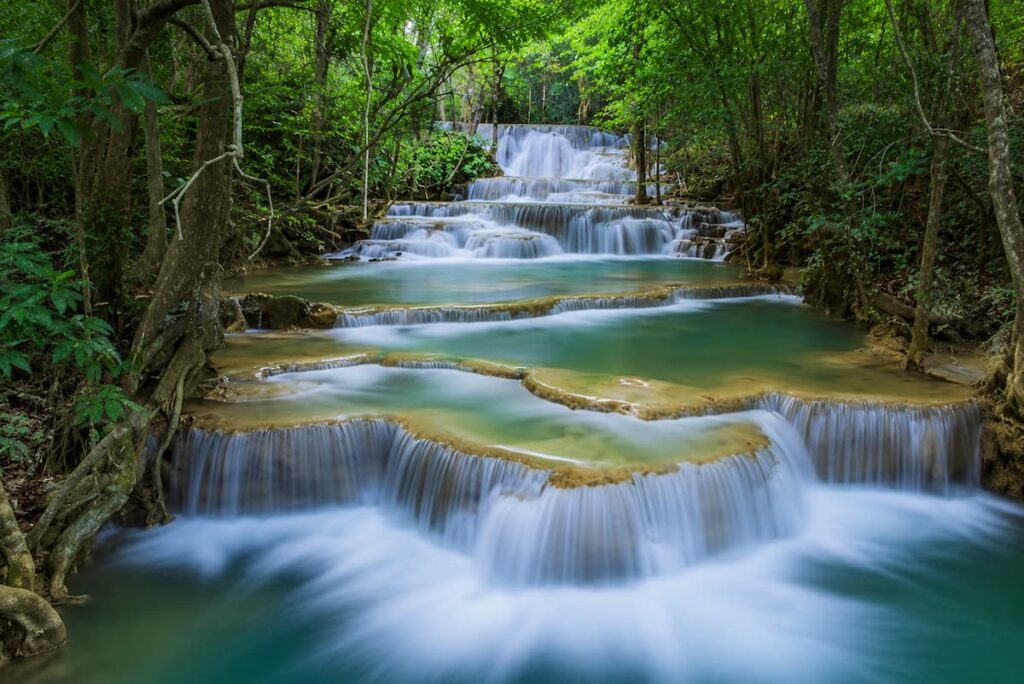
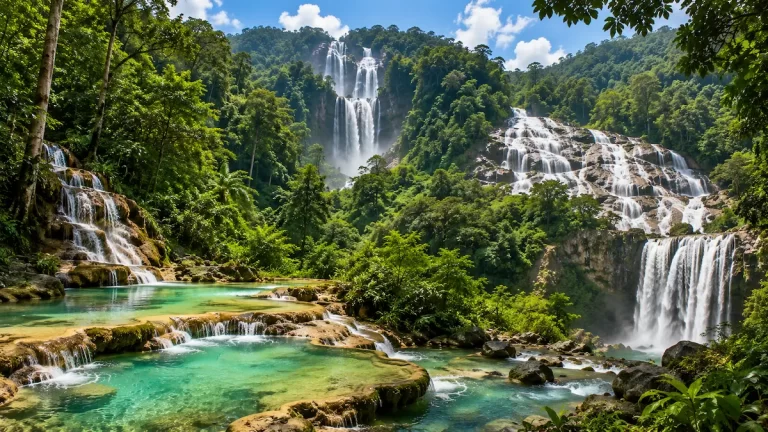
Erawan Waterfall offers a striking natural contrast to Kanchanaburi’s wartime landmarks. Located within Erawan National Park, approximately 65 kilometres from Kanchanaburi town, the waterfall descends through seven limestone levels surrounded by forest, turquoise pools and smooth rock formations.
The lower levels are relatively easy to reach and attract most visitors, particularly those who want to swim or relax beside the water. As the trail climbs, it becomes steeper, rougher and quieter. Reaching the seventh level requires considerably more effort than photographs of the lower pools might suggest, but it provides a fuller experience of the waterfall and surrounding forest.
Each level has a different character. Some contain broad pools suitable for swimming, while others feature narrow cascades, overhanging limestone or water flowing across rounded rock. The colour and strength of the waterfall vary with rainfall, recent weather and seasonal water levels, so visitors should not expect precisely the same conditions throughout the year.
Comfortable footwear with good grip is more suitable than beach sandals, particularly for anyone planning to continue beyond the lower levels. Paths and rocks can become slippery, and the combination of humidity, climbing and strong midday heat makes the ascent more demanding. Carry drinking water, travel light and allow enough time to descend before the upper trail closes.
Swimming is part of Erawan’s appeal, but conditions and access rules may change following heavy rain or when park authorities consider particular pools unsafe. Fish live within many of the pools and may nibble at exposed skin, which some visitors find amusing and others distinctly uncomfortable. Food restrictions around the upper levels help protect the water and reduce litter, so visitors should follow park instructions and carry everything back out.
Erawan can technically be combined with the Bridge over the River Khwae during a long day from Bangkok, but this usually creates a rushed experience dominated by road travel. Staying in Kanchanaburi allows an earlier start and makes it easier to enjoy the waterfall before the largest tour groups arrive. It also leaves the Death Railway sites for a separate day, when their history can be considered properly.
Temporary closures can occur because of flooding, storms, wildfire, poor air quality or other safety concerns. Check current national park announcements before making the journey, especially during periods of unsettled weather.
Best for: Waterfalls, swimming, forest scenery and active travellers.
Allow: At least three to five hours inside the national park.
Best time: Early morning, before the strongest heat and largest crowds.
Consider if: You are comfortable with slippery paths, climbing and changing natural conditions.
5. Wat Arun, Bangkok
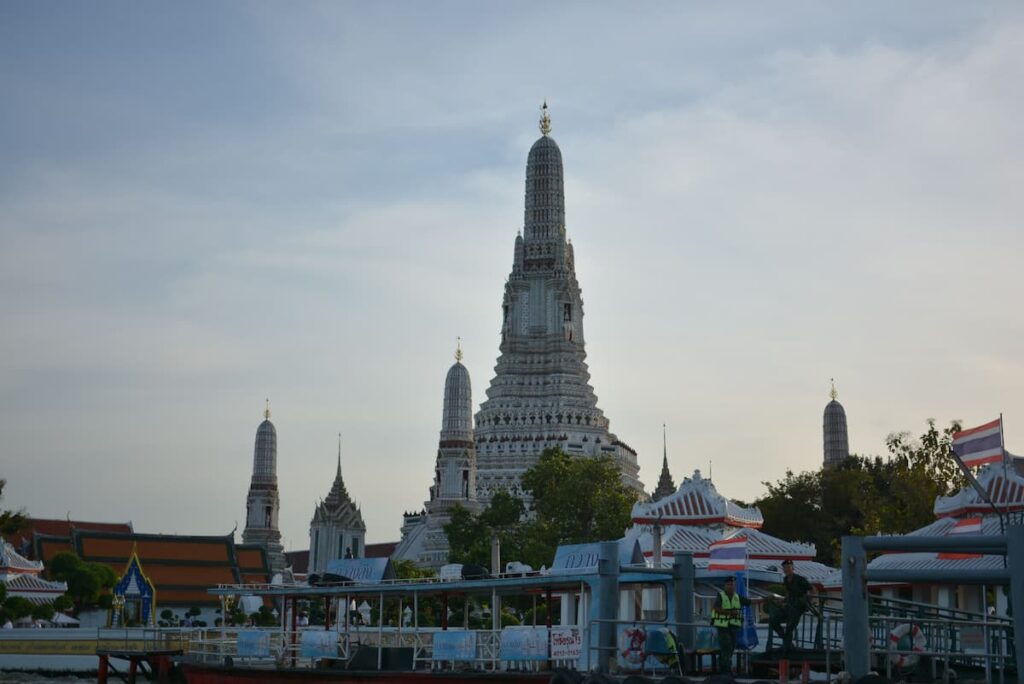
Wat Arun rises beside the Chao Phraya River as one of Bangkok’s most recognisable landmarks. Often called the Temple of Dawn, the temple is dominated by a central prang surrounded by four smaller towers, creating a distinctive silhouette that can be seen from boats and the opposite riverbank.
Although a temple has occupied the site since before Bangkok became Thailand’s capital, much of Wat Arun’s present appearance developed during the early Rattanakosin period. Its central prang is decorated with intricate floral patterns assembled from coloured porcelain and ceramic fragments. From across the river, these details blend into a pale textured surface; seen close up, the scale and precision of the decoration become much more apparent.
Visitors can explore the courtyard and climb partway up the central prang using steep exterior steps. The elevated terraces provide views across the river towards Wat Pho, the Grand Palace area and the rooftops of old Bangkok. The steps are narrow and demanding, particularly when descending, so visitors with limited mobility or discomfort with heights can still enjoy the temple without climbing.
Despite its English name, Wat Arun is not necessarily best experienced at dawn, when the compound may not yet be open. Early morning offers cooler conditions and fewer visitors, while late afternoon brings warmer light across the temple. One of the most memorable views comes from the Tha Tien side of the river, where the prang can be seen across the water as the light changes towards sunset.
Wat Arun is easily combined with Wat Pho using the short cross-river ferry. The Grand Palace is also nearby, but attempting to explore all three major sites in a tightly scheduled morning can reduce each to a hurried photographic stop. Allowing most of a day creates time for the ferry crossings, temple interiors, riverside surroundings and breaks from the heat.
Wat Arun remains an active Buddhist temple rather than only a sightseeing attraction. Visitors should cover their shoulders and knees, speak quietly around worshippers and avoid climbing or sitting on structures not designated for public access. The temple’s popularity for rented traditional Thai clothing can produce beautiful photographs, but respectful behaviour remains more important than creating the image.
Best for: Riverside architecture, temple details, photography and first-time visits to Bangkok.
Allow: Approximately one to two hours.
Best time: Early morning for cooler conditions or late afternoon for attractive light.
Consider if: You want to climb the prang, as the steps are steep and narrow.
6. Maeklong Railway Market, Samut Songkhram
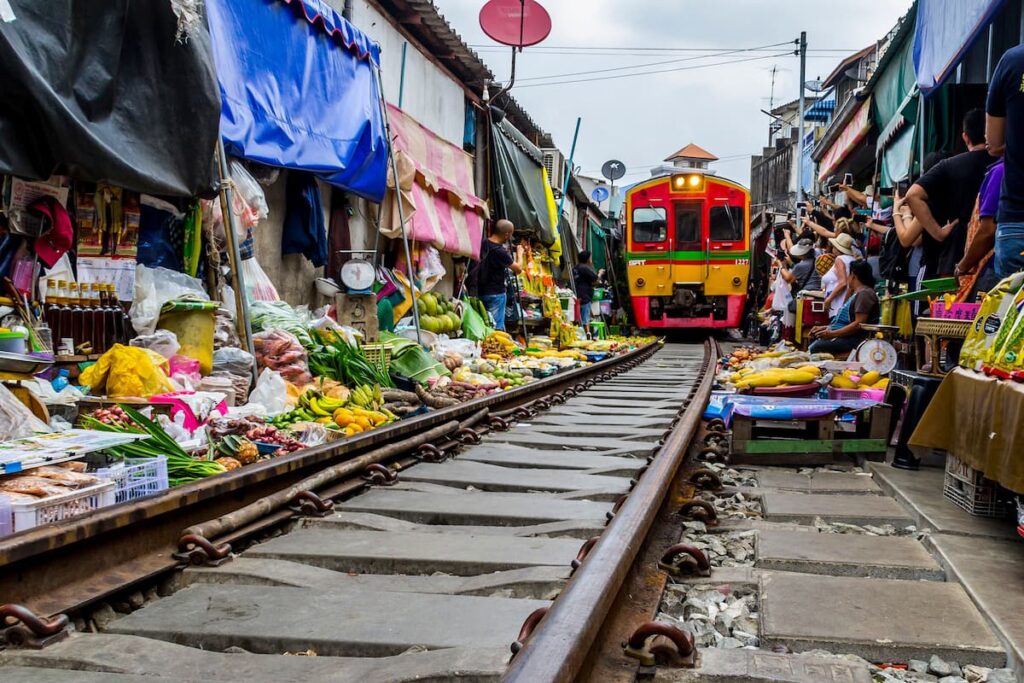
Maeklong Railway Market is one of Central Thailand’s most unusual working attractions. Known locally as Talat Rom Hup, or the Umbrella-Folding Market, it occupies a narrow section of railway beside Mae Klong Station, with vendors displaying fresh seafood, fruit, vegetables and other goods immediately alongside the tracks.
For most of the day, the railway resembles an ordinary market lane covered by low awnings. Shortly before a train arrives, vendors retract their canopies and pull baskets away from the rails. The train then passes slowly between the stalls, sometimes only a short distance from waiting visitors. Once it has cleared the market, the awnings unfold and business resumes within minutes.
The train’s arrival is the obvious highlight, but the market is more interesting when treated as more than a staged photographic event. It remains a place where local people buy food and everyday products, although tourism has substantially changed the atmosphere around the railway. Walking beyond the busiest section reveals more of the working market and provides a better sense of its role within Mae Klong.
Timing is essential because trains pass through only at scheduled intervals. Arriving without checking the current timetable may mean waiting several hours or missing the event entirely. Visitors should confirm railway times shortly before travelling, then arrive early enough to explore the market and choose a safe viewing position.
Crowds often press towards the tracks when a train approaches. Follow vendors’ instructions, remain completely behind the marked or cleared area and avoid leaning towards the carriages for photographs. The train moves slowly, but the remaining clearance can be extremely narrow. Bags, cameras and loose clothing should be kept close to the body.
Maeklong is frequently combined with Damnoen Saduak Floating Market, which operates most actively in the morning. This creates a convenient sightseeing route, although both attractions can be crowded and heavily tour-oriented. On weekends, Amphawa Floating Market offers an alternative afternoon or evening combination. Travellers interested in a quieter canal community might instead consider Tha Kha, provided its limited operating schedule matches their visit.
Maeklong can be reached independently by road or through an unusually memorable train journey involving local railways and a ferry crossing. Independent travel requires more time and planning, but arriving by train allows visitors to experience the market from both perspectives—first aboard the train and then from beside the tracks.
Best for: Local markets, unusual railway experiences, food photography and day trips from Bangkok.
Allow: Approximately one to two hours once in Mae Klong.
Best time: Planned around a confirmed train arrival or departure.
Consider if: You are comfortable with crowds, narrow spaces and a heavily photographed attraction.
7. Phraya Nakhon Cave, Prachuap Khiri Khan
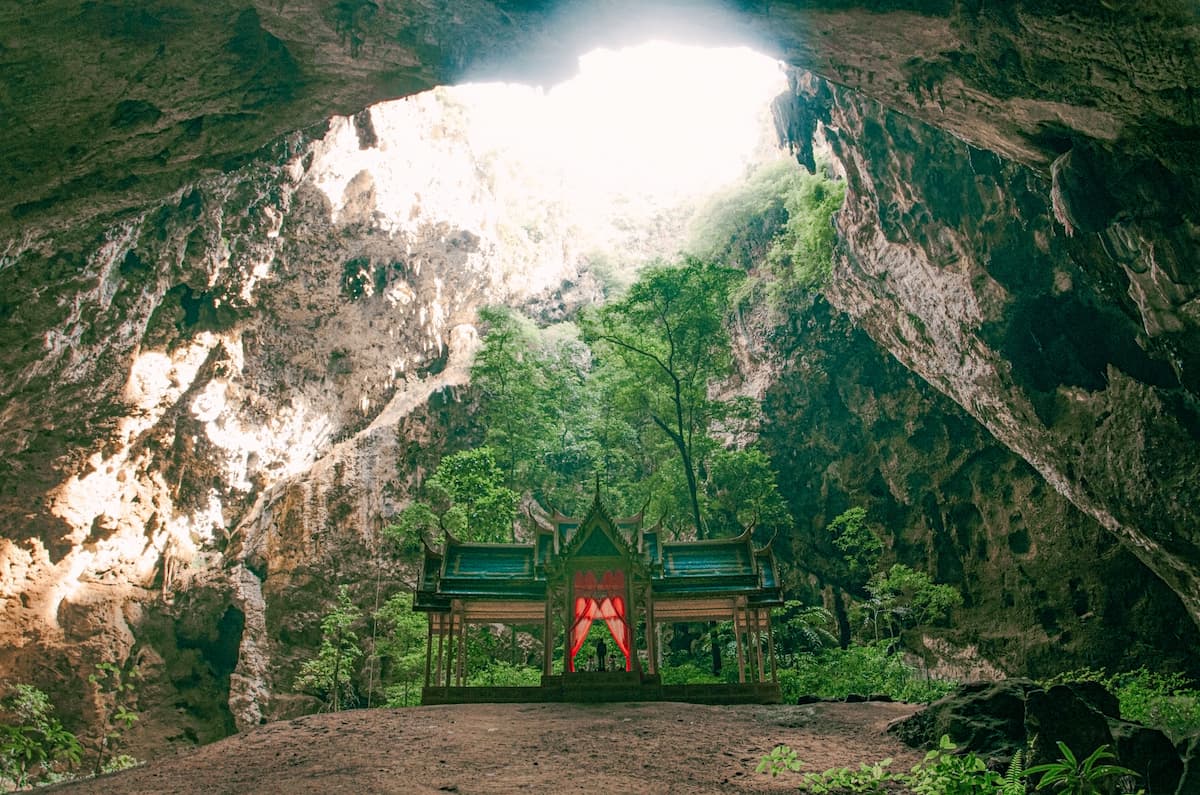
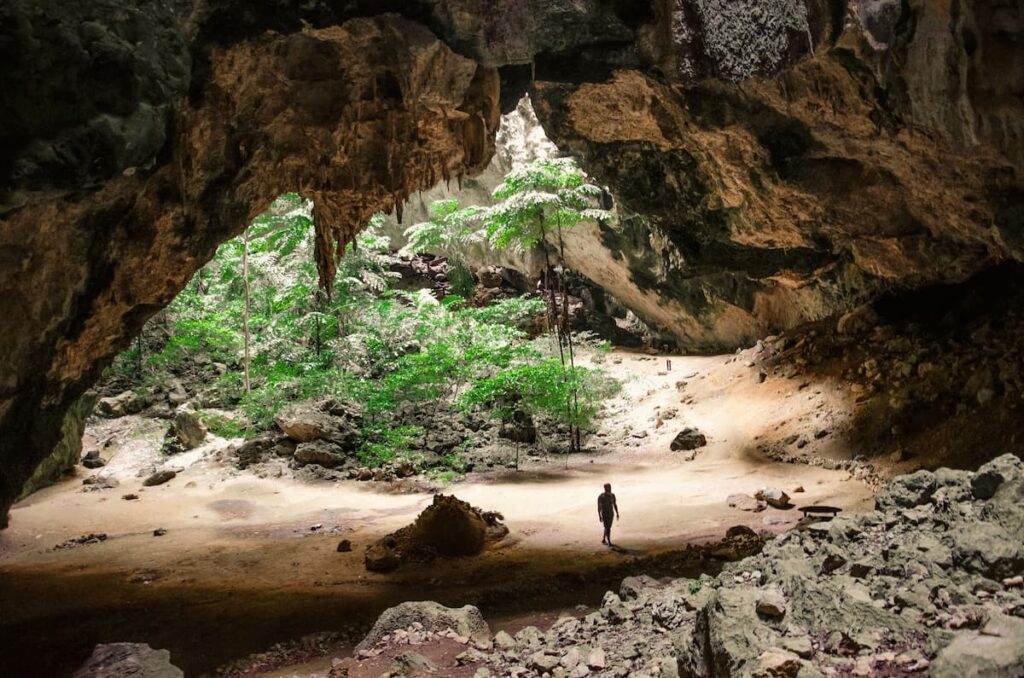
Phraya Nakhon Cave combines coastal scenery, physical adventure and royal history within Khao Sam Roi Yot National Park. Its defining feature is the Kuha Karuhas Pavilion, an elegant royal pavilion standing beneath an opening in the cave roof. When sunlight reaches the chamber, the small structure appears illuminated against the surrounding rock and forest growth.
The experience begins at Bang Pu village, from where visitors must first reach Laem Sala Beach. This can be done by walking over a steep coastal headland or taking a short local boat journey when sea conditions permit. The boat reduces the first section of walking but does not avoid the principal climb to the cave.
From Laem Sala, a steep and uneven trail ascends through the forest before descending into the cave complex. The distance is not especially long, but stone steps, exposed roots, humidity and limited airflow make it physically demanding. Visitors should not interpret the boat option as providing effortless access to the pavilion.
The cave contains two large chambers, both opened to the sky where sections of the roof have collapsed. Vegetation grows beneath these openings, creating an unusual transition between forest and cavern. The Kuha Karuhas Pavilion stands within the second chamber and was constructed for a royal visit during the reign of King Rama V. Its scale is modest, but its isolated position and natural setting make it one of Thailand’s most memorable architectural scenes.
Light conditions influence how the pavilion appears. Sunlight is most likely to fall into the chamber during the late morning, although the precise angle varies by season and weather. Arriving early enough to complete the climb before the strongest heat is generally more important than trying to reproduce a particular photograph seen online.
Wear supportive footwear, carry sufficient water and allow time for rests during both the ascent and return journey. The climb may be unsuitable for travellers with limited mobility, significant knee problems or difficulty exercising in humid conditions. Rain can make the rocks and steps particularly slippery, while rough seas may prevent boats from operating.
Phraya Nakhon Cave is sometimes promoted as an easy excursion from Hua Hin, but the road journey, boat arrangements and hike require most of a day when approached at a relaxed pace. Staying around Sam Roi Yot or Pranburi makes an early start easier and allows more time to enjoy Laem Sala Beach and the surrounding national park.
Best for: Active travellers, cave landscapes, photography and unusual historical settings.
Allow: Approximately four to six hours including access, walking and time inside the cave.
Best time: Morning, before the strongest heat and with a chance of sunlight reaching the pavilion.
Consider if: You are comfortable with a steep, humid climb over uneven terrain.
Eight More Remarkable Attractions in Central Thailand
The following attractions may not require the same depth of coverage, but they should not be considered second-rate alternatives. Some will be more rewarding than the principal seven for travellers with particular interests, while others fit naturally into journeys through Bangkok, Ayutthaya and the provinces surrounding the capital.
Wat Pho, Bangkok
Located immediately south of the Grand Palace, Wat Pho is best known for its enormous Reclining Buddha, which extends for 46 metres through one of the temple’s principal halls. The figure’s gilded surface, peaceful expression and intricately decorated feet make it impressive, but the surrounding complex deserves more attention than many short visits allow.
Wat Pho contains numerous chedi, courtyards, Buddha images and inscriptions associated with traditional knowledge. It is also regarded as an important centre for Thai massage and traditional medicine. Its proximity to the Grand Palace and the ferry to Wat Arun makes it easy to include in a cultural day, although allowing at least an hour provides a much better experience than visiting only the Reclining Buddha.
Bang Pa-In Royal Palace, Ayutthaya
Bang Pa-In Royal Palace offers a very different experience from Ayutthaya’s ruined temples. Set within landscaped gardens beside the Chao Phraya River, the complex contains Thai, Chinese and European-influenced buildings developed across different periods of royal use. Its most recognisable structure is the elegant Aisawan Thiphya-Art pavilion, which appears to float in the middle of an ornamental pond.
The palace is often included on journeys between Bangkok and Ayutthaya Historical Park, but attempting both within a rushed half-day leaves little time for either. It is best suited to travellers interested in royal architecture, formal gardens and the transition from Ayutthaya-era history to the later Chakri period. Visitors must follow palace dress requirements, and golf carts may be available for those who prefer not to walk around the extensive grounds.
Damnoen Saduak Floating Market, Ratchaburi
Damnoen Saduak is Thailand’s most internationally recognised floating market, known for narrow canals filled with boats carrying fruit, food and colourful produce. The market is most active in the morning, when visitors can explore the canals by boat and see vendors operating from both the water and the surrounding walkways.
Its fame has also made Damnoen Saduak highly commercial and heavily oriented towards tour groups. Prices can be higher than at ordinary markets, and parts of the experience may feel created for visitors rather than local trade. It remains visually memorable and culturally interesting when approached with realistic expectations, but travellers seeking a quieter community atmosphere may prefer Tha Kha or an overnight stay around Amphawa.
Amphawa Floating Market, Samut Songkhram
Amphawa offers a different rhythm from the morning activity of Damnoen Saduak. The market develops along a canal lined with old wooden buildings, where shops, restaurants and boat vendors sell seafood, snacks, drinks and Thai desserts. It is particularly atmospheric from late afternoon into the evening as the waterfront lights begin to reflect across the canal.
The market generally operates on weekends and public holidays and can become extremely crowded, particularly on Saturday evenings. It feels more connected to its surrounding community than some purpose-built visitor markets, but it is no longer an undiscovered local experience. Staying overnight allows visitors to enjoy the quieter canal area before and after the day-trip crowds and makes it easier to combine Amphawa with Maeklong Railway Market or nearby cultural sites.
Phra Nakhon Khiri Historical Park, Phetchaburi
Phra Nakhon Khiri Historical Park occupies three connected hilltops overlooking Phetchaburi. Known locally as Khao Wang, the complex was commissioned by King Rama IV and combines a former royal palace with temples, ceremonial buildings, observatories and a prominent white chedi. Its architecture blends Thai, Chinese and European influences, reflecting the changing outlook of nineteenth-century Siam.
Visitors can reach the upper complex by funicular or climb the hill on foot before exploring the buildings and elevated viewpoints. The park receives fewer international visitors than Bangkok’s royal landmarks and offers a rewarding introduction to Phetchaburi’s history. Monkeys are common around the hill and can grab food, drinks or loose belongings, so everything should be secured before entering the park.
Phra Pathom Chedi, Nakhon Pathom
Phra Pathom Chedi rises prominently above the centre of Nakhon Pathom and is one of Thailand’s most significant Buddhist monuments. Its immense bell-shaped chedi reaches approximately 120 metres and can be seen from across the city. The present structure was largely developed during the nineteenth century around the remains of a much earlier monument associated with the Dvaravati period.
Visitors can walk through the surrounding cloisters, view collections of Buddha images and observe local worship away from Bangkok’s busiest temple circuit. The adjacent museum provides additional historical context when open, while the surrounding streets become known for their food stalls later in the day. Phra Pathom Chedi is particularly worthwhile for travellers interested in the early history of Buddhism in Central Thailand.
Phra Prang Sam Yot, Lopburi
Phra Prang Sam Yot is Lopburi’s most recognisable historical monument. Its three connected stone towers were constructed during the period of Khmer influence over the region and originally formed part of a Hindu sanctuary before later Buddhist adaptations. The monument provides an important reminder that Lopburi’s history extends far beyond its modern association with monkeys.
Long-tailed macaques frequently gather around the monument and neighbouring streets, creating an unusual but sometimes challenging visitor experience. They may pull at bags, glasses, phones or anything resembling food, so loose possessions should be secured before approaching the site. Visitors uncomfortable around assertive animals may prefer viewing the monument from a short distance or checking current conditions locally before entering.
Mon Bridge, Sangkhlaburi
Mon Bridge crosses the water between Sangkhlaburi town and the Mon community of Wang Kha in northwestern Kanchanaburi. The long wooden structure is especially atmospheric around sunrise, when mist sometimes settles over the surrounding hills and local residents cross between the two sides. Walking over the bridge offers views across the reservoir, traditional houses and boats below.
Its remote location makes Mon Bridge unsuitable as a quick addition to a conventional Kanchanaburi day trip. Sangkhlaburi is best approached as an overnight destination, allowing time to experience the bridge beyond its busiest photographic periods and explore the surrounding Thai, Mon and Karen cultural landscape. Visitors should treat morning alms-giving and community life respectfully rather than approaching them as staged tourist performances.
How to Choose the Right Central Thailand Attractions
The most famous attraction is not automatically the right choice for every traveller. Consider what you want to understand or experience, how much walking you are comfortable with and whether you prefer an easy day in Bangkok or a longer journey into the surrounding provinces.
| If you are most interested in… | Prioritise |
|---|---|
| Thailand’s royal history | Grand Palace, Wat Phra Kaew and Bang Pa-In Royal Palace |
| Ancient cities and temple ruins | Ayutthaya Historical Park and Phra Prang Sam Yot |
| Second World War history | Death Railway sites and Hellfire Pass |
| Buddhist art and architecture | Wat Phra Kaew, Wat Arun, Wat Pho and Phra Pathom Chedi |
| Waterfalls and swimming | Erawan Waterfall |
| Scenic walking and adventure | Phraya Nakhon Cave |
| Markets and everyday culture | Maeklong Railway Market, Amphawa and Damnoen Saduak |
| Photography | Ayutthaya, Wat Arun, Maeklong and Phraya Nakhon Cave |
| Less-visited historical landmarks | Phra Nakhon Khiri and Phra Pathom Chedi |
| Slow travel and community atmosphere | Sangkhlaburi and Mon Bridge |
| Easy sightseeing within Bangkok | Grand Palace, Wat Pho and Wat Arun |
| A straightforward day trip from Bangkok | Ayutthaya or the Maeklong and floating-market area |
Travellers with only one free day outside Bangkok should usually choose a single geographical area. Ayutthaya provides the strongest introduction to ancient Siam, Kanchanaburi combines difficult history with beautiful scenery, and Samut Songkhram offers markets and canal culture. Trying to combine attractions from different directions generally creates more time in traffic than at the places you travelled to see.
Can You Visit These Attractions from Bangkok?
Bangkok is the main transport hub for Central Thailand, and several major attractions can be reached on organised or independent day trips. However, the fact that a journey is technically possible within one day does not necessarily make it enjoyable. Traffic, train schedules and onward travel from provincial centres can turn apparently short distances into long excursions.
Attractions Within Bangkok
The Grand Palace, Wat Phra Kaew, Wat Pho and Wat Arun are all located around Bangkok’s historic riverside district. They can be combined without a vehicle using walking routes and the cross-river ferry.
Visiting all four is possible within one day, but it involves considerable walking and sustained exposure to the heat. A more relaxed approach is to prioritise the Grand Palace and one or two temples, leaving time for lunch, ferry journeys and the surrounding riverside neighbourhoods.
Comfortable Day Trips from Bangkok
Ayutthaya Historical Park is one of the most straightforward choices, with road and rail connections from Bangkok. Bang Pa-In Royal Palace can be added to a full-day itinerary, although doing so reduces the number of Ayutthaya temples that can be explored properly.
Maeklong Railway Market, Damnoen Saduak and Amphawa can also be reached within a day. Maeklong and Damnoen Saduak work naturally as a morning combination, while Amphawa is better suited to a weekend afternoon or evening. Phra Pathom Chedi provides a less demanding alternative west of Bangkok and can be visited by road or train.
Possible but Demanding Day Trips
Kanchanaburi town can be visited from Bangkok in a day, particularly if the objective is to see the bridge, war cemetery and railway museum. Including Erawan Waterfall creates a much longer outing, while attempting to add Hellfire Pass usually sacrifices the time required to understand the historical sites properly.
Phra Nakhon Khiri in Phetchaburi is also reachable from Bangkok, but the journey becomes more rewarding when incorporated into a broader Phetchaburi or western Gulf itinerary.
Better With an Overnight Stay
Hellfire Pass, Erawan Waterfall and the wider Death Railway are best experienced while staying in Kanchanaburi. Separating the historical sites from the waterfall prevents two very different experiences from being compressed into one rushed day.
Phraya Nakhon Cave is better approached from Hua Hin, Pranburi or Sam Roi Yot because reaching the trailhead is only the beginning of the excursion. Sangkhlaburi requires an even longer journey and deserves at least one or two nights rather than an exhausting return trip from Bangkok.
Choosing accommodation close to the more distant attractions provides more than convenience. It allows earlier starts, cooler walking conditions and time to experience each place after the largest Bangkok-based tour groups have departed.
How Many Central Thailand Attractions Should You Visit?
The right number depends on how many days you have, where you are staying and whether attractions are located within the same area. Visiting three neighbouring temples in Bangkok is very different from trying to combine Ayutthaya, Kanchanaburi and a floating market.
One Day in Bangkok
Choose the Grand Palace and one or two nearby temples. Wat Pho and Wat Arun combine particularly well because they are connected by a short ferry journey. Trying to add a distant day trip on the same day leaves too little time for Bangkok’s historic district.
One Day Beyond Bangkok
Select one geographical area:
- Ayutthaya for ancient history and temple ruins
- Kanchanaburi town for Second World War history
- Maeklong and a floating market for local commerce and canal culture
- Nakhon Pathom for a shorter and less demanding cultural excursion
One well-planned day trip is usually more rewarding than a tour attempting to cross several provinces.
Three to Five Days
This allows time for Bangkok’s principal landmarks followed by Ayutthaya and either Kanchanaburi or the market communities southwest of the capital. Travellers interested in nature can stay in Kanchanaburi and give Erawan Waterfall a separate day from the Death Railway sites.
One Week or Longer
A longer journey can combine Bangkok, Ayutthaya and Kanchanaburi before continuing towards Phetchaburi, Hua Hin or Sam Roi Yot. Alternatively, travellers seeking a slower and less conventional experience can devote several days to western Kanchanaburi and Sangkhlaburi.
There is no advantage in visiting all 15 attractions simply because they appear in the same guide. Central Thailand covers a substantial area, and its most meaningful experiences often require time for historical context, local journeys and unplanned moments between the major landmarks. Choose the places that most closely match your interests and experience them without turning the journey into a race.
Planning Your Visits
Central Thailand’s major attractions include active temples, royal properties, national parks, markets and historical sites. Their schedules, physical conditions and visitor requirements differ considerably, so a small amount of preparation can prevent lost time and uncomfortable surprises.
Start Early
Early starts provide cooler conditions and usually reduce the time spent among large tour groups. This is particularly valuable at the Grand Palace, Ayutthaya, Erawan Waterfall and Phraya Nakhon Cave, where heat and exposed walking can become demanding by late morning.
Markets require more specific timing. Maeklong must be planned around confirmed train movements, Damnoen Saduak is most active in the morning, and Amphawa develops later in the day and primarily operates on weekends and public holidays.
Check Current Opening Days and Conditions
Opening hours and admission arrangements can change for royal ceremonies, religious events, maintenance or public holidays. Museums may close on particular weekdays even when their surrounding temples remain open.
National parks and natural attractions are more dependent on conditions. Heavy rain, flooding, storms, wildfire or poor air quality can restrict access to waterfalls, caves and walking trails. Check official information as close to your visit as possible rather than relying entirely on an older itinerary or travel article.
Dress Appropriately for Temples and Royal Sites
Visitors should cover their shoulders and knees when entering temples, the Grand Palace and Bang Pa-In Royal Palace. Clothing should be respectful rather than merely designed to pass an entrance inspection. Lightweight, breathable garments make the requirements easier to manage in Thailand’s heat.
Shoes must frequently be removed before entering temple buildings. Footwear that is comfortable for walking but easy to remove is therefore more practical than complicated boots or tightly fastened shoes.
Prepare for Heat and Walking
The Grand Palace, Ayutthaya and Bang Pa-In involve more walking than their individual buildings suggest. Erawan and Phraya Nakhon add steep, uneven or slippery trails. Carry water, use sun protection and allow regular breaks rather than planning every hour around continuous sightseeing.
Supportive footwear is especially important at waterfalls, caves and historical ruins. Smooth temple surfaces, worn stone steps and wet limestone can all become slippery.
Avoid Overloading a Day Trip
Attractions that appear close on a map may require long road transfers or indirect public transport. Ayutthaya, Kanchanaburi and Samut Songkhram should generally be treated as separate excursions from Bangkok.
Be cautious with itineraries promising Ayutthaya, a floating market and several Bangkok temples within one day. Such tours may reach every location, but much of the experience will consist of vehicles, queues and hurried photographs.
Use Guides Where Context Matters
A guide is not essential everywhere, but good interpretation can substantially improve the Grand Palace, Ayutthaya and the Death Railway sites. These places contain layers of history and symbolism that are easily missed when visitors move between buildings without explanation.
At natural attractions, local guides or park staff can provide current information about trail conditions and access. The value lies in knowledge and interpretation rather than simply having someone lead the route.
Carry Cash and Confirm Transport
Smaller attractions, local ferries, market vendors and some transport services may require cash. Carry smaller denominations rather than relying entirely on cards or large banknotes.
Confirm how you will leave an attraction before arriving, particularly around Hellfire Pass, Erawan, Sam Roi Yot and Sangkhlaburi. Ride-hailing coverage and public transport can be limited outside urban areas, and a vehicle available in one direction may not be easy to find for the return journey.
A Travel With Insight Perspective
Central Thailand’s most famous attractions can easily become items on a sightseeing checklist. The Grand Palace, Ayutthaya and the Bridge over the River Khwae are so familiar from guidebooks and photographs that arriving, taking the expected picture and moving quickly to the next stop can feel like the natural way to experience them.
Their real value often emerges when you allow enough time to understand what you are seeing. Ayutthaya is more than a collection of photogenic ruins; it was the centre of a kingdom whose influence can still be traced through Thailand’s architecture, religion and national identity. The Death Railway is not simply a bridge made famous by a film, but an extensive landscape shaped by forced labour, suffering and loss. Bangkok’s royal temples become more meaningful when viewed as part of the transition from the former capital to the modern city.
The quieter details can be equally revealing. Watching vendors restore Maeklong Railway Market within moments of a train passing demonstrates how ordinary commerce adapts around an extraordinary setting. Crossing the Chao Phraya by local ferry places Wat Arun within the daily movement of Bangkok rather than isolating it as a monument. Climbing towards Phraya Nakhon Cave makes the effort, heat and changing landscape part of the experience rather than an inconvenience before reaching the pavilion.
You do not need to visit every attraction in this guide to understand Central Thailand. Choosing fewer places, learning something about them beforehand and leaving room to absorb their surroundings will usually create a deeper and more memorable journey than rushing between the region’s most famous photographs.
Frequently Asked Questions
What is the most famous attraction in Central Thailand?
The Grand Palace and Wat Phra Kaew are arguably Central Thailand’s most famous attractions and are essential for many first-time visitors to Bangkok. Ayutthaya Historical Park, Wat Arun, the Bridge over the River Khwae and Damnoen Saduak Floating Market are also internationally recognised.
Is Ayutthaya worth visiting from Bangkok?
Yes. Ayutthaya is one of the most rewarding day trips from Bangkok, particularly for travellers interested in history, temples and photography. Allow a full day and concentrate on four or five significant sites rather than attempting to visit every temple. Staying overnight provides cooler conditions and a quieter atmosphere.
Can you visit Erawan Waterfall and the Bridge over the River Khwae in one day?
It is possible with private transport or an organised tour, but the day will involve considerable travel and limited time at each attraction. A better approach is to stay in Kanchanaburi and visit the Death Railway sites and Erawan Waterfall on separate days.
Which Central Thailand attractions are best for families?
Wat Arun, Maeklong Railway Market, Ayutthaya and the lower levels of Erawan Waterfall can suit families, depending on the children’s ages and interests. Consider heat, walking distances and water safety when planning. The climb to Phraya Nakhon Cave may be too demanding for younger children.
Which floating market should you visit?
Choose Damnoen Saduak for the iconic morning scene of vendors and boats, Amphawa for weekend food and evening atmosphere, or Tha Kha for a smaller and more locally focused experience. Maeklong is not a floating market but combines naturally with the canal markets of Samut Songkhram and Ratchaburi.
What should you wear when visiting temples and royal palaces?
Wear clothing that covers the shoulders and knees. Avoid transparent garments, very tight clothing and anything displaying disrespectful images or wording. Shoes are removed before entering certain temple buildings, so comfortable footwear that is easy to take off is useful.
How many days do you need for Central Thailand?
Three to five days allows time for Bangkok’s main landmarks and one or two excursions, such as Ayutthaya or Kanchanaburi. A week or longer is better for combining Bangkok with Ayutthaya, Kanchanaburi and the western Gulf provinces without rushing.
Are Central Thailand’s major attractions open throughout the year?
Most cultural attractions operate throughout the year, although closures can occur for royal ceremonies, religious events, maintenance and public holidays. Natural sites may close temporarily because of flooding, storms, wildfire or unsafe trail conditions. Floating markets also have different operating days, so always check current information before travelling.
Continue Exploring Central Thailand
Central Thailand’s attractions are only one part of the region’s appeal. Use our broader destination guides to decide where to stay, understand how the different provinces fit together and build an itinerary that balances major landmarks with food, culture and time to explore.
Thailand Travel Guide
Discover Thailand’s regions, destinations and different holiday experiences to begin planning a journey that matches your interests and preferred pace.
Central Thailand Travel Guide
Explore Bangkok, Ayutthaya, Kanchanaburi and the central plains, with guidance on the region’s history, culture, landscapes and practical travel considerations.
Where to Go in Central Thailand
Compare the region’s leading destinations and discover whether Bangkok, Ayutthaya, Kanchanaburi or one of Central Thailand’s less-visited provinces is right for your journey.
Related Reading
- Historical Places in Thailand
Explore ancient capitals, archaeological sites, wartime landmarks and other places that reveal the different periods of Thailand’s history. - Best Temples in Central Thailand
Discover royal temples, ancient religious sites and important Buddhist landmarks across Bangkok and the central provinces. - Best National Parks in Thailand
Compare waterfalls, caves, wildlife, mountains and marine landscapes to find a national park suited to your interests. - Floating Markets in Thailand
Understand the differences between Thailand’s famous floating markets and choose an experience that matches your expectations.
About the Author
David Hibbins is a travel publisher, destination researcher and the creator of Travel With Insight.
Through years of travel, tourism and publishing projects across Southeast Asia, he has developed a particular interest in how travellers research destinations, compare experiences and make travel decisions.
His work focuses on helping travellers move beyond popularity rankings, marketing claims and generic “best of” lists by providing balanced, research-driven destination guides. Rather than telling people where they should travel, his goal is to help readers understand the strengths, limitations and unique character of each destination so they can choose the places that best match their own interests, travel style and goals.
As the creator of Travel With Insight, David researches destinations throughout Southeast Asia, exploring not only where travellers go, but why they choose certain places, how destinations differ and what creates genuinely memorable travel experiences.
His work covers destination research, regional travel planning, traveller behaviour and the decision-making frameworks that help people plan more rewarding journeys.
Explore More Travel Resources
Every great journey begins with informed decisions. The more you understand a destination before you arrive, the more rewarding your travel experience becomes.
Whether you’re still researching Southern Thailand or you’re ready to start planning your itinerary, these additional resources can help.
Travel With Insight
Continue exploring our in-depth destination guides, travel inspiration and practical planning advice designed to help you make informed travel decisions throughout Thailand and Southeast Asia.
Go Find Asia
Looking for even more travel inspiration? Go Find Asia explores destinations, experiences and travel ideas across Asia, helping you discover where to go, what to see and how to plan your next adventure.
Resurgence Travel
When you’re ready to turn your research into reality, Resurgence Travel offers curated itineraries, personalised travel planning and local expertise to help you experience the very best of Thailand and Southeast Asia.
2 Comments
Comments are closed.