Historical Places in Central Thailand
Central Thailand’s history extends far beyond the familiar temple ruins of Ayutthaya. Across the region, ancient settlements, former capitals, royal palaces and wartime landscapes reveal how different cultures, kingdoms and international influences helped shape the country we recognise today.
This is not simply a list of the region’s oldest or most photographed landmarks. We have selected seven historical places that represent different periods and turning points—from the early Dvaravati culture and Khmer influence to the rise of Ayutthaya, the establishment of Bangkok and the human cost of the Second World War.
Some are extensive historical landscapes requiring a full day or longer. Others are compact archaeological parks or museums that can be explored in a few hours. Their value also differs. Ayutthaya impresses through the scale of its ruined capital, while U Thong relies more heavily on archaeology and museum interpretation. Lopburi brings several historical periods together within one town, and Hellfire Pass offers a much more recent and sobering experience.
Having spent time in Ayutthaya on several visits, I have found the city most rewarding when approached slowly. A sunset dinner beside the river and time exploring beyond the most frequently photographed ruins helped me appreciate it as a former international capital rather than simply another collection of temples.
The same principle applies throughout this guide. You do not need to visit all seven places to understand Central Thailand’s history. Choosing two or three that represent different periods can create a more meaningful journey—and reveal how the region developed from early trading settlements into the political and historical centre of modern Thailand.
Quick Summary: Historical Places in Central Thailand
These seven places have been arranged broadly by historical period rather than ranked by popularity. Each reveals a different part of Central Thailand’s development, so the best choice will depend on whether you are most interested in archaeology, former capitals, royal history or more recent events.
| Historical Place | What It Represents | Best For | Suggested Time |
|---|---|---|---|
| U Thong Ancient City | Early settlement and Dvaravati culture | Archaeology and early regional history | 2–3 hours |
| Muang Sing Historical Park | Khmer-period cultural and religious influence | Quiet ruins and lesser-visited history | 1–2 hours |
| Lopburi Old Town | Lavo, Khmer influence and King Narai’s royal centre | Several historical periods in one town | Half to full day |
| Ayutthaya Historical Park | A powerful international Siamese capital | Monumental ruins, museums and river history | Full day or overnight |
| Historic Thonburi and Rattanakosin | The rebuilding of Siam and establishment of Bangkok | Royal, political and urban history | Full day |
| Phra Nakhon Khiri Historical Park | Rama IV, diplomacy and nineteenth-century modernisation | Palace architecture and panoramic views | Around 3 hours |
| Burma–Thailand Railway | Forced labour and the human cost of the Second World War | Wartime history and remembrance | 1–2 days |
Ayutthaya provides the strongest introduction for first-time visitors, but it does not tell the complete story. U Thong and Muang Sing reveal earlier cultural connections, while Lopburi brings several periods together within a compact old town. Historic Bangkok and Phra Nakhon Khiri explain how Siam rebuilt and adapted, and the Burma–Thailand Railway brings the historical journey into the twentieth century.
Understanding the Historical Story of Central Thailand
Central Thailand’s history did not develop through a single uninterrupted kingdom. Its rivers, fertile plains and connections with surrounding regions supported settlements long before Ayutthaya became a powerful capital. Over time, different communities absorbed religious beliefs, artistic traditions and political influences arriving from India, the Khmer world and other parts of Southeast Asia.
Early settlements such as U Thong are associated with Dvaravati culture, which developed across parts of present-day Central Thailand between approximately the sixth and eleventh centuries. Dvaravati is sometimes described as a kingdom, but archaeological evidence more reliably suggests a network of related urban centres sharing religious, artistic and commercial traditions rather than one clearly defined centralised state.
Khmer influence later became visible in places including Lopburi and Muang Sing. This did not mean every community was governed in the same way from Angkor, but surviving architecture, sculpture and religious imagery demonstrate significant cultural and political connections across the region.
Ayutthaya emerged during the fourteenth century and developed into the centre of a powerful Siamese kingdom. Its location beside navigable rivers helped it control regional trade and establish diplomatic relationships extending across Asia, the Middle East and Europe. After the capital was destroyed in 1767, King Taksin established a new centre at Thonburi before Rama I moved the capital across the Chao Phraya and founded Rattanakosin in 1782.
During the nineteenth century, Siam faced increasing pressure from European colonial powers. Royal sites such as Phra Nakhon Khiri reflect how the country responded through diplomacy, reform and the selective adoption of international ideas while retaining its independence.
Central Thailand’s historical landscape also includes more recent and painful events. The Burma–Thailand Railway demonstrates how the region became part of the wider Second World War and preserves the memory of the prisoners of war and Asian civilian labourers forced to construct it.
Together, these places show that Central Thailand was shaped not only by kings and capitals, but also by trade, migration, religion, diplomacy, conflict and cultural exchange.
1. U Thong Ancient City – Before the Rise of Ayutthaya
Location: Suphan Buri Province
Historical period: Prehistoric occupation and Dvaravati culture
Best for: Archaeology and the early history of Central Thailand
Recommended time: 2–3 hours
U Thong provides an important starting point for understanding Central Thailand because its history extends centuries before the foundation of Ayutthaya. Archaeological evidence indicates that communities occupied the area from prehistoric times before it developed into a substantial moated settlement associated with Dvaravati culture.
Between approximately the sixth and eleventh centuries, several urban centres across the central plains shared related forms of Buddhist art, architecture and religious practice. Rather than thinking of Dvaravati as one clearly defined kingdom, it is more useful to understand it as a network of communities connected through culture, trade and belief.
U Thong appears to have been one of those important centres. Archaeological discoveries reveal contact with India and participation in wider regional trading networks. Religious sculpture, coins, beads, pottery and other objects demonstrate that the settlement was not isolated. Ideas and goods were moving through this part of Southeast Asia long before the emergence of the later Thai kingdoms.
The ancient city was surrounded by a moat and defensive earthworks, with religious monuments constructed both inside and beyond its boundaries. Although many surviving structures are now reduced to foundations or low archaeological remains, they help illustrate the scale and organisation of the former settlement.
What You Can See Today
U Thong National Museum is the best place to begin. Its exhibitions follow the area’s development from prehistoric occupation into the Dvaravati period, displaying objects discovered during archaeological surveys and excavations.
The collection includes Buddhist sculptures, religious tablets, jewellery, beads, coins and other evidence of commercial and cultural exchange. These displays provide essential context before exploring the archaeological sites scattered around the wider ancient city.
U Thong does not create the immediate visual impact of Ayutthaya. Visitors will not find a concentrated landscape of towering prangs and monumental ruins. Its importance becomes clearer through the artefacts, maps and interpretation inside the museum.
This makes U Thong especially rewarding for travellers interested in how archaeologists reconstruct the lives of early communities. It also provides a valuable reminder that Central Thailand’s historical development began long before its famous former capitals.
Planning Your Visit
Allow approximately two to three hours for the museum and a selection of nearby archaeological remains. Those with a deeper interest in archaeology may want longer to explore the wider area.
U Thong is easiest to visit by car and works well as part of a journey through Suphan Buri. Public transport is possible, but reaching the archaeological locations outside the museum can be less convenient without private transport.
At the time of writing, U Thong National Museum is generally open from Wednesday to Sunday between 9:00 am and 4:00 pm. It is normally closed on Mondays, Tuesdays and selected public holidays. Admission charges and opening arrangements can change, so confirm them before travelling.
U Thong is not the strongest choice for visitors seeking dramatic photography or grand architecture. Its value lies in interpretation: the museum and archaeological remains reveal an early chapter of Central Thailand that is easily overlooked when the region’s history is allowed to begin with Ayutthaya.
Before visiting, you can explore the U Thong National Museum’s online exhibition, which introduces the ancient city’s development, Dvaravati culture, maritime trade connections and significant archaeological discoveries.
2. Muang Sing Historical Park – Central Thailand’s Khmer Connections
Location: Sai Yok District, Kanchanaburi Province
Historical period: Late twelfth to early thirteenth centuries
Best for: Khmer-period architecture and quieter archaeological sites
Recommended time: 1–2 hours
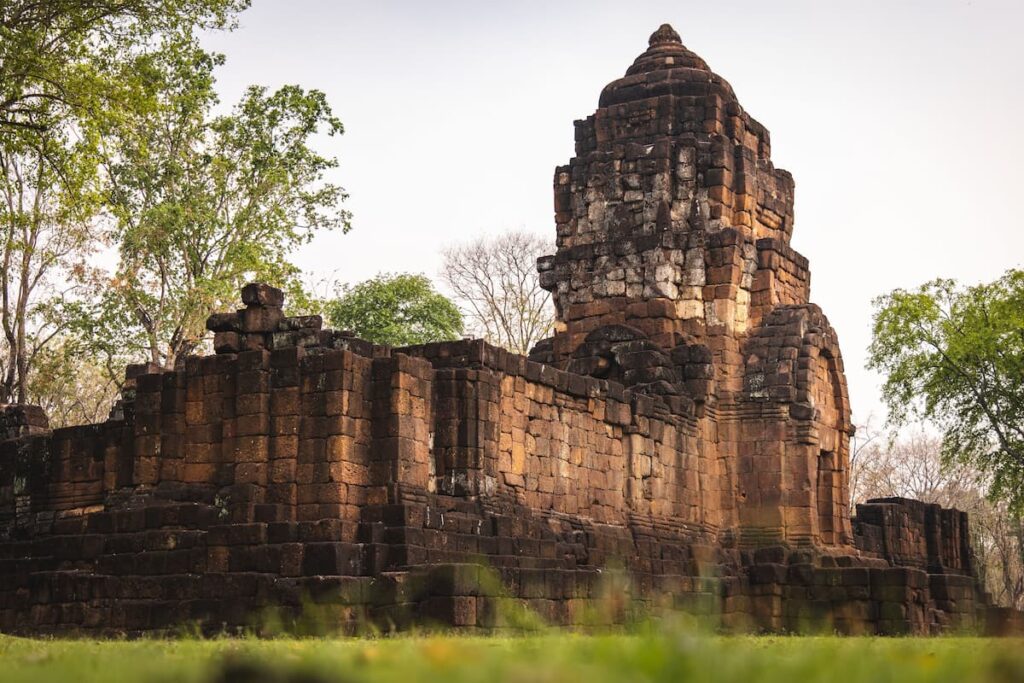
Muang Sing Historical Park introduces a very different part of Central Thailand’s past. Located beside the Khwae Noi River, the ancient settlement contains the westernmost substantial group of Khmer-period monuments found in Thailand.
The surviving architecture and sculptures display characteristics associated with the Bayon style of the late twelfth and early thirteenth centuries. The principal sanctuary was probably constructed during the reign of the Khmer ruler Jayavarman VII, whose building programme extended across parts of mainland Southeast Asia.
Religious objects discovered at Muang Sing include representations of the Buddha, Avalokiteshvara and Prajnaparamita, reflecting the Mahayana Buddhist beliefs associated with Jayavarman VII’s period. These discoveries provide strong evidence of cultural and religious connections with the Khmer world.
However, Muang Sing should not be presented simply as a distant military outpost controlled directly from Angkor. The exact political relationship between the settlement and the Khmer centre remains open to interpretation. What can be said confidently is that its architecture, sculpture and religious traditions demonstrate far-reaching connections across western Thailand.
Its position beside the Khwae Noi River was also significant. Rivers acted as routes for settlement, communication and the movement of goods and ideas. The surrounding walls, moats and monuments indicate that Muang Sing formed part of an organised community rather than consisting of an isolated temple.
What You Can See Today
The historical park occupies a rectangular walled area with several groups of archaeological remains arranged along its central axis. The most complete is Monument No. 1, a laterite sanctuary surrounded by enclosure walls and entered through a formal gateway.
Monument No. 2 retains the foundations and partial structures of another religious complex, while the remaining sites are considerably less complete. Archaeological displays help visitors understand some of the sculptures and objects recovered during excavation.
Prehistoric human remains and burial objects were also discovered outside the ancient city wall. These finds show that people lived in the river valley before the Khmer-period sanctuary was constructed, although the two periods should not be treated as one continuous settlement story without qualification.
The grounds are landscaped and relatively compact, making Muang Sing much easier to explore than Ayutthaya. Its quieter atmosphere also allows visitors to study the laterite construction and layout without the congestion found at Thailand’s more famous historical parks.
Planning Your Visit
Allow one to two hours to walk through the main monument groups and visit the archaeological displays. The site is exposed in places, so an early visit is more comfortable than arriving during the hottest part of the afternoon.
Muang Sing lies outside Kanchanaburi town and is easiest to reach by car. It can be combined with Sai Yok, a journey towards Hellfire Pass or an overnight stay beside the Khwae Noi River. Tha Kilen railway station is nearby, but train schedules and the final connection to the park require advance planning.
The historical park normally opens daily from the morning, but published closing times vary between official and tourism sources. Confirm the current hours before making a late-afternoon visit.
Muang Sing will not occupy an entire day, but that is part of its appeal. It offers a manageable and comparatively peaceful encounter with the cultural connections that reached across Central Thailand centuries before the rise of Ayutthaya.
3. Lopburi Old Town – A City with Several Historical Lives
Location: Lopburi Province
Historical periods: Dvaravati, Lavo, Khmer influence and Ayutthaya
Best for: Experiencing several historical periods within one town
Recommended time: Half to full day
Lopburi is best understood not through one monument, but as a historic town that has repeatedly changed in importance and identity. Its surviving ruins, religious buildings and royal palace reflect cultural influences extending across more than a thousand years.
The city was historically associated with Lavo, an important regional centre that developed before the rise of Ayutthaya. Archaeological discoveries demonstrate connections with Dvaravati culture, while several prominent monuments display Khmer-period architectural and religious influence.
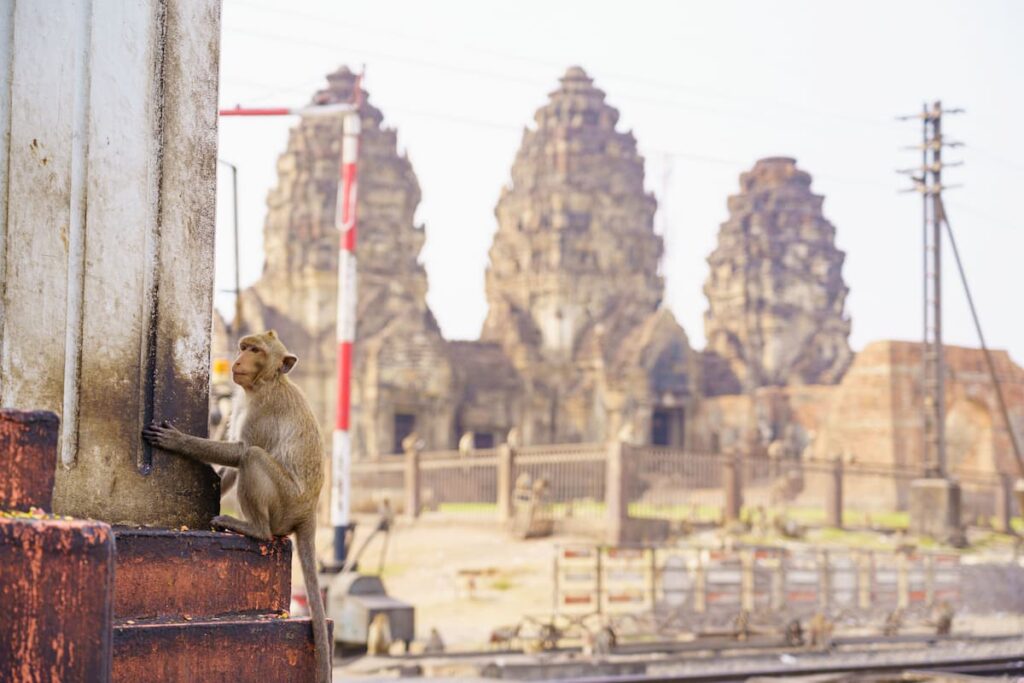
Phra Prang Sam Yot is the most recognisable example. Its three connected laterite towers are associated with the Bayon style and Mahayana Buddhist traditions of the late twelfth or early thirteenth century. A later prayer hall was added after Lopburi became part of the Ayutthaya political world, demonstrating how important structures were adapted as religious practices changed.
Lopburi regained considerable prominence during the reign of King Narai in the seventeenth century. Rather than replacing Ayutthaya as the sole capital, it functioned as a second royal centre where the king spent extended periods.
Phra Narai Ratchaniwet became an important setting for government, royal life and international diplomacy. Foreign ambassadors and advisers arrived during a period when Siam maintained relationships with Persia, France and other regional and European powers.
Ban Wichayen, originally constructed for foreign envoys and later associated with the Greek adviser Constantine Phaulkon, provides surviving evidence of this international presence. Its European-influenced buildings, reception spaces and church remains create a sharp contrast with Lopburi’s earlier Khmer-style monuments.
Following King Narai’s death in 1688, Lopburi’s political importance declined and parts of the palace deteriorated. King Mongkut, Rama IV, later restored sections of the complex and constructed new royal buildings during the nineteenth century, adding another historical layer to the site.
What You Can See Today
The old town’s main historical sites are relatively close together, making Lopburi one of the easiest places in this article to explore on foot.
Phra Prang Sam Yot stands close to Lopburi Railway Station and remains the city’s best-known landmark. Nearby, Wat Phra Si Rattana Mahathat contains structures from several periods and provides a more extensive archaeological landscape.
Phra Narai Ratchaniwet preserves walls, gateways, foundations and restored buildings from the royal complex. Within the grounds, King Narai National Museum displays sculpture, religious art, ceramics and archaeological objects representing Lopburi’s different historical periods.
Ban Wichayen adds the international dimension, while smaller ruins scattered around the old town help connect the principal sites into a broader historical district.
Lopburi’s Changing Monkey Population
Lopburi has long been promoted as Thailand’s “Monkey City,” particularly around Phra Prang Sam Yot and San Phra Kan. However, extensive capture, sterilisation and relocation programmes have reduced the number of macaques roaming parts of the old town.
Visitors may still encounter monkeys, but conditions can differ significantly from older travel photographs and videos. They remain wild animals, so avoid feeding them, secure food and loose belongings, and do not attempt to touch them.
This changing situation is another reason to visit Lopburi for its history rather than treating its monuments as a backdrop for monkey encounters.
Planning Your Visit
A half-day visit is sufficient for the most prominent monuments, but a full day allows time for the palace, museum and lesser-known ruins without rushing.
Lopburi can be reached from Bangkok or Ayutthaya by train, and the railway station is conveniently located beside the old town. Travelling by car provides more flexibility but is not essential for exploring the central historical area.
King Narai National Museum is generally open Wednesday to Sunday from 9:00 am to 4:00 pm and closes on Mondays, Tuesdays and selected public holidays. Other monuments maintain their own opening arrangements and admission charges.
Lopburi’s real strength is the way its different periods remain visible within one compact area. Khmer-influenced towers, Ayutthaya-era palace remains and European-style diplomatic buildings reveal a much richer city than its familiar monkey-centred image suggests.
4. Ayutthaya Historical Park – The International Capital of Siam
Location: Phra Nakhon Si Ayutthaya Province
Historical period: 1350–1767
Status: UNESCO World Heritage Site
Best for: Monumental ruins, museums and the history of the former Siamese capital
Recommended time: Full day or overnight
Ayutthaya is Central Thailand’s most important and recognisable historical destination, but its significance reaches far beyond the ruined temples normally shown in travel photographs.
Founded around 1350, Ayutthaya became the centre of a powerful Siamese kingdom that survived for more than four centuries. Its strategic position on an island formed by the Chao Phraya, Lopburi and Pa Sak rivers provided natural protection while connecting the capital with agricultural areas, regional trading routes and the Gulf of Thailand.
The city’s roads, canals and moats were arranged around royal, religious, commercial and residential areas. Its water-management system helped control movement, support trade and respond to seasonal flooding. Ayutthaya was therefore not simply a collection of monasteries but a carefully organised river city.
Between the fourteenth and eighteenth centuries, Ayutthaya developed into one of the world’s largest and most cosmopolitan urban centres. The royal court maintained diplomatic and commercial relationships with China, Japan, Persia, India and several European powers.
Foreign traders, diplomats, missionaries and advisers lived in communities outside the principal royal centre. Portuguese, Japanese, Dutch and other settlements developed along the rivers downstream from the palace, allowing ships and goods to reach commercial areas without entering the most protected parts of the capital.
Beyond the principal historical island, Prasat Nakhon Luang offers a very different expression of Ayutthaya-period architecture. Built during the reign of King Prasat Thong beside the Pa Sak River, the complex is believed to have served as a royal stopping place for journeys towards the Buddha’s Footprint in Saraburi. Its imposing brick corridors and tiered design reflect Khmer architectural influence, while later additions reveal its continued religious use after the Ayutthaya period.
These international relationships influenced art, architecture, technology and life at court. Ayutthaya absorbed outside ideas while developing a recognisable Siamese identity that later influenced the architecture and planning of Bangkok.
The capital was attacked and destroyed by a Burmese army in 1767. It was abandoned as the political centre and never rebuilt on the same scale. The ruined monasteries, palace foundations and altered urban landscape now preserve evidence of both its former prosperity and sudden collapse.
What You Can See Today
The UNESCO-inscribed historical park covers the best-known central ruins, but the former city extended far beyond this protected core. Understanding the difference helps visitors appreciate why important sites are distributed across and beyond the island.
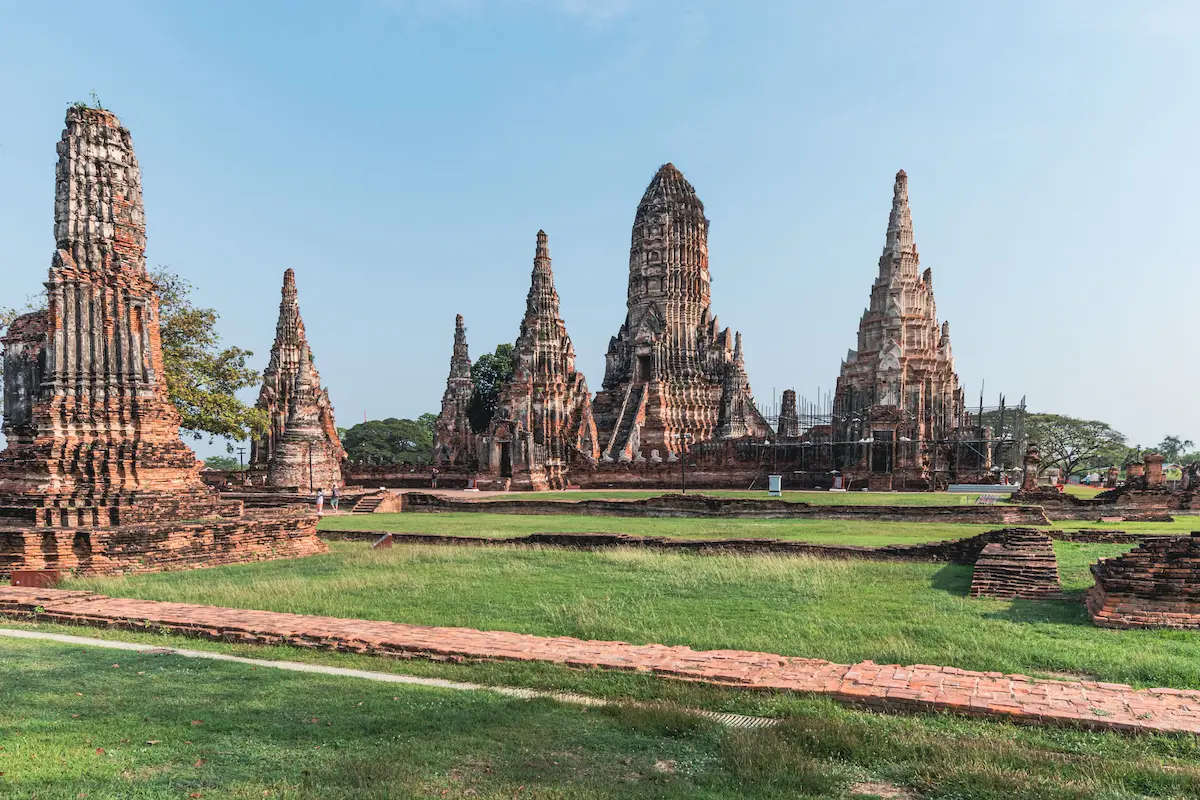
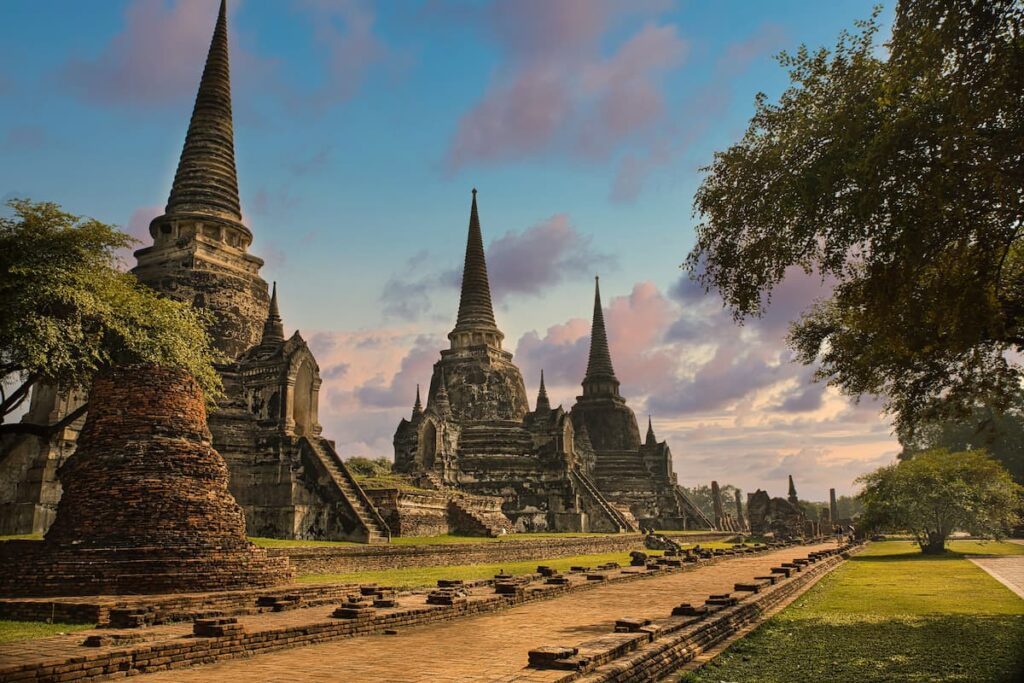
Wat Phra Si Sanphet formed part of the royal precinct and was one of the kingdom’s most important religious sites. Its three surviving chedis create one of Ayutthaya’s most distinctive views and provide a sense of the scale of the former palace area.
Wat Mahathat is best known for the Buddha head surrounded by tree roots, but it was once an important royal monastery. The precise story of how the head reached its present position is not firmly documented, so it is better understood as part of the site’s long period of abandonment than through the legends often repeated online.
Nearby Wat Ratchaburana contains a prominent central prang and important crypt paintings. Wat Chaiwatthanaram, positioned beside the Chao Phraya, demonstrates the relationship between the city’s monuments and riverside landscape.
The Chao Sam Phraya National Museum is one of the most valuable additions to a historical visit. Objects recovered from temple crypts and archaeological excavations help visitors imagine the gold, craftsmanship and religious art that once filled buildings now seen primarily as exposed brick ruins.
Locations outside the central park—including the Portuguese and Japanese settlement areas and the remains of Dutch commercial activity—reveal Ayutthaya’s international character more clearly than the famous temple circuit alone.
A Travel With Insight Perspective
Having visited Ayutthaya several times, I have found it far more rewarding when I stop treating the city as a checklist of temples.
One of my favourite experiences was a sunset dinner beside the river. Watching boats move past the former capital created a stronger connection with Ayutthaya’s story than rushing between another sequence of ruins. The rivers were not simply attractive boundaries; they were fundamental to the city’s trade, defence and everyday life.
Slowing down also makes it easier to notice how widely the historical sites are distributed. Ayutthaya becomes more understandable when experienced as a former city rather than a single archaeological park.
Planning Your Visit
Ayutthaya can be visited as a day trip from Bangkok, but allow a full day rather than attempting to cover it in a few hours. Staying overnight provides time to visit the central ruins, museum and riverside sites while also experiencing the city before and after the largest tour groups arrive.
The historical park is not one enclosed attraction with a universal ticket. Several major monuments charge separate admission fees and maintain their own opening arrangements. Combination tickets may be available for selected sites, but inclusions and prices should be confirmed locally.
Bicycles suit travellers concentrating on the central island, although the heat, traffic and distances to outer sites need consideration. Tuk-tuks provide a convenient way to connect the major monuments, while a car offers the greatest flexibility for reaching museums, foreign settlements and riverside locations.
Begin early if visiting during the warmer months and reserve the middle of the day for the museum, lunch or a slower riverside break. Temple ruins offer limited shade, and repeatedly entering similar-looking sites during the hottest hours can quickly make the experience feel rushed and repetitive.
Ayutthaya deserves its position as Central Thailand’s leading historical destination. Its greatest value, however, comes from seeing beyond the famous Buddha head and temple silhouettes to recognise the remains of a sophisticated, international river capital.
5. Historic Bangkok – From Thonburi to Rattanakosin
Location: Bangkok
Historical period: 1767 onwards
Best for: Understanding how Siam rebuilt after Ayutthaya and established its modern capital
Recommended time: Full day
Bangkok’s familiar palaces, temples and riverside districts make more sense when viewed as part of the political recovery that followed Ayutthaya’s destruction in 1767.
After the former capital fell, the kingdom fragmented into competing regional centres. King Taksin reunified much of the territory and established a new capital at Thonburi on the western bank of the Chao Phraya.
Thonburi offered several strategic advantages. It was closer to the Gulf of Thailand, making maritime trade and the movement of supplies easier. Its riverside position also allowed better communication with other regions and provided more options for defence or withdrawal if another major attack occurred.
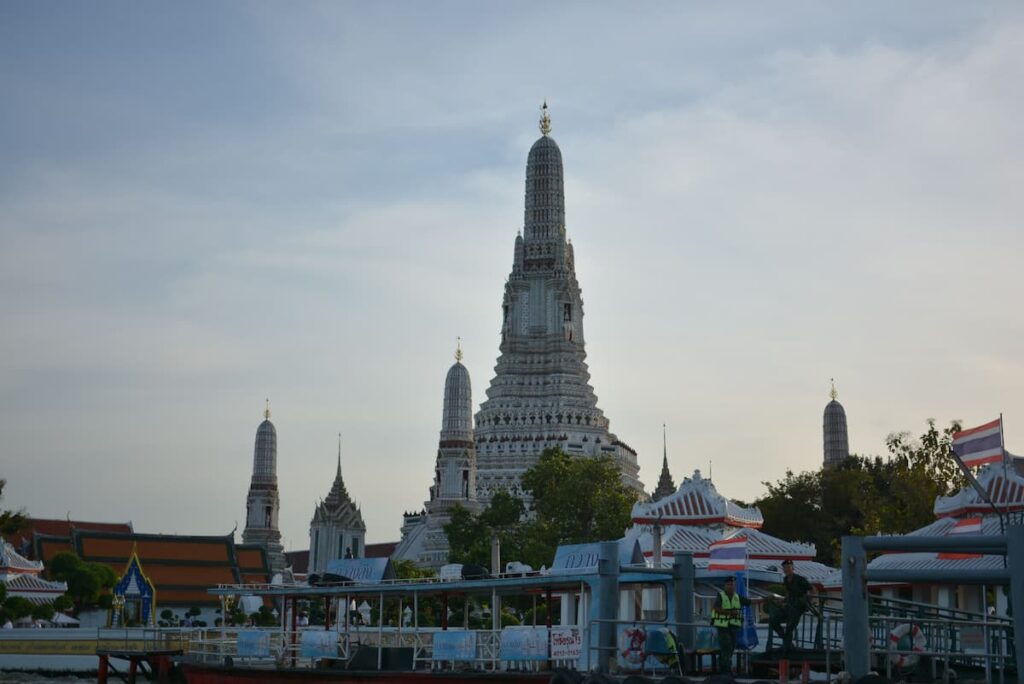
The Thonburi capital existed for only around 15 years, but it provided the political bridge between Ayutthaya and modern Bangkok. King Taksin established his palace near Wat Arun, with the river acting as the central route through the new royal and commercial area.
In 1782, Rama I founded the Chakri dynasty and moved the capital to the eastern side of the Chao Phraya. The new centre became known as Rattanakosin.
The Grand Palace and Wat Phra Kaew formed the royal and ceremonial heart of the capital. Defensive canals were excavated around the area, creating what is commonly called Rattanakosin Island. City walls, forts, royal buildings, monasteries and government areas gradually developed within and around the protected centre.
Bangkok was not designed without reference to the past. Craftspeople, builders and surviving members of communities displaced from Ayutthaya helped establish the new capital. Elements of Ayutthaya’s architecture, royal ceremony and urban organisation were deliberately carried forward.
The result was not a reconstruction of the destroyed city but a new capital that used Ayutthaya’s traditions to reinforce political continuity.
What You Can See Today
Historic Bangkok is a wider urban landscape rather than one contained attraction. The Chao Phraya remains the strongest physical connection between the Thonburi and Rattanakosin periods.
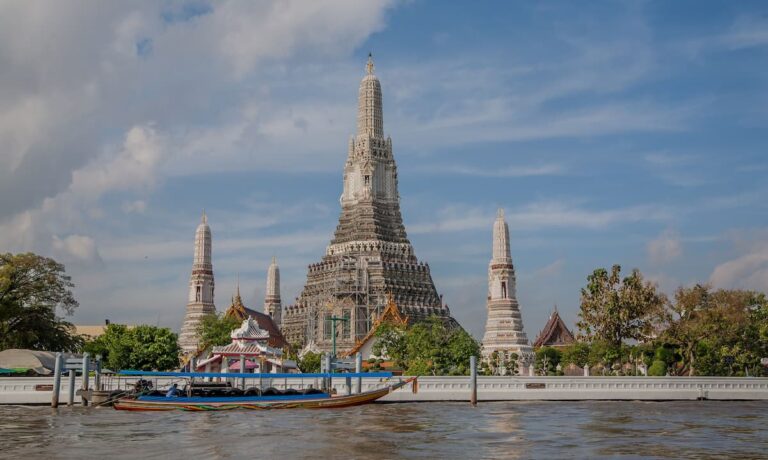
On the western bank, Wat Arun occupies an area closely associated with King Taksin’s former palace. The temple existed before Thonburi became the capital, although its famous central prang reached much of its present scale and appearance during the later Rattanakosin period.
Nearby Wichai Prasit Fort and the grounds of the former royal area preserve further connections with the Thonburi capital, although access to some military-controlled locations is restricted.
The Thonburi side of the river also contains historic communities that developed through migration, trade and religious diversity. Areas such as Kudi Chin preserve Thai Buddhist, Chinese, Portuguese Catholic and Muslim connections within a compact riverside district.
Across the Chao Phraya, the Grand Palace remains the most prominent expression of the new Rattanakosin capital. Wat Phra Kaew, royal halls, defensive walls and ceremonial spaces illustrate the political and religious authority established by Rama I and developed by later kings.
Sanam Luang, the old city canals, surviving forts and surrounding neighbourhoods help place the palace within the wider capital. Seen together, these places demonstrate how Bangkok grew from a protected royal centre into a much larger city.
Planning Your Visit
Allow a full day, but do not attempt to include every major temple and museum in historic Bangkok. A smaller route connected by the river will create a clearer experience than rushing through an extensive list of famous landmarks.
One possible approach is to begin around the Grand Palace and Rattanakosin in the morning, cross the Chao Phraya by ferry and explore Wat Arun or selected parts of historic Thonburi during the afternoon.
River ferries are often more useful than travelling by road between the two sides. They also help visitors understand why the Chao Phraya was so important to the location and development of both capitals.
The Grand Palace currently opens daily, but ticket sales finish earlier than the final closing time. Conservative clothing is required, and the site may occasionally adjust visitor access around royal ceremonies. Check the official schedule before travelling.
Wat Arun maintains separate opening hours and admission. Visitors should also dress respectfully because it remains an active religious site rather than simply a historical monument.
Historic Bangkok can easily expand into several days of exploration. For this article, its importance lies in one central story: Thonburi and Rattanakosin reveal how Siam recovered from Ayutthaya’s destruction and created a new capital that carried earlier traditions into the modern era.
6. Phra Nakhon Khiri – A Royal Palace Facing a Changing World
Location: Phetchaburi Province
Historical period: Reigns of Rama IV and Rama V
Best for: Royal history, mixed architectural styles and panoramic views
Recommended time: Around 3 hours
Phra Nakhon Khiri Historical Park brings the story into nineteenth-century Siam, when the country was responding to expanding European influence, new diplomatic relationships and changing ideas about science, government and architecture.
Construction began in 1859 under King Mongkut, Rama IV, who regularly visited Phetchaburi and appreciated the surrounding landscape. Built across three connected hilltops above the city, the complex became a royal residence commonly known as Khao Wang, meaning Palace Hill.
Phra Nakhon Khiri was more than a scenic retreat. Its royal halls, religious buildings, fortifications and observation structures reflected King Mongkut’s varied interests and the practical requirements of a functioning palace.
The king had spent many years as a monk before ascending the throne and developed strong interests in Buddhism, astronomy, languages and international affairs. He recognised that Siam would need to understand and engage with Western powers while protecting its political independence.
That outlook is visible throughout Phra Nakhon Khiri. European neoclassical forms appear alongside Thai proportions, Chinese decorative features and the highly regarded stucco craftsmanship of Phetchaburi. Rather than copying one foreign style, the builders combined several traditions into architecture suited to the hilltop environment and royal use.
The palace also received diplomats and foreign visitors. During the reign of King Chulalongkorn, Rama V, parts of the complex were restored and used to accommodate royal guests, continuing its connection with Siam’s international relationships.
What You Can See Today
The historical park extends across three peaks, each with a different character.
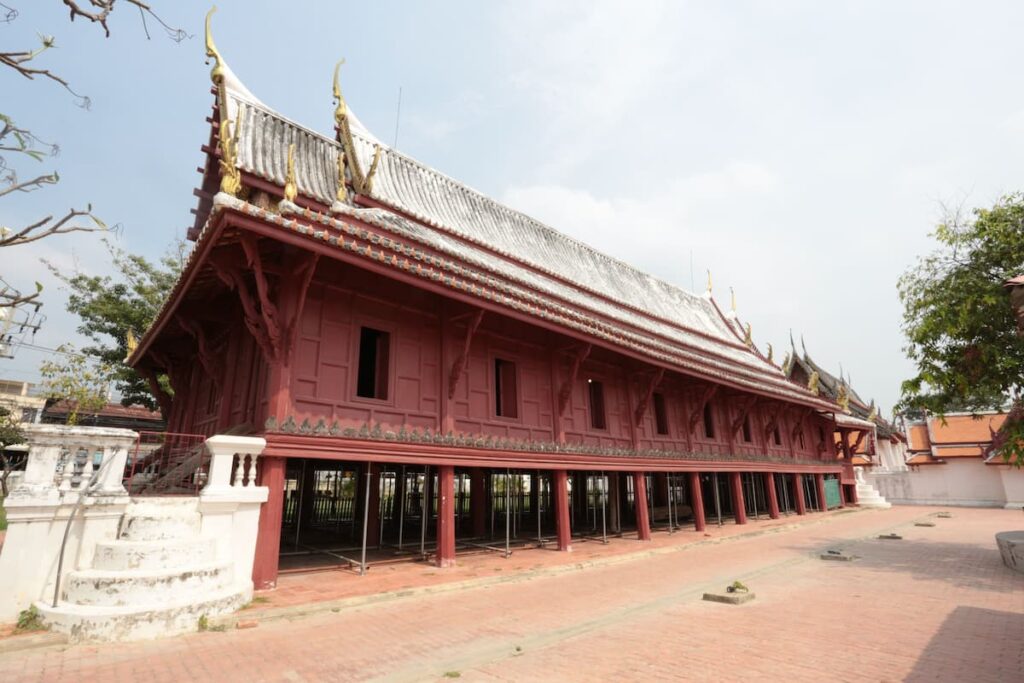
The western peak contains the principal palace area, including royal halls, residential buildings, courtyards and service structures. Some interiors now form part of Phra Nakhon Khiri National Museum and display royal objects, furniture and items connected with palace life.
The central peak is dominated by Phra That Chom Phet, a white chedi that can be seen from much of Phetchaburi. Its elevated position provides extensive views across the city and surrounding plains.
The eastern peak contains Wat Phra Kaeo, a royal temple constructed for the palace complex. Although its name resembles that of Bangkok’s Temple of the Emerald Buddha, it is a separate religious site built to serve Phra Nakhon Khiri.
Other structures include fortifications, gates and an observation tower associated with King Mongkut’s interest in astronomy. Curving paths connect the peaks, revealing different views and architectural details as visitors move through the complex.
Planning Your Visit
Allow approximately three hours to explore the main palace buildings, museum and hilltop structures. Visitors interested in architecture or photography may want longer, particularly during the softer light of the morning or late afternoon.
A cable railway provides the easiest route to the western palace area. Walking routes are also available, but the combination of steep slopes, heat and limited shade can make the climb tiring.
The paths across the hilltops remain uneven in places, so comfortable footwear is recommended. Monkeys live around the park and can approach visitors. Keep food hidden, secure loose belongings and avoid feeding or interacting with them.
Phra Nakhon Khiri is usually open during daytime hours and charges separate admission for foreign visitors. The cable railway also has its own fare. Opening arrangements and charges should be confirmed before travelling.
The park can be visited on a day trip from Bangkok or Hua Hin, but it works particularly well as part of a longer exploration of Phetchaburi. Combining the hilltop palace with the old town, local temples or Khao Luang Cave provides a broader view of the province’s history.
Phra Nakhon Khiri earns its place in this guide because it represents adaptation rather than collapse. Its architecture and diplomatic history reveal how nineteenth-century Siam responded to a changing international world while continuing to express its own royal, religious and artistic traditions.
7. The Burma–Thailand Railway – History, Suffering and Remembrance
Location: Kanchanaburi and Sai Yok
Historical period: Second World War
Best for: Wartime history, memorial sites and understanding the human consequences of forced labour
Recommended time: One to two days
The Burma–Thailand Railway brings this historical journey into the twentieth century and presents a much more confronting experience than Central Thailand’s ancient cities and royal palaces.
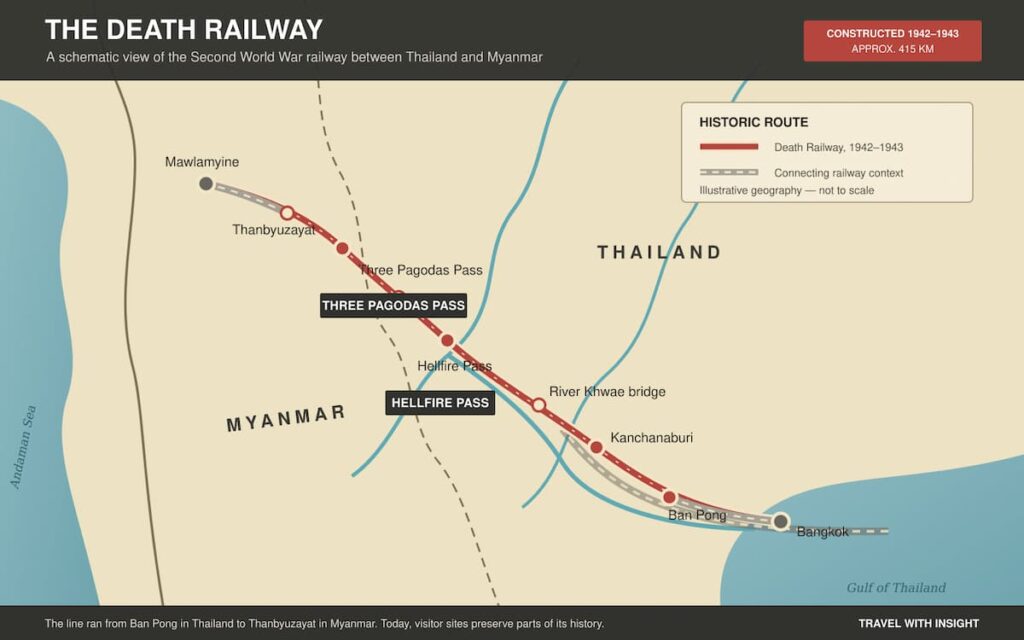
During the Second World War, the Imperial Japanese Army required a more secure route for transporting troops, weapons and supplies to support its campaign in Burma. Shipping through surrounding seas had become increasingly vulnerable to Allied attack, leading to the construction of an overland railway between Nong Pladuk in Thailand and Thanbyuzayat in Burma, now Myanmar.
The approximately 415-kilometre route crossed rivers, dense jungle and mountainous terrain. Construction began in 1942 and was completed in 1943 under extraordinary pressure.
The Japanese used around 60,000 Allied prisoners of war alongside a much larger force of Asian civilian labourers, commonly known as rōmusha. They worked with inadequate tools, food, shelter and medical care while suffering from disease, exhaustion, malnutrition and violence.
Historical estimates vary, particularly for the Asian labour force, whose experiences were documented less completely than those of Allied prisoners. More than 12,000 Allied prisoners are generally estimated to have died, while the number of Asian civilian deaths may have reached many tens of thousands.
These figures should not be presented as precise totals. The incomplete records are themselves part of the tragedy, especially for the rōmusha recruited or forced from Malaya, Burma, Thailand, Java and other parts of Asia.
Hellfire Pass
Hellfire Pass, originally known as Konyu Cutting, became one of the railway’s most demanding construction areas. Prisoners and Asian labourers were forced to cut through solid rock using hammers, drills, picks and limited explosives.
During the period known as “Speedo,” work continued for exceptionally long hours as the Japanese pushed to complete the railway. At night, fires and lamps illuminated exhausted workers inside the cutting. Former prisoners later recalled that the scene resembled an image from hell, giving the pass its familiar English name.
The railway tracks were removed from this section after the war, but the cutting and sections of the original track bed remain. The landscape now forms part of the Hellfire Pass Memorial Walking Trail.
The modern interpretive centre uses historical objects, photographs, personal accounts and audio recordings to explain the construction of the railway. It also recognises the prisoners of war and rōmusha who suffered and died along the route.
The Bridge and the River Kwai Story
The steel bridge in Kanchanaburi is genuinely connected with the wartime railway, but its popular identity has been heavily shaped by fiction.
Pierre Boulle’s novel The Bridge over the River Kwai and the later film used a fictionalised story inspired by the railway’s construction. The film was not shot at the surviving bridge in Thailand, and many of its characters and events do not accurately represent what happened.
The wartime bridges near Kanchanaburi crossed the Mae Klong River. After the story and film generated international interest, the section passing beneath the surviving bridge was renamed the Khwae Yai, allowing visitors to find a bridge over a river carrying the expected name.
Recognising this does not make the surviving bridge historically unimportant. Prisoners of war and civilian labourers worked on the railway and bridges in this area, which were later damaged by Allied bombing. It does mean the historical site should be separated from the fictional narrative that made it famous.
What You Can See Today
Kanchanaburi War Cemetery contains the graves of thousands of Commonwealth and Dutch prisoners who died while working on the railway. It should be approached as a place of commemoration rather than a conventional tourist attraction.
Nearby, the Thailand–Burma Railway Centre provides detailed interpretation of the route, labour forces, construction conditions and individual experiences. Visiting the museum before travelling further along the railway gives the wider landscape much greater meaning.
The surviving steel bridge can be crossed on foot when trains are not approaching. It remains part of the operational railway, so visitors must pay attention to warnings and keep clear when trains cross.
Passenger services continue from Kanchanaburi towards Nam Tok. The route passes beside the Khwae Noi and crosses the wooden Wampo Viaduct near Tham Krasae, where the track runs between the river and a steep cliff.
Although the journey provides striking views, its historical significance should remain central. The scenery forms part of the difficult terrain through which labourers were forced to construct the railway.
Hellfire Pass lies farther into Sai Yok District. Visitors can explore the interpretive centre and descend to the former railway cutting. A shorter return walk reaches the main memorial area, while the longer trail follows more of the abandoned track bed through the surrounding landscape.
Planning Your Visit
One long day from Kanchanaburi can include the cemetery, museum, bridge and selected railway locations. However, two days allow a more thoughtful experience and make it easier to include Hellfire Pass without compressing several emotionally demanding sites into a rushed schedule.
The Hellfire Pass Interpretive Centre normally operates from 9:00 am to 4:00 pm, with audio-guide services ending earlier. It closes on selected holidays and for an annual maintenance period, usually during May, so check current arrangements before travelling.
Allow at least 90 minutes for the centre and shorter memorial walk. The longer trail requires several hours, suitable footwear, drinking water and reasonable mobility. Parts of the route are exposed, steep or uneven, and the heat can be demanding.
Hellfire Pass is easiest to reach by car or arranged transport. Combining the public train with the centre is possible but requires careful coordination because the railway terminates at Nam Tok and does not continue directly to Hellfire Pass.
The Burma–Thailand Railway should not be reduced to a famous bridge or scenic train journey. Its historical importance lies in the experiences of the prisoners and Asian labourers forced to build it—and in the responsibility to remember people whose suffering was frequently overshadowed by the fictional story that later made the railway internationally famous.
Which Historical Place Should You Visit?
You do not need to visit all seven places to gain a meaningful understanding of Central Thailand’s history. The best choice depends on the period that interests you, the time available and whether you prefer monumental ruins, museums, architecture or more recent history.
| If You Are Most Interested In… | Choose | Why |
|---|---|---|
| Early archaeology and Dvaravati culture | U Thong Ancient City | The museum and surrounding remains introduce Central Thailand before Ayutthaya |
| Khmer-period architecture | Muang Sing Historical Park | A compact and comparatively quiet laterite sanctuary beside the Khwae Noi |
| Several historical periods in one place | Lopburi Old Town | Khmer-influenced monuments, an Ayutthaya-era palace and European connections are close together |
| A major former capital | Ayutthaya Historical Park | Monumental ruins, museums, rivers and foreign settlements reveal an extensive historic city |
| The establishment of modern Bangkok | Historic Thonburi and Rattanakosin | The two sides of the Chao Phraya explain how Siam rebuilt after Ayutthaya |
| Royal history and mixed architecture | Phra Nakhon Khiri | A hilltop palace combining Thai, Chinese, European and Phetchaburi traditions |
| Second World War history | Burma–Thailand Railway | Museums, cemeteries, the surviving railway and Hellfire Pass preserve a difficult modern history |
For a first visit to Central Thailand, Ayutthaya offers the most complete introduction. Travellers with additional time could pair it with historic Bangkok to understand the transition between former capitals.
U Thong and Muang Sing are better suited to visitors seeking less familiar archaeological sites, while Lopburi provides the greatest historical variety within a relatively compact area. Phra Nakhon Khiri offers a strong contrast to the ancient ruins, and Kanchanaburi requires more time because its wartime history is distributed across a much wider landscape.
Planning a Historical Journey Through Central Thailand
Central Thailand’s historical places are spread across several provinces, and attempting to combine all seven into one fast circuit would create more driving than meaningful exploration. A better approach is to choose places that fit naturally with the destinations already included in your holiday.
From Bangkok
Ayutthaya is the easiest major historical addition to a Bangkok stay. It can be reached by train, minivan, private transfer or car and works as either a full-day trip or an overnight visit.
Lopburi can also be reached by train, although the longer journey makes an early start important. Travellers interested in both cities could visit Ayutthaya first and continue north to Lopburi rather than returning to Bangkok between them.
U Thong and Phra Nakhon Khiri are possible as day trips by car, but they are better incorporated into wider journeys through Suphan Buri or Phetchaburi. Public transport reaches the principal towns, although onward travel to individual historical sites can be less convenient.
From Kanchanaburi
Muang Sing Historical Park and the Burma–Thailand Railway sites should be approached from Kanchanaburi rather than treated as simple extensions of a Bangkok sightseeing day.
Muang Sing can be included while travelling through Sai Yok, while the railway museum, bridge and war cemetery are concentrated around Kanchanaburi town. Hellfire Pass lies considerably farther away and requires additional road travel.
Allowing at least two nights in Kanchanaburi provides enough time to experience the wartime sites without reducing them to hurried stops between long transfers.
Travelling by Train
Train travel works particularly well for Ayutthaya and Lopburi because their railway stations are close to the historical areas. Kanchanaburi can also be reached by train, and the journey towards Nam Tok forms part of the experience of the surviving wartime route.
However, train timetables limit flexibility. Reaching outer monuments, museums and Hellfire Pass may still require tuk-tuks, taxis, songthaews or arranged transfers.
Travelling by Car
A car provides the greatest flexibility for U Thong, Muang Sing, Phetchaburi and the more widely separated sites around Kanchanaburi. It also allows you to slow down, omit locations that no longer interest you and continue when a visit requires less time than expected.
Travel With Insight
My preferred way to explore Central Thailand is by car. It may add to the budget, and driving through busy traffic can be tiring, but having your own transport becomes particularly useful once you leave Bangkok.
I have not experienced significant problems finding fuel or dealing with language barriers while driving in Thailand. The greater advantage is being able to change the pace of the journey. Historical parks and museums do not all require the same amount of time, so flexibility is more valuable than following a tightly timed itinerary.
Try to avoid driving at night, when heavy trucks become more active and unfamiliar roads are harder to read. When returning to Bangkok, choose accommodation with onsite parking where possible rather than assuming parking will be available nearby.
Check Museum Closure Days
Many national museums close on Mondays and Tuesdays, even when the surrounding historical park remains open. This is particularly important at U Thong, Lopburi and Ayutthaya, where museum collections provide much of the context needed to understand the archaeological remains.
Opening hours, admission charges and restoration access can also change. Confirm practical details shortly before travelling rather than relying entirely on older travel articles.
Allow for the Climate
Most ruins and historical parks provide limited shade. Begin early, carry water and use the hottest part of the day for museums, lunch or travelling between locations.
A slower schedule will usually produce a better historical experience. Visiting two well-chosen places from different periods can reveal more about Central Thailand than rushing through seven destinations simply to complete the list.
Frequently Asked Questions About Historical Places in Central Thailand
What Is the Most Important Historical Place in Central Thailand?
Ayutthaya is generally the most important place for understanding Central Thailand’s political and cultural history. It served as the Siamese capital for more than four centuries and influenced the later development of Bangkok.
However, it does not represent every historical period. U Thong is more useful for understanding early Dvaravati culture, while Kanchanaburi provides the region’s most significant Second World War sites.
Can You Visit Ayutthaya as a Day Trip from Bangkok?
Yes. Ayutthaya can be reached from Bangkok by train, minivan, car, private transfer or organised tour. A full day is sufficient for several major ruins and a museum or river experience.
Staying overnight is better for travellers who want to explore outer sites, visit the national museum and experience the city before or after the busiest day-trip hours.
Are There Historical Places in Central Thailand Other Than Temples?
Yes. Central Thailand’s historical places include ancient settlements, royal palaces, museums, old urban districts, defensive structures, foreign trading communities, wartime railways and military cemeteries.
U Thong National Museum, Phra Narai Ratchaniwet, Phra Nakhon Khiri and the Burma–Thailand Railway demonstrate that the region’s history extends well beyond religious monuments.
Which Historical Place Is Best for Avoiding Crowds?
U Thong Ancient City and Muang Sing Historical Park are generally quieter than Ayutthaya or Bangkok. Muang Sing offers the stronger visual experience, while U Thong is more dependent on museum interpretation and an interest in archaeology.
Visitor numbers can increase during weekends, public holidays and local festivals, but neither location normally receives the volume of international tours found at Ayutthaya.
Is the Bridge on the River Kwai Historically Accurate?
The surviving steel bridge in Kanchanaburi genuinely formed part of the wartime Burma–Thailand Railway. However, the familiar story was heavily fictionalised in Pierre Boulle’s novel and the later film.
The wartime bridges crossed the Mae Klong River. The relevant section was later renamed the Khwae Yai after the fictional story created international demand to see a “Bridge on the River Kwai.”
How Many Days Are Needed to Explore Central Thailand’s Historical Places?
Allow at least five to seven active sightseeing days for a meaningful selection, rather than attempting to visit all seven places in rapid succession.
Bangkok and Ayutthaya can be combined easily, while Lopburi can be added farther north. U Thong and Phetchaburi work best with a car, and Kanchanaburi deserves at least two nights if including the railway, museums and Hellfire Pass.
Which Historical Place Is Best for a First-Time Visitor?
Ayutthaya is the strongest first choice because its monumental ruins, museums and rivers provide the most complete historical experience.
For a second destination, choose historic Bangkok to follow the transition between capitals or Kanchanaburi for a completely different period and emotional experience.
Final Thoughts on Central Thailand’s Historical Places
Central Thailand’s history cannot be understood through one ruined capital or a collection of famous temples. The region developed through successive periods of settlement, cultural exchange, political change, international diplomacy and conflict.
U Thong reveals that organised communities and commercial connections existed long before Ayutthaya. Muang Sing demonstrates how Khmer-period religious and artistic influence extended into the western river valleys, while Lopburi brings several historical periods together within one compact town.
Ayutthaya provides the most impressive archaeological landscape, but its deeper value lies in recognising it as a sophisticated international city rather than simply a group of photogenic ruins. Historic Thonburi and Rattanakosin continue that story by showing how Siam recovered after 1767 and created a new capital beside the Chao Phraya.
Phra Nakhon Khiri represents a later period when Siam was adapting to greater contact with Western powers while continuing to express its own royal and artistic traditions. The Burma–Thailand Railway then brings the historical journey into the twentieth century, preserving the memory of prisoners of war and Asian civilian labourers whose suffering should never be reduced to a scenic train ride.
Few travellers will visit all seven places during one Central Thailand holiday, nor is that necessary. Choosing two or three sites representing different periods can create a more meaningful experience than rushing through every destination.
Ayutthaya and historic Bangkok provide the strongest introduction. U Thong, Muang Sing and Lopburi reward travellers prepared to explore beyond the familiar route, while Phetchaburi and Kanchanaburi reveal very different chapters in the region’s development.
Together, these places demonstrate why Central Thailand remains the country’s historical and political heart—and how much of its story is still visible in the landscapes visitors can explore today.
Continue Exploring
Complete Central Thailand Travel Guide
Plan your journey through Bangkok, Ayutthaya, Kanchanaburi, Hua Hin and the wider region, with guidance on destinations, attractions, transport and the best ways to combine them.
Thailand Travel Guide
Explore Thailand’s different regions, compare major destinations and find practical guidance for planning a trip that matches your interests, available time and preferred pace.
Related Reading
Where to Go in Central Thailand
Compare the region’s major cities, former capitals, coastal destinations and quieter provinces to decide which locations belong in your itinerary.
Must-See Attractions in Central Thailand
Discover seven defining experiences selected to represent the region’s history, culture, landscapes, wildlife and modern city life.
Best Temples in Central Thailand
Explore seven temples offering different architectural, spiritual, historical and scenic experiences across Bangkok and the central provinces.
Making the Most of Your Central Thailand Holiday
Use practical planning advice and first-hand travel insight to build a realistic journey without rushing between too many destinations.
Historical Places in Thailand
Travel beyond Central Thailand to discover former capitals, ancient settlements, archaeological parks and wartime sites representing different periods of the country’s history.
About the Author
David Hibbins is an Australian travel publisher, destination researcher and the creator of Travel With Insight.
David spends considerable time in Phuket and has travelled extensively throughout Thailand and Southeast Asia. His work combines first-hand experiences, repeat visits and practical observations with careful destination research and current information.
Where David has visited a destination himself, those experiences help shape the guidance he provides—from understanding how places feel beyond their best-known attractions to recognising transport challenges, changing conditions and small practical details that shorter visits can miss. Research is used to verify historical context, current visitor information and aspects he has not experienced personally.
His work focuses on helping travellers move beyond popularity rankings, marketing claims and generic “best of” lists. Rather than telling readers where they should travel, his goal is to explain the strengths, limitations and individual character of each destination so they can choose the places that best match their interests, travel style and available time.
Through Travel With Insight, David explores not only where travellers go, but why they choose particular destinations, how experiences differ and what helps turn a well-researched trip into a genuinely memorable journey.
Explore More Travel Resources
Every rewarding journey begins with informed decisions. The more you understand a destination before arriving, the easier it becomes to choose experiences that suit your interests, expectations and preferred pace.
Whether you are researching one destination, comparing several possibilities or preparing a complete itinerary, these additional travel resources can help.
Travel With Insight
Continue exploring in-depth destination guides, first-hand travel insight and practical planning advice created to help you make informed travel decisions throughout Thailand and Southeast Asia.
Go Find Asia
Discover destinations, attractions and travel ideas from across Asia, with inspiration to help you decide where to go, what to experience and which places deserve a closer look.
Resurgence Travel
Move from research to practical planning with curated itineraries, personalised travel support and local insight focused on creating more rewarding journeys through Thailand and Southeast Asia.